Tuesday, December 22, 2009

Dalai Lama is talking on the podcast about being 74 and maybe in ten years 84 and then in ten years 94. Maybe he will see a different Tibet in his lifetime. I like his tone.
Stop and look around you.
Look out from the frameless window
Of a long pause.
Let the images come to you
Rather than chasing outward after them.
Allow yourself to reorient so that
You're no longer pulled along
By the stream of events.
If you want to see differently,
You'll have to look differently. - Ji Aoi Isshi
Finish one to one interviews with students in Comparative Religion course in Maine State Prison. It was a good semester. Last night we had the students from University College at Rockland course on East Asian Philosophy to the hermitage for final make-up class with meditation practice, lentil soup, bread, then apfel kuchen. The young son of one of the students kept Rokpa busy. Now to read papers, grade tests, and issue grades.

"I am one of the six billion human beings," he says. Non-violence and religious harmony are his predominant messages.
MEANING OF AHIMSA

Ahimsa or non-injury, of course, implies non-killing. But, non-injury is not merely non-killing. In its comprehensive meaning, Ahimsa or non-injury means entire abstinence from causing any pain or harm whatsoever to any living creature, either by thought, word, or deed. Non-injury requires a harmless mind, mouth, and hand.

Ahimsa is not mere negative non-injury. It is positive, cosmic love. It is the development of a mental attitude in which hatred is replaced by love. Ahimsa is true sacrifice. Ahimsa is forgiveness. Ahimsa is Sakti (power). Ahimsa is true strength
.
(-from BLISS DIVINE, A Book of Spiritual Essays On the Lofty Purpose of Human Life And the Means to Its Achievement, by Swami Sivananda)
Away from his job, a young (age 29) correctional officer died suddenly of apparent heart-related difficulty. His memorial is tonight in Rockland. I knew him by sight. I will sit on my cushion with him in mind in solitude memorial at the hermitage.

The tone of Dalai Lama suggests he might just be the last Dalai Lama. Not only does everyone die, so too every institution and every sentient being pass on, pass away, or pass over.

At this time of meditation on the metaphor of coming-to-life of Life-Itself within the surround of what we call "life" -- I turn attention to the tone of the Dalai Lama who notes that democracy, liberty, freedom, and tolerance are very good things.

It would be nice to return to a religious faith that was open to the reality of life.

One of the men in prison suggested that faith was not having to deny anything.

I hear this as radical openness.

A person of faith sees everything as matter for reflection, love, and kindness.

The Dalai Lama is silent now.

Now everything listens.

Sunday, December 20, 2009

It is fruitless to try to eliminate "the other".

There are two ways. One is Karl Barth writing,"Gott ist der ganz andere" (God is wholly other). Another is the sentence: There is no other.

There is a middle way between one and two. It is being caught in the paradox that says it is fruitless to try to eliminate the other because -- there is no other.

At this season of the Incarnation it seems the metaphor of God becoming man is an instance of that paradox -- namely, God is God by becoming man. Man is man by becoming God.

When the Son of Man dies, death is no other -- so, resurrection takes place indicating there is only that which is -- namely, God, or Life.

So too with reincarnation and rebirth. Death being not-other than life, it is not a state of being, nor is it non-being. Death is death by becoming life. Life is life by moving through death back to itself.

Isn't this what is longed for?

We are not one. Nor are we two.

Each is itself.

It is fruitless to try to eliminate the other.

No?

There is non(e) to speak of.

Blessings of the day!

Saturday, December 19, 2009

If people in positions of authority do not work for the benefit of the people, then...
Aposiopesis (from Classical Greek, "becoming silent") is a rhetorical device wherein a sentence is deliberately broken off and left unfinished, the ending to be supplied by the imagination, giving an impression of unwillingness or inability to continue. An example would be the threat "Get out, or else—!" This device often portrays its users as overcome with passion (fear, anger, excitement) or modesty. To mark the occurrence of aposiopesis with punctuation an 'em dash' or an ellipsis may be used.
http://en.wikipedia.org/wiki/Aposiopesis
There is an energy in words or presence that refuses to finish the journey.

There is only the journeying.

Christmas comes nearer.

Thursday, December 17, 2009

Lament we spend a million dollars a year for each military person in a war zone.

Bemoan conservative right-wing politicians refusing health care to everyone.

Decry the demise of representative government replaced by capitalistic bribes by the monied.

The temperature outside in Maine tonight is zero. The weathering cold stops you. Nothing moves. Everything tightens.

I look at the stars.

I load wood-stove.

I root for my brothers and sisters -- for their health, their warmth, and their safety.

A new war, undeclared, has begun.

You and I are in the sights of those willing to sacrifice us for profit.

It is good light is coming.

Wednesday, December 16, 2009

Foolishness.

That's what the Chinese philosopher said we need.
Today we are afraid of simple words like goodness and mercy and kindness. We don't believe in the good old words because we don't believe in good old values anymore. And that's why the world is sick.
(--Lin Yutang)
We get it. In abundance.

Many, many, fools practicing foolishness.

Now we have to sort out the scamps from the scoundrels.

Any suggestions?

Tuesday, December 15, 2009

If you've ever done the right thing just because it was the right thing to do, you know the inherent desire of being human.

You write that unity, as opposed to duality, is "the purpose of evolution." What do you mean?

The fact that we experience separation is really a perceptual artifact. There's only a single reality that differentiates into both mind and body and then from body and environment. So our perceptual experience of the environment is different than the body, the body is different from the mind, and the mind is different from the soul.

There are two types of ignorance that we come to in this world, one is innate ignorance, which is this perceptual artifact of separation and the other is cultural ignorance.

Just like, your DNA, for example, differentiates into the different cells of your body, your heart cells and your brain cells, and your kidney cells are different in appearance, but not different in their essence. They came from the same double strand of DNA and if I wanted to isolate the DNA in every cell of your body, even though these belong to different organs, I'd get the same information. So the appearance of the expression of the different organs in the body is different, but it's still the same essence. So, too, every observer is a differentiated aspect of a single observer and every object of perception is a differentiated expression of the same observer, because the observer and the observed, the seer and the scenery, the knower and the known are differentiated aspects of a single consciousness. The goal of all spiritual seeking is to realize that experientially and intellectually—but more importantly experientially.

Cultural ignorance is when we take these ideas of duality and then we create institutions around them—so religious and cultural and social indoctrination perpetuates the ignorance.

(from, Spirituality in a Material World, Interview with Depak Chopra by Lisa Schneider, http://www.beliefnet.com/Health/2004/10/Spirituality-In-A-Material-World.aspx?p=2)

I don't know much about God.

Still, I'm fond of the idea there is a source of compassion and love.

Compassion and love are right things.

They are our inherent desires.

Monday, December 14, 2009

I am disturbed by so much.
Beyond Hope

1. Don't wish for perfect health. In perfect health, there is greed and wanting. So an ancient said, " Make good medicine from the suffering of sickness." 2. Don't hope for life without problems. An easy life results in a judgmental and lazy mind. So an ancient once said, "Accept the anxieties and difficulties of this life". 3. Don't expect your practice to be clear of obstacles. Without hindrances the mind that seeks enlightenment may be burnt out. So an ancient once said, "Attain deliverance in disturbances".
(--Zen Master Kyong Ho [ 1849-1912], in Thousand Peaks)
Lord, deliver me!
Standing at edge of wharf Rockport Harbor at sunrise reading psalm from Nan Merrill's Psalms For Praying, I realize that cars coming down ramp might think I was planning to jump into the freezing water. I think this because it is always an option, others have done it, and the thinking mind thinks too much.
You should therefore cease from practice based on intellectual understanding, pursuing words and following after speech, and learn the backward step that turns your light inwardly to illuminate your self. Body and mind of themselves will drop away, and your original face will be manifest. If you want to attain suchness, you should practice suchness without delay.

For sanzen (zazen), a quiet room is suitable. Eat and drink moderately. Cast aside all involvements and cease all affairs. Do not think good or bad. Do not administer pros and cons. Cease all the movements of the conscious mind, the gauging of all thoughts and views. Have no designs on becoming a Buddha. Sanzen has nothing whatever to do with sitting or lying down.

(from, FUKANZAZENGI, by Eihei Dogen )
Saskia and her mom prepare and bake seasonal Kipferl and Linzer torte. Tom works on wiring bookshed. Cat looks down from crawlspace above kitchen.

I don't jump. I bask, instead, in the lovely rendition of psalmic verse by Nan Merrill. Sun comes up over Beauchamp point trees after announcing itself on clapboards and in windows on west side of harbor. Schooner Timberwind, covered and securely tied to pilings, is pushed by wind lifting lines from water taut to land. Coffee and muffin from Market Basket on Route One. Water and wind, dawn and sun from the mystery, creator, and nature of Being-Itself.
Suits
by David R. Slavitt

Each morning, as I confront my closet's array,
I have to admit again that the life I lead
is hardly good enough: I have not been named
ambassador to Malta; I am not on the board

of any college or large corporation; I shall not
receive a major prize today and pose
for photographers. Those suits, the shirts, the ties
are ready, but I am not, and the shoes are shined

as they wait for different occasions than I imagined
on the tailor's block, when I shopped for a dandified
future brighter than what I expect or deserve.
Even for weddings and funerals that require
a suit, I choose from the second best, reserving
that one for the dream into which I yet hope to awake.

(Poem, "Suits" by David R. Slavitt, from William Henry Harrison and Other Poems. Louisiana State University Press, 2006. From The Writer's Almanac)
I pick up my wrinkled shirts and hang them from metal clothes-tree on hangers hooked on two remaining trident prongs. My life is messy. Dust from years ago has despaired of being swiped away and deposited elsewhere. Books thick with decade dust lean against different genres with indifference. None are especial. All are abandoned.

I go to eye doctor and get completely different readout for corrective lenses. How could every number change from one town and 12 days to another? It is, or course, the season of miraculous changes.

Many hands decorated the tree yesterday. Evening practice was holy imperfection (as one woman averred). All we do is sit, walk, read, eat, and speak of what is taken place. It's just us. As we are. Becoming present.

I find the worlds of politics, sports, celebrity, punditry, experts, know-it-alls, and assorted camouflaged soldiers fighting unspecified battles under their breath -- I find all of it to be less and less interesting.

Dogen's words return:
Body and mind of themselves will drop away, and your original face will be manifest. If you want to attain suchness, you should practice suchness without delay.


Such it is.

Where we are.

Let there be.

Practice.

Sunday, December 13, 2009

To find God lose God. To find yourself lose yourself.

What's left?
To find you, I moved beyond the city,
A wide path led me, by mulberry and hemp,
To a new-set hedge of chrysanthemums
Not yet blooming although autumn had come.
I knocked; no answer, not even a dog.
I waited to ask your western neighbor;
But he told me that daily you climb the mountain,
Never returning till sunset.
- Sen Chiao-jan
God isn't hard to find.

It's raining.

I told you.

Friday, December 11, 2009

Three promises of Meetingbrook monastics, renewed yearly on December 10th:

Contemplation, Conversation, Correspondence.
...as held by Meetingbrook Dogen & Francis Hermitage“m.o.n.o.”(monastics of no other).

Contemplation is the promise of simplicity.
It is a gift of poverty inviting open waiting, receptive trust, attention, and watchful presence. It is a simple Being-With.
* It is attentive presence.

Conversation is the promise of integrity.
It is a chaste and complete intention to listen and speak, lovingly and respectfully, with each and all made present to us. It is a wholeness of listening and speaking.
* It is root silence.

Correspondence is the promise of faithful engagement.
It is responsible attention and intention offered obediently to the Source of all Being, to the Human Family, to Nature. It is a faithful engagement with all sentient beings, with this present world, with existence with all its needs & joys, sorrows & hope.
* It is transparent service.

…………………………………………………………………

Meetingbrook Dogen & Francis Hermitage invites & welcomes individuals interested in the practice of these 3 promises in their life. Whether the interest is in conversing, praying, deepening, learning, or even holding these 3 promises, we invite you to enter the inquiry and stillness. May the loving light and the compassionate peace of the Christ and the Bodhisattva accompany and support the efforts of each one.

………………………………………………………………..

Quotes: 1. We are going to have to create a new language of prayer. (Thomas Merton, Calcutta 1968)

2. When you go apart to be alone for prayer…see that nothing remains in your consciousness mind save a naked intent stretching out toward God. Leave it stripped of every particular idea about God (what he is like in himself or in his works) and keep only the awareness that he is as he is. Let him be thus, I pray you, and force him not to be otherwise. (Anonymous)

3. I long for a great lake of ale. / I long for the men of heaven in my house. / I long for cheerfulness in their drinking. / And I long for Jesus to be there among them. (Brigid, Celtic saint)

4. It is not by closing your eyes that you see your own nature. On the contrary, you must open your eyes wide and wake up to the real situation in the world to see completely your whole Dharma Treasure, your whole Dharma Body. The bombs, the hunger, the pursuit of wealth and power - these are not separate from your nature….You will suffer, but your pain will not come from your own worries and fears. You will suffer because of your kinship with all beings, because you have the compassion of an awakened one, a Bodhisattva. (Thich Nhat Hanh)

5. He who truly attains awakening knows that deliverance is to be found right where he is. There is no need to retire to the mountain cave. If he is a fisherman he becomes a real fisherman. If he is a butcher he becomes a real butcher. The farmer becomes a real farmer and the merchant a real merchant. He lives his daily life in awakened awareness. His every act from morning to night is his religion. (Sokei-an)

Thursday, December 10, 2009

We pronounce our lay-monastic promises at conversation tonight. It is December 10th. It is Thomas Merton Transition Day.
...a digression on each point in order to reach the center.
(--Pascal, Pensees)
I sometimes pass my days and nights in vain. Or, as another translation has it, " Do not waste your time by night or day." This is the final line of the poem "Sandokai" -- a poem by the eighth Chinese Zen ancestor Shitou Xiqian (Sekito Kisen, 700–790).
The Sandokai is chanted daily in Soto Zen places of practice.
SANDOKAI

Harmony of Difference and Sameness

The mind of the great sage of India
is intimately transmitted from west to east.
While human faculties are sharp or dull,
the Way has no northern or southern ancestors.
The spiritual source shines clear in the light;
the branching streams flow on in the dark.
Grasping at things is surely delusion;
according with sameness is still not enlightenment.
All the objects of the senses
interact and yet do not.
Interacting brings involvement.
Otherwise, each keeps its place.
Sights vary in quality and form,
sounds differ as pleasing or harsh.
Refined and common speech come together in the dark,
clear and murky phrases are distinguished in the light.
The four elements return to their natures
just as a child turns to its mother;
Fire heats, wind moves,
water wets, earth is solid.
Eye and sights, ear and sounds,
nose and smells, tongue and tastes;
Thus with each and every thing,
depending on these roots, the leaves spread forth.
Trunk and branches share the essence;
revered and common, each has its speech.
In the light there is darkness,
but don't take it as darkness;
In the dark there is light,
but don't see it as light.
Light and dark oppose one another
like the front and back foot in walking.
Each of the myriad things has its merit,
expressed according to function and place.
Phenomena exist; box and lid fit.
principle responds; arrow points meet.
Hearing the words, understand the meaning;
don't set up standards of your own.
If you don't understand the Way right before you,
how will you know the path as you walk?
Progress is not a matter of far or near,
but if you are confused, mountains and rivers block your way.
I respectfully urge you who study the mystery,

do not pass your days and nights in vain.
Translation/Compilation copyright Soto Shumucho 1997
(November 15-16, 97; revised version)
There's plenty to be confused about. The Way right before me might actually be several ways at once. I am reading about MWI (Many Worlds Interpretation of Quantum Mechanics). Perhaps it's not just a case that we have all been here before, but more like we are all here and here and there and there at the same time.
Bonnie Mitchell: "Living in the electrons of cyberspace, we have no gender, we have no race, we are neither old nor young, intelligent nor naive, we have only an e-mail address to identify us. Our writing style and smileys reveal our virtual personalities. We are not alone. Yet we sit in physical isolation. Our machines satisfy our quest for social acknowledgment. We speak with our fingers and the machine replies.... Nonphysical intimacy. Security and privacy. Suppressed expression. Electrically altered ego. We have no need for faces. Don't show me yours. We have no need for bodies. They deteriorate anyway. We have no need for voice. We speak through thought. We have no need for any of these things. We have fingers, words, and images. We have an Internet connection. We have our virtual selves.
(--Segmentation / Alternative paths. Silvio Gaggi, From Text to Hypertext. Metonymy and Metaphor in the Fiction of Forking Paths: "http://www.columbia.edu/itc/visualarts/r4100/plot.html)
Someone suggested we might change the phrase from 'the spiritual life" to "the life of consciousness." Maybe the lexical tension between material/spiritual would mutate into a deeper appreciation of awareness or consciousness that does not cultivate opposition.

When the chickadee swoops over kitchen roof, I go there. When red squirrel runs between barn and bookshed, I go there. Not I, we. Not we -- just Chickadee, just Red Squirrel.
Q.15 Where are the other worlds?

Non-relativistic quantum mechanics and quantum field theory are quite unambiguous: the other Everett-worlds occupy the same space and time as we do.
The implicit question is really, why aren't we aware of these other worlds, unless they exist "somewhere" else? To see why we aren't aware of the other worlds, despite occupying the same space-time, see "Why do I only ever experience one world?" Some popular accounts describe the other worlds as splitting off into other, orthogonal, dimensions. These dimensions are the dimensions of Hilbert space, not the more familiar space-time dimensions.

The situation is more complicated, as we might expect, in theories of quantum gravity (See "What about quantum gravity?"), because gravity can be viewed as perturbations in the space-time metric. If we take a geometric interpretation of gravity then we can regard differently curved space-times, each with their own distinct thermodynamic history, as non-coeval. In that sense we only share the same space-time manifold with other worlds with a (macroscopically) similar mass distribution. Whenever the amplification of a quantum-scale interaction effects the mass distribution and hence space-time curvature the resultant decoherence can be regarded as splitting the local space-time manifold into discrete sheets.

(-from, 22. THE EVERETT FAQ, Michael Clive Price, February 1995 http://www.hedweb.com/everett/everett.htm#believes)
I like the phrase "discrete sheets" -- it sounds so...bedtime civilized.

Clarity has an Opening Reception at Camden Library tonight. Their show is elegant. So are the dips and biscotti.

However many universes, dimensions, alternate realities there might be, I'm happy to be weaving my way -- our way -- through them all.

Wednesday, December 09, 2009

Snow cancelled everything but the car stuck at end of driveway. That went on for a while.
Wind blows as first storm of the season enters ninth hour.

I sit zazen then call the man further down coast. He is not well. Not sleeping. Legs in pain. Just starting dinner. He'll call back.

It's not what is said. It's the listening.
After Missing the Recluse on the Western Mountain

To your hermitage here on the top
Of the mountain I have climbed,
Without stopping, these ten miles.
I have knocked at your door,
And no one answered;
I have peeped into your room,
At your seat beside the table.
Perhaps you are out walking,
Or fishing, more likely, in some autumn pool.
Sorry though I am to be missing you,
You have become my meditation.

The beauty of the grasses, fresh with rain,
And close beside the window the music of pines,
I take into my being all that I see and hear,
Soothing my senses, quieting my heart;
And though there be neither host nor guest,
Have I not had a visit complete?
The afternoon fades,
I make my way
Back down the mountain.
Why should I wait for you any longer?

- Ch-iu Wei
Why wait, indeed!

I like missed appointments, cancelled classes, and unworded conversation. Worded ones can work too.
He Gets Around to Answering the Old Question
by Miller Williams

He doesn't see as well as he thinks he remembers.
His fingers sometimes find it hard to bend.
He often can't find the name to go with a face.
Sometimes he doesn't hear but decides to pretend.

Weekends, week by week, are closer together.
Sometimes he has to sit down to put on his pants.
No lady seems to mind if he calls her Honey,
never grins nor even throws a glance.

Sometimes he's told himself what all this means.
"Every year some more of me is dead,
but there's a lot of stuff still left to collapse."
He started to laugh but talked to himself instead.

"Think of yourself as a plumbing system, a clock.
As soon as you're done, you start to come undone.
It's almost interesting when you pay attention,
how working parts stop working, one by one.

So now you've asked me the oldest question of all.
You want to know how I'm doing. I told you before,
I'm dying. Been at it for years. Still, I think
I could hang a few more calendars on the door."

(Poem, "He Gets Around to Answering the Old Question" by Miller Williams, from Time and the Tilting Earth.
The elderly man calls back and we talk. He's finished dinner. He's worried. I tell him about the poem. He tells me he's not afraid to die. It's just his mind is worried. A changed diagnosis, brain and legs not working well, no sleep for 4 nights.

Talk to your foot, your legs, your head -- I say to him. Maybe they feel neglected. Ask them to help you out. Tell them you'll ask them questions, listen to their responses, inform them about what you'd like. He says he likes that idea. Why not ask them to help in the same way he might ask God to help. He says why not move into a more bodily prayer.

I tell him about the 22 year old young man who's been in a coma for the past week since his car accident. He tells me that's sad. I tell him about the way they pray for so many specifics, how they trust that God's will -- no matter what happens -- will be done. They have it covered. He tells me how he doesn't dream of hell these days.

I tell him about Jill Bolte Taylor's Stroke of Insight on TED.com. He tells he'll watch it.

Earlier, someone asks about giving a talk to hospice volunteers about spirituality. I won't know what to say. I say yes. We'll have to have a conversation at the session. It's all about conversation, isn't it?

And gratitude.

I'm grateful to this body for serving so long with me.
I'm grateful to this mind for helping things along all these years.

It's an old question: How are you doing?

It's beyond amazing that we're doing anything!

Tuesday, December 08, 2009

For Events, see http://sites.google.com/site/meetingbrookhermitage/Home/events-at-meetingbrook
..............

Today, December 8th, we are presented with two unusual stories.

One man is opened to the transparency and emptiness of everything and finds his true nature, sees compassion and wisdom as that original nature, lets fall all duality, and is known in history as Shakyamuni Buddha

One woman-to-be, in utero, arrives in her mother, Anne, to grow into this existence with an openness that is said to have no separation or flaw, preparing her (Mary) to receive the embodied wholeness history will name Jesus.

1. A man under a tree sees the morning star and realizes he and that star are not two things. He considers this for a long time then spends the rest of his life teaching about suffering, desire, release from desire, and the way to do it.

2. A couple conceive and their future child is considered to be free from a sin that is part of a mythic centuries-old story not yet identified as "Original Sin" until three hundred years later. Her doctrine is declared 1500 years later.

Still, they are good stories.
Bodhi Day Sermon:
Today we commemorate the awakening of Shakyamuni Buddha. Shakyamuni means the “Sage of the Shakya Clan.” Buddha is a title which means “Awakened One.” Out of all the millions and millions of people who have lived upon this earth, we believe that he, at least, awoke from the dream of life’s all too frequent sufferings and all too fragile joys and saw the Truth for himself. This Truth that he awakened to was the Truth which resolved all his previous concerns about the meaning of life and death. This Truth was the solution to the problem of suffering that he had been seeking. All of his subsequent teachings and all the efforts of the 2,500 year old community that has passed on those teachings to the present day are all for the purpose of helping us to see the Truth for ourselves as well, the very same Truth that the Buddha realized.
http://nichirenscoffeehouse.net/Ryuei/BodhiDay2.html
Then:
Immaculate Conception, The doctrine:

In the Constitution 'Ineffabilis Deus' of 8 December, 1854, Pius IX pronounced and defined that the Blessed Virgin Mary "in the first instance of her conception, by a singular privilege and grace granted by God, in view of the merits of Jesus Christ, the Saviour of the human race, was preserved exempt from all stain of original sin."
(-The Catholic Encylopedia, http://www.newadvent.org/cathen/07674d.htm)
In Maine today, sun shines. Snow melts drip by drip. Morning mountain walk on Ragged with Saskia, Cody (her mom's German Shepherd) and Rokpa (our Border Collie). Coffee and toast. Lighting incense and candle on front room altar honoring both Mary and Siddhartha.

These last few days for me it seems that everything is a story.

We are told stories; we tell stories.

Of course they're mostly true -- even if the rational consciousness cannot grasp the facts or ideas proposed. But something deeper, more open, less mental -- does say 'yes' and goes on about the day with a gratitude for what the stories present.

They present us.

Opening --

A good story!

Saturday, December 05, 2009

Snow. Everything changes.

Friday, December 04, 2009

There are souls calling out to souls saying: Listen to me!

That's what the 90 year old woman said in poetry today.

Those in the circle nodded.

Thursday, December 03, 2009

Maybe there is no way out.
The Way Out
Like someone lost in the forest, if you're not really convinced that there's a way out, you give up very easily. You run into a thicket here, a steep cliff there, and it just seems way too much. But if you're convinced there's got to be a way out, you've heard of other people who've made their way out, you think, "It's got to be in here someplace." You keep looking, looking, looking. And finally you see how the other people made their way out: "Oh. That was the path they took."

-Thanissaro Bhikkhu, "Power of Conviction," Tricycle, Winter 2006
Maybe there is.

Look.

Look.

Look.

Monday, November 30, 2009

Weep --
war
will
widen.

Sunday, November 29, 2009

For Events, see http://sites.google.com/site/meetingbrookhermitage/Home/events-at-meetingbrook

....

At times, when moon is bright, I can see nothing clearly.

Most times, I can't see anything.
Do not say, "I understand! I have attained mastery!" If you have attained mastery, then why are you going around asking other people questions? As soon as you say you understand Zen, people watch whatever you do and whatever you say, wondering why you said this or that. If you claim to understand Zen, moreover, this is actually a contention of ignorance. What about the saying that one should "silently shine, hiding one's enlightenment?" What about "the path is not different from the human mind?"
- Foyan (1067–1120)
Even hermits have to be alone some days.

Moonlight everywhere!

Saturday, November 28, 2009

After you watch the film "Trouble the Waters" you come to see Hurricane Katrina as the storm that opened the window to let in the awful truth of poverty -- that poor people don't matter, are an embarrassment, and should go away, preferably to prison.

In prison today we talk about Shahadah, Salat, Zakat, Sawm, and Hajj. The statement of acknowledgment and submission to Allah; the five times of prayer daily; the charity shown and shared with one another; the fasting during the month of Ramadan; and the pilgrimage to Mecca.

Wholeness matters. Practicing and doing what we are...doing, matters. Serving all our brothers and sisters matters. Self-emptying and surrendering to the whole-beyond-ego, matters. Journeying alone-with-others to the common place of undifferentiated sacred practice, matters.

God -- at all times, with all people, the intimate transcending mere compassion beyond a limiting self -- is our practice and journey with everyone and everything that lives and breathes and has being in this world.

Poor people matter. Are instances of compassion. Belong. And prisons must dissolve.
Sitting alone in peace
Before these cliffs
The full moon is
Heaven's beacon
The ten thousand things
Are all reflections
The moon originally
Has no light
Wide open
The spirit of itself is pure
Hold fast to the void
Realize its subtle mystery
Look at the moon like this
This moon that is the heart's pivot

- Han-shan
One Imam called Allah "the compassionate and the compassionating."

To surrender to God is to allow compassion to be who and what we are.

To be asked, "Do you believe in God?" is to be asked, "Is compassion for you?"

Yea, it is.

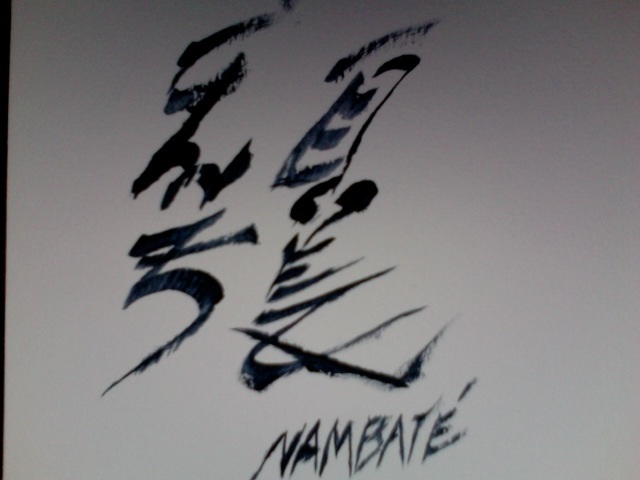
David leaves us his Tibetan calligraphy. It encourages perseverance.

For me to be.

For us to become.

For peace to pervade.

We Persevere.

Nambate!

Friday, November 27, 2009

Listening to Yusuf Islam sing "Peace Train."

Listening to rain outside window.

Listening to the sound of surrender to the compassionating wholeness.

Tomorrow, several hours' class on Islam in prison.

Thursday, November 26, 2009

According to Berkeley, "esse est percipi" ("to be is to be perceived").

If not perceived, then, perhaps, not.
Wanting to go to the eastern cliff
Setting out now after
How many years
Yesterday I used the vines
To pull myself up
But halfway there
Wind and mist made
The going tough
The narrow path grabbed
At my clothes
The moss so slippery
I couldn't proceed
So I stopped right here
Beneath this cinnamon tree
Used a cloud as a pillow
And went to sleep

- Han-shan
The joy of being a hermit is being able to stop right where you are. It is Thanksgiving. Being at home is a gift. With oneself. No need to be where one is not.

If you are looking for what is not, don't.

Stop right here.

Sleep well!

Wednesday, November 25, 2009

Is God in us? Or, are we in God?

Such a silly question.

Everybody knows the answer.


God is God. Allah is Allah. Christ is Christ. Yahweh is Yahweh. Reality is Reality.

Now, then -- was there something you wanted to know?

Or would you rather feel what is beyond knowledge?

Or, perhaps, we might just say: "Thank You!"

You are.

Welcome!

Tuesday, November 24, 2009

Anthropologist spoke of Afghanistan at Camden Library tonight.
The moon illuminates a thousand peaks
with the brilliance of daylight,
The sound of the bell falls
on my pillow of old friend's poems;
In my thin monk's robes,
unafraid of the frost's harshness,
I rise, roll up the thin blinds,
sit in the depths of the night.

- Tesshu Tokusai (?–1366)
Nowhere is there an easy solution.

    Who makes these changes?
    I shoot an arrow right.
    It lands left.
    I ride after a deer and find myself
    chased by a hog.
    I plot to get what I want
    and end up in prison.
    I dig pits to trap others
    and fall in.

    I should be suspicious
    of what I want.

    -- Jalaluddin Rumi (Dari Poet)
Each poem tries.

To see through.

What we want.

Monday, November 23, 2009

No dogma. No apologetics. No authority.
Looking for a place to settle
Cold Mountain will do just fine
Fine wind among thick pines
The closer you listen
The better the sound
Under them a man
His hair turning white
Mumbling, mumbling
Taoist texts
He's been here ten years
Unable to return
Completely forgotten the way
By which he came.

- Han-shan
But oneself.

No other.

Sunday, November 22, 2009

There's a Tibetan word, "shenpa." It is usually translated "attachment."
Pema Chodron says it means more the energy that hooks us into our habitual patterns.

The Catholic Bishop of Rhode Island has said Patrick Kennedy is banned from receiving Holy Communion because of his public views on abortion. The bishop is full of shenpa.
The white clouds
On the mountain tops
Poke halfway into this thatched hut
I had thought too cramped
Even for myself

- Koho Kennichi (1241–1316)
At Sunday Evening Practice there were six of us, cat and dog included. Reading Pema's "The Natural Warmth of the Heart" from the Shambhala Sun Magazine issue was perfect.

Hospitality was a full house. Two conversations in prison Friday, one at Quarry Hill nursing facility, and one at hermitage made for four fine engagements. Canoeing Hosmer Pond and hiking Ragged Mountain yesterday -- climbing Beech Hill for silent sitting this morning -- we recognize and acknowledge the wonderful gifts of nature and community we are given.

Our life is like a Zen koan.
Koans are Zen riddles that you do not solve so much as step through, as through Alice's looking glass, into Mad Hatterish conundrums designed to stun rational sense and in its place induce wordless insight.
(from "Philosopher's Disease," in Shambhala Sun, November 2009, excerpted from ales of Wonder: Adventures Chasing the Divine, An Autobiography, by Huston Smith)
Compline, gong, a computer episode, and now, time for bed.

Hanging opposite commode in new frame the words of Tecumseh read by Rob McCall on Awanadjo Almanack (on WERU radio).
The Teaching of Tecumseh

Live your life that the fear of death
can never enter your heart.
Trouble no one about his religion.
Respect others in their views
and demand that they respect yours.
Love your life, perfect your life,
beautify all things in your life.
Seek to make your life long
and of service to your people.
Prepare a noble death song for the day
when you go over the great divide.
Always give a word or sign of salute when meeting
or passing a friend, or even a stranger,if in a lonely place
Show respect to all people, but grovel to none.
When you rise in the morning, give thanks for the light,
for your life, for your strength.
Give thanks for your food and for the joy of living.
If you see no reason to give thanks,
the fault lies in yourself.
Touch not the poisonous firewater that makes wise ones turn to fools
and robs the spirit of its vision.
When your time comes to die, be not like those
whose hearts are filled with fear of death,
so that when their time comes they weep and pray for a little more time to live their lives over again
in a different way.
Sing your death song, and die like a hero going home.

(Tecumseh (March 1768 – October 5, 1813) also Tecumtha or Tekamthi, was a Native American leader of the Shawnee and a large tribal confederacy that opposed the United States during Tecumseh's War and the War of 1812.
Being wordless is parallel to doing nothing. At the same time, everything speaks for itself, and nothing is left undone.

This is the way the word begins -- not with a sound, but a presenter.

Saturday, November 21, 2009

At dawn chiming gong on porch of meditation cabin. After dusk, after darkened cabin chanting compline, gong again. The gong is prelude. Silence follows.

What if every sound is the sound of awakening earth?
If you are spiritually sharp,
you can open your eyes and
see as soon as you hear me
tell you about this.
Have not people of immeasurable
greatness said this truth
is not comprehensible by thought,
and that it is where
knowledge does not reach?
Were it not like this,
how could it be called
enlightened truth?
Nowadays, however, people
just present interpretations and views,
making up rationalizations;
they have never learned to be thus,
and have never reached this state.

- Foyan (1067–1120)
Once we wanted to be a different kind of hermit monastic Buddhist Christian whose only faith was eco-spiritual wholeness.

It is no longer wanted.

This moment.

Is it.

Friday, November 20, 2009

"We are poor passing facts," wrote Robert Lowell in his poem "Epilogue."

Jack wanted to show me a paragraph from The Course in Miracles.
Words will mean little now. We use them but as guides on which we do not now depend. For now we seek direct experience of truth alone. The lessons that remain are merely introductions to the times in which we leave the world of pain, and go to enter peace. Now we begin to reach the goal this course has set, and find the end toward which our practising was always geared.
(ACIM, Introduction Part II, Workbook for students)
I tell him I am so pleased that words (will) mean the "little-now." There's so much emphasis these days on the big Now. I delight in words and I delight in the little-now, the particular, specific and immediate place and time wherein we dwell.
Body impermanent like spring mist;
Mind insubstantial like empty sky;
Thoughts unestablished like breezes in space.
Think about these three points over and over.

- Godrakpa (1170-1249)
Even so, this body, this mind, this thought place me here in this little-now.
Farmhouses, Iowa

Invariably, a family in each one
And someone opening the fridge to fetch
A carton of milk, someone sitting in
A chair and shelling peas, someone looking

Out a window at a barn, two willow trees.
Solitude broods like a pursuing shadow;
A radio fades in and out -the voice
Eager yet eerie. Three ages anchor

The oaken dinner table: Mom and Dad
Up-before-dawn weary, Grandma perturbed
About half-thawed rolls, the children recounting
School stories, then silent. In the parlor
A whiskey tumbler rests beside a Bible.
The old collie whimpers when a car goes by.

"Farmhouses, Iowa" by Baron Wormser, from Scattered Chapters. Sarabande Books, 2008.
Whiskey gone. Bible closed.

Collie prays for each passing.

The 90 year old woman at nursing home, after reading several poems of hers, remembers as she leaves room that she had been a librarian and helped young students to write poems.

She'd forgotten for a while what she'd done in her life.

A passing forgetfulness.

Thursday, November 19, 2009

During conversation tonight my mind drifted to an eleven syllable haiku:
What is real?
How silly!
Who are you?
...am I

(wfh)
Visitors in the recovering community speak about how they broke. How they asked for help. And connect to God, higher power, or by some other name a truth that changes.
Who enters this door, who studies this teaching
Has to be thorough and push to the end.
Empty your body, and reason remains;
Blank your mind, and the world is void.
Cloud-draped trees form a sheet of white;
In a mountain's mouth the sun' s a red slice.
The flag moves or is it the wind?
It isn't the wind or the flag.

- Stonehouse
Cleaning up old roofing from grass into pickup on tarps.

Work slows to molasses on a cold day.

Last night in class, Chu-Tsi (12th C.), Wang Yang-Ming (15th-16th C.) and Jill Bolte Taylor (20th-21st C.) combine to point out rational and ideal Neo-Confucian philosophy, and the miracle of narrative following a stroke. Her stroke of insight sums up all philosophy.

Ingrid made sticky buns for the class. Four students gave presentations.

The trip to the dump and back was a meeting in itself.
Who are
you
am I
We tidy as best we can.

The rest stays where it falls.

Wednesday, November 18, 2009

I feel like the middle of November.
Whatever you are doing, twenty-four hours a day, in all your various activities, there is something that transcends the Buddhas and Zen Masters; but as soon as you want to understand it, it's not there. As soon as you try to gather your attention on it, you have already turned away from it. That is why I say you see but cannot do anything about it.
- Foyan (1067–1120)
I try to find my mind.

It' not there.

Tuesday, November 17, 2009

For Events, see http://sites.google.com/site/meetingbrookhermitage/Home/events-at-meetingbrook
..........

There was a young man that went into the wild in Alaska. He came upon a bus. There he stayed.

Reminds me of a friend who died 30 years ago asking someone not to steal his money in Mexico.

It's the way things happen sometimes.
"Just give me one thing
That I can hold on to
To believe in this living

Is just a hard way to go"

(--from song, Angel From Montgomery,"lyrics by John Prine)
We end conversation tonight saying: Live the mystery, investigate it, and stop worrying about it.

Nothing to it. Just give up everything that isn't real and present.
All of the river boat gamblers are losing their shirts
All of the brave union soldier boys sleep in the dirt
But you know and I know, there never was reason to hurt
All of our lives were entwined to begin with,
Here in spoon river.

(--from song "Spoon River", lyrics by Michael Smith
What do I long for? Here it is: the open, loving, with trust, natural, and present.
Imagine there's no heaven
It's easy if you try
No hell below us
Above us only sky

(--from song "Imagine", lyrics by John Lennon)
The stars are dancing. That's what Saskia said. I go out through the barn.

There they were.

Dancing.

Monday, November 16, 2009

I look around and through what stands around me and you.

Cabin was like a sweat lodge at Sunday Evening Practice. The wood-stove cranked hotter than the moderate outside temperature called for. And the candles went out one by one. The cardiologist from Antigonish and the homeopath from Rockport sat beside the artist from Vermont and the carpenter now living in Illinois, the lay monastic auditor/baker from Toronto and the mendicant with motto 'ama nesciri' from the country of Brooklyn rounded out the meditation cabin with white dog with black spot with herding stock from Pennsylvania and New York.
A man of the Way comes rapping
At my brushwood gate,
Wants to discuss the essentials of Zen experience.
Don't take it wrong if this mountain monk's
Too lazy to open his mouth:
Late spring warblers singing their heart out,
A village of drifting petals.

- Jakushitsu Genko (1290-1367)
Table reading was Sharon Salzberg's dharma talk "A More Complete Attention" in current issue of Tricycle. It seemed just right. As did the lentil soup (with or without sausage and beef). Rokie did his weekly plaintive wail for the lost ball deep under bookshelf in corner of dining room.

Poet Charles Olson wrote, "There is no intelligence the equal of the situation." Jacque Ranciere wrote that, "All have equal intelligence." The idea seemed right that intelligence and compassion are less a matter of who has them, but more a matter of who responds to them as they present themselves within each situation. Thus, what a person is to do is to show up in each situation, attend to the reality revealing itself, respond to/with the intelligence and compassion found there, and cease considering yourself 'other' than the situation.

We are standing around what is standing around with and for us. Circumstance -- of which we are not-other.

Jose Ortega y Gasset (1883-1955) wrote, "Jo soy jo y mi circunstancia."
Philosophy
Circunstancia

For Ortega y Gasset, philosophy has a critical duty to lay siege to beliefs in order to promote new ideas and to explain reality. In order to accomplish such task the philosopher must, as Husserl proposed, leave behind prejudices and previously existing beliefs and investigate the essential reality of the universe. Ortega proposes that philosophy must, as Hegel proposed, overcome both the lack of idealism (in which reality gravitated around the ego) and ancient-medieval realism (which is for him an undeveloped point of view in which the subject is located outside the world) in order to focus in the only truthful reality (i.e. life). He suggests that there is no me without things and things are nothing without me, I (human being) can not be detached from my circumstances (world). This led Ortega to pronounce his famous maxim "Yo soy yo y mi circunstancia" ("I am myself and my circumstance") which he always situated in the core of his philosophy. For Ortega, as for Husserl, the Cartesian 'cogito ergo sum' is insufficient to explain reality"therefore the Spanish philosopher proposes a system where life is the sum of the ego and circumstance. This circunstancia is oppressive; therefore, there is a continual dialectical exchange of forces between the person and his or her circumstances and, as a result, life is a drama that exists between necessity and freedom. In this sense Ortega wrote that life is at the same time fate and freedom, and that freedom "is being free inside of a given fate. Fate gives us an inexorable repertory of determinate possibilities, that is, it gives us different destinies. We accept fate and within it we choose one destiny." In this tied down fate we must therefore be active, decide and create a "project of life" -- thus not be like those who live a conventional life of customs and given structures who prefer an unconcerned and imperturbable life because they are afraid of the duty of choosing a project
.
(from AllExperts, About.com, Free Encyclopedia) http://en.allexperts.com/e/j/jo/josé_ortega_y_gasset.htm
"I am myself and my circumstance." (Ortega y Gasset)

So,
(Question): Where do we find ourselves?
(Response): Where are you?

Who am I?
What are you doing?

Am I free?
You choose!

The rain has stopped. We had flooded celler and leaky roof (which is not quite finished being re-shingled). The Irish workman left the west side of dormer completely unprotected last season. The Scot temporarily cut and nailed an obtuse triangular temporary cover of plywood earlier this season. The roofer from Hope hadn't gotten to it yet last week. But the torrential rain coming from southwest did get to it. For hours of slashing downpour. The upstairs and downstairs bathrooms danced with dripping water through wall and ceiling. Pots and pans and multicolored towels bravely stood their ground during the deluge. Saskia fortified the troops. The battle subsides. All is well. And wet.

The brook roared and edged its limits under our footbridges. Big stones grumbled under water-falls. The sluice dug two months ago took runoff down Ragged Mountain that would have hit barn off to the other side of septic mound and across the road. I build make-shift earthen diverter dams to help water go away from new gambrel bookshed being built askew barn. Hosmer Pond was profoundly beyond its normal limits, flooding fields and backing toward road by 20-30 feet. Where we keep the green canoe on wood frame by pond was two feet too deep for our boots to approach -- so we turned back with life jackets hanging from paddles over shoulders.

November is warm this week. Many dogs ran the Snow Bowl. Color has fallen from trees to mountain mulching. Dawn gives light. I wake up early.

This.

All of this.

And you.

This is what I am.

Thank you.

With heartfelt gratitude!

Saturday, November 14, 2009

A hermeneutic:

In the beginning earth breathing wholeness is monotheism's awakening.

Then, embodying wholeness is God become human.
Know the essence of mind.
Its intrinsic essence is pure clarity.
It is essentially the same as a Buddha.
Know the functions of mind.
Its functions produce the treasury of teachings.
When its activity is always silent,
Myriad illusions become suchness.

- Tao-hsin (580-651)
When no longer angered or disturbed by the reality of what is taking place around me, I surrender to the wholeness.

This is the course of Oneness -- of monotheism -- moving through Judaism, to Christianity, to Islam.

Fragmented and scattered mind finds Itself.

In whole-sight.

What needs doing...

Is being done.

Friday, November 13, 2009

Have you affirmed the Charter for Compassion yet?

http://charterforcompassion.org/Add Image

Thursday, November 12, 2009

There's no purpose. We're useless.

And we love it.

The Zen Master asks, "But, what is 'it'?"
"And, irrespective of what one might assume, in the life of a science, problems do not arise by themselves. It is precisely this that marks out a problem as being of the true scientific spirit: all knowledge is in response to a question. If there were no question, there would be no scientific knowledge. Nothing proceeds from itself. Nothing is given. All is constructed."
(--Gaston Bachelard in La formation de l'esprit scientifique, 1934)
Everything is itself. Everything is done for itself. No other purpose. No other reason.

Stop trying to be something. Or to do something.
As long as we insist that meditation must be meaningful, we fail to understand it. We meditate with the idea that we’re going to get something from it—that it will lower our blood pressure, calm us down, or enhance our concentration. And, we believe, if we meditate long enough, and in just the right way, it might even bring us to enlightenment.

All of this is delusion.

- Steve Hagen, from “Looking For Meaning,” Tricycle, Fall 2003
A man stops by. His wife has entered an Alzheimer's unit. He misses her. I feel for them.

Words and presence are the manifest realities of true silence and inseparate wholeness.

It grows starker these nights.

It is clearly, coldly, November.

Wednesday, November 11, 2009

Men and women who've served in the military -- especially those who experienced combat circumstances -- are to be acknowledged and thanked.

Those responsible for the stupidity of war are to be held accountable for their actions.

War is the one insult to human intelligence that human intelligence has not yet figured out.
The great way of the buddhas is profound, wondrous, inconceivable; how could its practice be easy? Have you not seen how the ancients gave up their bodies and lives, abandoned their countries, cities, and families, looking upon them as shards of tile? After that they passed eons living alone in the mountains and forests, bodies and minds like dead trees; only then did they unite with the way. Then they could use the mountains and rivers for words, raise the wind and rain for a tongue, and explain the great void, turning the incomparable wheel.
- Dogen (1200-1253)
However much we hate war, we have compassion for those suffering it -- combatants and civilians.
IX
Calm fell. From Heaven distilled a clemency;
There was peace on earth, and silence in the sky;
Some could, some could not, shake off misery:
The Sinister Spirit sneered: "It had to be!"
And again the Spirit of Pity whispered, "Why?"

(- final stanza from poem, And There Was a Great Calm, by Thomas Hardy)
The spirit of compassion, even pity, must be responded to.

Tuesday, November 10, 2009

We're not sure what to do with life or death.
Sniper Who Killed 10 Is Executed in Virginia
By IAN URBINA 1 minute ago; New York Times, 10Nov09

John A. Muhammad, whose murderous shooting spree in the fall of 2002 left at least 10 people dead, was executed on Tuesday night at a Virginia state prison.
We might be safer with him dead.

But we're not any wiser; not any better. Do we even want to be?
There is more to desire than just suffering. There is a yearning in desire that is as spiritual as it is sensual. Even when it degenerates into addiction, there is something salvageable from the original impulse that can only be described as sacred. Something in the person wants to be free, and it seeks its freedom any way it can. […]

As the well-known contemporary Indian teacher Sri Nisargadatta, famous for sitting on a crowded street corner selling inexpensive bidis, or Indian cigarettes, once commented, “The problem is not desire. It’s that your desires are too small.” The left-handed path means opening to desire so that it becomes more than just a craving for whatever the culture has conditioned us to want. Desire is a teacher: when we immerse ourselves in it without guilt, shame, or clinging, it can show us something special about our own minds that allows us to embrace life fully.
(- Mark Epstein, from “In Defense of Desire,” Tricycle, Spring 2005)
We are so many dead men walking around no longer breathing -- but not willing to close eyes and exhale.

Tide out.

We hardly want to know what we truly desire.

But we are just.

We can kill.

Legally.

Monday, November 09, 2009

No need to be afraid of knowledge.

No need to be afraid of uncertainty.

Hospitality, conversation, and meditation are good examples of small ways available to us to affirm the simplicity of service, silence, and stillness.

I don't for a minute think that an empty room is empty of all the beings once occupying it.

Zen is the practice of seeing this emptiness through.

Sunday, November 08, 2009

What is Ultimate Reality? It is what-is without the blade of thought to cut it.

There is only Ultimate Reality. All thinking that severs and divides is illusory thinking.
Imagination draws its energy from a confrontation with desire. It feeds off desire, transmuting and magnifying reality through desire’s power. Fantasy does the opposite; it avoids desire by fleeing into a crude sort of wish-fulfillment that seems much safer. Fantasy might be teddy bears, lollipops, sexual delights, or superhero adventures; it also might be voices in one’s head urging acts of outrage and mayhem. Or it might be the confused world of separation and fear we routinely live in, a threatening yet seductive world that promises us the happiness we seek when our fantasies finally become real. Imagination confronts desire directly, in all its discomfort and intensity, deepening the world right where we are. Fantasy and reality are opposing forces, but imagination and reality are not in opposition: imagination goes toward reality, shapes and evokes it.
(- Norman Fischer, from “Saved From Freezing,” Tricycle, Spring 2005)
Karl sends postcard from Village Soup with photo of us at the shop by the harbor. He says,"This photo always brings back fond memories...".

We imagine a new reality. Evoking it.

Shaping it.

Becoming it.

Saturday, November 07, 2009

No teacher. Everything teaches.
No religion. Everything holds together.
No God. Everything resounds of God.
A Buddhist Retreat Behind Broken-Mountain Temple

In the pure morning, near the old temple,
Where early sunlight points the tree-tops,
My path has wound, through a sheltered hollow
Of boughs and flowers, to a Buddhist retreat.
Here birds are alive with mountain-light,
And the mind touches peace in a pool,
And a thousand sounds are quieted
By the breathing of a temple-bell.

- Ch'ang Chien
Nothing to hold on to. Everything falls.
Only silence. Everything vibrates.
Loss and emptiness. Everything comes alive.

UPROOTED

The artists painting Cuba from memory
or from photographs, from family stories
of the exodus, from dreams, know
their bloodlines are not clear. The work
is mongrel, neither Cuban nor American.

They paint masks, figures floating, palm
trees set on pedestals. They sculpt women
locked in birth. What they want is a particular
place. What they find is borrowed space.
In hand-colored gelatin silver prints or wood

with oil and gold leaf or oil on linen or on
masonite or on carved locust bark, they discover
new rooms, dream landscapes, regions of origin
as small as phone-booths, as expansive as cane
fields, rented, tenanted, temporary.

—Interprete mi silencio—, one says.
They are like poets scratching out their
metaphors sideways on pieces of lined paper,
crossgrain, drafting possibilities,
unsettled, undecided.

These artists ask and never receive replies,
remember without mementos, feel without touching.
They have heard of the royal palm, seventy feet tall
and seek its landscape. How odd its trunk
is almost hollow, its roots mere threads.

(Poem by Jill Peláez Baumgaertner )

Gertrude wondered where Louise had gone with the poem Gertrude wrote about her husband. Her memory isn't so good. Louise steps off the elevator with the original and the copy she made for the poetry folder in the library of the Assisted Living Facility in Camden. Gertrude was a native of Brooklyn. Me too. Park Slope and Bensonhurst. She wondered if she'd passed my on the bus going to Brooklyn College. There in the foyer outside Suzanne's office we spoke waiting for the poem to reappear. When it did she was pleased. Louise put the copy in the red folder and said goodbye. Gertrude began her walk down corridor to room. It would soon be the evening meal. We go down the stairs.

Poetry has a way of reappearing just when you thought it gone.

She is a good listener.

Friday, November 06, 2009

To ask if we believe in the Bible is to ask if we believe in the fact of humankind. Do we believe we are alive? Do we think there is a mind? And what does any of it have to do with what we call "God?"
Beginning with Abraham, the Hebrew experience has resulted in the evolutionary unfolding of the human psyche. The Bible is the living record of this development, and therefore it has maintained its validity throughout the ages, up to and including the technological age of our own time.
(from p.69, in The Structure of Biblical Myths, The Ontogenesis of the Psyche, by Heinz Westman)
Present open thought. Here everywhere all dimensions. (Not being a marijuana smoker, still, the acronym is "pot head" for the prior sentences.)

The Course in Miracles circles through this issue:
The self you made is not the Son of God. Therefore, this self does not exist at all. And anything it seems to do and think means nothing. It is neither bad nor good. It is unreal, and nothing more than that. It does not battle with the Son of God. It does not hurt him, nor attack his peace. It has not changed creation, nor reduced eternal sinlessness to sin, and love to hate. What power can this self you made possess, when it would contradict the Will of God?
Your sinlessness is guaranteed by God. Over and over this must be repeated, until it is accepted. It is true. Your sinlessness is guaranteed by God. Nothing can touch it, or change what God created as eternal. The self you made, evil and full of sin, is meaningless. Your sinlessness is guaranteed by God, and light and joy and peace abide in you.
Salvation requires the acceptance of but one thought; - you are as God created you, not what you made of yourself. Whatever evil you may think you did, you are as God created you. Whatever mistakes you made, the truth about you is unchanged. Creation is eternal and unalterable. Your sinlessness is guaranteed by God. You are and will forever be exactly as you were created. Light and joy and peace abide in you because God put them there.

(from Lesson 93, ACIM)
Let's not argue whether there is a God. Let's discuss whether you and I are here. Here and not perpetually absent. Missing. Nowhere to be found.

Westman says that Abram is told by the Lord to "Go from your country...into the land of your own becoming."(p.71)

What about you?

You want a special engraved eviction notice?

An inmate had a line in his poem today something to the effect: We are holding on even though we are already gone.

Anybody here?

Who's there?

Thursday, November 05, 2009

Too many words about God. Let's keep still. And silent.
On Going to see a Taoist Master

A dog barking and the sound of water;
Peach blossoms heavy with dew.
In these deep woods, deer can be seen;
At noon along the stream, I hear no bell.
Wild bamboo divides gray clouds;
Waterfalls hang from blue peaks.
No one knows where you’ve gone;
Disheartened, I lean against a second,
Now a third pine.

- Li Po
Like the weather: falling cold rain, darkness too soon, an empty landscape.

Maybe up is down. Or, no up, no down. Maybe, up is up, down, down. However said, there is no opposite.
Living is joy, but death can only weep. You see in death escape from what you made. But this you do not see; that you made death, and it is but illusion of an end. Death cannot be escape, because it is not life in which the problem lies. Life has no opposite, for it is God. Life and death seem to be opposites because you have decided death ends life. Forgive the world, and you will understand that everything that God created cannot have an end, and nothing He did not create is real. In this one sentence is our course explained. In this one sentence is our practicing given its one direction. And in this one sentence is the Holy Spirit's whole curriculum specified exactly as it is.

What is the peace of God? No more than this; the simple understanding that His Will is wholly without opposite. There is no thought that contradicts His Will, yet can be true. The contrast between His Will and yours but seemed to be reality. In truth there was no conflict, for His Will is yours. Now is the mighty Will of God Himself His gift to you. He does not seek to keep it for Himself. Why would you seek to keep your tiny frail imaginings apart from Him? The Will of God is one and all there is. This is your heritage. The universe beyond the sun and stars, and all the thoughts of which you can conceive, belong to you. God's peace is the condition for His Will. Attain His peace, and you remember Him.

(--from ACIM, Manual for Teachers, http://courseinmiracles.com/teachers_manual/what_is_the_peace_of_god20.htm/
God's will is wholly without opposite.

What must it be like to be all alone?

All.

Alone.

Tuesday, November 03, 2009

Election Day.

We like to think each vote counts. It does.
Evening mountains veiled in somber mist;
One path entering the wooded hill:
The monk has gone off locking his pine door.
From a bamboo pipe a lonely trickle of water flows

- Ishikawa Jozan (1583-1672)
Cedar shingling north wall of book shop/shed.

Just that.

And hopes for equality and compassion.

Monday, November 02, 2009

Men and women in harm's way in war zones deserve our support. They live in hell.

Those who start wars deserve that hell, not those they send to fight.
What is the test of truth? The Buddha offers a simple formula: Test things in terms of cause and effect. Whatever is unskillful, leading to harm and ill, should be abandoned; whatever is skillful, leading to happiness and peace, should be pursued. Apply the test of skillfulness to all teachings in all your actions. Where is this teaching taking you? Is it moving you in a direction that is wise and kind? One quick test isn’t enough, you know.

You have to keep at it, so that your sensitivity to the results of your actions grows more and more refined with practice. When you’ve done the hard work of asking these questions, then you can decide for yourself whether a teaching, or a teacher, is worth following. And at the same time, you’ve also taught yourself how to live—a learning that can bring with it joy and the energy to go even deeper.

- Larry Rosenberg, from “The Right to Ask Questions,” Tricycle, Fall 2003
Watched "Operation Homecoming" and was touched by the reality they described. Watch this film. It sobers.

It is All Soul's Day.

About war...

Apophasis!

Sunday, November 01, 2009

Bright full moon. Older Canadian Buddhist cardiologist stumbles in to dimly lighted cabin after sitting under weigh. He plops cushion down just shy of dog center circle rug. Moonlight gave shape through shadow soon.
Right among the people coming and going
I have a place t
o stay
I shut the gate even in the daytime
And feel as though I had bought
Wo-chu the great mountain
And had it with me in town.
Never since I was born have I
Liked to argue, mouth full of blood.
My mouth is made fast to heaven and earth
So the universe is still.

- Muso Soseki (1275-1351)
At table he tells us of Catholic Bishop in Antigonish resigning then arrested for bringing child pornography into Canada. When interviewed on television the elder Buddhist said the man was probably in hell these days and there was probably a need for compassion.

The Dalai Lama said his religion is simple -- his religion is kindness.

We should drop everything and forget everything but kindness.

i would opt for religious life with such a rule.