Saturday, March 13, 2010

I look at you.

You look at me.

If we learn to listen and speak with open mind and open heart we are practicing the promise of conversation. It is the practice of faith most needed today.

Almost a Conversation

I have not really, not yet, talked with otter
about his life.
He has so many teeth, he has trouble
with vowels.
Wherefore our understanding
is all body expression—
he swims like the sleekest fish,
he dives and exhales and lifts a trail of bubbles.
Little by little he trusts my eyes
and my curious body sitting on the shore.
Sometimes he comes close.
I admire his whiskers
and his dark fur which I would rather die than wear.
He has no words, still what he tells about his life
is clear.
He does not own a computer.
He imagines the river will last forever.
He does not envy the dry house I live in.
He does not wonder who or what it is that I worship.
He wonders, morning after morning, that the river
is so cold and fresh and alive, and still
I don't jump in.

(Poem by Mary Oliver)

Nobody's death in particular, but every death today.

I listen to "God Moving Over the Face of the Waters" by Moby from soundtrack of film "Heat." It is a death scene set to a creation theme. The good guy and the bad guy at end clasp hands. We are not to think anything. We are to feel.
Mourner's Kaddish
Yit'gadal v'yit'kadash sh'mei raba (Cong: Amein).
May His great Name grow exalted and sanctified (`Cong: Amen.)

b'al'ma di v'ra khir'utei
in the world that He created as He willed.

v'yam'likh mal'khutei b'chayeikhon uv'yomeikhon
May He give reign to His kingship in your lifetimes and in your days,

uv'chayei d'khol beit yis'ra'eil
and in the lifetimes of the entire Family of Israel,

ba'agala uviz'man kariv v'im'ru:
swiftly and soon. Now say:
(Mourners and Congregation:)

Amein. Y'hei sh'mei raba m'varakh l'alam ul'al'mei al'maya
(Amen. May His great Name be blessed forever and ever.)

Yit'barakh v'yish'tabach v'yit'pa'ar v'yit'romam v'yit'nasei
Blessed, praised, glorified, exalted, extolled,

v'yit'hadar v'yit'aleh v'yit'halal sh'mei d'kud'sha
mighty, upraised, and lauded be the Name of the Holy One
(Mourners and Congregation:)

B'rikh hu.
Blessed is He.

l'eila min kol bir'khata v'shirata
beyond any blessing and song,

toosh'b'chatah v'nechematah, da'ameeran b'al'mah, v'eemru:
praise and consolation that are uttered in the world. Now say:
(Mourners and Congregation:)

Amein
Amen

Y'hei sh'lama raba min sh'maya
May there be abundant peace from Heaven

v'chayim aleinu v'al kol yis'ra'eil v'im'ru
and life upon us and upon all Israel. Now say:
(Mourners and Congregation:)

Amein
Amen

Oseh shalom bim'romav hu ya'aseh shalom
He Who makes peace in His heights, may He make peace,

aleinu v'al kol Yis'ra'eil v'im'ru
upon us and upon all Israel. Now say:
(Mourners and Congregation:)

Amein
Amen
http://www.jewfaq.org/prayer/kaddish.htm
We don't know what happens after death.

We barely know what happens after birth.

Look at me.

I look at you.

There's nothing else.

Only the gaze.

Friday, March 12, 2010

Like John Crichton in Farscape series, we seem to be mostly through the wormhole. The star system outside the window today is bright and sunny. The remainder of the website is drifting toward a new location.
Astronaut John Crichton assumes he'll be home in time for dinner. But a freak accident during an experimental space mission catapults him across a thousand galaxies to an alien battlefield. Suddenly, he's trapped among alien creatures wielding deadly technology - a battle that 20th century sci-fi pop culture never prepared him for. Hunted by a merciless military race, Crichton begins his quest for home from a galaxy far, far away...
(--from The Jim Henson Company website, http://www.henson.com/fantasy_scifi.php?content=farscape)
With the help of Bob O'C, who arrived from an unspecified galaxy, we have begun to transfer the domain, hosting, and blog so ably created and maintained by Karl G for so many years into a new search for a new home that should resemble the place we began before the wormhole.

Home is no place to lose.

And, there is no place like it.

Friday, March 05, 2010

Hello

Thursday, March 04, 2010

I think I've begun a process of moving this blog. Like being in a wormhole, I have no idea where it will emerge. Or whether it will.
Salat

poetry is prayer
light dancing inside words
five times a day
I try to write

step by step
I move towards the mihrab
I prepare to recite
what is in my heart

I recite your name


(Poem by E. Ethelbert Miller)
If we know the direction for prayer, perhaps we know the direction of the one praying.

It is the poem.

Look there.

Word yourself.

Wednesday, March 03, 2010

Plato worried we would not have the courage for democracy. It's a reasonable worry even these 2500 years later. Lies and other demos-denying behaviors run rampant.
Song of T'aego Hermitage

I've lived in this hermitage
How long I don't know
Deep and secret and
Without obstructions
Heaven and earth meet
Like box and cover:
There's no turning toward
Or turning away.
I do not stay in the east, west,
South or north
The jewel tower and the jade palace
Do not stand opposite me.
I do not take guidelines from
Bodhidharma as a model
As the light shines freely through
Eighty four thousand gates.

- T'aego (1301-1382)
I think that education is invitation and prelude to presence and compassion.

John O'Donohue spoke it well:
Transformation: Let’s move to the presence of compassion. How do we recognize it?

O’Donohue: We recognize compassion in the willingness of someone to imagine himself into the life of another person. We recognize its presence in the withholding of huge negative moralistic judgment. We see compassion in the expression of mercy, in the refusal to label someone with a short-circuiting terminology that condemns her, even though her actions may be awkward. We see compassion in an openness to the greater mystery of the other person. The present situation, deed or misdeed is not the full story of the individual, there is a greater presence behind the deed or the person than society usually acknowledges. Above all, we see the presence of compassion as the vulnerability to be disturbed about awful things that are going on.

Transformation: What is the relationship between absence and compassion?

O’Donohue: Absence and presence are sisters. The opposite of presence is not absence, the opposite of presence is vacancy. Vacancy is a void, a space which is hungrily empty, whereas absence is a space of spatial emptiness, but there is a trail of connection toward the departed one, the lost one, the absent one. To feel absence is to feel connection with the one who has gone. There is still a huge affective involvement with the person. In exploring compassion and vacancy, vacancy is a sinister pain, because of its hunger, its emptiness. A form of vacancy that is prevalent in post-modern culture is indifference, the inability to imagine or show compassion to others who are in trouble. Absence is different. The feeling of absence can create an incredible feeling of compassion.
(--from, The Presence of Compassion, An Interview with John O’Donohue,
By Mary NurrieStearns, http://www.personaltransformation.com/ODonohue.html)
We have to care. To be responsible for the world and the new ones entering it. For the creating materials of truth and dialoguing difficult reasoning discourse together.
THE ORANGE

At lunchtime I bought a huge orange
The size of it made us all laugh.
I peeled it and shared it with Robert and Dave—
They got quarters and I had a half.

And that orange it made me so happy,
As ordinary things often do
Just lately. The shopping. A walk in the park
This is peace and contentment. It’s new.

The rest of the day was quite easy.
I did all my jobs on my list
And enjoyed them and had some time over.
I love you. I’m glad I exist.

(Poem, The Orange, by Wendy Cope)
So do I...

Love you...

Glad you, and I, exist.

Tuesday, March 02, 2010

Two is where three is but for one alone.

Ask anyone.

Monday, March 01, 2010

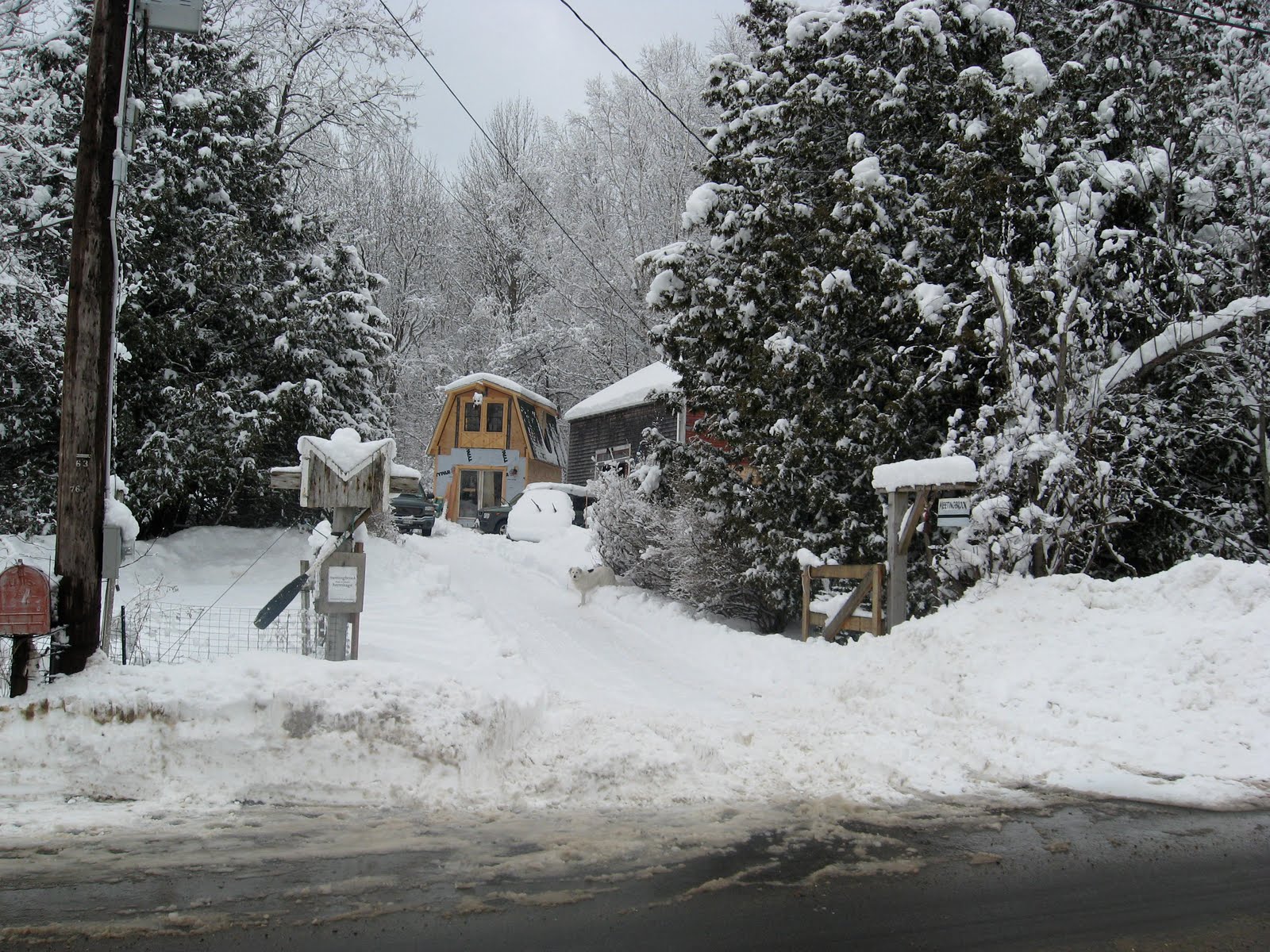
Meetingbrook Hermitage is a place of contemplation, conversation, and correspondance at Ragged Mountain just across from Bald Mountain on Barnestown Road in Camden Maine.

We will soon begin again.

Sunday, February 28, 2010


See?

Yes, you see!
All religions are founded on a deep spiritual experience of unity consciousness where there was complete union between the personal and universal. Unfortunately, many times the followers of religion, instead of understanding the religious experience and seeking it for themselves ended up merely worshiping the founder of the religion. It is more important to fully grasp the teaching of the religion and its basic tenets, that have come from a deeper experience of transcendence. Self-righteous morality is not a means for experiencing higher consciousness. Higher consciousness, spontaneously leads to moral and ethical behavior. However, because spiritual knowledge is powerful, the custodians of organized religion have frequently ended up with destructive behaviors -- power mongering, cronyism, control, corruption, and influence peddling. As a result organized religion has frequently become quarrelsome, divisive, and led to conflict. No organized religion has been immune to this unfortunate tendency. So, we have had the crusades and witch-hunts of Christianity, the Jihads of Islam, the violent communal riots instigated by fundamentalist Hindus and the persecution of minorities and ethnic cleansing all in the name of God.

Our present times are particularly dangerous because ancient habits combined with modern capacities and technologies of destruction are a devastating combination that can destroy life on our planet.

(--Deepak Chopra, Only Spirituality Can Solve The Problems Of The World: February 24, 2010 10:22 AM, http://www.huffingtonpost.com/deepak-chopra/only-spirituality-can-sol_b_474221.html)
Generator worked. Well pump installed. Rain again. Sump pump working. Bell at end of silent sitting always surprises when on timer.

Is there really anything to look for? To see?
George Harrison's My Sweet Lord Lyrics

My sweet lord
Hm, my lord
Hm, my lord

I really want to see you
Really want to be with you
Really want to see you lord
But it takes so long, my lord

My sweet lord
Hm, my lord
Hm, my lord

I really want to know you
Really want to go with you
Really want to show you lord
That it wont take long, my lord (hallelujah)

My sweet lord (hallelujah)
Hm, my lord (hallelujah)
My sweet lord (hallelujah)

I really want to see you
Really want to see you
Really want to see you, lord
But it takes so long, my lord (hallelujah)

My sweet lord (hallelujah)
Hm, my lord (hallelujah)
My, my, my lord (hallelujah)

I really want to know you (hallelujah)
Really want to go with you (hallelujah)
Really want to show you lord (aaah)
That it wont take long, my lord (hallelujah)

Hmm (hallelujah)
My sweet lord (hallelujah)
My, my, lord (hallelujah)

Hm, my lord (hare krishna)
My, my, my lord (hare krishna)
Oh hm, my sweet lord (krishna, krishna)
Oh-uuh-uh (hare hare)

Now, I really want to see you (hare rama)
Really want to be with you (hare rama)
Really want to see you lord (aaah)
But it takes so long, my lord (hallelujah)

Hm, my lord (hallelujah)
My, my, my lord (hare krishna)
My sweet lord (hare krishna)
My sweet lord (krishna krishna)
My lord (hare hare)
Hm, hm (gurur brahma)
Hm, hm (gurur vishnu)
Hm, hm (gurur devo)
Hm, hm (maheshwara)
My sweet lord (gurur sakshaat)
My sweet lord (parabrahma)
My, my, my lord (tasmayi shree)
My, my, my, my lord (guruve namah)
My sweet lord (hare rama)

[fade:]

(hare krishna)
My sweet lord (hare krishna)
My sweet lord (krishna krishna)
My lord (hare hare)
If we can speak, we can sing. If we can sing, we can find a way to smile and laugh.

And with that posture of joy, we can cry freely.
Oh happy day
Oh happy day
When Jesus washed
Oh when He washed
Mmm, when He washed
All my sins away
Oh happy day

Oh happy day (Oh happy day)
When Jesus washed (When Jesus washed)
Oh when He washed (When Jesus washed)
Mmm, when He washed (Mmm, when He washed)
All my sins away (Oh happy day)

He taught me how to watch
Watch and pray
Watch and pray (Watch and pray)
And live rejoicing every day
Every day (Every day)

Oh happy day (Oh happy day)
When Jesus washed (When Jesus washed)
Oh when He washed (When Jesus washed)
Mmm, when He washed (Mmm, when He washed)
All my sins away (Oh happy day)

It was a happy day (Oh happy day)

(--Music and lyrics by Edwin Hawkins, 1967, based on 18th century hymn)
Music is the excuse we can use to step away from all forms lacking compassion, contemplation, and consideration.

You know the tunes.

Go ahead.

Sing.

Saturday, February 27, 2010

Simone Weil said: "Absolute unmixed attention is prayer."
Like entrusting yourself
To a brave person
When greatly afraid,
By entrusting yourself
To the awakening mind,
You will be swiftly liberated,
Even if you have made appalling errors.

- Majjhima Nikaya
To pray always is to practice this absolute unmixed attention.

Begin again.

You are in my prayer.

Wednesday, February 24, 2010

Very wet and rainy.

John Dewey says that totality is continuity.
Totality means continuity -- the carrying on of a former habit of action with the readaptation necessary to keep it alive and growing. Instead of signifying a ready-made complete scheme of action, it means keeping the balance in a multitude of diverse actions, so that each borrows and gives significance to every other. Any person who is open-minded and sensitive to new perceptions, and who has concentration and responsibility in connecting them has, in so far, a philosophic disposition.
(John Dewey, in Democracy and Education)
Go on.

All of you.

Tuesday, February 23, 2010

If you haven't seen the film Departures, do.
Pine trees murmur in the wind.
Spring water bubbles in stone.
The moon sets at dawn.
An owl hoots in the mountains.

- Jinkag Haesim (1178-1234)
Off you go.

We'll meet again.

That's what the gate-keeper said.
Temporary site for events and update.

Monday, February 22, 2010

Dying is safe. That's what Singh said in her book. Good words.
Once the human mind goes astray,
Truth, the true pattern of the Tao,
Is lost.
Once the human mind is gathered in,
The true pattern of the Tao is there.

- Hu Juren (1434-1484)
My personal response to the themes of hospice conversation:
  • To understand the spiritual significance of death and dying :
Be still with it, listen with a silence that sorts; a silence which is “an ordering instinct [which] sends people into the hush where the voice can be heard." (Patricia Hampl)-

  • To recognize the difference between spirituality and religion:
Spirituality is the longing for true home, for true belonging; religions are the attempts to organize that longing. One is not the other. We each have an innate spirituality. Sometimes that spirituality finds a welcoming organization for it to visit.

  • To identify the spiritual concerns of the dying person:
Trust the dying person and yourself to allow the revealing of what needs revealing in its own good time. No forcing. No fretting. No trying to save or change the dying person’s view. Only loving, compassionate, presence.

  • To respect the spiritual needs and perspective of the patient:
We are guests and visitors to their journey. We are not teachers and guides. We must learn with them their way at this time in this place.

  • To learn to respond to questions relating to life after death:
We respond with our presence and our appreciation of the questions. Honest open conversation follows honest open listening.

  • To learn to provide support and understand the role of the volunteer:
To serve as a companion on the way. Be “voluntary” in your support and understanding, i.e., “voluntary (of your own free will or design; done by choice; not forced or compelled”-

  • To provide an overview of the role of cultural attitudes in death, dying, and bereavement:
Not everyone says there is a heaven or a hell somewhere else. Not everyone says we live on only in those who remember us. Not everyone says we will rest a while then experience rebirth on earth. Not everyone says reincarnation is based on karma. Not everyone says we dissolve back into the one ocean of being. Not everyone says there is a spirit world, multiple dimensions of physical/mental/spiritual dwelling beyond this visible dimension we occupy. Not everyone says there is nothing after death, just this life, that’s it. Not everyone thinks a priest, pastor, imam, sheik , rabbi, roshi, guru, shaman, pagan leader, chaplain of any denomination, or official representative of any other religious or spiritual point of view -- is necessary to minister to the dying person.

Some do. And that’s the wonder of being alive amid so much diversity. There are many ways. The task of the volunteer is to be open and responsive to the particular focus and questions of the dying person, and to be of whatever assistance you can be. You do not need to know the answers to all questions. But you can help to assist the dying person and the family feel more comfortable in the search.
'Safe': from Latin 'salvus' meaning 'uninjured.' Not likely to be harmed or lost.

We are safe. Dying is safe. Death is safe.

Dance well!

Sunday, February 21, 2010

Don't be stingy. That's the 8th precept. It was table reading tonight.

We haul water from the brook. Well pump died.
Subhuti, does it occur to you that I believe that through me living beings are led to liberation? Never think that way, Subhuti. Why? Because there is no separate being to lead to liberation. If I were to think there was, I would be caught in the notion of a self or person or a life span. Subhuti, what I call a self is essentially not a self in the way that an ordinary person thinks of it. But neither do I think of anyone as an ordinary person. However, knowing the essence, I can use the name, ordinary person.
(- from Diamond Sutra)
We walk pastures and back fields today on other side of Ragged near Alfred Lake. So little snow remains.
"Prayer only looks like an act of language; fundamentally it is a position, a placement of oneself. Focus. Get there, and all that's left to say is the words. They come: from ancient times, from the surprisingly eloquent heart, from the gush and chatter of the day's detail longing to be rendered.

So what is silence?

Silence speaks, the contemplatives say. But really, I think, silence sorts. An ordering instinct sends people into the hush where the voice can be heard."

(—Patricia Hampl, excerpted from Virgin Time; quoted on 'Speaking of Faith' with Krista Tippitt, Krista's Journal, May 22, 2008)
We'll talk about prayer and spirituality tomorrow at hospice training. An open invitation to invite the open.
"[The French philosopher Simone Weil said, 'Absolutely unmixed attention is prayer.'] I love that. I think that could be as close as someone can get to a wonderful definition of prayer. In that sense, prayer has nothing spiritual or religious about it. A mathematician working at a problem or a little kid trying to pick out scales on the piano is a person at prayer. She's not saying prayer is absolute unmixed attention; it's the other way. The attention itself is the quality that she wants to call prayer. So whatever context you're putting it in, whether it's inside a church or inside a toy box, that's the quality that is the sacred one."
(--from Krista's Journal, May 22, 2008, quoting Translator Stephen Mitchell)
Pray always. Don't know prayer. Be it.

In everything you do.

Saturday, February 20, 2010

There is
nothing wrong
with silence
Rethinking Ralph Nader. He didn't spoil the 2000 nor 2004 elections. He ran for office. That's that.
The mighty ocean has but one taste,
The taste of salt.
Even so, the true way has
But one savor,
The savor of freedom.

- Majjhima Nikaya
I like the idea of freedom. Even more, I like the practice of it.

Something difficult creeps into the politics of this country.

What shall we call it?

Something Naderless.

We need to find a cure.
Soon.

Friday, February 19, 2010

Enter my mind and take off your body.

God's invitation.
How I love the natural Buddha
Who waters the wide world with his mercy.
No place to hide in the vast sky;
Even inside the overturned bowl it's wet.

- Jinkag Haesim (1178-1234)
We grow old. The body says it is time to fail. As the poet wrote: "There's no success like failure, and failure's no success at all."
Tattoo

What once was meant to be a statement --
a dripping dagger held in the fist
of a shuddering heart -- is now just a bruise
on a bony old shoulder, the spot
where vanity once punched him hard
and the ache lingered on. He looks like
someone you had to reckon with,
strong as a stallion, fast and ornery,
but on this chilly morning, as he walks
between the tables at a yard sale
with the sleeves of his tight black T-shirt
rolled up to show us who he was,
he is only another old man, picking up
broken tools and putting them back,
his heart gone soft and blue with stories.
(Poem by Ted Kooser, from Delights & Shadows, published by Copper Canyon Press, 2004,)
Soft and blue.
Sit a while. Tell me a story. Let it be sad if it wishes.

I can hear it.

I've got no place to go.

Nothing else to do.

Merely a mindless and nescient nobody.

Thursday, February 18, 2010

The peanut butter is organic from the co-op.

The wind is natural from northeast.

Freeman Dyson, theoretical physicist and mathematician known for his work in quantum field theory, makes a distinction about being a practicing Christian, not a believing Christian:
I am myself a Christian, a member of a community that preserves an ancient heritage of great literature and great music, provides help and counsel to young and old when they are in trouble, educates children in moral responsibility, and worships God in its own fashion. But I find Polkinghorne's theology altogether too narrow for my taste. I have no use for a theology that claims to know the answers to deep questions but bases its arguments on the beliefs of a single tribe. I am a practicing Christian but not a believing Christian. To me, to worship God means to recognize that mind and intelligence are woven into the fabric of our universe in a way that altogether surpasses our comprehension. When I listen to Polkinghorne describing the afterlife, I think of God answering Job out of the whirlwind, "Who is this that darkeneth counsel by words without knowledge?... Where wast thou when I laid the foundations of the earth? Declare, if thou hast understanding.... Have the gates of death been opened unto thee? Or hast thou seen the doors of the shadow of death?" God's answer to Job is all the theology I need. As a scientist, I live in a universe of overwhelming size and mystery. The mysteries of life and language, good and evil, chance and necessity, and of our own existence as conscious beings in an impersonal cosmos are even greater than the mysteries of physics and astronomy. Behind the mysteries that we can name, there are deeper mysteries that we have not even begun to explore.
(in The New York Review of Books, Volume 49, Number 5 · March 28, 2002, Science & Religion: No Ends in Sight, By Freeman Dyson, reviewing: The God of Hope and the End of the World, by John Polkinghorne http://www.nybooks.com/articles/15220)
God is love. Perhaps there's no need to believe in God or anything else.

There is a need to practice love, to practice God. Here, and here, and here.

Wednesday, February 17, 2010

"Nescere Ama Nesciri." There. Something belonging to itself.

It is a good motto. "To not know... love... to be unknown."
Psalm 102 (103)

The Lord is compassion and kindness,
full of patience, full of mercy.
He will not fight against you for ever:
he will not always be angry.
He does not treat us as our sins deserve;
he does not pay us back for our wrongdoing.
As high as the sky above the earth,
so great is his kindness to those who fear him.
As far as east is from west,
so far he has put our wrongdoing from us.
As a father cares for his children,
so the Lord cares for those who fear him.
For he knows how we are made,
he remembers we are nothing but dust.
Man – his life is like grass,
he blossoms and withers like flowers of the field.
The wind blows and carries him away:
no trace of him remains.
Don't know.

Be unknown.

Only love.
Lady of silences
Calm and distressed
Torn and most whole
Rose of memory
Rose of forgetfulness
Exhausted and life-giving
Worried reposeful
The single Rose
Is now the Garden
Where all loves end
Terminate torment
Of love unsatisfied
The greater torment
Of love satisfied
End of the endless
Journey to no end
Conclusion of all that
Is inconclusible
Speech without word and
Word of no speech
Grace to the Mother
For the Garden
Where all love ends.

(--from poem Ash Wednesday by T.S. Eliot)
No.

Beginning.

No.

End.

Tuesday, February 16, 2010

Fort Kent, Caribou, Presque Isle, Houlton. We skirt the edges of Canada. Things look different up here.
Stop and look around you.
Look out from the frameless window
Of a long pause.
Let the images come to you
Rather than chasing outward after them.
Allow yourself to reorient so that
You're no longer pulled along
By the stream of events.
If you want to see differently,
You'll have to look differently.

(- Journeys on Mind Mountain)
A man with balloons on his hat greeted us on our walk tonight along the streets of Houlton. He thinks it will snow.

The masons erected a bust of George Washington in a center square.

A martial arts group went through their storefront exercises.

It's Tuesday night. Tomorrow will be Wednesday.

Nothing more.

Seen clearly.

Sunday, February 14, 2010

Here is what love is.
Overcome your uncertainties
And free yourself
From dwelling on sorrow.
If you delight in existence,
You will become a guide
To those who need you,
Revealing the path to many.

- Sutta Nipata
Love is what God is.

And that is this:

Love is this moment speaking.

God is what is being said.

Saturday, February 13, 2010

Practice Ahimsa, do no harm, avoid violence,

I've never been fond of violence, sacred or profane. Violence is too easy to perform, too easy to rationalize.

I dislike violent terrorist attacks on people and places. I dislike violent retaliatory attacks on people and places.

I dislike that the United States is engaged in two wars, or that we conduct assassinations, coups, secret hostilities in at least three other MiddleEast countries. I dislike that we are the major provider of guns and money to powers using both against their people or neighbors. These are troubling times.

I dislike cynicism and simple-mindedness, mine and others'. I cannot see any upside to the meanness and intransigency of right-wing propagandists and divas. I shake my head at the lack of resolve and courage on the part of left-wing placaters resulting in meaningless half-steps. I'm afraid slogans and placards have replaced the practice of reasonable dialogue.

I think we regress to a primitive and dangerous place when the only strategy used by ideologues and pretenders is fear and violence.

In the Christian metaphor, who understands the cross and crucifixion? Perhaps not even Christians. Which makes the task of moving beyond belief and egoic delusions of divisive duality desperately difficult.
Sacred Violence
No summary could convey the subtlety of the Girardian theory, and an oversimplified presentation of it would lead to misconceptions, defeating the very purpose of an introduction. Suffice it to say that Girard has uncovered the role violence plays in archaic religion and the role these religious systems play in human culture. Human history is the relentless chronicle of violence that it is because when cultures fall apart they fall into violence, and when they revive themselves they do so violently. Primitive religion is the institution that remembers the reviving violence mythologically and ritually reenacts its spellbinding climax. Primitive religion grants one form of violence a moral monopoly, endowing it with enough power and prestige to preempt other forms of violence and restore order. The famous distinction between “sacred” and “profane” is born as the culture glorifies the decisive violence (sacred) that brought an episode of chaotic violence (profane) to an end and made warriors into worshipers. Distinguishing these two forms of violence is always an extremely arbitrary affair, but that does not keep the distinction from having beneficial effects. Religion makes possible these benefits by bestowing sacred status on a socially tolerable form of violence to which the culture can resort as an alternative to greater and more catastrophic violence. “It is better that one man should die,” said Caiaphas of Jesus, “than that the whole nation be destroyed.”

Caiaphas was invoking a mechanism for preserving culture that is as old as culture itself. Whether it is the Assyro-Babylonian myth declaring that Marduk created the world by killing the monster Tiamat; or the Teutonic myth telling how Odin formed the world by raising the corpse of Ymir from the sea of Ymir’s own blood, or Pope Urban II declaring that God willed the first Crusade; or Thomas Jefferson saying that the tree of liberty must be periodically watered with the blood of patriots and tyrants; or Lenin saying you can’t make an omelet without breaking eggs — cultures have forever commemorated some form of sacred violence at their origins and considered it a sacred duty to reenact it in times of crisis. The logic of sacred violence is nowhere expressed more succinctly nor repudiated more completely than in the New Testament, where the high priest solemnly announces its benefits and the crucifixion straightaway reveals its arbitrariness and horror. The New Testament account of the crucifixion reproduces the myths and mechanisms of primitive religion only to explode them, reveal their perversities, and declare allegiance to the Victim of them. As the theologian Robert Hamerton-Kelly, one of Girard’s most astute interpreters, puts it: “Christian theology provides a trenchant critique of religion.”
The Waning Of Scapegoating Violence
There was, however, something profoundly true about what Caiaphas said. Up to this very day, cultures rely on scapegoating violence to a far greater degree than we realize. The reason culture is now in such disarray, however, is that this ancient recipe for generating social solidarity has ceased to have its once reliable effects. It has been gradually shorn of its religious mystifications, and, as a result, its ability to promote cultural order has waned. By mystifying human violence and attributing it to the gods, archaic religion endowed a certain form of physical might — usually the most powerful form — with metaphysical significance. As long as the myths that mythologized certain human violence remained in effect, this sacralized violence was able to ward off other violence or crush it with religious conviction when it arose. As the myths that divinized the violence were weakened, the difference between order-destroying violence and order-restoring violence likewise began to break down.

Which brings me back to the hole in the parlor floor (a metaphor used by the poet Richard Wilbur whereby a carpenter’s work in progress allows the observer to see the foundation of the house). As Girard explained in his next book — Things Hidden since the Foundation of the World — the hole in the parlor floor into which he had peered in Violence and the Sacred was made by the Galilean Carpenter who was publicly executed outside Jerusalem two thousand years ago. As profoundly novel as Girard’s insights seem, he insists that they simply clarify and explicate a revelation of sacred violence that has its seeds in the Hebrew Scriptures and its stunning climax in the New Testament passion story. The Carpenter made a hole in the parlor floor and Girard simply looked into it and saw there things hidden since the foundation of the world. “Thus,” writes Robert Hamerton-Kelly, “Girard points us to a possible restatement of biblical faith that places it at the center of the struggle for a culture beyond violence.”

(--from: paying attention to the sky, blog, an entry quoting Gil Baille's book Violence Unveiled, Humanity at the Crossroads, interpreting Rene Girard's work on violence.)
http://payingattentiontothesky.com/2010/02/12/gil-bailie-interprets-rene-girard//
The carpenter for the bookshed leaves with his dog. He is nearing completion. He has done good work.

There's a used fed-ex truck for sale. It tempts as a bookmobile/bakemobile. It's the right size and right price. We'd have to have someone look at the engine and chassis and save us from ourselves.

Trying to be in the world nonviolently involves awareness of the impulses and thoughts urging violent responses to disrespect, dishonesty, and debilitating hypocrisy. To long for heaven is to long for a change in one's personal response so as to permit others to change their personal attacks, to change one's personal attack thoughts so as to invite others to change their responses.
To the Jewish mind, heaven is not a fixed, unchanging geographical location somewhere other than this world. Heaven is the realm where things are as God intends them to be. The place where things are under the rule and reign of God. And that place can be anywhere, anytime, with anybody.
(from Ch.1, God Wears Lipstick, in book Sex God, Exploring the Endless Connections Between Sexuality and Spirituality
I hope we haven't grown weary of the longing for heaven. Even setting aside wrong-minded location and direction, the longing itself speaks to us through deep silences. We continue the vigil. We are looking for nonviolent relationality rooted in respectful appreciation engaging dialogic solving of problems encountered in this world.

A heavenly embodiment; an emergence worth awareness!

Even here.

At this very moment.

With one another.

Thursday, February 11, 2010

Emergence. That's the word I left out last night in class.
Your patience with each other is your patience with your selves. Is not a child of God worth patience? I have shown you infinite patience, because my will IS that of our Father, from whom I learned of infinite patience. His voice was in me, as it is in you, speaking for patience towards the Sonship, in the name of its Creator. What you need to learn now is that only infinite patience CAN produce immediate effects. This is the way in which time is exchanged for eternity. Infinite patience calls upon infinite Love, and by producing results NOW renders time unnecessary.

To say that time is temporary is merely redundant. We have repeatedly said that time is a learning device which will be abolished when it is no longer useful. The Holy Spirit, who speaks for God in time, also knows that time is meaningless. He reminds you of this in every passing moment of time, because it is His special function to return YOU to eternity and remain to bless YOUR creations there. He is the only blessing you can truly give, because He is so truly blessed. And because He has been given you so freely by God, you must give Him as you received Him.

(from ch. V, Time and Eternity, A Course in Miracles)
Encounter, engagement, experience, experiment, embodiment.

That's the movement of being, existence, and knowledge.

Then -- emergence.
"Christ is emergence."

That was spoken in a 4th floor apartment building on Belmont Avenue in the Bronx in 1970.

Zen is this seeing through.

Wednesday, February 10, 2010

Time is.
Running.
Out.

Of
Wednesday.

Tuesday, February 09, 2010

We barely miss deer on route one -- but we do.

Good fortune for the moment.

A near deer death experience.

Sunday, February 07, 2010

"So, to come back as a worm wouldn't be a career ender?"

We were talking about reincarnation. It came to the possibility that "being reborn" is not the problem in the Buddhist or Hindu or even Christian tradition. Rather it is the continuation of the ego. Every atom continues. Energy has no half-life. We're all part of everything. But -- to identify yourself with what you become due to some karma is the localizing-by-ego effect of not yet having been released from the illusory control of ego.

We all come back. For a very few, it is no problem. They've been through "Mu" (or "Wu") and become what they are. For the rest of us, we so want to be this or that, attain this reward or avoid that punishment -- we fail to surrender to the facticity of emptiness, and remain a solid continuation of false identification.

He unasks.

"So, to come back as a worm wouldn't be a career ender!"

That's what Dean said.

And like a man with a pool cue in his hand, circling the table, in the zone, he cleared the green felt.

The cheddar veggie chowder was delicious.

Saturday, February 06, 2010

Maine is cold and dry. Old snow has been packed solid by tires in dooryard. Not so in places south this weekend.
Forecasters were predicting that the mountains of West Virginia and Maryland, west of the nation's capital, would receive the most snow -- possibly 3 feet.
"Tomorrow will be a day when everybody's digging out," Maryland Gov. Martin O'Malley said. "And Sunday, for that matter, too."
Accumulations of 20 to 30 inches are expected in the D.C. area. It could turn out to be one of the heaviest snowfalls Washington has seen, forecasters said.
The storm is expected to produce record snowfall for Baltimore, Washington, D.C. and metropolitan areas, according to the National Weather Service.

(-- from: Travel grinds to halt after powerful Mid-Atlantic snowstorm, From Greg Morrison, CNN, February 6, 2010 4:01 a.m. EST)
These quiet hours pre-dawn!

Friday morning was conversations at Maine State Prison, (Paramahansa Yogananda in Protective Custody, Kahlil Gibran's "On Freedom" in Education Department). Friday afternoon was poetry at Quarry Hill (May Sarton, Nikki Giovanni, Charles Simic, Rudyard Kipling, Walt, Gertrude, Baron Wormser, Hafiz) with a dozen residents in a circle of elderly smiles. Friday evening conversation was re-engaging John O'Donohue's Anam Cara -- (the first time six of us sat in reflective circle in the upstairs of nearly completed BookShed -- the fruit of Jay's Chief Codger Construction Formaning begun last August). Afterward, Friday night was sitting with someone looking at their decision-in-progress to transition through a change in focus. Now Saturday morning, a couple will come by to have us witness their wedding with each other.

We are surrounded by Being, Consciousness, Bliss.
'The Unmanifest Absolute according to Sri Aurobindo'
In Indian philosophy, the Absolute is conceived of as being Sat-Chit-Ananda, of the nature of pure Being, Consciousness, and Bliss. On the basis of this, Sri Aurobindo speaks of the "Upper Hemisphere" or "Supreme [Absolute-Divine] Nature" which constitutes infinite and unitary existence, and which he divides into the planes of Pure Being (Sat), Consciousness-Force (Chit-Tapas), Bliss (Ananda), and Truth-Consciousness ("Supermind"). The latter constitutes a somewhat more manifest level then Sachchidananda (Being-Consciousness-Bliss), a sort of "logos" or "Divine Mind" between the true Unmanifest and the Creation. But all these realities are eternally pre-existent, and constituting the modes or qualities of the Absolute. At the level of the Absolute, there is no differentiation. As Sri Aurobindo puts it,
"Existence is Consciousness and there can be no distinction between them; Consciousness is Bliss and there can be no distinction between them;"[The Life Divine, p.126].
Here existence is "solely and simply a pure identity in oneness." [Ibid, p.320]. So there is only one Sachchidananda, but this contains within Itself specific modes. And although these three attributes - Sat-Chit-Ananda, existence, Consciousness, and Bliss - are in inseparable unity, each "can stand in front of the others and manifest its own spiritual determinates, for each has its primal aspects or inherent self-formulations, although all of these together are original to the triune Absolute"
[Ibid, p.314]. http://www.kheper.net/topics/Aurobindo/Sachchidananda.htm
The morning fire leans against the morning cold. The elderly Waterford wood stove yawns before slowly chewing frozen logs with red teeth.

It is an illusion, they say, that we seem so alone and separated.
The Mahavakyas are "Great Sayings" of the Upanishads, the foundational texts of Vedanta. Though there are many Mahavakyas, four of them, each from one of the four Vedas, are mentioned often as "the Mahavakyas". The subject matter and the essence of all Upanishads being the same, all the Mahavakyas essentially say the same in a concise form.
The four statements indicate the ultimate unity of the individual (Atman) with God (Brahman)
The Mahavakyas are:
Prajnanam Brahma - "Consciousness is Brahman" (Aitareya Upanishad 3.3 of the Rig Veda)
Ayam Atma Brahma - "This Self (Atman) is Brahman" (Mandukya Upanishad 1.2 of the Atharva Veda)
Tat Tvam Asi - "Thou art That" (Chandogya Upanishad 6.8.7 of the Sama Veda)
Aham Brahmasmi - "I am Brahman" (Brhadaranyaka Upanishad 1.4.10 of the Yajur Veda)
The Kanchi Paramacharya says in the book "Hindu Dharma" [1]:
“ It is to attain this highest of states in which the individual self dissolves inseparably in Brahman that a man becomes a sannyasin after forsaking the very karma that gives him inward maturity. When he is initiated into sannyasa he is taught four mantras, the four [principal] mahavakyas.
”
(from Mahavakyas, (From Wikipedia, the free encyclopedia, http://en.wikipedia.org/wiki/Mahavakya)
Rokpa sleeps on daybed at end of Wohnkuche. The Yule Tree will slip out of ornaments and lights today. It has served so well, beautifully illuminating the darkest time of the year in New England. Now that mid-winter lengthens light earlier and later, the lovely tree will return to the earth, leaning against barn a while, then laying down to rest as it is drawn back into its origin-soil with our deep gratitude.
Trees
I think that I shall never see
A poem lovely as a tree.

A tree whose hungry mouth is prest
Against the sweet earth's flowing breast;

A tree that looks at God all day,
And lifts her leafy arms to pray;

A tree that may in summer wear
A nest of robins in her hair;

Upon whose bosom snow has lain;
Who intimately lives with rain.

Poems are made by fools like me,
But only God can make a tree.

(Poem by Joyce Kilmer. 1886–1918)
Only God.

God Alone.
We have seen the highest circle of spiraling powers. We have
named this circle God. We might have given it any other name
we wished: Abyss, Mystery, Absolute Darkness, Absolute Light,
Matter, Spirit, Ultimate Hope, Ultimate Despair, Silence.
We come from a dark abyss, we end in a dark abyss, and we call the luminous interval life.
(From The Saviors of God, by Nikos Kazantzakis, 1927; English 1960)
The epitaph on Nikos Kazantzakis' tomb is: "I hope for nothing. I fear nothing. I am free."

We read his words, and wonder.

God is with us as we are with one another.

As each day arises and falls.

We greet one (as, with, within) another.

Friday, February 05, 2010

I sit in silent stillness with and in all my brothers, sisters, sentient beings everywhere this morning. May each and all be well within themselves!

Thursday, February 04, 2010

Always passing through.
And an orator said, "Speak to us of Freedom."
And he answered:
At the city gate and by your fireside I have seen you prostrate yourself and worship your own freedom,
Even as slaves humble themselves before a tyrant and praise him though he slays them.

(from, Freedom, by Khalil Gibran)
Forgoing, even freedom,

Is,

This,

Freedom?

Wednesday, February 03, 2010

Yes and no.

Are we at war with Pakistan too?
Constantly see your body as
Empty and quiet
Inside and outside
Communing in sameness.
Plunge the body into
The realm of reality,
Where there has never been
Any obstruction.

- Tao-hsin (580-651)
One by one.

We war.

(Silence)

"Help!"

Tuesday, February 02, 2010

What we need is presence. You, me, everyone.

Not your or my ideas, money, or our particular narratives.

But presence.
The mind is all sky,
The heart utterly empty,
And the perfect moon
Is completely transparent
Entering western mountains.

- Saigyo
Midwinter is a time people begin to think they are tired and it is time to go.

Let's make it a turning point. Rob McCall says it is a time to visit one another. Just that. A turning to one another. A presentation of particular arrival.
And draw us near
And bind us tight
All your children here
In their rags of light
In our rags of light
All dressed to kill
And end this night
If it be your will

If it be your will.

(Lyrics from "If it Be Your Will" by Leonard Cohen)
The will of God, should that phrase be meaningful, is presence with compassion.

The door is open.

This morning I sit here -- with you -- and thank you for your visit.

You are a turning point.

Monday, February 01, 2010

The bleak midwinter.
Prodigy

I grew up bent over
a chessboard.

I loved the word endgame.

All my cousins looked worried.

It was a small house
near a Roman graveyard.
Planes and tanks
shook its windowpanes.

A retired professor of astronomy
taught me how to play.

That must have been in 1944.

In the set we were using,
the paint had almost chipped off
the black pieces.

The white King was missing
and had to be substituted for.

I’m told but do not believe
that that summer I witnessed
men hung from telephone poles.

I remember my mother
blindfolding me a lot.
She had a way of tucking my head
suddenly under her overcoat.

In chess, too, the professor told me,
the masters play blindfolded,
the great ones on several boards
at the same time.
(Poem by Charles Simic)
Half gone; half remaining.

I turn out the light.

Retiring.

No king.

Nothing.

Else.

Sunday, January 31, 2010

Keep the essence; ditch the form. That's the implication. We are moving from form to form in our sleepy wandering from religion to spirituality from denomination to liberation. We are a formless people. We carry the essence of spirituality with us. But we seem to want to park it somewhere.

That's what some felt at the circle discussion following the showing of Velcrow Ripper's "Fiercelight, Where Spirit Meets Action."
They sprang to their feet and hustled him out of the town; and they took him up to the brow of the hill their town was built on, intending to throw him down the cliff, but he slipped through the crowd and walked away.
(--from Luke 4:29-30)
We suspend our memberships in banks, churches, social clubs, and political parties. We wander the backstreets and edges of known routes. We are the thousands of individuals and small organizations battling through personal and corporate deception and inauthenticity -- seeking a way home. We're not sure what that home is -- but it will be reached by means of compassion, kindness, fierce longing for truth, and a love that is grounded and real.
Why Are Your Poems So Dark?

Isn't the moon dark too,
most of the time?

And doesn't the white page
seem unfinished

without the dark stain
of alphabets?

When God demanded light,
he didn't banish darkness.

Instead he invented
ebony and crows

and that small mole
on your left cheekbone.

Or did you mean to ask
"Why are you sad so often?"

Ask the moon.
Ask what it has witnessed.
(Poem by Linda Pastan, Source: Poetry, August 2003).
Tide so high in Rockport Harbor today.

I am sad often, too. It comes with the journey.

Slipping through the crowd. Walking away. Living to learn...another day.

Saturday, January 30, 2010

Sometimes it feels the heart will stop. Like some flywheel it manages to turn over. It gives me one sentence at a time.
The true practitioner of the Way completely transcends all things. Even if heaven and earth were to tumble down, I would have no misgivings. Even if all the Buddhas in the ten directions were to appear before me, I would not rejoice. Even if the three hells were to appear before me, I would have no fear. Why is this so? Because there is nothing I dislike.
(from The Record of Linji, Linji Yixuan, Rinzai)
I don't ask God many questions. Not about someone's sister diagnosed with brain cancer. I request a healing peace for those who suffer the road ahead.
One Art

The art of losing isn't hard to master;
so many things seem filled with the intent
to be lost that their loss is no disaster.

Lose something every day. Accept the fluster
of lost door keys, the hour badly spent.
The art of losing isn't hard to master.

Then practice losing farther, losing faster:
places, and names, and where it was you meant
to travel. None of these will bring disaster.

I lost my mother's watch. And look! my last, or
next-to-last, of three loved houses went.
The art of losing isn't hard to master.

I lost two cities, lovely ones. And, vaster,
some realms I owned, two rivers, a continent.
I miss them, but it wasn't a disaster.

--Even losing you (the joking voice, a gesture
I love) I shan't have lied. It's evident
the art of losing's not too hard to master
though it may look like (Write it!) like disaster.

(Poem by Elizabeth Bishop)
I still think I might call family and friends dead now over thirty years.

I look around in a solitude of thankfulness we've been here at all.

Friday, January 29, 2010

The Full Wolf Moon. So bright on fresh snow!
The bamboo's shadow sweeps the yard,
But the dust doesn't move.
Moonlight enters the sea,
But the wave leaves no trace.

- Jinkag Haesim (1178-1234)
Listening to President Obama take questions by House Republicans at their retreat in Maryland, I am delighted in the intelligence and clarity of responses. If reason has any staying power, we are well served by this President.

We await a return to hard work by our politicians. Republicans have painted themselves into a corner-- how compromise with a man they publicly say is trying to destroy the country with his policies; they know their words insincere. Time to stop posing and do some work. This tired marriage of democracy and ordinary people.

Like former married couple drifted apart there is a longing to remember what might not have been.
The Old Flame

My old flame, my wife!
Remember our lists of birds?
One morning last summer, I drove
by our house in Maine. It was still
on top of its hill -

Now a red ear of Indian maize
was splashed on the door.
Old Glory with thirteen stripes
hung on a pole. The clapboard
was old-red schoolhouse red.

Inside, a new landlord,
a new wife, a new broom!
Atlantic seaboard antique shop
pewter and plunder
shone in each room.

A new frontier!
No running next door
now to phone the sheriff
for his taxi to Bath
and the State Liquor Store!

No one saw your ghostly
imaginary lover
stare through the window
and tighten
the scarf at his throat.

Health to the new people,
health to their flag, to their old
restored house on the hill!
Everything had been swept bare,
furnished, garnished and aired.

Everything's changed for the best -
how quivering and fierce we were,
there snowbound together,
simmering like wasps
in our tent of books!

Poor ghost, old love, speak
with your old voice
of flaming insight
that kept us awake all night.
In one bed and apart,

we heard the plow
groaning up hill -
a red light, then a blue,
as it tossed off the snow
to the side of the road

(Poem by Robert Lowell).
Elizabeth Hardwick wrote in 1965 about Selma, Alabama. She wrote about the ghost of the South walking its last steps ending a devastating one hundred years:
How do they see themselves, we wonder, these posse-men, Sheriff Clark's volunteers, with their guns and sticks and helmets, nearly always squat, fairfaced, middle-aged delinquents and psychopaths? The State Troopers seem one ghostly step ahead of them on the social ladder. They ride around in their cars, their coats hanging primly in the back; they might be salesmen, covering their territory, on to the evening's motel. Who will open the door of the University of Alabama or Clemson or Tulane to the sons of Klansmen? The posse-men live in a joyless night, with no culture or consolation except whiskey. The ignoble posture one observes so frequently in them puzzles. They are strangers to beauty and grace and are indeed the saddest looking people to be seen anywhere in the world. Even the hungry, bone-thin poor of Recife do not present such a picture of deep, almost hereditary, depression. These Southerners have only the nothingness of racist ideas, the burning incoherence, and that is all. No sacred text or hymn bock or Armageddon in which all the black devils of the earth are to be swallowed up in some final quicksand of white eternity. Only violence can fill a hole so deep; this bereft, static existence which seems to go back so many generations has its counterpart in the violent, deranged hopelessness of the deprived youth in the cities.
(--from The New York Review of Books, Volume 4, Number 6 · April 22, 1965, Selma, Alabama: The Charms of Goodness, By Elizabeth Hardwick, Selma, Ala., March 22)
We read that in prison this morning. Along with Jimmy Breslin's piece. Good writing helps to see history.

Thursday, January 28, 2010

On the video Desmond Tutu says: "I exist only because you exist."
Cat comes up onto bed. He is here only because I am here.

The near full moon shines white with frost mist on newly fallen snow.

No more categories and thoughts. Only the fact of things.
You exist because you are lovely, loved, and loving.

Now then. Turning off light. Wind outside. Furnace air inside.

The mere reality of what is! This is prayer, poetry, and practice enough.
We pray for all whose hearts long for mere prayer.

Wednesday, January 27, 2010

Who prays? And for whom?
"Better worlds (I suggest) are born, not made; and their birthdays are the birthdays of individuals. Let us pray always for individuals, never for worlds." (--from I: six nonlectures, by e.e. cummings)
Pray for peace. In individuals.
This room is so wide and empty
Every thought vanishes in it.
A narrow lane carved in rock,
A well sprung from a hole in a stone.
The bright moon hangs at the
End of the eaves,
And a cold gust shakes the valley.
Who can follow in the footsteps of the scholar
And, sitting quietly, learn true happiness?

-
Deagam Tanyon (1070-1179)
Take a load off. Sit down. How's your day been?

Tuesday, January 26, 2010

I like the phrase: God is Itself, or, Itself is God. I don't know what it means, I just like it. If the word "God" fell out of use, I'd be happy with "Itself."

Perhaps it is the identity, unity, and onliness about the word. It is itself and none other.
A nice old temple against a green mountain;
A white cloud opens and closes
Its two brushwood doors.
All I have is a water bottle and a stick,
And I don't care if time passes or not.

- Daegak Euchon (1055-1101)
I worry about those wanting to do good as I worry about those inclined toward bad. I prefer those wanting to do what asks be done when the time arises. Fidelity to what is. Nothing more. Nothing less. A state of what might be called "grace." The doing of what needs be done when the doing of it needs to happen.
There are two fundamental lies: the one that proclaims, "I am telling the truth," and the one that states, "I cannot say." The reasonable being who reflects on himself knows the emptiness of these two propositions. The first fact is the impossibility of not knowing oneself. The individual cannot lie to himself, he can only forget himself.
(--p. 57 The Ignorant Schoolmaster, by Jacques Ranciere)
After the earthquake in Haiti many donate money. May it get to them, be useful, help relieve suffering, and heal the hurt!

Some say don't send money, it'll do no good to send good money after bad. This is their opinion. They need not send money. Others do.
As for the truth, it doesn't rely on philosophers who say they are its friend: it is only friends with itself. (p.60, Ranciere)
Truth is a funny thing.

Just when you think you get it, you don't.

Nothing to worry about. It hasn't gone anywhere. It's just not ours to own.

Only to acknowledge in passing.

Monday, January 25, 2010

I would have said, "Not yet, wait a while. Let's have a coffee or a cup of tea."

But I wasn't there. I didn't know. It's what we do. In our mind. Afterwards.

Each human encounter invites contemplation, conversation, and correspondence. She'd been someone who'd stop into the shop in town from time to time over the years.

The seemingly fleeting and passing -- no more than that. So we think. It's one of the ways we protect ourselves in this fragile wandering into the realm of who we really are.

Still, contact and connection always transcend the casual. Our relational knowledge, even cloaked by evanescence and impermanence, is personal, intimate, and profound.

Yesterday I read of her death last week by suicide at 41.

"Would you like some Apfel Kuchen with that?" I'd ask.

This morning I light a candle and burn a stick of incense in her name.

"Any time you'd like to sit in silence together, I'm here."

Sunday, January 24, 2010

Nirvana, Thay says, is release from all views.

That's what he says.

Worth listening to.

As is "Peace through Music, Playing for Change" worth seeing.