


OP-ED Columnist, RELIGION BEYOND THE RIGHT, by Frank BruniPublished: May 6, 2013, The New York Times
Excerpt:As the Boy Scouts of America reassesses its ban on gay scouts and leaders, we’re hearing a lot about the organization’s need to remain sensitive to people whose religions condemn homosexual behavior. Their morals must be properly respected, their God aptly revered. http://www.nytimes.com/2013/05/07/opinion/bruni-religion-beyond-the-right.html?partner=rssnyt&emc=rssToo-late comment:


ALONE
"When I'm alone"—the words tripped off his tongue
As though to be alone were nothing strange.
"When I was young," he said; "when I was young..."
I thought of age, and loneliness, and change.
I thought how strange we grow when we're alone,
And how unlike the selves that meet and talk,
And blow the candles out, and say good night.
Alone... The word is life endured and known.All but...
It is the stillness where our spirits walk
And all but inmost faith is overthrown.
(Poem by Siegfried Sassoon, 1886-1957)
The main point, I think, is slightly hidden near the end. As the narrator describes the people who decline the bargain, she mentions the place to which these people go. It is a better place than Omelas; she says, almost in passing, "I cannot describe it at all."
Recall -- and this is the thing that would be easy to miss -- that this same narrator just spent the beginning of the story describing a city of perfect happiness to us. And she did it very well. She did not introduce the tragedy, the price, the child, until later on. And yet here she is, now, saying that she cannot describe this place that is better than Omelas, at all. One would have thought that the better place would simply be like Omelas, minus the hidden room, minus the tormented child. But the narrator could have described that; in fact, she did. So the place to which the decliners go must be some other sort of place, entirely.
The point here is very deep. I think the idea of the story is that the narrator cannot violate the logic of human happiness, which requires a price, a flip-side. Our very conception of happiness, perhaps, has built into it a notion of the impossibility of perfection. This being the case, the fact that there must be a price of some sort -- not so dramatic or singular as the price of a tormented child in a locked room, but a price none the less -- seems inescapable. The place where the people who decline the bargain of Omelas go must therefore be a place where something other than happiness reigns; a place where some other inconceivable concept applies. http://www.dailykos.com/story/2009/01/25/688925/-About-That-Kid-in-Omelas#The inconceivable concept other than happiness -- interests me.

You can go your own way"There's danger at the edge of town," sang Jim Morrison.
Go your own way
You can call it
Another lonely day
You can go your own way
go your own way
You can call it
Another lonely day (--Fleetwood Mac, 1976)

PROMETHEUS
The time is past for words; earth quakesSensibly: hark! pent thunder rakesThe depths, with bellowing dinOf echoes rolling ever nigher:Lightnings shake out their locks of fire;The dust cones dance and spin;The skipping winds, as if possessedBy faction-north, south, east and west,Puff at each other; seaAnd sky are shook together: LoThe swing and fury of the blowWherewith Zeus smiteth meSweepeth apace, and, visibly,To strike my heart with fear. See, see,Earth, awful Mother! Air,That shedd'st from the revolving skyOn all the light they see thee by,What bitter wrongs I bear!
Another translation:(--from Internet classics archive)
PROMETHEUS[1080] Indeed, now it has passed from word to deed—the earth rocks, the echoing thunder-peal from the depths rolls roaring past me; the fiery wreathed lightning-flashes flare forth, and whirlwinds toss the swirling dust; the blasts of all the winds leap forth and set in hostile array their embattled strife; the sky is confounded with the deep. Behold, this stormy turmoil advances against me visibly, sent by Zeus to frighten me. O holy mother mine, O you firmament that revolves the common light of all, you see the wrongs I suffer!
We are translating human experience into the ancient now.[Amid thunder and lightning Prometheus vanishes from sight; and with him disappear the daughters of Oceanus.](--From PROMETHEUS BOUND , TRANSLATED BY H. W. SMYTH)


consciousness is associated with learning by a living substance. The knowing how of life is consciousness, whether it occurs in an animal nervous system, a plant or an amoeba. Living processes in general are associated with consciousness whenever they represent the emergence of something new. . . Schrodinger suggests further that such consciousness is intimately associated with organic evolution. (-- pp. 463-4)
"All science is a function of the soul, in which all knowledge is rooted. The soul is the greatest of all cosmic wonders, it is the conditio sine qua non of the world as an object. It is remarkable that Western mankind, with few exceptions, has accorded so little value to this fact. The flood of external objects of cognizance has made the subject of all cognizance withdraw into the background, and often into apparent nonexistence." (-- 1946 Eranos Meeting, Switzerland, quoted in Moore, p. 464)


"It is customary to blame secular science and anti-religious philosophy for the eclipse of religion in modern society. It would be more honest to blame religion for its own defeats. Religion declined not because it was refuted, but because it became irrelevant, dull, oppressive, insipid. When faith is completely replaced by creed, worship by discipline, love by habit, when the crisis of today is ignored because of the splendor of the past, when faith becomes an heirloom rather than a living fountain, when religion speaks only in the name of authority rather than with the voice of compassion, its message becomes meaningless."There's a debate going on in America. Some want to preserve their ability to shoot and kill, animals or 'bad guys.' The other side wishes guns and ammunition to be more circumspectly portioned out. Parents and families of slaughtered children feel powerfully about this. Those who hand out money, profiting from sales and receipts, feel their economic rights strongly endangered. Another group, those who feel they'd like to have enough guns and ammo to countervail an arrogant and threatening government when the time comes -- these are the most serious.
--Abraham Joshua Heschel, in God in Search of Man: A Philosophy of Judaism
Ms. Tippett: One scientist talked to me about the spirituality of a scientist, and here's how he described it. He said, "The spirituality of a scientist is like the spirituality of a mystic, which is that in any given moment you are discerning truth as best you can and you're also completely aware that you have everything yet to discover."
An evolutionary biologist who's not religious recently said to me that he thinks scientists need to recover the word spirituality. He said we talk about it. We talk about the spirit of inquiry. So I just want to ask you, you know, very personally. Like, you know, if you did use that phrase, the spirituality of scientists, what would that mean for you?
Dr. Krauss: I think you've captured some of it. If I had to use the term, I'd use awe in the wonder of nature and the realization that spirituality isn't having the answers before you ask the questions. And that's the main thing: that real spirituality comes from asking the questions and opening your mind to what the answers might be.
(--from, Transcript for Our Origins and the Weight of Space with Lawrence Krauss, April 11, 2013, with Krista Tippett: On Being. "The physicist Lawrence Krauss says that one of the values of science is to make us uncomfortable.")There's a lot we don't know, can't see, or hear, and have no idea of wherefore or whither or whence.
Audience Participant: Thank you. Can you explain to us what dark energy and dark matter are and why — excuse me, how — it's important to us?
Dr. Krauss: Well, they are almost everything in the universe. Let me make it quite clear that you are indeed far more insignificant than you ever imagined. [Laughter]
Dr. Krauss: Not just you, but you, not me, but all of you, but, uh, no, all of us, because we have learned that, if you'd look at everything we could see, the beauty of the night sky here and it's nice and dark at night. I was looking last night at the stars.
The beauty of the night sky and everything we see is just a bit of cosmic pollution in a universe full of dark matter and dark energy. Ninety-nine percent of the universe, 30 percent of the universe roughly is this dark matter, which is made, we're reasonably convinced, of some new type of elementary particle that doesn't exist here on earth. Seventy percent is dark energy, which is the energy of nothing. [Ibid]

In all, Kant’s theory of pure beauty had four aspects:
- its freedom from concepts,
- its objectivity,
- the disinterest of the spectator, and
- its obligatoriness.
- By “concept,” Kant meant “end,” or “purpose,” that is, what the cognitive powers of human understanding and imagination judge applies to an object, such as with “it is a pebble,” to take an instance. But when no definite concept is involved, as with the scattered pebbles on a beach, the cognitive powers are held to be in free play; and it is when this play is harmonious that there is the experience of pure beauty.
- There is also objectivity and universality in the judgment then, according to Kant, since the cognitive powers are common to all who can judge that the individual objects are pebbles. These powers function alike whether they come to such a definite judgment or are left suspended in free play, as when appreciating the pattern along the shoreline. This was not the basis on which the apprehension of pure beauty was obligatory, however. According to Kant, that derived from the selflessness of such an apprehension, what was called in the eighteenth century its
- “disinterest.” This arises because pure beauty does not gratify us sensuously; nor does it induce any desire to possess the object. It “pleases,” certainly, but in a distinctive intellectual way. Pure beauty, in other words, simply holds our mind’s attention: we have no further concern than contemplating the object itself. Perceiving the object in such cases is an end in itself; it is not a means to a further end, and is enjoyed for its own sake alone.
- It is because Morality requires we rise above ourselves that such an exercise in selfless attention becomes obligatory. Judgments of pure beauty, being selfless, initiate one into the moral point of view. “Beauty is a symbol of Morality,” and “The enjoyment of nature is the mark of a good soul” are key sayings of Kant. The shared enjoyment of a sunset or a beach shows there is harmony between us all, and the world.
[bullets and numbers added]
(--Barry Hartley Slater, on Internet Encyclopedia of Philosophy, A Peer-Reviewed Academic Resource, "Aesthetics") http://www.iep.utm.edu/aestheti/
Addendum: Lyrics from "My Fair Lady" apply here:Show me! Show me! Don't talk of love lasting through time.Make me no undying vow. Show me now!Sing me no song! Read me no rhyme!(Lyrics and music by Lerner and Loewe)
Don't waste my time, Show me!


And even when Wilder bases a play (or its title anyway) on an overtly religious text, “And the Sea Shall Give Up Its Dead”—from the Anglican Book of Common Prayer for burial at sea—he challenges conventional piety. The dead, in a clear precursor of Our Town, lose their personalities at the Last Judgment. The Empress reflects:
We still cling obstinately to our identity, as though there were something valuable in it. This very moment I feel relics of pleasure in the fact that I am myself and no one else. Yet in a moment, if there is a moment, we shall all be reduced to our quintessential matter, and you, Mr. Nissem, will be exactly indistinguishable from me. God himself will not be able to tell the Empress of Newfoundland from the Reverend Dr. Cosroe. (CP, 39)
The souls are "panic-stricken." This does not mean that the collection as a whole denies an afterlife: the plays of Malchus and Childe Roland imply the immortality of the individual soul. Nor is the idea that the soul dissolves into the cosmos a particularly new one. Edgar Allan Poe in Eureka (1848) rhapsodizes about just such an event: “Think that the sense of individual identity will be gradually merged in the general consciousness—that Man, for example, ceasing imperceptibly to feel himself Man, will at length attain that awfully triumphant epoch when he shall recognize his existence as that of Jehovah.”65 That is, the universe, both man and matter, is the diffused God, and God will cyclically reunite in one supreme consciousness.
Nevertheless, it is a painful idea for many.Tennyson is horrified in In Memoriam to think that his dear friend A. H. H. might be swallowed up in some oversoul: “Remerging in the general Soul / Is faith as vague as all unsweet” (Section 47). And the great Catholic existentialist Miguel de Unamuno, whose work Wilder knew, dismissed the entire idea: “All this talk of a man surviving in his children, or in his works, or in the universal consciousness, is but vague verbiage which satisfies only those who suffer from affective stupidity, and who, for the rest, may be persons of cerebral distinction. For it is possible to possess great talent, or what we call great talent, and yet be stupid as regards the feelings and even morally imbecile.”66 “And the Sea Shall Give Up Its Dead” may well provoke religious meditation, but it is not of a comforting sort. Of course, if the world is only material, then the ego is extinguished in death. But this playlet suggests that even if the world is not reducible to the material, the ego may still be extinguished
(--pp.25-26 Thornton Wilder & Amos Wilder, Writing Religion in Twentieth-Century America, by Christopher J. Wheatley, University of Notre Dame Press Notre Dame, IN.) http://www3.undpress.nd.edu/excerpts/P01489-ex.pdfHeidegger said that language is the house of being. Words, then, might form rooms, phrases sketch horizons of dwelling possibilities for our future
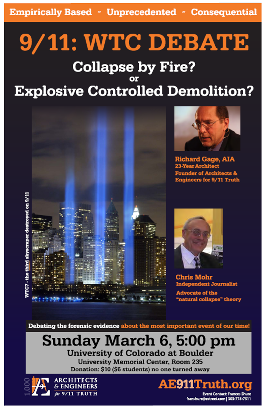 "On Sunday afternoon, March 6th, [2011] at the Boulder campus of the University of Colorado, Colorado 9/11 Visibility hosted a debate between Richard Gage, AIA (American Institute of Architects), and Chris Mohr, Denver investigative journalist and nondenominational minister. This is the audo of that historic debate."http://visibility911.libsyn.com/9-11-wtc-debate-collapse-by-fire-or-explosive-controlled-demolition
All sorts of useful things may be written in perfectly adequate prose: editorials, history, philosophy, theology, even lasting novels. But there is no such thing as a perfectly adequate poem, because a poem into which some strange and surprising excellence has not entered, a poem that is not in some inexplicable way beyond the will of the poet, is not a poem.
(--PROSE FROM POETRY MAGAZINE, In Praise of Rareness, “The more respect you have for poetry, the less of it you will find adequate to your taste and needs.” -- Christian Wiman) http://www.poetryfoundation.org/poetrymagazine/article/178842
from One Time
The need for guns relies on the need to forget our true relationship to one another. It is easier to kill another out of hatred or fear than it is to say "I hate you!" and let it go at that. Or: "I am afraid of you." and let that sink in to everyone in hearing proximity. It would mean we are available to what we really feel.by Christian Wiman2. 2047 Grace Street
But the world is more often refuge
than evidence, comfort and covert
for the flinching will, rather than the sharp
particulate instants through which God's being burns
into ours. I say God and mean more
than the bright abyss that opens in that word.
I say world and mean less
than the abstract oblivion of atoms
out of which every intact thing emerges,
into which every intact thing finally goes.
I do not know how to come closer to God
except by standing where a world is ending
for one man. It is still dark,
and for an hour I have listened
to the breathing of the woman I love beyond
my ability to love. Praise to the pain
scalding us toward each other, the grief
beyond which, please God, she will live
and thrive. And praise to the light that is not
yet, the dawn in which one bird believes,
crying not as if there had been no night
but as if there were no night in which it had not been. (http://www.poets.org/viewmedia.php/prmMID/21964#sthash.G4vjG75A.dpuf )
We come up against a notion here which seems to me of capital importance but for which it is difficult to find an idiomatic English equivalent—at least neither I, nor the English translator of my previous work, Being and Having, managed to do so. The French terms I use are disponibilité and indisponibilité. Literally, in English, one would render these as availability and unavailability, but it might sound more natural if one spoke of handiness and unhandiness, the basic idea being that of having or not having, in a given contingency, one’s resources to hand or at hand. The self-centred person, in this sense, is unhandy; I mean that he remains incapable of responding to calls made upon him by life, and I am not thinking merely of the appeals for help that may be made to him by the unfortunate. I mean rather that, over a much wider field, he will be incapable of sympathizing with other people, or even of imagining their situation. He remains shut up in himself, in the petty circle of his private experience, which forms a kind of hard shell round him that he is incapable of breaking through. He is unhandy from his own point of view and unavailable from the point of view of others.(--in Quantum Est In Rebus Inane, Philosophy, Literature, Logic, Language, and Orthodoxyhttp://kellydeanjolley.com/2011/07/18/212/)I eat segments from grapefruit given Saskia by folks she liked so much staying at Mary House in Spencer near Trappist Monastery.
If you do wrong and get beaten for it, what credit can you claim? But if you put up with suffering for doing what is right, this is acceptable in God’s eyes.It was for this you were called, since Christ suffered for you in just this way and left you an example, to have you follow in his footsteps. He did no wrong; no deceit was found in his mouth. When he was insulted, he returned no insult. When he was made to suffer, he did not counter with threats. Instead, he delivered himself up to the One who judges justly. In his own body he brought your sins to the cross, so that all of us, dead to sin, could live in accord with God’s will. By his wounds you were healed. At one time you were straying like sheep, but now you have returned to the shepherd, the guardian of your souls.
(--From the first letter of the apostle Peter 2:11-25, Christians are strangers in this world; ttp://divineoffice.org)It is often mysterious what to think Peter or anyone else means by their words about "Christ" or "God." Time over Holy Week in stronghold of theological and liturgical catholic atmosphere deepens this mysterious metaphoric milieu of thought.
These Poems, She Said
These poems, these poems,
these poems, she said, are poems
with no love in them. These are the poems of a man
who would leave his wife and child because
they made noise in his study. These are the poems
of a man who would murder his mother to claim
the inheritance. These are the poems of a man
like Plato, she said, meaning something I did not
comprehend but which nevertheless
offended me. These are the poems of a man
who would rather sleep with himself than with women,
she said. These are the poems of a man
with eyes like a drawknife, with hands like a pickpocket’s
hands, woven of water and logic
and hunger, with no strand of love in them. These
poems are as heartless as birdsong, as unmeant
as elm leaves, which if they love love only
the wide blue sky and the air and the idea
of elm leaves. Self-love is an ending, she said,
and not a beginning. Love means love
of the thing sung, not of the song or the singing.
These poems, she said….
You are, he said,
beautiful.
That is not love, she said rightly.
(--Poem by Robert Bringhurst, “These Poems, She Said”)
In the eyes of many, hope may of course boil down to wishful thinking. [Gabriel] Marcel readily concedes that this happens many times, perhaps most of the time. Can hope escape this criticism? The answer is provided by the distinction between “hoping” and “hoping that. . . .” Genuine hope is unconditional hope. Genuine hope belongs to the field of “being” rather than “having” (another of Marcel’s favorite distinctions): the person who, “without any condition, without limitation, lives in absolute trust, shall experience the safety of ‘being’ or safety in ‘being,’ rather than the radical insecurity of ‘having.’” Absolute hope, beyond any condition and any image or representation, is interpreted by Marcel as the creature’s response to the infinite Being or even the absolute Thou—and here, of course, most if not all Buddhists will beg to differ.But we may be prepared to hear him when he observes: “Nobody can experience the lightness of living in hope unless he/she be fully liberated from the bonds of possession(s).” He adds, “We remain open to hope, even in a small way, provided there still are some cracks or chinks in the armor of possession, the armor of ‘having,’ built around us.” There is thus a fundamental distinction between hope and expectation, between hope and desire, between hope and self-centeredness. Hope—this is Marcel’s conclusion and last word—hope essentially is disponibilité (being or keeping oneself available, open, receptive).
(--from, "In Hope against Hope" A Christian Meditation in the Light of Buddhism, by Jacques Scheuer, In Monastic Interreligious Dialogue) http://www.dimmid.org/index.asp?Type=B_BASIC&SEC=%7B5A5193BF-26B2-4FC1-A743-BC9574428D76%7DRegarding the hopeless with fond emptiness is odd comfort. Sitting in Merton Retreat this Easter Tuesday after walking vacated Snow Bowl where remnant melting mountainside holds sliding dusk silence in its fading tracks.
Prayer is misunderstood. It's not meant to get you anything or get you anywhere.Expectations involve calculation, management, and—most of the time without our being aware of it (avidyâ)—the double-bind of desire: a relation of both controlling power and passive dependence between subject and object. Desire also includes a “spatialization” of time. All this is rather obvious in the question of the disciples after the resurrection of Jesus: “Lord, is this the time when you will restore the kingdom to Israel?” He replied, “It is not for you to know the times or periods that the Father has set by his own authority” (Acts 1,6-7). No answer thus, except perhaps the following: “You will receive power when the Holy Spirit has come upon you” (1,8). In order to realize that their question is meaningless, that it has no genuine object, the disciples will need a good forty or fifty days—or is it forty years, or forty kalpas?Hope seems quite close to the attitude of mu-shotoku: without expectation, without aim or intended object. Is it then a shift from object to subject? Or is it rather the attitude or quality of being unconcerned about subject or object? One should perhaps say: there is hope but no hoping individual—in the same way one says: there is suffering, but no suffering subject. To hope is to remain in this pure openness. Such an understanding and practice of hope would, in a paradoxical way, come quite close to the Chan and Zen tradition of “great doubt” (dai-gi). From a Christian perspective, one would dare say that the true subject of hope is “He who comes,” He who, through his coming, makes hope possible, is the source of hope, opens a space for hope. This coming One is the “Deus semper maior” (E. Przywara), the ever greater Godhead. (Ibid)
"My God my bright abyss / into which all my longing will not go / I come to the edge of all I know / and believing nothing believe in this:"This.
(--final stanza of unfinished poem by Christian Wiman, recent editor of Poetry magazine)


