Saturday, October 05, 2019

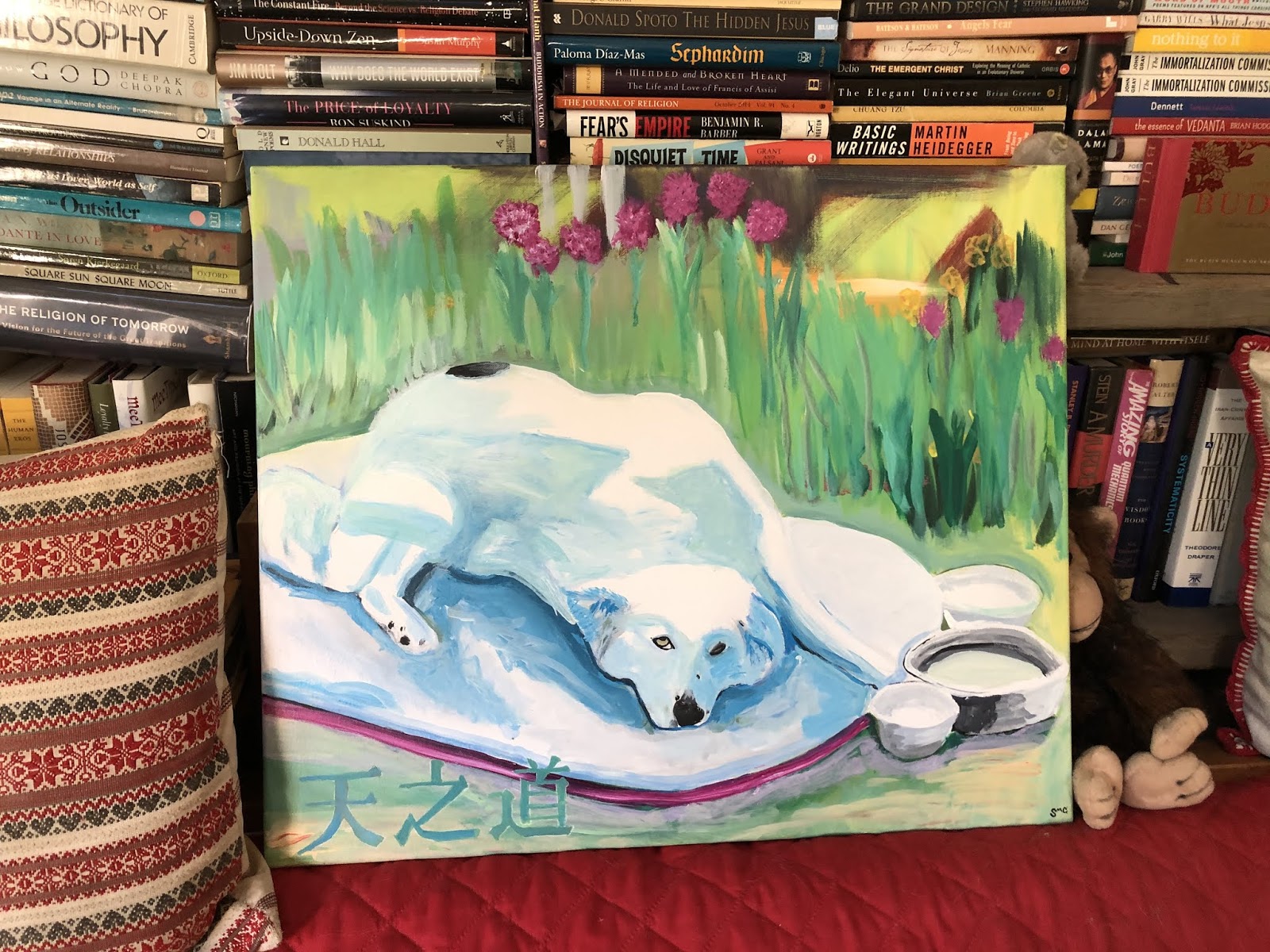
painting received on Rokie’s birthday yesterday


From one of the men in our Friday morning conversation gathering.

What a beautiful gift!

He titled it, “ the way to heaven.”

A Japanese garden language expert writes and translates, “So beautiful!!  It says (literally) 
’the road/path of heaven’.”

Friday, October 04, 2019

pax et bonum

St. Francis day.

We celebrate his gift to this earth.

Thursday, October 03, 2019

what you can’t find, create

Call it creation.
Say, for instance, there’s no god but god,

and what we call god is
the sound of creation revealing Itself.

Francis along the mountain
Across brook, up trail

Looking at creation looking as god is
Looking at the mendicant

No owning, only use, no other
It is Transitus

Creation is passing
Mountain sleeps


Wednesday, October 02, 2019

here

We’ve never really understood what “here” means. 

Let’s try.

“Angel of God, my guardian dear,
to whom God's love commits me here,
ever this day be at my side,
to light and guard, to rule and guide.

Amen.”

to light and guide

Phrases of intelligent encouragement.

Pauses of reflective gaze.

Practices of light and inclusion.

It is the feast of Guardian Angels.

Those whom we see not but wander near even when we don’t comprehend at all.

Tuesday, October 01, 2019

this poem

Aleph Pattern
In Hebrew, the word women is the word men
with the first letter dropped. Not just any letter
but the first first letter, the aleph of the aleph-bet:

אנשים       anashim—men
נשים           nashim—women

The steel band securing the forehead
to the bed is preheated, but cools quickly.
Inside every men is a women
you’ll need to amputate to find.

אלוהים     Elohim—god
לוהים          lohim—to tire

Even the god gets tired in our first story.
Adonai has many lids over each eye
and so she pretends to rest
closing one set of eyelids at a time.
Never a Sabbath of visionless sleep.

אבא           aba—father
בא                 ba—come

Do away with the role charged to the first father
and we will all orgasm more freely.
We will bleat like beasts while we come,
our wooly curls matted and frizzy without a single embarrassed shiver.

אני             ani—I/me
ני                 ni—lamentation

Too many of the dead
cry silently in their coffins
grateful for a place they can finally weep alone
but fearful even now to be overheard.
The dirt we are formed from can seem so thin.

אים            iyom—threatening
ימ                  yam—sea

If the ocean is the first mother
then the lakes are those moments we hear ourselves
threaten our children in our mother’s voice.
Afterward, we absorb the tears into our own waters.

אסור          asoor—forbidden
סור                soor—withdraw

What’s forbidden is often drawn as a circle.
But every circle, no matter how small
contains another circle within.
The way to escape circumscription is inward.

אפשר         efshar—possible
פשר            pishair—compromise

To say possible is to leave someone out.
No one is possible until everyone is.
On this one truth, never compromise.

Monday, September 30, 2019

שנה טובה ומתוקה

Shanah Tovah, u’metuka —

A good and sweet year!

Rosh Hashanah

Sunday, September 29, 2019

helping across, this also can be, love

This looks interesting. 

Yes, ‘this looks’ — and is interesting.
Well, you know that I love to live with you 
But you make me forget so very much 
I forget to pray for the angels 
And then the angels forget to pray for us
(—from, So Long, Marianne, song by Leonard Cohan) 
We are moving from perspectival viewing to aperspectival seeing. Where everything is looking from everywhere and everywhere is being seen.

for here there is no place that does not see you.  
You must change your life.
(—from,  Archaic Torso of Apollo, poem by  )
We don’t see angels because there is nothing to see. Angels are the intelligence behind everything that is. Mostly, we cannot see behind us. Mostly, we cannot read situations. And if angels are the intelligence behind situations, and we are ignorant of the readout of situations, then we need help with literacy.
There is no intelligence the equal of the situation.
(—from, Love, poem by Charles Olson)
Arrive anywhere, intelligence is there. Leave anywhere, intelligence remains there and is waiting for your next step, next arrival.
Many arrivals make us live 
(—from, Manifestation, poem by Theodore Roethke)
Angels are arrivals at situations longing to be seen.

We come to ‘see’ by feeling what is revealing itself to us in this and this and this.

It is the feast of Michaelmas and all angels.

Michael, Raphael, Gabriel, Jophiel, Ariel, Azrael, Chamuel. (Chiefs, all)

Who is like God

Heals

Strength

Beauty

A powerful life-force

Helping across

Seeing God

This is what we have.

Moving beyond names.


There are only two ways: 
Create the situation (and this is love) 
Or avoid it. This also can be Love.
(Charles Olson, Love

This is interesting! 

Saturday, September 28, 2019

circumstance graced

Comes Michaelmas.
Now, to get something absolutely clear, you must understand that angels are not humans who have died and gone to heaven. Angels are a different kind of being altogether. For most of the Church, angels are pure intelligences (that is they have no physical bodies) and are among God’s first created beings (insofar as we can talk about creation being ordered or taking place in time). Angels are guiding principles of creation. Stratford Caldecott goes so far as to identify the kinds of animals mentioned in Genesis 1.24 (not each specific animal but the fact that God created them of, or according to, every kind) as angels. He writes:
“I am sure the Book of Genesis still contains many mysteries. We read the story of Adam naming the animals, and then we discover that at least one of the animals in the Garden is an angel. The serpent is that creature of God sometimes called the Archangel Lucifer. What if all the animals in the story were angels? In fact, what if the story is about the relationship of the archetypal Man with archetypal Angels: and the archetypal Animals are none other than the angels of tradition” (The Radiance of Being, 54).
(Angels in Creation: Reflections on Our “Older” Siblings for Michaelmas, 9?29/16, by David Russell Mosley)
Intelligence behind the manifestation of each thing.  A resignation of presence.

Circumstance graced.

Friday, September 27, 2019

words

In prison today many men share their thoughts with us about death of Rokie.

It doesn’t surprise.

It is our community.

Saskia’s first visit without the pup in over eight years.

The men were kind and empathetic.

That’s what happened.

Staff too, guards too.

Entering without him, leaving without him.

He is in the center doing his work.

Wednesday, September 25, 2019

hic, haec, hoc

If God is
What is
Coming to be —

Let’s make
What is
Here 

Ready 
To be
What is coming

throughout

Silence

Monday, September 23, 2019

monday, monday

Gift of those who opened the mountain

Gift of Japanese lantern


Gift of sweet Border Collie, Rokpa

Become mountain

Become light

Sunday, September 22, 2019

as evening nears

Where
           once
                   was (...)


Is
    now (?)


Or
      ever
              (to continue)


sunday afternoon


From Lila, by Roberg Pirsig:

…They were all walking down the road … when one of those raggedy nondescript dogs that call Indian reservations home came onto the road and walked pleasantly in front of them … [the woman] asked John ‘What kind of dog is that?’. John thought about it and said, ‘That’s a good dog.’… The woman …wanted to know what genetic, substantive pigeonhole of canine classification this object walking before them could be placed in. But John Wooden Leg never understood the question. He wasn’t joking when he said ‘That’s a good dog’. He probably thought she was worried the dog might bite her … John had distinguished the dog according to it’s Quality, rather than according to its substance. That indicated he considered Quality more important...

https://medium.com/perspectiva-institute/thank-you-robert-pirsig-ad8605dc1607

sunday morning


Saturday, September 21, 2019

three words

Listening to psalms, the prayer at end: Glory be to the Father and the Son and the Holy Spirit.

The thought occurs — of another wording.

A wording of the trinity that signifies originating, creating, and including.

Origination. (Father)

Creation.  (Son)

Inclusion.  (Holy Spirit)

Glory be to Origination, and to Creation, and to Inclusion — for all and in all time until eternal now becomes the wholeness of what is seen!

ready to walk mountain

A beautiful Saturday morning!

At practice, Richard Rohr and Sadhguru.

With Rokie on porch.

Resurrection, Not a One-Time Miracle
And


Where will Rokie go when he goes beyond?

Rohr says there is only transformation.

He’ll most likely go from here to here.

Where he will find us, ready to walk mountain, step by step.

Friday, September 20, 2019

photo taken several days ago

And, as it is, tonight is Rokie’s last night with us.

His kidney failure, anemia, giving up eating, and inability to get up, collapsing when he does, subcutaneous infusion of fluids, have brought us to this final night.


Tomorrow noon a vet will be coming here.

What a sweet pup!

darkness into light

At prison:
God is 
what is 
coming 
to be
There is no future and no past.

There is only the immense present which is presence right here right now.

God's name is "I don't know "--and-- "I am here as what is here revealing itself."

This after reading the discourse of the Buddha on the four types of individuals, four types of life brought by one of the men.

The four of us.

Listening.

Learning about one

another.

Thursday, September 19, 2019

9 1 9 1 9

So often what we see is an answer or response to a question we're unaware is being asked.

Some examples:
  • Q: On a scale from 1 two 10, where are we with regard to the end of existence as we know it?   
A:  (9.  1.  9.  1.  9)  (The answer fluctuates according to the ability of the human being to understand the question.)
  • Q: Are we as humans separate, alienated beings, so divided that there is no hope for unity?         
A: Nein, one; nein, one; nein! (The answer indicates both a definite response as well as a dyslexic misspelling.)
  • Q: Is there any numerological significance to this/these numbers?    
          A: Well, there's always this -- Angel Numbers.
Washing machine is about to end its spin cycle. English muffin is ready to toast. Breakfast sausages nap in black skillet. Chai tea with chocolate milk in blue Maine cup sits on arm of futon bench.

Rokie is on sunporch consulted over by trusted women, one from flower nursery physically sitting near him, then later one by phone from rescue farm from whence he came 12 years ago. He's not getting up any more. He's very tired.

And loved.

Wednesday, September 18, 2019

there you are

In the film the doctor, say reviewers, was being asked to play god.

What does that mean?

I know.

God doesn’t know.

To play god is to remain unknowing before what shows itself rising up.

Ah, there you are

And here it arrives

So, what shall we think of this?

Be like god

Love to be unknown 

we have no time

Here:
The Present 
For the present there is just one moon,
though every level pond gives back another. 
But the bright disc shining in the black lagoon,
perceived by astrophysicist and lover, 
is milliseconds old. And even that light's
seven minutes older than its source. 
And the stars we think we see on moonless nights
are long extinguished. And, of course, 
this very moment, as you read this line,
is literally gone before you know it. 
Forget the here-and-now. We have no time
but this device of wantonness and wit. 
Make me this present then: your hand in mine,
and we'll live out our lives in it. 
(—Poem by Michael Donaghy,1954-2004)
There! 

Tuesday, September 17, 2019

ama nesciri

The question seems simple: What is good for us?

Is  what-is good for us?

The question is interminable: Is that which is for-us?

Are we in a hospitable reality? Is it good for us?

Or are we supposed to be battling reality so as to have emerge what is actually good?

If I eat a chicken sandwich am I incorporating that chicken into my humanity?

If I murder someone, is that person taken into me?

If life is a dream, is that so bad? Are thoughts dreams? Are ideas dreams?

Memories — are they dreams?

Are we meant to take our grandmother’s song to heart and simply row row row our boats gently down the stream?

And if life is a dream, is waking up a transcending of life?

Is death a refusal to wake up?

Is hell really other people?

Is God reality?

Is reality good?

Monday, September 16, 2019

after flu shot in conference room A

reading student papers,

harbor

boats, all sizes

demasting, trailering

slip

this ending season

Sunday, September 15, 2019

ça va

You are not alone.
“Nobody can discover the world for anybody else. It is only after we have discovered it for ourselves that it becomes a common ground and a common bond, and we cease to be alone ...      (--Wendell Berry, A Place on Earth )  
And the world cannot be discovered by a journey of miles, no matter how long, but only by a spiritual journey, a journey of one inch, very arduous and humbling and joyful, by which we arrive at the ground at our feet, and learn to be at home.” (-- Wendell Berry, The Unforeseen Wilderness: Kentucky's Red River Gorge)
You are alone with the Alone. 

Saturday, September 14, 2019

quia per sanctam crucem tuam

The cross is where ego dies.

Christ on cross says not here not now not me.

Dies

Everything not itself not god-reality

Giving over

What is not it’s own

Life

sculling

      (a haiku for Sam)

abaft in dory,

Sam stands with light touch, sculling

untied, drifts from dock...

Friday, September 13, 2019

appetite for nothing

Theres not much to say after you say there’s not much to say.

God is silence surrounded by vast emptiness.

Most don’t want God. Rather noise and distraction.

Truth be told, there’s not much appetite for truth.

Rather distraction and noise.

The full harvest moon lifts itself over trees to a sky chilled with September.

Thursday, September 12, 2019

seen where we stand

No one goes very far from where one is.

It's hard to measure no-space, equally hard to tell no-time.
Little Elegy
Oh how he loved his cup 
and now he’s dirt 
under the pine trees 
 –Li Po
A moment of silence at Soup Kitchen
for our saint of the quick grip, faking
a side stitch to hide the bottle under his coat,
for his taped shoes and worm-eaten watch cap,
that clarifying fish pier scent, raw-grained
and terrifying smell of the skids,
how little it takes to wake up over a grate,
half-dissolved in shadow and mist–
half-dissolved, but still blissed out, bantering
with buddies, flailing on icy streets,
then catching hold of a lamppost and nodding
to it, to the sky, the glittery walk,
to a passing taillight, an old belief,
foolish or fearless, that everything’s sacred,
and now he’s gone. 
(--poem by Betsy Sholl “Little Elegy” is from Late Psalm (University of Wisconsin Press, 2004).
That grate is not far in the dream from which I wake shivering.

This old belief we live as though we were here and could be seen where we stand.

surrounded by green in september

delicate weeds grow up over wheels brakes seat fuel tank rear view mirror riderless

for two years the machine leans into huge cedar tree under wide branches hovering

dog goes around it does his business mower throws cut grass against disc brakes


she left it here when she left yurt to move into second floor room with winter

view to ski runways cut into northeast side of ragged mountain lighted trails

the motorcycle uncovered after first year weathers all seasons rain or sun, snow


waiting as each

one of us

is doing

Wednesday, September 11, 2019

las mirada

Remember

We are here

Then gone —

My heart

Still sorrows

That awful day

18 years ago

Tuesday, September 10, 2019

eternal, a haiku

Tomorrow morning,

Wednesday, the world again shakes —

Can you feel it...now

Monday, September 09, 2019

and we recognize -- words after 9/11

 As September 11 approaches, this:
For me, that there's something "out there" and that I'm here no longer meant anything, because every time I thought there was something out there, it turns into inevitably something opposed to me. Something I have to define myself against, whether that's God, or whether that's a Christian, or whether that's a Muslim, or whether that's a Buddhist. And that's not my experience.  
My genuine experience of life is that there is nothing "out there." This is all there is. And when you see the seamlessness of it all, that's what I mean by "God." Every tradition has that. Every morning, three times a day since I'm five or six years old, I've been saying, "Hear O Israel, the Lord is our God, the Lord is One." Right? It's one of our few creedal statements, the Shema. Three times a day, since I'm six years old.  
If you ask what 9/11 really did, it made me understand the truth of that. The truth of that, "Everything is one." Not that there's some guy hanging out there who has it all together, who we call "One," but that it is all one. We all know it deep down. We've all had those experiences. whether it's looking at our child in a crib or whether it's looking at our lover or looking at a mountaintop, or looking at a sunset. Right? We've all had those experiences. And we recognize, "Whoa. I'm much more connected here."  
That's what those firemen had. They recognized; they didn't have time to think about it, right? Because actually, if you think about it, you begin to create separations. They didn't think about it. All they knew is we're absolutely connected. We're absolutely connected to the 86th floor. Well, that's where God is. That's not where God is. God isn't anywhere. That's what we mean when we say God. ...
(--from, Faith and Doubt at Ground Zero, PBS interview, Rabbi Irwin Kula, winter 2002) 
Words take on so much more when they are deeply felt. 

no t here

Voice: remember,

Listener: remember what?

Voice: remember you know nothing and have nothing to teach.

[silence]

Voice: are you still there?

Listener: yes.

Voice: there’s the problem!

Listener: yes, of course.

Sunday, September 08, 2019

by any other name

 We are one phrase in the universe’s telling of itself.
Stones: Stones are very slow stories with secret memories of fire inside. If you just put a stone on a table it becomes an altar, and a temple appears around it. 
(—John Tarrant, in Meet the Blue Dragon, Lion’s Roar, 31july19)
Dont make anything out of it.

It will go away. 

Saturday, September 07, 2019

turning away

when the burley man

stood in doorway of his agenda

nothing else entered room

Friday, September 06, 2019

from the creative void

We begin eleventh year of poetry group at nursing facility. Twice a month for an hour.

At conversation on porch at hermitage solitaries claim their idiosyncratic preferences.

We are only what is taking place.

lived through

Reading about Robert Lowell, his poetry, manic-depression, and family history of mental illness.
Robert Lowell, Setting the River on Fire: A Study of Genius, Mania, and Characterby Kay Redfield Jamison, 2017
It’s a hard and distressing disease.

Still, one does what one can with what one has.

“Darkness honestly lived through is a place of wonder and life.” (Robert Lowell)

He also wrote,
All’s misalliance. 
Yet why not say what happened?
(—from his poem Epilogue, 1977) 

Thursday, September 05, 2019

prête à partir

As nears what nears

Good dog weakens

His caretaker has gone to the mats

Keeping close

As what seems to be closing

Comes closer

Wednesday, September 04, 2019

In the earth

What is Christ? Whatever Christ is, Christ is in the earth.

Where is Christ? Wherever Christ is, Christ is in the universe.

Teilhard de Chardin looked in.

In is where what is resides and reverberates.

And generates energy to actualize expansion to everything we consider to be the outer or exterior presentation to everything else in the realm of encounter.

The within of existence — that which stands in, before and beyond,
 [Christ] is the image of the invisible God, the first-born of all creation; for in  him all things were created, in heaven and on earth, visible and invisible . . . . all things were created through him and for him [Colossians 1:15]. . . . 
But Teilhard felt that the full cosmic significance of this vision and its physical reality had been overlooked among his coreligionists. . . . 
When Teilhard tried to stress the cosmic aspect and bring it forward as a central motif in the Christian view of reality, his friends were embarrassed. . . . Teilhard apparently had an instinctive grasp of something which he was not free to express under the terms of his tradition. Yet it was a vital feature of his own system, in fact, it was the bond which he so desperately sought between his God in heaven, taught by his religion, and his God in the earth, taught by science and experience in life. The story of his life is the story of his struggle to bring this darkly sensed Mediator into such a form that both sides of him could live with it. It was a terrible conflict, but it produced a great many beautiful fruits both in his writings and in his own character. . . . 
The central conception in Teilhard’s notion of the cosmic Christ is that “the universe forms one natural whole, which finally can subsist only by dependence from [Christ]. That’s the main thing.” [1] Teilhard sees himself as “the evangelist” of “Christ in the universe,” one who preaches Christ as containing “all the unyielding immensity and grandeur of the world.” [2] His “fundamental vision” [3] as expressed in The Divine Milieu is of Christ as All-in-everything, in its reality and in its future. 
(— in, Cosmology: Part Two, All-in-Everything, Beatrice Butreau, in Richard Rohr’s Daily Meditation, Wednesday, September 4, 2019)
When some say we are meant to dwell in God, they are suggesting something much deeper that one might suspect. 

beable, this spiritual reality

Just what it looks like.
I. ‘BEABLES’ AND INDUCTION 
When I was in graduate school in Scotland, I was told the following parable by my advisors. An economist, a mathematician, and a logician were on a train traveling north. Just after they passed the Scottish border they noticed a single cow standing in a field. The economist remarked, “That cow is brown. All cows in Scotland must be brown.” The mathematician replied, “No, one cow in Scotland is brown.” The logician quietly but firmly muttered “No, one side of one cow in Scotland is brown.” There are many versions of this parable involving a variety of professions and there are any number of lessons to be taken from it. It is usually meant as a dig at one of the particular professions that is included, especially when told by a member of one of the other professions. At the heart of the parable, though, is an open question: how much can we reasonably infer from a given observation? 
It is worth noting here that my advisors were both mathematicians. As such, I always had the impression that the parable, as they told it, was meant as a dig at both economistsand logicians. Clearly the economist has over-extrapolated from the given data. That point is hardly up for debate. But has the logician under-extrapolated? The fact is that our intrepid travelers do not know if the cow is the same color on both sides absent additional information. It is entirely possible that the mathematician, in casually suggesting that the cow was entirely brown, was wrong. Yet, in our own experience with cows, most of us would probably think it highly unlikely that a cow had such asymmetrical coloring as to be entirely different on either side. 
... 
For the purposes of science, the existence of certain things is taken as self-evident. I may awake tomorrow to find that I am actually a Buddhist monk living in a monastery in the Himalaya and that my life as a physicist was nothing but a dream. The logician mightrightly point out that I can’t disprove that. But it doesn’t help me in the here and now where, dream or not, I am a physicist. As one unnamed reviewer in Philosophical Magazineonce put it, science is the “rational correlation of experience” (as quoted in [13]). In order to ‘do’ science we must have some common base from which we can build our theories. So we assume that certain elements of our collective experience simply must exist. In fact the logician in the parable does not deny the existence of the cow nor even that one side of the cow is brown. The denial is only of an inferred experience. The logician takes the phrase “rational correlation of experience” literally in that none of the travelers ‘experience’ (observe) the other side of the cow. They can only rationally correlate what they directly experience. Of course that’s a problem for quite a few theories. Here is where Bohr and Bell are right; the world of our direct experience is classical[*].
(from, Bell’s Theory of Beables and the Concept of ‘UniverseIan T. Durham Department of Physics, Saint Anselm College, Manchester, NH 03102(Dated: May 8, 2018)
[* What is the definition of classical physics?clas·si·cal physics (klăs′ĭ-kəl)Physics that is based on Newton's laws of motion and does not make use of quantum mechanics and the theory ofrelativity. ♦ Classical mechanics refers to Newton's laws of motion and other principles of mechanics based on them.Classical mechanics does not work when dealing with bodies (such as electrons) moving at speeds close to that oflight, or when making measurements of atoms and subatomic particles. These phenomena can only be described byquantum mechanics and the theory of relativity. ](--The American Heritage® Student Science Dictionary, Second Edition. Copyright © 2014 by Houghton Mifflin Harcourt Publishing Company. )
From one's perspective.

What, then, is the aperspectival view?
It is the self consciousness of the collapse and meaninglessness of our spiritual reality which has lost the efficacy to provide us with the live meaning of our being. Gebser's uniqueness consists however in his profound insight into the today's situation of our spiritual reality. Namely, as mentioned above (at the beginning), he saw a transition of the structure of consciousness and its confusion resulted from the struggle between the power of conservatism and the surge of the new consciousness and its phenomena ready to make a leap. 
This Gebser calls the integral structure of consciousness which is revealed in the aperspective world whose characteristics are becoming evident in visual arts, music and sciences and philosophies. 
One of the characteristics is disclosed in the concretion of time, whose early emergence may be evidenced in projective geometry with its symbolic form of sphere, Mozart's music (don Giovanni et al), further cubism, surrealism and tachism in painting, the emergence of the modern physics, several philosophical attempts of concretizing time from its abstraction as a whole (Bergson, Nietzsche, Jaspers and Heidegger). Another feature is the overcoming of Reason and rationality by transcending duality, rejection of reductionism, liberation from atomization (including egoistic individualism),
being free from space and scientific objectivism. 
More positively said it is the pursuit of integration of all separation, isolation, fragmentation and opposition by concretization of time as a whole. By so doing, reality becomes transparent. This Gibser calls diaphaneity. 
In the face of the desperate threat to our humanity from the above mentioned deficient forms of the mental, perspectival structure of consciousness, Gebser's ultimate goal is to properly understand this new emergent reality consciousness by exploring concrete phenomena of the structures of consciousness as its principles. Thus in order to actualize that this new spiritual reality, when more intensified, becomes more real and effective, we must have an explicit awareness of this spiritual reality. 
In his approach Gebser is rigorously phenomenological in the widest sense (although he does not officially admit it). Gebser attempts to explore and reveal the intentional correlation between the various structures of consciousness and the cultures as the correlates of these projections of consciousness. His concept of doiphany is precisely the procedure and attitude in which what is concealed is to reveal itself. The self-evidentness of our mundaneity has to be put to the "epoche", and the concealment of our everyday doxa must be demolished, thus we are drawn out of our mundane attitude and shifted to the attitude of diaphany or transparency such that the genuine reality is to disclose itself to us as it actually is.
(from, TAO AND THE APERSPECTIVAL WORLD, For Cultural Studies Conference1990, At University of Oklahoma, by Eiichi Shimomisse, California State University) 
The students I'm studying with this semester will have to forgive me my going-over-the-time.

A faculty member yesterday said I've a reputation for doing so.

I didn't know it was noticed. 

from ramon panikkar's website


Cosmotheandric or theo-anthropo-cosmic (dimension) 

“The cosmotheandric intuition is the totally integrated vision of the seamless fabric of the entire reality… the undivided consciousness of the totality” (The Cosmotheandric Experoence). 
“There are not three realities: God, Man, and the World; but neither is there one, whether God, Man or World. Reality is cosmotheandric. It is our way of looking that makes reality appear to us at times under one aspect, at times under another. God, Man, and World are, so to speak, in an intimate and constitutive collaboration to construct Reality, to make history advance, to continue creation: (The Triniity and the Religious Experience of man, London and New York 1975). 
The cosmotheandric intuition expresses the all embracing indissoluble union, that constitutes all of Reality: the triple dimension of reality as a whole: cosmic-divine-human. The cosmotheandric intuition is the undivided awareness of the totality." What Panikkar proposes is to live so open to this triple dimension of reality, open to others, to the world, and to God that we might achieve harmonious communion with the all: the cosmotheandric reconciliation. It is a matter of an experience more mystical and ineffable than philosophic in the traditional sense, but it breaks the customary philosophico-theological molds.

The cosmotheandric dimension is another way of expressing the radical Trinitarian conception of reality (cf. later discussion). The triadic structure and the trinitarian conception in RP are not merely in his thinking but also in his methodology, and he even organizes his writings in triadic structures as in the case of his “novenas” (three times three).

Cosmotheandrism, "the goal and fullness of all religion" (The Trinity), is an indispensable concept for understanding panikkarian thinking. The cosmotheandric intuition, the cosmotheandric mystery, or more precisely although less euphonically, the theoanthropocosmic reality, reveals that it is relationship that unites the divine, human and cosmic reality.

Understanding this vision requires the perspective of advaitic non-dualism and of radical relativity (cf. later discussion), and a new innocence that overcomes the fragmented vision of reality that we humans have in order to achieve that understanding and unitary experience of the reality in which we are immersed.

This new innocence “has been freed from the longing for perfection, which necessarily implies being better than the rest… It is pure aspiration… [It is situated in] the realm of pure grace” (La nueva inocencia, Estella 1993). The aspiration to harmony “is established in reality when we are in accord” and presupposes good humor, sweetness, serenity and peace, which are “manifestations of the structure of reality”. It is not the ingenuous dream of wanting to recover paradise, but rather “the healing, in modern Western culture, of the wound the Enlightenment inflicted by separating epistemology from ontology, by making knowledge the hunt for the object by the subject”. Thus, “no part of the dichotomy between the object, the objective thing disconnected from man and the subject, subjective mind”, falls outside the “concupiscence of objective knowledge”; rather the new innocence envelopes knowledge and the knower in the same act because it knows that the one is not given without the other”, without the relationship (Ibid.).
If the Christian message means something, it is this experience of the cosmotheandric reality of all being, of which Jesus Christ, true God and true Man, is the paradigm. In Christ Matter is not on its own, nor is Man on one side and God on the other; none of these intrinsically united dimensions surpass the others, so that it does not make sense to affirm that Christ is more divine than human, more worldly than heavenly, or vice versa. The veil of separation has been torn, and the integration of reality begins with the redemption of man” (Culto y secularización. Apuntes para una antropología litúrgica, Madrid 1979).

Tuesday, September 03, 2019

nothing here

Mind. Itself.

No me. No you.

See this

See everything

Monday, September 02, 2019

to sit still

Labor Day.
Vocation to Solitude — To deliver oneself up, to hand oneself over, entrust oneself completely to the silence of a wide landscape of woods and hills, or sea, or desert; to sit still while the sun comes up over that land and fills its silences with light. To pray and work in the morning and to labor and rest in the afternoon, and to sit still again in meditation in the evening when night falls up on that land and when the silence fills itself with darkness and with stars… to belong completely to such silence, to let it soak into the bones, to breathe nothing but silence, to feed on silence, and to turn the very substance of life into a living and vigilant silence. 
—Thomas Merton from "Thoughts In Solitude" (Farrar, Straus and Giroux, 1956). (louie, louie)
Silence of morning. 

Sunday, September 01, 2019

science and non-duality

I finally heard the cliché.

Listen to the cliché, David Foster Wallace said.

The cashier said, "Have a good one."

And I heard it -- the koan invitation.

To have

a

Good

One.

look back; looking’s here

Perhaps we’ve never been safe.

The emerging narrative is that if you feel wronged it is your prerogative to shoot and kill anyone in your path.

If you are someone with power, you mock and insult anyone you wish.

I do not like shooters or arrogance without decency.

My dislike is useless.

I choose, instead, to become what I am not.

I talk to a man in a hospice room about Robert Lowell, about manic depression, about the ways we disappear inside a chaos of disarray, a mind gone away from itself.

Psychiatry sits without remedy.

Poetry walks without destination.

Philosophy thinks about peach cobbler.

Two dogs down the hall, one on bed, one on floor, wonder when their human will wake up.

August ends and September dawns.

Mind is what is, appearing before us.

If we lose our mind it is because we lose the ability to face, with grace, that which appears.

In a chaotic world — in a chaos of social, economic, unseeing foundation, and unloving distraction — we have no need of one another.

So we destroy one another. Just as mind tries to destroy matter, just as we become addicted to resentment and revenge, just as desolate disconnection reasons that all’s misalliance. Why bother saying what’s happening.

The peach cobbler tastes good. Like long desired equanimity.

Here.

Here’s looking at you!

Go on.

Look back.