Now that the millionaires have scolded the billionaire about his jealousy and racial comments, all the professional athletes will cease doing what they do that would get them censured and scorned by the rest of us milling around with stoneless hands.

Tuesday, April 29, 2014
Abnegatio
Now that the millionaires have scolded the billionaire about his jealousy and racial comments, all the professional athletes will cease doing what they do that would get them censured and scorned by the rest of us milling around with stoneless hands.

Monday, April 28, 2014
In memory of Giordano Bruno
The cosmos is our primary scripture.
Our hermeneutic is primitive.
Exegesis is our savior.
Sunday, April 27, 2014
Octave; to where we dwell
Father is karma. Son is rebirth. Spirit is emptiness.
The whole of it, transformed in our phenomenological existence, is resurrection.
The work presented his critique of the key Buddhist theories of karma, rebirth, and emptiness. Then, remarkably using Buddhist philosophical language and phraseology, [Ippolito Desideri] argued for the Christian doctrine of the Holy Trinity and dealt with possible objections against this doctrine that might be raised from the Buddhist philosophical standpoint.In Christian tradition Father has long been associated with judgment, anger, or compassion. Son has been associated with incarnating, suffering, dying, and rebirthing. And Spirit has been associated with inspiration, awakening, non-separation, and wise being-in-the-world.
(--p.11, in Toward a True Kinship of Faiths, How the World’s Religions Can Come Together, by HH The Dalai Lama, 2010)
Taken as a whole, this narrative is one of resurrection -- a coming back to life after death, or, a coming back to life within life-itself. It is this notion that death is not confined to the cessation of biological life, but involves a transformation of all forms of life -- physical, psychological, emotional, intellectual, and spiritual -- into a new form of life as a new being in a heretofore unrealized realm of existence.
This transformed realm is not someplace else. It is we who are, if you will, someone else. It is what has been called the realm of heaven, the sphere of engaged relationality wherein we see and connect with all things and every being in a happy, healthy, and holy manner.
This fits closely with Jesus’s words to the dying brigand in Luke: “Today you will be with me in Paradise.” 5 Despite a long tradition of misreading, paradise is here, as in some other Jewish writing, not a final destination but the blissful garden, the parkland of rest and tranquillity, where the dead are refreshed as they await the dawn of the new day. 6 The main point of the sentence lies in the apparent contrast between the brigand’s request and Jesus’s reply: “Remember me,” he says, “when you come in your kingdom,” implying (whether ironically or not does not concern us here) that this will be at some far distant future. Jesus’s answer brings this future hope into the present, implying of course that with his death the kingdom is indeed coming even though it doesn’t look like what anyone had imagined: “Today you will be with me in Paradise.” There will still, of course, be a future completion involving ultimate resurrection; Luke’s overall theological understanding leaves no doubt on that score. Jesus, after all, didn’t rise again “today,” that is, on Good Friday. Luke must have understood him to be referring to a state of being-in-paradise, which would be true, for him and for the man dying beside him, at once, that very day— in other words, prior to the resurrection. With Jesus, the future hope has come forward into the present. For those who die in faith, before that final reawakening, the central promise is of being “with Jesus” at once. “My desire is to depart,” wrote Paul, “and be with Christ, which is far better.” 7
Resurrection itself then appears as what the word always meant, whether (like the ancient pagans) people disbelieved it or whether (like many ancient Jews) they affirmed it. It wasn’t a way of talking about life after death. It was a way of talking about a new bodily life after whatever state of existence one might enter immediately upon death. It was, in other words, life after life after death.
(--Wright, N. T. (2009-04-24). Surprised by Hope (pp. 150-151). HarperCollins. Kindle Edition. )Some call the process a similar one to the death of the ego, or the stepping out of the small-self, or ceasing to cling to the particular perspectival preferences with which we are habituated.

Seven times down, eight times up.
Whether zen adept or just man/woman -- we fall to ground, long to arise, and struggle to see our way clear and through.
To where we dwell in peace.
Freedom.
Safety.
Happiness.
Our true home.
Saturday, April 26, 2014
come apart, and rest awhile
We might have to consider adding “monai” after “m.o.n.o.” --
Here we need to revisit a point we made earlier. What does Jesus mean when he declares that there are “many dwelling places” in his father’s house? 4 This has regularly been taken, not least when used in the context of bereavement, to mean that the dead (or at least dead Christians) will simply go to heaven permanently rather than being raised again subsequently to new bodily life. But the word for “dwelling places” here, monai, is regularly used in ancient Greek not for a final resting place but for a temporary halt on a journey that will take you somewhere else in the long run.Monastics of no other - dwelling places!
(--from, Wright, N. T. (2009-04-24). Surprised by Hope (p. 150). HarperCollins. Kindle Edition.)
Would that make us mono-monaical instead of monomaniacal?
I’d prefer to stay right in this ever-here this ever-changing unpredictable and chaotic ephemera we call our earthly dwelling places with no otherness but clear and interconnected new forms of relational self.
It is Easter Saturday.
Heaven is no longer separate from earth -- not has it ever been.
None of us are any longer separate from God -- nor have we ever been.
Resurrect awareness and attention. Embody this new form of life...
Christ has.
Friday, April 25, 2014

Thursday, April 24, 2014
Wind gusts

A morning meditation.
"When it’s time to suffer, you should suffer; when it’s time to cry, you should cry. Cry completely. Cry until there are no more tears and then recognize in your exhaustion that you’re alive. The sun still rises and sets. The seasons come and go. Absolutely nothing remains the same and that includes suffering. When the suffering ends wisdom begins to raise the right questions." (—Seido Ray Ronci, “The Examined Life” -- in Tricycle)

For a brief while we are here.

"You practice the piano not in order to perform but for the sake of practicing the piano. With music, you don’t practice and then one day become a concert pianist. You are that. Practice is as much an expression of that as of practice itself." (—Philip Glass, “First Lesson, Best Lesson” -- in Tricycle)
Wednesday, April 23, 2014
Tuesday, April 22, 2014
Say it again ... (haiku interrupted) ... but without words this time
1.
universe next door
is connected; no, more: it
Is inside (this) one

2.
resurrection is
not after this life; it is
Inside (as) this life
Monday, April 21, 2014


Sunday, April 20, 2014
bitte noch einmal
“We just die into silence. Die to the past. Die to the future. Die to the breath. Completely let go. The silence reveals itself as refuge, as awareness that can be trusted, tenderly loving and resounding with the majesty and the mystery of the sacred.”
(--Adapted from “Living in the Light of Death” by Kathleen Dowling Singh)

(--Adapted from “Living in the Light of Death” by Kathleen Dowling Singh)

Life after life after death (N.T. Wright's phrasing)
With sunrise.
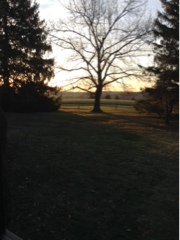
Drying socks.

The rising ordinary.
Putting the plates on second shelf.

Every thing appears as it is.
Saturday, April 19, 2014
not words
Poems are not words.
Poems are where words go to die;
then to resurrect into
contemplation.
unworded silence, light wind touches bowing branches
"What is happening? Today there is a great silence over the earth, a great silence, and stillness, a great silence because the King sleeps; the earth was in terror and was still, because God slept in the flesh and raised up those who were sleeping from the ages. God has died in the flesh, and the underworld has trembled."
(--from An Ancient Homily for Holy Saturday)
|

Friday, April 18, 2014
Broken Open Haiku
Once coyotes yelped
through poem of
Old Fox
on Good Friday --
Now, barely able to
find words
he offers stealth blood
and water silence
(--for fr Robert, ocso, Good Friday 2014)
through poem of
Old Fox
on Good Friday --
Now, barely able to
find words
he offers stealth blood
and water silence
(--for fr Robert, ocso, Good Friday 2014)
Thursday, April 17, 2014
"For-you" is a new way to see life and bread
As the story is told, it is as if Jesus was asked, "What is this?" at table when he took bread and looked at them.
"This?" he responded. "This is for-you."
"For me?" one asked.
"No."
"For us?"
"No." Jesus answered. It is for-you."
They looked at him.

Wednesday, April 16, 2014
Morning snow; nothing to see here
Maine midcoast, April 16, snow.

New York Times has investigative story of alleged rape and sexual assault by Heisman Trophy winning national champion quarterback at Florida State University in Dec. 2012.
http://www.nytimes.com/interactive/2014/04/16/sports/errors-in-inquiry-on-rape-allegations-against-fsu-jamies-winston.html?hp&_r=0

Tuesday, April 15, 2014
Monday, April 14, 2014
and I sort of felt, for lack of a better word, everything
From India, about Amma, a perspective.
Excerpt:
Darshan is the intimate process of seeing and being seen by a deity. Hindus describe darshan not as the detached, passive sight of aesthetic observance but with the active transitive verbs of taking (in Hindi, darshan lena) and giving darshan (darshan dena). In modern usage, the term darshan signifies the moment when humans view the supernatural, whether through an icon of a deity (murti), a sacred site (tīrtha), or a living embodiment of the divine (avatār). Through darshan, the deity and the devotee engage in a mutual seeing in “a moment of dramatic spiritual interaction.”7 This interactive process symbolizes the “desire for fusion— for the subject/object dissolution of the ‘double sensation.’ ”8 As Isabelle Nabokov/Clark-Decès explains, “The act of darshan . . . also becomes a form of absorbing, so that any objectification of a supernatural is always a form of assimilation as well.”9 It is in such moments of Hindu devotional ritual that the individual both recognizes divinity and is recognized as divinity.10 In Hindu practice, it is through darshan that humanity gains the opportunity to experience the divine on earth. Ideally the darshan experience dissolves the individual ego into cosmic unity with divinity. When interpreted through the advaita vedantic theological ideal of nonduality, the moment of darshan between guru and devotee provides the opportunity for the dissolution of the individuated ego, the symbolic union with divinity, and the intense physical expression of metaphysical cosmic oneness that eradicates duality. Ideally, darshan transforms the individual through these temporary suspensions of the sense of self and individuated difference that incite the recognition of the ultimate similitude between the self and divinity.
Through darshan, devotees not only see the image of the deity but infuse themselves within it in an active process of becoming. Devotees aim to absorb the gaze of the deity and in the process be transformed. As Lawrence Babb suggests, there is a parallel between the impulse be- hind eating blessed food (prasad), wherein “you become what you eat,” and the process of darshan, in which “you somehow become what you see.”11 Thus darshan should not be explained in terms of being merely an aesthetic experience—something that one passively witnesses—but, rather, as an agentive interaction—something in which one actively engages, a transformative and participatory process. A devotee of Mother Meera understands her unique method of silent visual darshan in highly active terms of transformation. She says, “Along with the gaze from Mother Meera’s eyes comes an infusion of light, light designed to heal wounds within the psyche and give a person sufficient power to move from the perspective of the personality to a divine perspective. . . . This is not one woman staring as the other stares back. Instead, one offers the gift of her soft, penetrative gaze, and the other offers the gift of acceptance.”12 In the Radhasoami tradition the compassionate gaze of the guru during darshan is believed to assist devotees in their spiritual de- velopment: “the drishṭi, the ‘seeing’ or ‘glance,’ of the guru aids the devotee in achieving deliverance.”13 Devotees of Sathya Sai Baba experience darshan as “a moment of ultimate self-transformation by which they are ‘captured’ spiritually and experience a ‘complete immersion in Sai Baba’s love.’ ”14
Amma’s devotees relate similar experiences of the dissolution of indi- vidual boundaries, immersion in divine love, and cosmic awakenings. Shanti relayed a particularly powerful experience of her darshan during one Devī Bhāva night: “As we knelt in front of Amma, she put our heads together, cheek to cheek, and looked straight into our eyes, the right eye on me and the left eye on Caleb. I remember thinking, Oh no! here we go!!! I lost all track of where I was . . . there was no sense of time, the universe was swirling to life in her eye, and then I was in the universe and I sort of felt, for lack of a better word, everything that has ever been and every thing that will ever be in one second. She pulled back and it was over. I totally lost track of where I was for a second. But as soon as she disengaged I was back with no confusion.” Devotees long for the darshan experience because of the potential for this type of transformative experience, the possibility of experiencing a glimpse into the cosmic reality of the divine, and the efficacy of darshan for catalyzing spiritual awakening.
(--from Chapter 1, A Darshan Embrace, Experiencing Authenticity and Feeling Witnessed, in Reflections of Amma, Devotees in a Global Embrace, Amanda J. Lucia (Author) http://www.ucpress.edu/content/chapters/12560.ch01.pdf)
Subscribe to:
Posts (Atom)