Saturday, July 05, 2008

Mary brings Lalla to read at Poetry Tea and Literature.
FOUR QUESTIONS

Who is awake and who asleep?

What is this lake that is continually

oozing back into the earth?

What can a human being offer to God?

What do we most deeply want?

THE ANSWERS:

The mind is what sleeps.

What recognizes itself

as God is awake.

This always-disappearing lake

is made of our appetites,

these moving-about,

this talking and listening.

The only offering you can make to God

is your increasing awareness.

And the last desire is

to be God in human form.
(--Lalla's Four Questions.)
(Lalla lived in Kashmir during the first part of the 1300s. In that period, Kashmir was home to devotees of Shiva and devotees of Vishnu, to Islamic Sufis and to followers of Tantric Buddhism. Lalla's poems reflect all she learned from these, but synthesized to become the expression of her own devotion in colloquial Kashmiri, rather than the Sanskrit of contemporary philosophical writing. The variety of her names reflects the wide appeal of her poems: In Hindi, she is Lal Ded (grandmother Lal); in Sanskrit, Lalleshwari (Lalla the yogini); while to Muslims, she is Lal Arifa.

Lalla was apparently from a family of Brahmins near Pampore; her poetry shows her knowledge of Sanskrit and of the Hindu scriptures. Tradition says that she left her husband after some years of an unhappy marriage to become a student of Hindu and Sufi teachers. Then she became an itinerant preacher throughout the Kashmir Valley, singing her vakhs (songs) of Shiva and of the search for truth, through an inner spirituality rather than dogma and ritual.
(--
http://home.infionline.net/~ddisse/lalla.html)
Lalla's first answer sounds just right this Saturday. "The mind is what sleeps. What recognizes itself as God is awake."


The evening cools
. Rokpa went for his first sail with Saskia and two crew. I cut two Yews, one to near ground. Old and strong. Remarkably strong. Demolition of ell between kitchen and barn introduces daylight and emptiness. Roof stands with pastiche supports. Four barn skunks find their way the last three days to peanut butter bait in hav-a-heart and are transported to parts away. I feel like a bomb demolition technician as I move step by step through the process with each skunk -- staying out of sight, covering trap, carrying, driving, uncovering, lifting release, waiting for exit, then making my way back home. That two go to one place and two to another worries my heart about breaking up family. I stay with the discomfort.
When you see yourself
and someone else
as one being,
when you know the most joyful day
and the most terrible night as one moment,
then awareness is alone with it's Lord.
(--Lalla Ishwari, trans. Coleman Barks.)
We are all losing the familiar in favor of the creating seeing of life.

Polyphonic chant plays. Folks drift through. Things are bought.

Car door closes. The sailors are home from the sea.

Who is awake? And who is asleep?

This ordinary day is grace.

A gift of increasing awareness.

Neverending.

Reverending.

Friday, July 04, 2008

In Maine last week a priest committed suicide. We talk to a Poor Clare hermit tonight. She knew him.

Suffering looks at many ways to solve its problem. But when we suffer strongly, every solution is blinded by our grief that we are as we are. Suffering grief fails to realize it is not a problem to be as we are.
Somewhere in this process, you will come face to face with the sudden and shocking realization that you are completely crazy. Your mind is a shrieking, gibbering madhouse on wheels barreling pell-mell down the hill, utterly out of control and hopeless. No problem. You are not crazier than you were yesterday. It has always been this way, and you just never noticed. You also are no crazier than anybody else around you. The real difference is that you have confronted the situation; they have not. So they still feel relatively comfortable. That does not mean that they are better off. Ignorance may be bliss, but it does not lead to Liberation. So don’t let this realization unsettle you. It is a milestone actually, a sign of real progress. The very fact that you have looked at the problem straight in the eye means that you are on your way up and out of it.
-Henepola Gunaratana, Mindfulness in Plain English

I like the notion that we are free.

There are flags everywhere today.

We are on our way up and out of this sorry state of these United States, aren't we? Let the poor be poor. Let those without health care stay without health care. Let our money and human resources go to war and the pitiful murderous acquisition of oil.

False pride is unwillingness to say aloud what you are. I don't understand false pride.

Especially mine.

Thursday, July 03, 2008

Doubt was Thomas' path to trust.

Walk carefully that path.
No one can find that which was never lost.

Companionable.

Tangible truth is good.

Wednesday, July 02, 2008

Is it naive to expect truth be told?
Repeatedly undergoing birth and death is just due to grasping at objects. When we reflect back on the mind that grasps at objects, we see that the real identity of mind is originally pure. Within this purity, grasping mind does not exist. Within nirvana, fundamentally there are no thoughts moving; the movement is ever still. Being still, there is no seeking.
(-- Records of the Lanka)
How about truth be known?
Or felt?
On top of it all, our bank crisis is not over. Two weeks ago, Goldman Sachs analysts said that U.S. banks may need another $65 billion to cover more write-downs of bad mortgage-related instruments and potential new losses if consumer loans start to buckle. Since President Bush came to office, our national savings have gone from 6 percent of gross domestic product to 1 percent, and consumer debt has climbed from $8 trillion to $14 trillion.

My fellow Americans: We are a country in debt and in decline — not terminal, not irreversible, but in decline. Our political system seems incapable of producing long-range answers to big problems or big opportunities. We are the ones who need a better-functioning democracy — more than the Iraqis and Afghans. We are the ones in need of nation-building. It is our political system that is not working.

I continue to be appalled at the gap between what is clearly going to be the next great global industry — renewable energy and clean power — and the inability of Congress and the administration to put in place the bold policies we need to ensure that America leads that industry.

(--Op-Ed Column, Anxious in America, By THOMAS L. FRIEDMAN, Published: June 29, 2008, The New York Times)
Truth isn't what we think it is, not what we'd like it to be. Truth is, we've lost interest in truth. We prefer expedience, or spin, or even truthiness.
truthiness (noun)
1 : "truth that comes from the gut, not books" (Stephen Colbert, Comedy Central's "The Colbert Report," October 2005)
2 : "the quality of preferring concepts or facts one wishes to be true, rather than concepts or facts known to be true" (American Dialect Society, January 2006)

(--Merriam-Webster, online)
One will set you free.

The other will enslave you to dangerous people.

Avoid preference or wishes.

Choose what is just like this.

Just this.

See it differently.

Tuesday, July 01, 2008

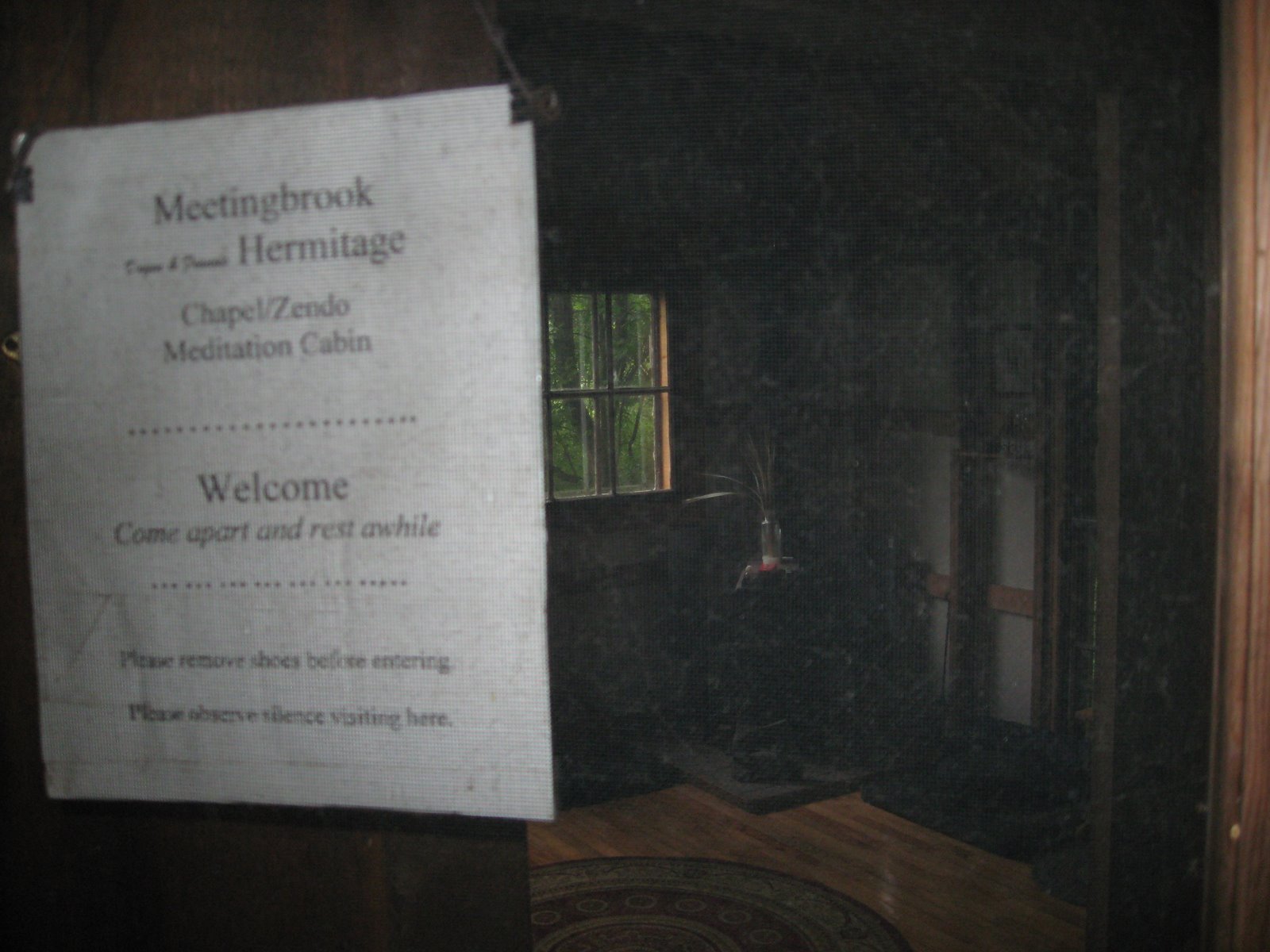
Sit in cabin. Chant Compline. It's Canada Day!
Those who would take over the earth
And shape it to their will
Never, I notice, succeed.
The earth is like a vessel so sacred
That at the mere approach of the profane
It is marred
And when they reach out their fingers
It is gone.
For a time in the world some
Force themselves ahead
And some are left behind,
For a time in the world some make a great noise
And some are held silent,
For a time in the world some are puffed fat
And some are kept hungry,
For a time in the world some push aboard
And some are tipped out;
At no time in the world will a person who is sane
Over-reach himself,
Over-spend himself,
Over-rate himself.

- Lao Tzu
Prayer is simple. Open mouth. Open mind.

Open heart.

Bow. 183 days in; 183 days to go.

Reside in God.

Monday, June 30, 2008

Taking tooth, it felt like dentist was taking jaw. Millimeter by millimeter I am fading away.
The birds have vanished into the sky.
Now the last cloud drains away.
We sit together, the mountain and me,
until only the mountain remains.

- Li Po (701-762)
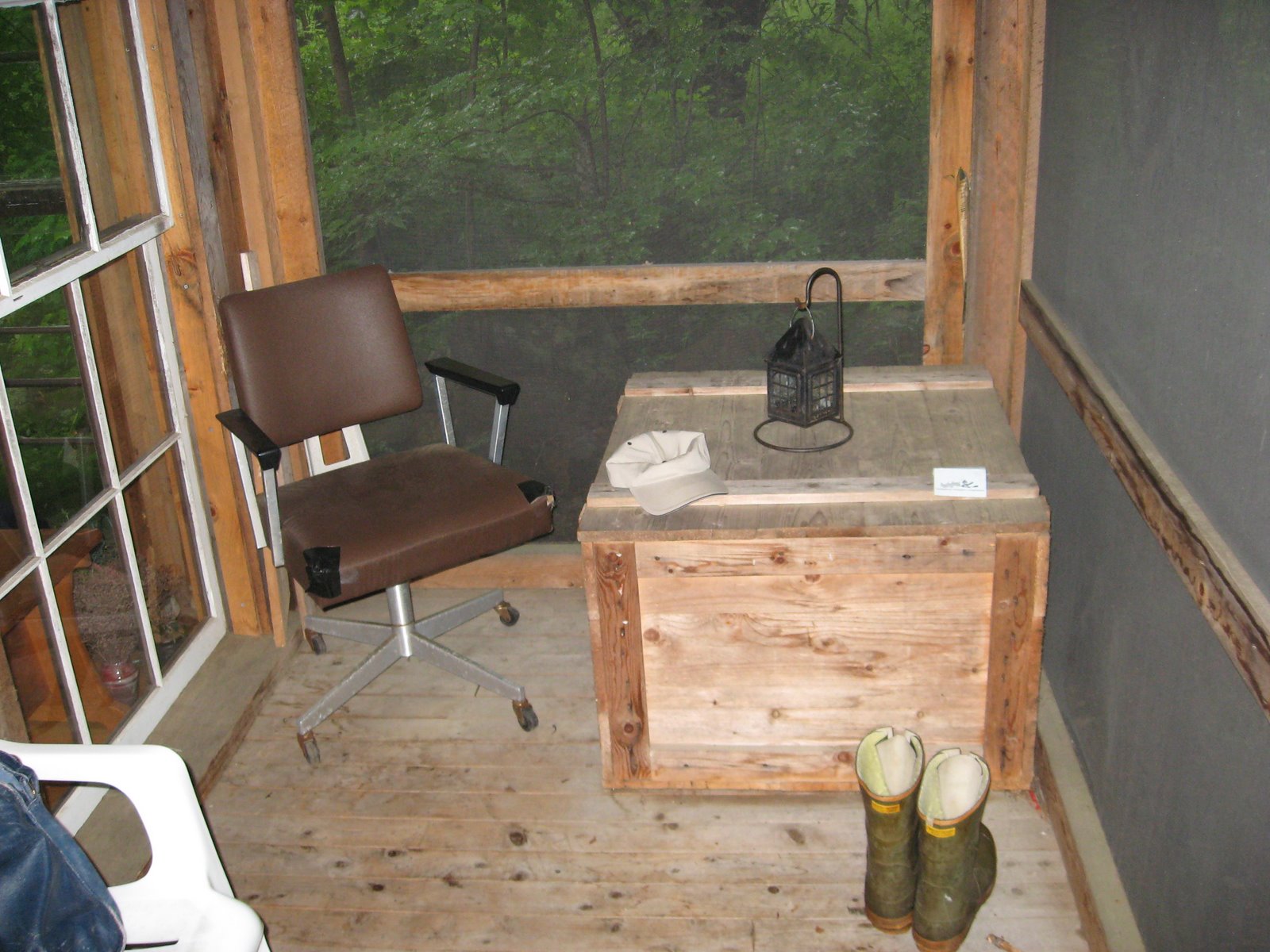
Daylight dims. White dog looks through screen on cabin porch up trail, alert at some movement. He is still, paw resting on sill. The stone painted with words "Be still and know that I am God" from Gale is just to left of paw.
The Lord, support of the just
I trust in the Lord, so why do you say to me:
“Fly up to the mountain like a sparrow”?

“For the wicked have drawn their bows, fitted the arrow to the string, to shoot in darkness at the upright of heart.
When the foundations are being overthrown, what are the just to do?”
(--from Psalm 10 (11))
It's good practice for this young Border Collie with sweet temperament -- watching alertly through dusk for movement; listening intently for evening emergence from earth.

These silent monks of tree monastery hold their positions of prayer. The twilight zabuton is ankle rich in meditation.
"In the course of epic events, matter was distilled out of radiant energy, segregated into galaxies, collapsed into stars, fused into atoms, swirled into planets, spliced into molecules, captured into cells, mutated into species, compromised into thought, and cajoled into cultures. All of this (and much more) is what matter has done as systems upon systems of organization have emerged over thirteen billion years of creative natural history."
(— Loyal Rue, philosopher at Loyola College)
Tonight, matter arranges itself on zendo zafu, and sits with measuring breath.

Prayer, this stillness of descending night, presences all.

Vacate your thinking; become the place.

Sunday, June 29, 2008

Perhaps it is not so much that God is with us. Rather, this: God is with-us.
-- causa PREP GEN = for sake/purpose of (preceded by GEN.), on account/behalf of, with a view to.
-- usus, usus
N M = use, enjoyment; experience, skill, advantage; custom.
(-- from Latin Dictionary, online, University of Notre Dame)
Is God -- Causa Usus -- with a view to use, to be useful, at your service?

And if we are to be of God, are we to be "Deus usus"? Are we to enter "The enjoyment, the experience, the custom of God"?
'Mindfulness, or awareness, does not mean that you should think and be conscious "I am doing this" or "I am doing that." No. Just the contrary. The moment you think "I am doing this," you become self-conscious, and then you do not live in the action, but you live in the idea "I am," and consequently your work too is spoiled.

You should forget yourself completely, and lose yourself in what you do. The moment a speaker becomes self-conscious and thinks "I am addressing an audience," his speech is distributed and his trend of thought broken. But when he forgets himself in his speech, in his subject, then he is at his best, he speaks well and explains things clearly.

All great work--artistic, poetic, intellectual or spiritual--is produced at those moments when its creators are lost completely in their actions, when they forget themselves altogether, and are free from self-consciousness.
(-- Walpola Rahula, in What the Buddha Taught)
What is wanted of us? Is it to be usus?

Are we ready to move through "I am" to "Us is"?

Concluding Prayer
O God, you have given us this holy day so that we may have the joy of venerating the apostles Peter and Paul.
Grant that your Church may follow their example in all things,
for it was from them that her life began.

(--from Office of Readings, Sunday 29 June 2008, Feast of Saints Peter and Paul, Apostles, Solemnity)
Through "Us is" to "This is what and who we are"?

This!

We are for the use of, in the service of, one another. In and through and with...God. Freely, mindfully, healing wounds.
unus, una, unum (gen -ius) ADJ [uncommon] = alone, a single/sole; some, some one; only (pl.)
alius, alia, aliud ADJ = other, another; different, changed; [alii...alii => some...others].
(-- Latin Dictionary, University of Notre Dame, http://www.archives.nd.edu/cgi-bin/wordz.pl?keyword=unus... etc)
Are we to be unus alius -- another alone? a single another? some one(s) changed? only different? one another?


At Sunday Evening Practice we read from Matthew Fox on Thomas Berry:
Another dimension where Thomas Berry and Aquinas link up – of course Berry is carrying us into new arenas – is Aquinas’ observation that every human person is “carpax universi” – capable of the universe. That’s who we are as a species. That’s how big we are, and neither our souls, nor our hearts nor our minds will be satisfied and therefore relieved of temptations to greed, until we are re-set in the context of cosmology of the universe itself. In this regard, this exciting teaching in our time, that reflect and support the powerful work of Thomas Berry and Brian Swimme, and others in recovering a Universe Story.

Speaking, for example, about Otto Rank, the great psychologist, father of humanistic psychology, he broke with Freud over many things. But Rank came to the conclusion that the number one problem for human beings is our feeling of separation. This feeling begins with our leaving the womb, which was our universe for 9 months and he thinks the rest of life is about trying to find reunion with the cosmos. He says: “ we surrender ourselves, in art or in love, to a potential restoration of the union with the cosmos which once existed and was then lost.” He talks about the ‘original wound’, which is a much happier term than ‘original sin’, that haunts our species.

And this is the wound: that we feel separated from the cosmos.

He says the only solution is the "unio mystica" – the mystical union – our being one with the All, in tune with the cosmos, and this he points out, is something that indigenous people all know about. Rank says: “This identification is the echo of an original identity, not merely of child and mother but of everything living. Witness the reverence of the primitive for animals. In humans, identification aims at re-establishing a lost identity with the cosmic process, which has to be surrendered and continuously re-established in the course of self-development. Thomas Berry’s work is a profound work of human healing,because it restores that lost identity, that lost relationship, that lost passion – between the human and the cosmos.

(--from Matthew Fox Tribute to Thomas Berry – November 3rd 2002,
http://64.233.169.104/search?q=cache:6a9ZfB7GfTkJ:www.earth-community.org/images/FoxTribute.pdf+matthew+fox+on+thomas+berry&hl=en&ct=clnk&cd=4&gl=us&client=firefox-a )

We begin today our 13th year of the bookshop/bakery at the harbor.

Grateful is a good word. It's what we are.

With-us, bless us, all!

Saturday, June 28, 2008

This is now the conversation.

That's what was said during Poetry, Tea, and Literature this afternoon.
'Your arrows do not carry, observed the Master, "because they do not reach far enough spiritually. You must act as if the goal were infinitely far off. For master archers it is in fact common experience that a good archer can shoot further with a medium-strong bow than an unspiritual archer can with the strongest. It does not depend on the bow, but on the presence of mind, on the vitality and awareness with which you shoot...."
(-- Eugen Herrigel, in Zen and the Art of Archery)
We either spoke of or read Mary Oliver, Wendell Berry, David Whyte, Liam Rector, Ann Lauterbach, Rainer Maria Rilke, and Hafiz.

The word "this" came up often.

There is nothing beyond this.

One Zen Master held the definition that "Truth" (was and) "is just like this."

What is this?

This is now the conversation.

Friday, June 27, 2008

Walking into prison and walking out from prison is always a surprising activity.
Do you know how to let the
mountain stream cleanse your mind?
Every thought is pulled out along the smooth,
polished stones, disappearing
downstream in the frothy current.
The mind keeps on making more thoughts
until it sees that they are
all being carried away downstream;
until it realizes that they
are all vanishing,
dissolving into an unseen point.
- Ji Aoi Isshi
Just that. Visiting men. Reading poetry.
Disgust

I was well towards the end
Of middle-age before I
Realized I loved saying

Disgusting things but didn't
Really myself much enjoy hearing
Them. They

Go to the heart of life,
I realize (I think
Everyone recognizes this),

Since almost everyone
Can agree: Life, so
Generally disgusting.

But no one really
Wants to hear
That much about

The disgusting (except,
Perhaps, those who have frozen
Significant portions

Of their senses of humor
In the fifth grade, as I have).
Those of us who love

Verbally bringing up
The disgusting
Incessantly

Are usually prevented
From ever holding
Truly executive positions

In any organized
Situation, but there are,
Looking around I've noticed,

Plenty of us
Placed somewhere
In middle-management.

We are the ones
Managing things
"On the ground,"

As they say, the ground
Which is also where,
I can't help but bring it

Up, most beasts of the field
Leave
Their ghastly deposits.


(--From The Executive Director of the Fallen World by Liam Rector, published by the University of Chicago Press. Copyright 2006.)
The people in the middle protect the lower and the higher from (as one man said) the shit of the other two.

Can you even trust those who protect and hide?

Opt for something more contemplative.

Allow and serve, forgive and serve, love and serve.

Enter this world open.

Thursday, June 26, 2008

Ethics isn't hard to teach. Open the newspaper, read any story or opinion piece, and mull. Not too long though. You're likely to get confused. And confusion is where learning begins. Especially in ethics. Wanna learn?

So much of what goes on in the world is the antithesis to ethics. Call it learning default. Find the fault and flaw. Learn to live through it.
My home’s in the
flowering mountains.
My joy is purest reflection
in a rush hut by a blue grotto,
at the end of a crazy winding path.
At noon I take a simple meal
and when I’m full
I take my staff
and wander to the
mountain top and gaze.

- Yun-K’an Tzu
Guns are reaffirmed. No gun safety law will escape pressure and precedent to change. Some presage return to private justice. Some see abdication of leadership and dark days ahead. These will be the good old days.
Op-Ed Columnist, Books, Not Bombs
By NICHOLAS D. KRISTOF, Published: June 26, 2008
AMMAN, Jordan
The dirty little secret of the Iraq war isn’t in Baghdad or Basra. Rather, it’s found in the squalid brothels of Damascus and the poorest neighborhoods of East Amman.

Some two million Iraqis have fled their homeland and are now sheltering in run-down neighborhoods in surrounding countries. These are the new Palestinians, the 21st-century Arab diaspora that threatens the region’s stability.

Many youngsters are getting no education, and some girls are pushed into prostitution, particularly in Damascus. Impoverished, angry, disenfranchised, unwanted, these Iraqis are a combustible new Middle Eastern element that no one wants to address or even think about.

American hawks prefer to address the region’s security challenges by devoting billions of dollars to permanent American military bases. A simpler way to fight extremism would be to pay school fees for refugee children to ensure that they at least get an education and don’t become forever marginalized and underemployed.

We broke Iraq, and we have a moral responsibility to those whose lives have been shattered by our actions. Helping them is also in our national interest, for we’ll regret our myopia if we allow young Iraqi refugees to grow up uneducated and unemployable, festering in their societies
.
(--New York Times, Op-Ed, Kristof)
Everyone I know is tired. Physically, psychologically, spiritually -- tired.

Psalm 43 (44)
But now, God, you have spurned us and confounded us,
so that we must go into battle without you.
You have put us to flight in the sight of our enemies,
and those who hate us plunder us at will.
You have handed us over like sheep sold for food,
you have scattered us among the nations.

You have sold your people for no money,
not even profiting by the exchange.
You have made us the laughing-stock of our neighbours,
mocked and derided by those who surround us.
The nations have made us a by-word,
the peoples toss their heads in scorn.

All the day I am ashamed,
I blush with shame
as they reproach me and revile me,
my enemies and my persecutors.

(--from Office of Readings, Thursday 26 June 2008, Thursday of week 12 of the year)
I'm tired.

Kristof ends his op-ed:
If we let the Iraqi refugee crisis drag on — and especially if we allow young refugees to miss an education so that they will never have a future — then we are sentencing ourselves to endure their wrath for decades to come. Educating Iraqis may not be as glamorous as bombing them, but it will do far more good.
(--New York Times, Op-Ed, Kristof)
On a different note, it was said in conversation tonight that "God takes a pee." If we are to near God, it has to be a "post ego existence" a "post egoic encounter" a "post egotistical engagement."

Whenever we have to pee, therefore, we consider what it takes to realize enlightenment devoid of the ego which keeps us in the dark.

Post ego enlightenment.

That'll be a relief.

Wednesday, June 25, 2008

When did Christianity become the property of self-deceiving men and women, again? It's always had promise, much like a mountain stream. But dams and damning again threaten to pollute and make stagnant what, of itself, would flow lively through our midst.

Flowing water, like vibrant spirit, originates, incarnates, and activates human beings on the earth in the world in ways spontaneous and consistent with inner call of what is taking place for relational, integral, and isomorphic being and act in particular manifestations of presence.

Convergence and correspondence are practice and fruit of originating being-in-the-world.
His mind is free from all thoughts.
His demeanor is still and silent.
His forehead beams with simplicity.
He is cold as autumn,
and warm as spring,
for his joy and anger
occur as naturally
as the four seasons.

- Chuang Tzu
Self-emptying is the benchmark of Christianity.
5
Have among yourselves the same attitude that is also yours in Christ Jesus,
6
Who, though he was in the form of God, did not regard equality with God something to be grasped.
7
Rather, he emptied himself, taking the form of a slave, coming in human likeness; and found human in appearance,
8
he humbled himself, becoming obedient to death, even death on a cross.
9
Because of this, God greatly exalted him and bestowed on him the name that is above every name,
10
that at the name of Jesus every knee should bend, of those in heaven and on earth and under the earth,
11
and every tongue confess that Jesus Christ is Lord, to the glory of God the Father.

(--Philippians 2: 5-11)
God-nature is become human-nature free, clear, and empty of separating, grasping, and restricting self. What we call 'God' is less a 'being' elsewhere, and more Being Here. Humankind longs for this God the way earth longs for the universe. Universe is not other than earth. Earth is universe in this place. So too, God is now not other than humankind. Humankind is God in this place.

If not this, then Christianity is not Christianity. This place, this person, this event, this need, this response, this act, this thought, this inspiration, this (yes) doubt, and this awareness -- all this is the emergence of God (some say 'Christ-reality') in and through present circumstance and circumstances.

Jose Ortega y Gasset captures this:
Philosophically Ortega moved from neo-Kantianism to a form of existentialism that he expounded unsystematically in a pungent, popular style. Ortega's metaphysics began with a critique of both realism and idealism. Neither view is acceptable, prior them is the category of life: "I am not my life. This, which is reality, is made up of me and of things. Things are not me and I am not things: we are mutually transcendent, but both are immanent in that absolute coexistence which is life." (from Unas lecciones de metafisica, 1966) Ortega identified reality with "my life", which is "myself" and "my circumstances" (yo soy yo y mi circumstancia - I am I and my circumstances).
(--from Books and Writers, José Ortega y Gasset (1883-1956) http://www.kirjasto.sci.fi/grasset.htm)
Perhaps the reason why 'this' is always so difficult for many of us is because 'this' is the doorway through the realization and manifestation of the absolute nearside we have long called 'God.' Until now we have been content to say 'God is near.' Now a different articulation longs to be voiced, heard, and incarnated -- namely, 'God is the absolute nearside beyond which is nothing other than this.'

It is understandable we fear this articulation and formulation. There is an intimacy and essence completely encompassing both unity and difference. One might say: everything is included, nothing left out; or -- nothing is included, everything is as it is. Here, in such consideration, the mind just stares, frozen in the realization that to say anything, to make any move, to begin to make any distinction or explanation with regard to the matter presented to it at hand, is to risk utter annihilation of what once was identified as 'self' and fall into the beautiful terror of a new viewing of 'What-Is Being-With...Us.'
Jesus said, ‘Beware of false prophets who come to you disguised as sheep but underneath are ravenous wolves. You will be able to tell them by their fruits. Can people pick grapes from thorns, or figs from thistles? In the same way, a sound tree produces good fruit but a rotten tree bad fruit. A sound tree cannot bear bad fruit, nor a rotten tree bear good fruit. Any tree that does not produce good fruit is cut down and thrown on the fire. I repeat, you will be able to tell them by their fruits.’
(--Matthew 7:15 - 20)
The fruits of realizing our true name is action without fear, action filled with compassion, wisdom, and lovingkindness. We will do no harm. We will find humility a refreshing flowing stream of awareness.

We will speak to one another in ways undreamed of.
"Conversation is the socializing instrument par excellence, and in its style one can see reflected the capacities of a race." (--Ortega y Gasset, from Invertebrate Spain, 1922)
Will we be willing to learn this?
"Jesus warns of the spiritual dangers of wealth, and tells others to sell all they have to the poor, but he enjoyed it when rich people had him for dinner. We debated whether his warnings and advice were dependent on the situation. These questions raise doubts about what you should do if you have money, and what you have to do to make it. Can you `serve God and mammon at the same time?'"

"When people come to Jesus he tells them a story - what he's doing is pushing them to broaden their horizons, think from the perspectives of others. There's a parable about a dishonest steward who cheats his employer and yet is praised by Jesus. I called this `The Story of the Crooked CEO." He's feathering his own nest, yet Jesus commends him, and students asked why. They wanted me to give an answer, but I wanted them to wrestle with it. Jesus doesn't give unambiguous signals - he has confidence that by pushing the imagination, enriching its power through stories, you enrich the context of the decision. You see that you are making decisions in a network of other people who will also be affected. The moral life is not a solo flight."

No Ivory Tower professor, Cox has always linked his work to current events, going to Latin America to write about the Liberation Theology movement, traveling around the world to research the growth of Pentecostalism, interviewing Buddhists and Hindus to study the appeal of those religions for Westerners "in Turning East." In the '60s he went south to support the civil rights movement, going on Freedom Rides, later taking part in protests against the Vietnam War and working for nuclear disarmament.

"The worrisome thing today," Cox said, "is the cynicism and resignation of students - but what can be done when our leaders are self-serving and corrupt? Students now are not like they were in the `60s. Sometimes I get angry. I tell them it's unacceptable to say you can't do anything to help the poor and oppressed - it's like turning things over to the serpent."

"The students today are good kids, they're not the curled-lip kind of cynics, but the fire in the belly is missing. The new spirituality doesn't do a good a job of linking the spirit to action, it doesn't produce activists. There's no one now like the Christian activists of the '60s - Daniel Berrigan, William Sloane Coffin, Martin Luther King. There was a tone in religion then, an idealism in Christianity that linked Jesus' concerns for the poor and the outcasts of society to social action. Today Christianity has been taken over by the right wing. No wonder kids aren't interested in mining the Christian tradition."

(--from Spiritually Incorrect, by Dan Wakefield, writing about book Jesus at Harvard, by Harvey Cox, the theologian who once said, "God is dead" chronicling years of wrestling with Jesus' teachings at the university. Copyright 2008 Beliefnet, Inc. http://www.beliefnet.com/story/159/story_15977_1.html)
The Christian tradition is not mine. It is us.

It is this mind.

Set free.

To see.

Tuesday, June 24, 2008

The zen saying is: When you sit, sit; when you stand, stand -- whatever you do, don't wobble.

I'm often wobbly. Sunday evening at table during practice we decide the zen saying is another zen trick. "Wobbly," we decide, is a good thing, approached by negative injunction.

Our understanding of "Wobbly" is "Wholeness of being, being love, you."

Then, of course, there's the Canadian version of wobble: "Wholeness of being, being love -- eh?"
She is clarity.
Hearing the truth,
she is like a lake,
pure and tranquil and deep.
Want nothing.
Where there is desire,
say nothing.
Happiness or sorrow,
whatever befalls you,
walk on untouched.

- Buddha in the Dhammapada
Cleaning barn gutters on aluminum ladder in fog and showers yesterday, looking out for periodic skunk visitor. Wobbly ladder. High mass. Rank accumulation of leaves, twig, and water compressed by time and inattention. Things seem covert even as everything grows and flowers. Summer ambivalence sets root in psyche. We are half the year.
The birth of the Precursor was announced in a most striking manner. Zachary and Elizabeth, as we learn from St. Luke, "were both just before God, walking in all the commandments and justifications of the Lord without blame; and they had no son, for that Elizabeth was barren" (i, 6-7). Long they had prayed that their union might be blessed with offspring; but, now that "they were both advanced in years", the reproach of barrenness bore heavily upon them. "And it came to pass, when he executed the priestly function in the order of his course before God, according to the custom of the priestly office, it was his lot to offer incense, going into the temple of the Lord. And all the multitude of the people was praying without, at the hour of incense. And there appeared to him an angel of the Lord, standing on the right side of the altar of incense. And Zachary seeing him, was troubled, and fear fell upon him. But the angel said to him: Fear not, Zachary, for thy prayer is heard; and they wife Elizabeth shall bear thee a son, and thou shalt call his name John: and thou shalt have joy and gladness, and many shall rejoice in his nativity. For he shall be great before the Lord; and shall drink no wine nor strong drink: and he shall be filled with the Holy Ghost, even from his mother's womb. And he shall convert many of the children of Israel to the Lord their God. And he shall go before him in the spirit and power of Elias; that he may turn the hearts of the fathers unto the children, and the incredulous to the wisdom of the just, to prepare unto the Lord a perfect people" (i, 8-17). As Zachary was slow in believing this startling prediction, the angel, making himself known to him, announced that, in punishment of his incredulity, he should be stricken with dumbness until the promise was fulfilled. "And it came to pass, after the days of his office were accomplished, he departed to his own house. And after those days,Elizabeth his wife conceived, and hid herself five months" (i, 23-24).
(--on John the Baptist, from Catholic Encylopedia,
http://www.newadvent.org/cathen/08486b.htm)
The hidden life is like summer ambivalence. Covert service, in metaphor of spiritual life, is life of prayer and kindness -- with this caveat: there is no payoff, no medical benefits, no retirement plan, no Rotary Club "Hi Joe!" nor gold watch to time you into declining sunset. The hidden life is only the hidden life. There is trust, but no trust fund. There's nothing there. No applause. No limo. No press conference.

Bereft.
I like John. He travels the edge of the story of Jesus. From kick-womb to kick-ass commentary about some powerful guy and his wife whose daughter showed sensuous swirl and asked for his head. In prison he wondered: Was his cousin the real thing? A prison visitor told him what he saw. About the sick, healed. About the poor, hearing good things. About how upside-down the world is with injustice and uncaring ruling over justice and kindness. And Jesus? Prison doesn't take away doubt and darkness. John hoped his dreams were not delusions. Don't we all!
Now
by Liam Rector

Now I see it: a few years
To play around while being
Bossed around

By the taller ones, the ones
With the money
And more muscle, however

Tender or indifferent
They might be at being
Parents; then off to school

And the years of struggle
With authority while learning
Violent gobs of things one didn't

Want to know, with a few tender
And tough teachers thrown in
Who taught what one wanted

And needed to know; then time
To go out and make one's own
Money (on the day or in

The night-shift), playing around
A little longer ("Seed-time,"
"Salad days") with some

Young "discretionary income"
Before procreation (which
Brings one quickly, too quickly,

Into play with some variation
Of settling down); then,
Most often for most, the despised

Job (though some work their way
Around this with work of real
Delight, life's work, with the deepest

Pleasures of mastery); then years
Spent, forgotten, in the middle decades
Of repair, creation, money

Gathered and spent making the family
Happen, as one's own children busily
Work their way into and through

The cycle themselves,
Comic and tragic to see, with some
Fine moments playing with them;

Then, through no inherent virtue
Of one's own, but only because
The oldest ones are busy falling

Off the edge of the planet,
The years of governing,
Of being the dreaded authority

One's self; then the recognition
(Often requiring a stiff drink) that it
Will all soon be ending for one's self,

But not before Alzheimer's comes
For some, as Alzheimer's comes
For my father-in-law now (who

Has forgotten not only who
Shakespeare is but that he taught
Shakespeare for thirty years,

And who sings and dances amidst
The forgotten in the place
To which he's been taken); then

An ever-deepening sense of time
And how the end might really happen,
To really submit, bend, and go

(Raging against that night is really
An adolescent's idiot game).
Time soon to take my place

In the long line of my ancestors
(Whose names I mostly never knew
Or have recently forgotten)

Who took their place, spirit poised
In mature humility (or as jackasses
Braying against the inevitable)

Before me, having been moved
By time through time, having done
The time and their times.

"Nearer my god to thee" I sing
On the deck of my personal Titanic,
An agnostic vessel in the mind.

Born alone, die alone—and sad, though
Vastly accompanied, to see
The sadness in the loved ones

To be left behind, and one more
Moment of wondering what,
If anything, comes next. . .

Never to have been completely
Certain what I was doing
Alive, but having stayed aloft

Amidst an almost sinister doubt.
I say to my children
Don't be afraid, be buoyed

—In its void the world is always
Falling apart, entropy its law
—I tell them those who build

And master are the ones invariably
Merry: Give and take quarter,
Create good meals within the slaughter,

A place for repose and laughter
In the consoling beds of being tender,
I tell them now, my son, my daughter.


(--From The Executive Director of the Fallen World by Liam Rector, published by the University of Chicago Press. Copyright 2006 by Liam Rector.)
We'll drive the back roads to Belfast. We'll arrive, no doubt, a smidgen late for mass at St Francis of Assisi. We'll sit and kneel in meditation wondering what it was kept John in touch with what enlivened him. We'll listen to what is offered. We'll present ourselves as nescient affirmation, as this day's radically unknowing body of Christ.

We'll wonder what keeps us in touch with life, with what is enlivening throughout.

The world, on one hand, is full of war, lies, intentional criminality, and arrogant power.

On the other hand, the world is permeated by quiet hope, simple kindnesses, unobtrusive pastoral visiting care, and poet's vision that breaks the heart with loving tears.

What is, then, really, the sound of one hand clapping?

Monday, June 23, 2008

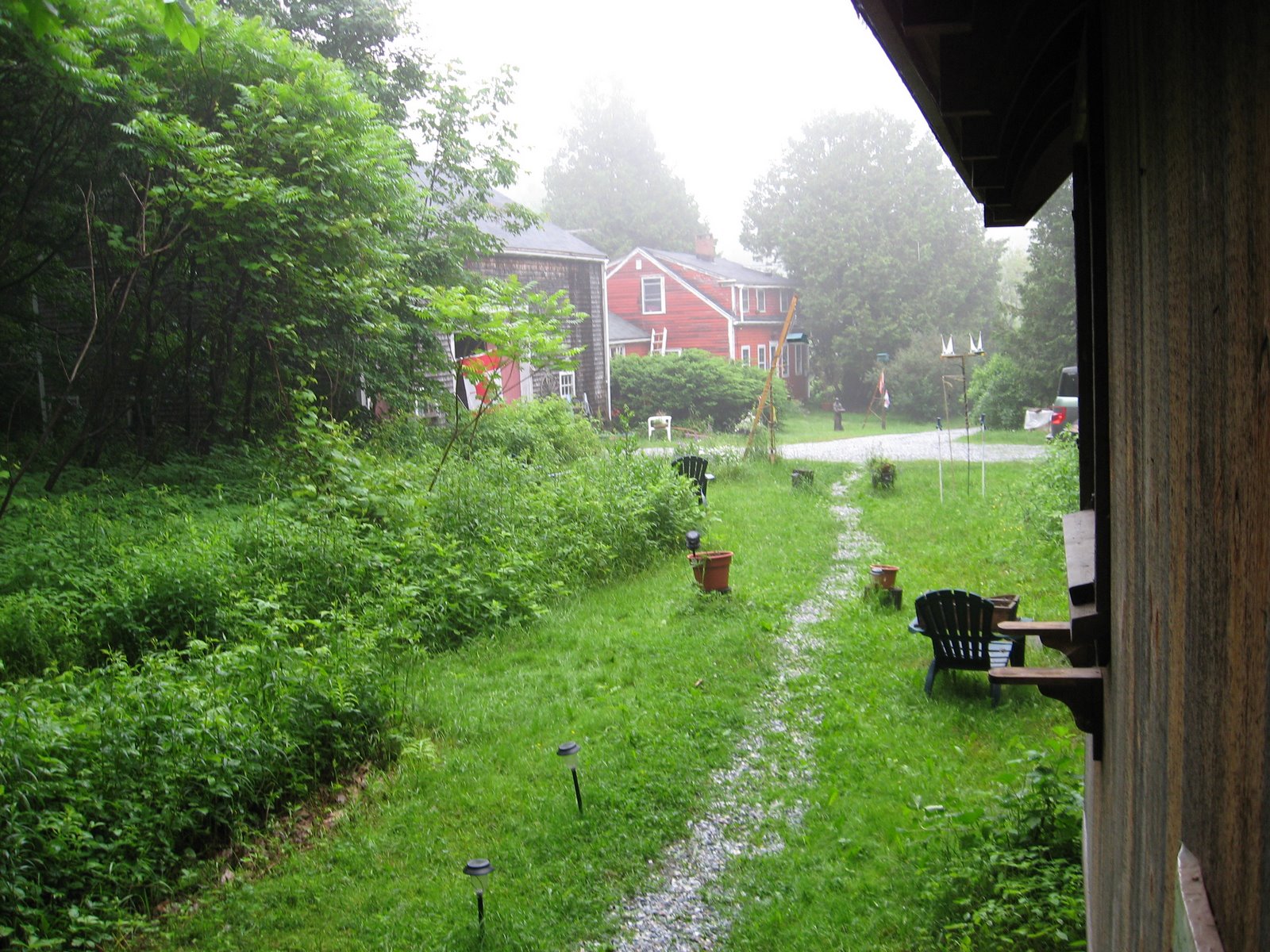
Jasmine incense at altar for Dogen. Moist green leaves. Brook up path. Dog gnawing stick. Drops patter maple leafs with slight breeze. Morning. Cars roll Barnestown Road. Birds busy aerial telegraph. Cat saunters path to cabin.

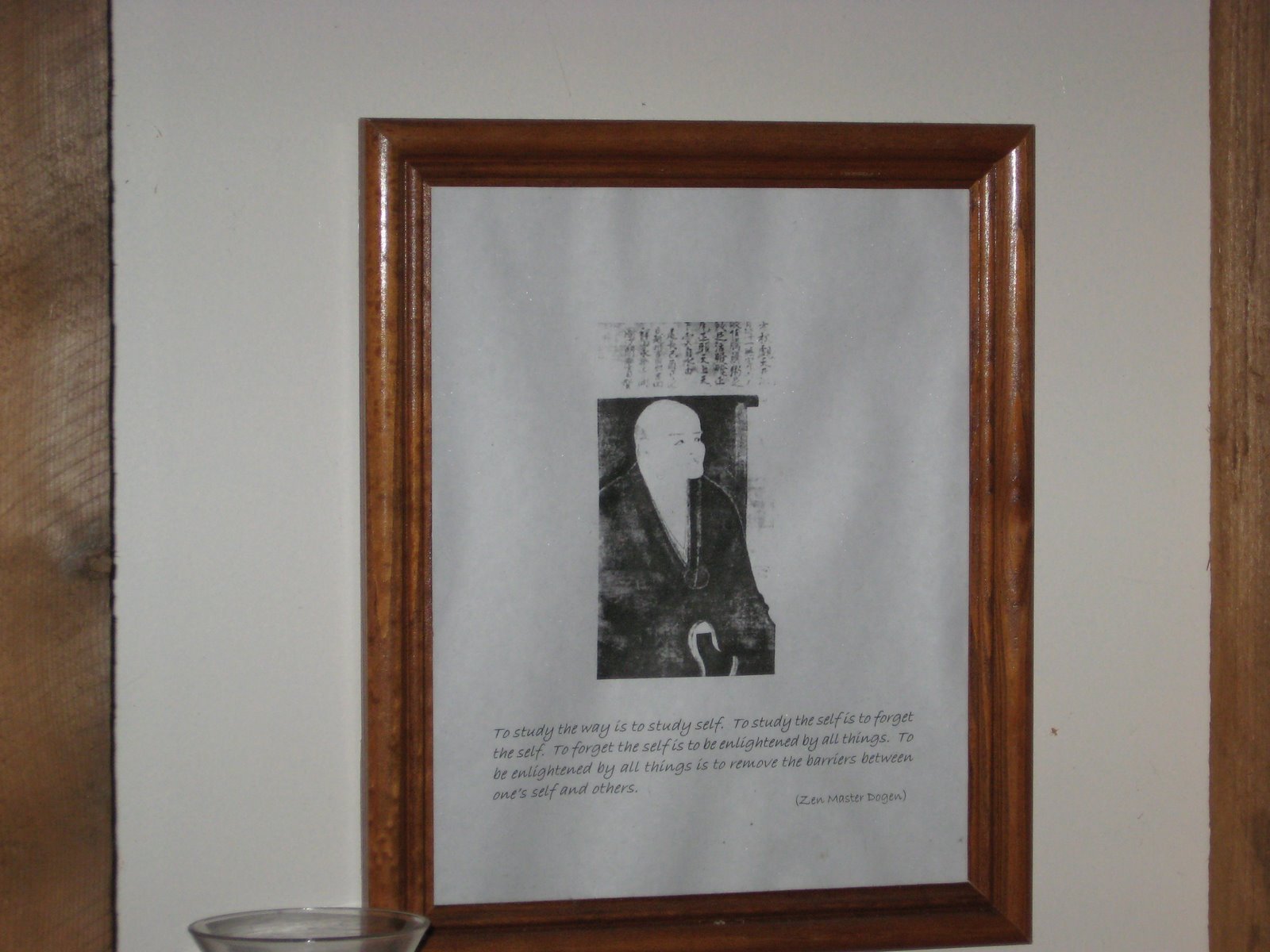
True spiritual practice is not founded on attainment or on the miraculous, but on seeing life itself as a true miracle. In the words of a Zen master,
My magical power and miraculous gift:
Drawing water and chopping wood
.
(--from Zen Sayings)
At Taize service in St Thomas Church last evening after meditation practice at hermitage -- flute, harp, piano, and cello wove between voices, candles, and icons -- a silence sounding stillness gathering.

Rain reminds -- earth receives, everything.
"Entering the forest he moves not the grass;
Entering the water he makes not a ripple."

--Zenrin Kushû (The Way of Zen 152, 224)
So much effort in this world to be known, get ahead, make a name for oneself. Less frequent the wish to remain unknown, stay put, enter no name.

Dog follows cat around meditation hall. Bored.

Only 32 of 800 to this hour have been found from ferry that capsized during typhoon in Philippines. What can you say? Woman off Owl's Head beach flies small plane into ocean; dies. Such a sudden quiet. If we have to say something, and there is nothing to say, how turn the mind?
"Speech is blasphemy, silence a lie. Above speech and silence there is a way out."
(--I-tuan, one of Nan-ch'uan's great disciples (The Golden Age of Zen 250, 322 n.13))
The way out, some point, is through. Through one, through another, no stopping. The Catholic priest in Belfast sometimes pauses the recitation of Nicene or Apostle's Creed after homily. It's his attempt to bring attention to the words and what they point to. When we chant the Heart Sutra Sunday evenings there is no stopping no pausing. Are we what is passing through creed and sutra? No pausing, no stopping, no ending. One thing after another.

Fragments

1. Not on my authority, but on that of truth, it is wise for you to accept the fact that all things are one.
2. This truth, though it always exists, men do not understand, as well before they hear it as when they hear it for the first time. For although all things happen in accordance with this truth, men seem unskilled indeed when they make trial of words and matters such as I am setting forth, in my effort to discriminate each thing according to its nature, and to tell what its state is. But other men fail to notice what they do when awake, in the same manner that they forget what they do when asleep.
3. Those who hear without the power to understand are like deaf men; the proverb holds true of them -- 'Present, they are absent.'
4. Eyes and ears are bad witnesses for men, since their souls lack understanding.
5. Most men do not understand such things as they are wont to meet with; nor by learning do they come to know them, though they think they do.
6. They know not how to listen, nor how to speak.
7. If you do not hope, you will not find that which is not hoped for; since it is difficult to discover and impossible to attain.
8. Seekers for gold dig much earth, and find little gold.
9. Controversy.
10. Nature loves to hide.
11. The lord at Delphi neither speaks nor conceals, but gives a sign.
12. And the Sibyl with raving mouth, uttering words solemn, unadorned, and unsweetened, reaches with her voice a thousand years because of the god in her.
13. What can be seen, heard, and learned, this I prize.
14. (For this is characteristic of the present age, when, inasmuch as all lands and seas may be crossed by man, it would no longer be fitting to depend on the witness of poets and mythographers, as our ancestors generally did), 'bringing forth untrustworthy witnesses to confirm disputed points,' in the words of Herakleitos.
15. Eyes are more exact witnesses than ears.
16. Much learning does not teach one to have understanding;

(--Heraclitus, (ca.500 BCE), Arthur Fairbanks, trans. and ed., The First Philosophers of Greece (Scribner, 1898))
I've neither learning nor understanding.

Dog sits in undergrowth and barfs. Cat watches from wood box on cabin porch. Both keen-eyed watchfulness at any movement.

Tomorrow is midsummer, St. John's Day.

Today is looking this way and that.
If everyone flocks to the world,
who then will be a hermit?
If everyone abandons the world,
who then will manage the world?
There is none like this Great Master
who dwells between the two,
neither defiled, nor pure;
neither Vinaya, nor Ch’an,
there is none like Hai-yueh.

- Su Shih (1073)
So unlike, none like -- just like this.
This is how we are in the world.

Tea, green; oatmeal, with berries!

This morning.

Sunday, June 22, 2008

Fog on Passagassawakeag River on Penobscot Bay. Three kayakers paddle in low tide. French and Webb launch three identically restored sailboats in Belfast Maine this afternoon after two and a half year makeover. Something done well is celebrated. A fourth hull, in disconsolate disrepair, waits down the street away from the nautical flags and new brass pulleys, unrestored, peeling, patronless.
I hear so many disparaging me,
‘“Terror from every side!”
Denounce him! Let us denounce him!’
All those who used to be my friends
watched for my downfall,
‘Perhaps he will be seduced into error.
Then we will master him
and take our revenge!’
But the Lord is at my side, a mighty hero;
my opponents will stumble, mastered,
confounded by their failure;
everlasting, unforgettable disgrace will be theirs.
But you, O Lord of Hosts, you who probe with justice,
who scrutinise the loins and heart,
let me see the vengeance you will take on them,
for I have committed my cause to you.
Sing to the Lord,
praise the Lord,
for he has delivered the soul of the needy
from the hands of evil men.

(--Jeremiah 20:10 - 13, Sunday 22 June 2008, 12th Sunday of the year)
The derelict sailboat is recognizable. She waits off-camara. Passersby look at her and look away. She's not pretty. She's old. And beaten. A reminder of something -- something off hidden, not quite in the forefront of the mind glancing away.

Still, it's a wonderful day!
Jesus said to his disciples, ‘Do not be afraid of them. For everything that is now covered will be uncovered, and everything now hidden will be made clear. What I say to you in the dark, tell in the daylight; what you hear in whispers, proclaim from the housetops.
(--Matthew 10:26 - 33)
It's a strained hope that considers reconstruction and transparency. The metaphor of dilapidation becoming redemptive restoration cast upon the waters is archetypically resonant at the edge of sea in fog muted thought. We're not really talking about pleasure craft here, are we?
The problem of representation, meaning, and memory is also illustrated by the case of a patient who has lost his arm in an accident. As is often the case, the brain creates a "phantom" limb in an apparent attempt to preserve a unified sense of self. For the patient, the phantom limb is painful. The brain knows there is no limb; pain is the consequence of the incoherence between what the brain "sees" (no arm) and the brain's "feeling" the presence of a phantom that it has created in its attempt to maintain a unified sense of self in continuity with the past. Such pain is not created by an external stimulus and cannot be eliminated by painkillers.

One famous case is that of a young man who had lost his hand in a motorcycle accident. In a therapeutic procedure devised by V.S. Ramachandran, and described in his book with Sandra Blakeslee, Phantoms in the Brain, the patient put his intact hand in one side of a box and "inserted" his phantom hand in the other side. As the illustration on this page shows, one section of the box had a vertical mirror, which showed a reflection of his intact hand. The patient observed in the mirror the image of his real hand, and was then asked to make similar movements with both "hands," which suggested to the brain real movement from the lost hand. Suddenly the pain disappeared. Though the young man was perfectly aware of the trick being played on him —the stump of his amputated arm was lying in one section of the box—the visual image overcame his sense of being tricked. Seeing is believing! Pain—the consequence of the incoherence between the brain's creation of a phantom limb and the visual realization that the limb does not exist—disappeared; what was seen (a hand in the mirror) matched what was felt (a phantom).

(--from Volume 55, Number 11 · June 26, 2008,How the Mind Works: Revelations, By Israel Rosenfield, Edward Ziff, in The New York Review of Books. http://www.nybooks.com/articles/21575 )
Lately, phantoms are rife. This one and that one from this uncertainty and that time have crisscrossed deep valleys and high passes in mountaineering imagination. I've lost touch with Sherpa and team. No path shows itself. Every phrase trying to be prayer is brittle, snap-twig dry, and yet without sound underfoot. Curiously -- in solitude -- this is not a problem. When others are conjured, strife.
You ask why I live in the mountain forest,
I smile, and am silent,
and even deep within remain quiet:
the peach trees blossom,
the water flows.

-- Li T’ai-po (701-?)
Lowell is right, "We are poor passing facts." Hugo is right, "What's wrong will always be wrong." So too is Roethke right, "We come to something without knowing why."

At edge of fog, birdsong.

Source, or our father, heavens what cannot be grasped. There is wisdom in not stretching out arm and hand for something not really there. Our phantom mind searches through pain and absence for something, something that will sound like tumblers in a locked safe, clicking to the touch -- Ah, Open! But, there's nothing there. Not even mind.
Caribbean poet and Nobel prizewinner Derek Wallcott says: “For every poet it is always morning in the world; history a forgotten, insomniac night. The fate of poetry is to fall in love with the world in spite of history.”

I believe Walcott names an accomplishment of Thomas’ poetic and mystical side—Thomas calls all of us to fall in love with the world in spite of the folly of human history. Thomas creates a context when he says “ecology is functional cosmology”--a context in which we can recover the zeal that comes from falling in love with the world once again. He puts our own personal and collective histories into context and he puts the context into a sacred context by reminding us that the primary sacrament is the universe itself. Every other sacrament, being and action is derivative of that holy sacrament.
(--from, Some Thoughts on Thomas Berry’s Contributions to the Western Spiritual Tradition, By Rev. Dr. Matthew Fox, http://www.matthewfox.org/sys-tmpl/tberry/)

I raise dregs of coffee in paper cup to the forlorn and functional cosmology resting on stands in boatyard -- merely there.

As we are, here.

However here.

Saturday, June 21, 2008

Summer.

It will be 12 full years at the harbour shop in 8 days since opening on 29June96.
Contemplation is a vision of Totality through discovery of the Center within.
-- Raimon Panikkar
This will be our transition year. We will end Meetingbrook's presence at the cape on Camden Harbour by the end of next spring. Our new landlord wants the upstairs for himself. He's told us that he's buying the building from his brothers and will live upstairs. He's wanted it for a while.

There it is.

We will revert to the hermitage at Ragged Mountain. We will focus on the life of solitude and prayer. There will still be conversations as we've had them the past 12 years at the shop -- only now at the hermitage or on the boat that will serve for retreat, hospitality, and conversation. (We don't have that boat yet, but we might someday.)
When all thoughts

When all thoughts
Are exhausted
I slip into the woods
And gather
A pile of shepherd's purse.

Like the little stream
Making its way
Through the mossy crevices
I, too, quietly
Turn clear and transparent.
(--Poem by Ryokan)
My thoughts return to our original inspiration. That was time ago.

There's a Zen koan: "All things return to the one. Where does the one return?"

I don't know.

You?

Friday, June 20, 2008

Light pauses today. "Oh," it says, "here I am in the balance of human attentiveness. They call me solstice."

Tree drips with rain and fog. Green sits on mountain. Clouds muse. Summer takes the bridge.
The iris pond has flowered
Before the old temple;
I sell tea this evening
By the water’s edge.
It is steeped in the cups
With the moon and stars;
Drink and wake forever
From your worldly sleep.
- Baisao (1675-1763)
Whenever I come to the end of something I never expect any tomorrow. My life ends. I'm surprised to wake to birdsong. Surely I'm no longer here.
Closed Path

I thought that my voyage had come to its end
at the last limit of my power,
---that the path before me was closed,
that provisions were exhausted
and the time come to take shelter in a silent obscurity.

But I find that thy will knows no end in me.
And when old words die out on the tongue,
new melodies break forth from the heart;
and where the old tracks are lost,
new country is revealed with its wonders.

(-- Poem by Rabindranath Tagore)
Spring goes. Night comes. Cat eats. Dog snoozes. I've died. Who says this? This is what makes me wonder about this life -- it is so difficult to figure who is saying what to whom.
Buddha: One who acts on truth is happy, in this world and beyond.

Jesus: You will know the truth and the truth will make you free.

Buddha: Hatred does not ever cease in this world by hating, but by love; this is an eternal truth... Overcome anger by love, Overcome evil by good. overcome the miser by giving, overcome the liar by truth.

Jesus: Love your enemies, do good to those who hate you, bless those who curse you, pray for those who abuse you. From anyone who takes away your coat do not withhold even your shirt. Give to everyone who begs from you; and if anyone takes away your goods, do not ask for them again.

(--from the book, Jesus and Buddha, the Parallel Teachings, by Marcus Borg)
We're not here to profit.

We're here to divest.

St. Benedict wrote -- To prefer nothing to Christ.

Nothing, you say?

Thursday, June 19, 2008

Reception.

It is not perception, accurate or faulty, that is our issue. Rather, it is reception -- the ability to merely receive what presents itself.
Forty-some years I’ve lived in the mountains
Ignorant of the world’s rise and fall
Warmed at night by a stove full of pine needles
Satisfied at noon by a bowl of wild plants
Sitting on rocks watching clouds and empty thoughts
Patching my robe in sunlight practicing silence
Till someone asks why Bodhidharma came east
And I hang out my wash.

- Shih-wu (1252-1352)
It's as though we have an inner transformer that, when prepared and empty of anything but clear light, is able to receive anything, however kindly or gross and vulgar, and transform it into a graced and equanimous reception.

No one can predict or control what comes our way. But belief in the act of transformation helps sort through what becomes of the world when whatever comes through is returned back through.
But my first theoretical article dealt with what I have later seen is called "the dissonance principle", which might be summarized thus: If you don't do what you believe in, you'll end up believing in what you do.
...
I still got enthusiastic later on over another of our thinkers who died very young: Joan Crexells. He taught me that nothing could be "absolved" from its determining factors – psychological, sociological, historical, et cetera – nor really "resolved" either, to give an ad hoc synthesis. For me, the gravest sin of all, now and always, is to postulate that man needs to believe in order to remain consistent. Hence my moral aversion to the application of principles and this formulation of "I never". The morality I stand for doesn't include this "never".
...
Once I was surprised by people who became radical when they got old. But it's happening to me too. I think that if, to cap it all, someone's created man, if there's a God that lets a mother see her child die in her arms in a bombing attack, I don't want to know him.

In Dios entre otros inconvenientes ("God and other inconveniences" – 2000), I focused on the theme of religion, the "myth", as a crystallisation of atavisms that reconstructs – on the symbolic level – instinctive solidarity that has been undermined by the development of "logos" (Bergson has bequeathed us a magnificent description of the process).

(--from: Xavier Rubert de Ventós, Daniel Gamper, Mercè Rius, "If I don't say what I think, what's the point of being mad?" A conversation with Catalan philosopher Xavier Rubert de Ventós)
What we think becomes determinative of the world that emerges with our participation following encounter with the world as we receive it. We didn't create the world that is there with or without us; we only create the world we encounter and transform.
The term atavism is sometimes also applied in the discussion of culture. Some social scientists describe the return of older, "more primitive" tendencies (e.g., warlike attitudes, "clan identity," etc. -- anything suggesting the social and political atmosphere of thousands of years ago) as "atavistic." "Resurgent Atavism" is a common name for the belief that people in the modern era are beginning to revert to ways of thinking and acting that are throwbacks to a former time. This is especially used by sociologists in reference to violence. Marxists refer to pre-capitalist classes (such as the peasantry, the aristocracy and the petit-bourgeoisie) as "atavistic" to indicate that they do not fit into the bipolar class division (bourgeoisie/proletariat) of modern capitalist society. Marxists therefore view them as a reactionary force that will try to stop not only socialism, but also bourgeois progress itself.
http://en.wikipedia.org/wiki/Atavism
There's always a danger of throwback. No bridges (but the metaphoric ones) are ever irretrievably burned. Every drunk knows what a slip is. Anyone who's promised anything remembers what betrayal feels like. It's not that we can't go home again; rather we've never left home. We're only on a sleepover -- temporarily elsewhere.

It is the feastday of Romuald, hermit and monk.

Sit in your cell as in paradise.
Put the whole world behind you and
forget it.
Watch your thoughts like a good fisherman watching for

fish.

The path you must follow is in the Psalms — never leave it.

If you have just come to the monastery, and in spite of your good
will you cannot accomplish what you want, take every opportunity you
can to sing the Psalms in your heart and to understand them with your
mind. And if your mind wanders as you read, do not give up; hurry back
and apply your mind to the words once more.

Realize above all
that you are in God's presence, and stand there
with the attitude of one who stands before the emperor.

Empty yourself completely and sit waiting,
content with the grace of God,
like the chick who tastes nothing and eats nothing
but what his mother brings him.
(--St. Romuald's Brief Rule for Camaldolese Monks and Oblates, 1006 AD)
I'm ignorant of the world's rise and fall.

I wish, though, to practice receiving.

Communion.

Towards transforming the world.

Wednesday, June 18, 2008

I understand the United States is still at war with Iraq.
The Buddha taught that all phenomena are impermanent; there is birth, then there is death. Our civilization is also like that. In the history of the earth, many civilizations have ended. If our modern civilization is destroyed, it also follows the law of impermanence. If our human race continues to live in ignorance and in the bottomless pit of greed as at present, then the destruction of this civilization is not very far away. We have to accept this truth, just like we accept our own death. Once we can accept it, we will not react with anger, denial, and despair anymore. We will have peace. Once we have peace, we will know how to live so that the earth has a future; so that we can come together in the spirit of brotherhood and sisterhood and apply the modern technology available to us, in order to save our beloved green planet. If not, we will die from mental anguish, before our civilization actually terminates.
(-- Letter from Thay {Thich Nhat Hanh} to Spiritual Family on the occasion of Autumn Retreat, Blue Cliff Monastery. October 12, 2007)
It won't last. The American citizenry and the many populations of the world won't let it go on.

It's been over five years.

It won't last. Religious leaders world wide will condemn it and call their congregations to oppose the war with strong action.

Count on it.

This is a just world hungering for justice.

An accounting will soon take place.

Eh?

Tuesday, June 17, 2008

Breaking News 11:54 PM ET: Boston Celtics Win N.B.A. Championship, 131-92
In the night the bells of the mountain temple
Are swung by the wind from the pines.
From my bed of stone by the wintry lamp
I can hear the flowering rain of Buddha.
- Wang Wen-lu
It's just a game, right?

Yea, right!

Pass the umbrella.

Monday, June 16, 2008

"The fool says in his heart, 'There is no God.'"(--Psalm 14:1)

Looking at the world we might conclude that if there is not no God, then, as Abbott and Costello asked, "Who's on first?"

We find "I don't know" is on third, so close to home, but caught in a seeming eternal recurrence of verbal return pointing to a dialogic dilemma. We cannot locate God in words. God is as invariably word as God is invariably silence. To look outside word is useless. To look inside word is muted incomprehension. Word is its own creation, its own sustenance, and its own withdrawal.

And yet, we are happy with this unattainable on-again off-again, appearing disappearing, comforting disconsolation we inexplicably call "God;" "I Am;""Thee."
The Right to Happiness

Whether people are beautiful and friendly or unattractive and disruptive, ultimately they are human beings, just like oneself. Like oneself, they want happiness and do not want suffering. Furthermore, their right to overcome suffering and be happy is equal to one's own.... When you recognize that all beings are equal in both their desire for happiness and their right to obtain it, you automatically feel empathy and closeness for them. Through accustoming your mind to this sense of universal altruism, you develop a feeling of responsibility for others: the wish to help them actively overcome their problems. Nor is this wish selective; it applies equally to all.

(--The Dalai Lama, Compassion and the Individual; From Everyday Mind, a Tricycle book edited by Jean Smith)
Maybe it's not about God. Maybe it's about being a fool. Maybe it's really about the word "there." The word "there" in this sentence is a trickster. We'd like to think it signifies a a conclusion reached, some synthesis of syllogism in the troika of logical argumentation. No, not here.

Actually, ('actually' is a word used when we accidentally stumble upon the right wording, or, maybe when trying to obfuscate something about to be said) , the word "there" in the sentence above means -- "No, not here."

The sentence re-rendered now reads: "The fool says in his heart, 'No, not here is no God.'"

Abstracting convolution, or removing double negative from the pericope, and the phrase reads: "No, here is God." Thus, the fool says in his/her heart: Here is God.

If "Here" is God, then it becomes more obvious why we cannot see the face of God. God is Here. Who sees Here? Not only that, but I recall that in the study of Logic,
The predicate of an affirmative proposition is regarded as having particular quantification, the predicate of a negative proposition, universal.
(--Aristotelian Syllogisms; after Raymond McCall, Basic Logic (Barnes & Noble, 1967) http://www.friesian.com/aristotl.htm )
Is "God" or "Here" absolute or particular?

The words "Here" and "Now" are very big words. They contain all that is, everything, everywhere, with no exceptions. Everything is here; all time is now. It is for this ungraspable truth that I despair my attitude to the current situation of my country and its leaders. It is a religious question I face. Dick the Republican was right -- "Stay away from politics," he'd say. (Then he'd send a contribution to George W. Bush and receive back a signed photograph of the first couple.) He'd say: "Judgment, criticism, and negativity are your enemy -- avoid them." (Then he'd judge, criticize, and conclude "You're wrong!" when we'd talk. This is why I was so fond of my deceased friend.) He'd have excoriated the following:
I'm sure I'll reserve a very small moment in my life when I'll feel sorry for Mr. Bush, when I'll briefly give him the benefit of doubt and consider that he merely was mistaken, misleading, and miserably wrong.

But that will pass. Quickly.

In my six decades in this land I have never seen nor heard a more frustrating and infuriating man who'd been entrusted with public responsibility and service. I, as many, have been ashamed of his presidency, ashamed to be a citizen of a country whose leader invaded, murdered, destroyed, lied, undercut the constitution, mocked and denigrated any idea differing from his take on things, and, finally, a man who posed as some pious evangelical religious prophet doing God's will toward a flirtatious endtime of human history.

Absurd man, absurd administration, absurd political and religious ideology.

There is much to be forgiven as the United States limps home from hated violence with blood dripping behind, as the American people dully begin to realize what fools they've been played, and as buffoonery masquerading as media watchdoggy lechery collapses into some digital landfill to rot away.

I'm not up to the forgiveness. Such recalcitrance is bound to weigh heavy on my soul. It is a burden I'll have to willingly bear.

(--Posted as response to: Sorry, Mr. President, But Your Legacy Is More Awful Than You Think, a piece by Bob Cesca, Huffington Post, Posted June 11, 2008 | 04:57 PM (EST))
And he'd be right. The inability to forgive, even in the context of recent disgrace, is missing the point of Here and Now.

What is most difficult to discern is the possibility that all of it extends anywhere in space or time; the disgrace and the anger, the reluctant prayer and the uncertainty there is any hearing of prayer -- that all of it is of God.

And that God is, whatever not else, poet -- which clarifies everything and nothing.

Some words about Ted Kooser point this out:
Website photos of Kooser typically depict him relaxing in a broad, wooden Adirondack chair or smiling affably in a checkered shirt and jeans. But there’s no mistaking the clear, steady gaze of someone who has spent his life observing the smallest of life’s details—and distilling them for meaning. From a jar of buttons to dishwater, from birthdays to book clubs, Kooser ponders those daily moments many would consider hardly worth writing about. He insists these are the very moments that do matter—small pieces of daily living that define us and connect us as human beings.

"I think a poem is the record of a discovery," he explains. "It can be a discovery in the world or in the process of writing. You record it as poet and the reader participates in that occasion of discovery.

"I do think attention span has been affected by the pace and nature of contemporary life, but you can train people to pay attention to detail. Get in the present moment and quit thinking about what happened yesterday and what’s going to happen tomorrow. Try to notice what’s going on. The detail is what makes your experiences unique."

(--Published September 2006: A Poet for the People, U.S. poet laureate brings his down-to-earth observations to Hawai‘i, by Libby Young, in http://www.hawaii.edu/malamalama/2006/09/f3_poet.html)
I'm pretty much a fool. No experience, and no thinking, serves to clarify this poet we call God, much more all entailed herein. No matter how much I look, I do not see God. That's because God is not "there" to see.

Each.

Detail.

I continue a fool's blind unseeing prayer. Often mistakenly asking for something else or to be somewhere else -- I'll continue to receive the only response prayer has silently given:
"I am here; I am with you; There is no other."
And as though God came from some New York bohemian literary cafe, I hear:
"Stop worrying and stop wanting. Drop the drama! It'll all be fine! Try not to think about it. Now, play the game, pass the cards; whose turn is it to deal? And what's the gig?"
A woman in a talk says the following:
"Happiness, and peace, and love is your nature. But the nature of the mind is acquisition and rejection."
(--Gangaji, Satsang -- the ungraspable offering)
I throw in my hand. There's nothing there. My mind is thrown in as well -- nothing there.

I'll think about what Richard said. I'll think about what Gangaji said. I'll think about what the Psalmist said.

I'll sit, as a fool, with What-Is-Here.

(In the dark, as usual.)