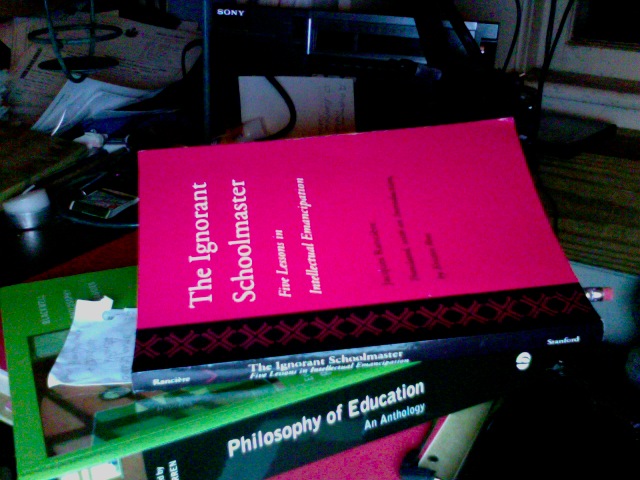
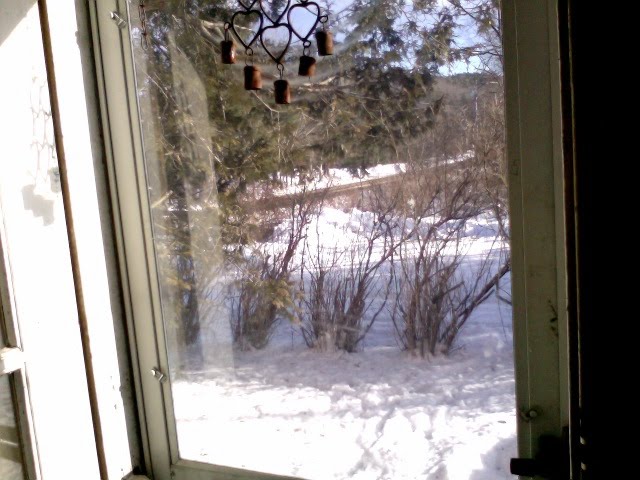
Friday, January 15, 2010

Either way. Whether perception is projection, or projection is perception, it is our choice what we see.
Enlightenment Song

Every green mountain is the
Cave of Amitabha Buddha
And the boundless sea is the
Palace of nirvana.

- Master Wonhyo (617-686)
"I'm glad you choose to see me the way you do." (Walter to Peter in episode of "Fringe" on Fox TV).

No thinking.

Only looking.

New moon.

Thursday, January 14, 2010

Walking frozen pond. Hammering ceiling boards in place. Teaching nothing I know.
"The language used by Zen is therefore in some sense an antilanguage, and the “logic” of Zen is a radical reversal of philosophical logic. The human dilemma of communication is that we cannot communicate ordinarily without words and signs, but even ordinary experience tends to be falsified by our habits of verbalization and rationalization. The convenient tools of language enable us to decide beforehand what we think things mean, and tempt us all too easily to see things only in a way that fits our logical preconceptions and our verbal formulas. Instead of seeing things and facts as they are we see them as reflections and verifications of the sentences we have previously made up in our minds. We quickly forget how to simply see things and substitute our words and our formulas for the things themselves, manipulating facts so that we see only what conveniently fits our prejudices. Zen uses language against itself to blast out these preconceptions and to destroy the specious “reality” in our minds so that we can see directly. Zen is saying, as Wittgenstein said, “Don’t think: Look!”"
-Thomas Merton, Zen and the Birds of Appetite, pp. 48-49
No system of thought suffices. Only experience.

Thinking is not thought. Thinking is seeing.

Look here.

Wednesday, January 13, 2010

We sorrow with Haiti.

Monday, January 11, 2010

There's nothing to say.

So, I'll say it.

Saturday, January 09, 2010

Things remain invisible until they are asked into sight. So too does data remain invisible until the right question organizes it into visibility. When you need help, ask for it -- and take what comes as the help made available.

At dusk, snowshoeing Hosmer Pond in stiff cold wind. My left heel and right elbow are in pain.

I know a question looms.

Thursday, January 07, 2010

A Barquentine came into port last summer. I had a birthday. Two nice people each gave me a cup from the vessel.

The body of Buddha is everywhere,
Does the Goddess of Mercy live in the eastern sea?
Every green mountain is a place of awakening;
Why must you seek Mount Potalaka?

- Paegun (1299-1375)
There's no place to go where we are not. Each place, each sound, is replete with fullness.

Potalaka, Mount

[(Skt; Jpn Fudaraku-sen)

A mountain said to be located on the southern coast of India, regarded as the home of Bodhisattva Perceiver of the World's Sounds. According to the Flower Garland Sutra, the boy Good Treasures, who was traveling in search of the Law, encountered Bodhisattva Perceiver of the World's Sounds on this mountain.

(From Soka Gakkai International (SGI) website)
Someone suggested at last evening's conversation that, unlike me, they were interested in more than the physical sensory things that were there in the room. They might be right. I suggested, after mulling this, that the distinction between physical and spiritual no longer interested me. That the versions of reality some call past, present, and future no longer seemed compelling. And that words like "levels" "hierarchy" and "more evolved" were not something I thought applied -- at least to my way of looking at things. It was good conversation.
A Stone Is Nobody's
A man ambushed a stone. Caught it. Made it a prisoner.
Put it in a dark room and stood guard over it for the
rest of his life.

His mother asked why.

He said, because it's held captive, because it is
captured.

Look, the stone is asleep, she said, it does not know
whether it's in a garden or not. Eternity and the stone
are mother and daughter; it is you who are getting old.
The stone is only sleeping.

But I caught it, mother, it is mine by conquest, he said.

A stone is nobody's, not even its own. It is you who are
conquered; you are minding the prisoner, which is yourself,
because you are afraid to go out, she said.

Yes yes, I am afraid, because you have never loved me,
he said.

Which is true, because you have always been to me as
the stone is to you, she said.

(Poem by Russell Edson, b.1935)
I'm sure I must have been lying. If you cannot tell the whole truth, is part of the truth any benefit? And do we have only versions of truth and not truth itself? Is the opposite of what we say or think also equally true?

There's a final push to finish the bookshed. Saskia and I work into the night installing fiberglass insulation. Then up before dawn, do silent sitting, then out to insert more panels. I withdraw when two workmen and one volunteer arrive. I cannot, it seems, work well with others. It is something I have to either accept, forgive, or celebrate -- perhaps all three at once.
Antimatter
On the other side of a mirror there's an inverse world,
where the insane go sane; where bones climb out of the
earth and recede to the first slime of love.

And in the evening the sun is just rising.

Lovers cry because they are a day younger, and soon
childhood robs them of their pleasure.

In such a world there is much sadness which, of course,
is joy.

(Poem by Russell Edson)
Maybe it's true that what I hold as true is that everything is here, everything is in everything, and that the opposite is equally true.

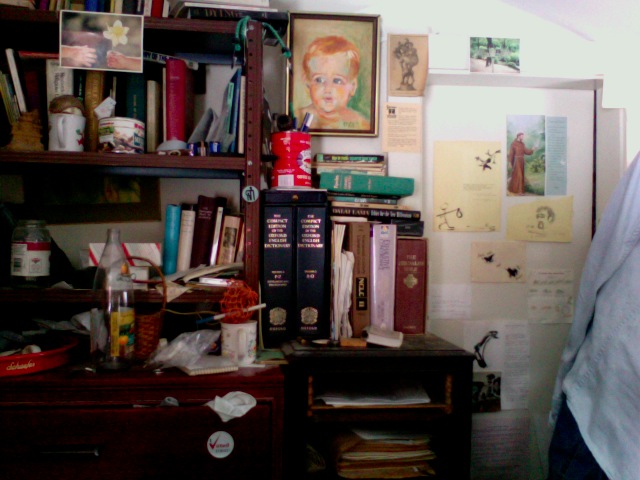
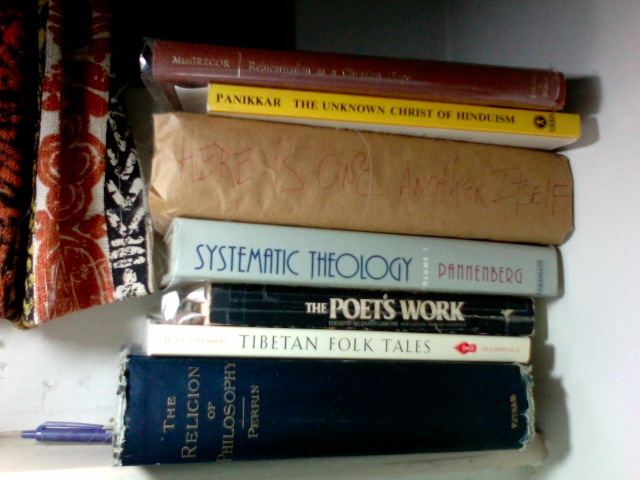
The mystery is that what we call reality tumbles out of nothing and, like a round carpet suddenly on the floor before you, situates itself as it is as ground until, you, turning in another direction, see two books -- say "Original Blessing" by Fox and "The Solitary Self" by Georgianna on a shelf under "Readings in Anthropology" and "Philosophy for a New Generation" and a book of poems by Haas entitled "Praise" -- whereupon the cat decides it is time to groom himself on the bed by blue, white, and red throw pillow. Not only that -- but it all can be, and is, different from what I describe. The mystery is that anything is communicable with any kind of intelligibility -- held in common, with shared intention, for benefit of anyone or everyone.

Like monks at dawn at prayer.

Like the intention of peace. Or kindness. Compassion.

Or even allowing another their sight, their version, their attempt to find a way of being that mirrors itself with love.

Wednesday, January 06, 2010

Epiphany means manifestation.

What was manifested in the story of Jesus? What was recognized as great gift in the land of Palestine?

What, today, shows itself in our life-situation? Isn't that equally the feast we come to revere?

The Void is fundamentally without spatial dimensions, passions, activities, delusions or right understanding. You must clearly understand that in it there are no things, no people and no Buddhas; for this Void contains not the smallest hairsbreadth of anything that can be viewed spatially; it depends on nothing and is attached to nothing. It is all-pervading, spotless beauty; it is the self-existent and uncreated Absolute. A perception, sudden as blinking, that subject and object are one, will lead to a deeply mysterious wordless understanding; and by this understanding will you awake to the truth of Zen.

(--from Transmission of Mind, by Huang-po, d.850)


We go out to see what we can see. We stay in looking at what there is to see. Isn't it strange -- traveling far to try to see what it is you carry in your heart?

Life, as we experience it here and now, is impermanent. But life itself -- what of it?


The Manifestation


Many arrivals make us live: the tree becoming

Green, a bird tipping the topmost bough,

A seed pushing itself beyond itself,

The mole making its way through darkest ground,

The worm, intrepid scholar of the soil--

Do these analogies perplex? A sky with clouds,

The motion of the moon, and waves at play,

A sea-wind pausing in a summer tree.


What does what it should do needs nothing more.

The body moves, though slowly, toward desire.

We come to something without knowing why.

(--Poem, "The Manifestation" by Theodore Roethke)


To be a hermit today is to be quietly present and aware of the ways yourself and others attempt to crowd and control emotions, thoughts, and actions. Do not be deceived. The only ground is, for now, underfoot. And it, too, is slippery.
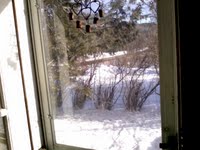
Snow: I

All night, snow, then, near dawn, freezing rain, so that by morn-

ing the whole city glistens

in a glaze of high-pitched, meticulously polished brilliance, every-

thing rounded off,

the cars submerged nearly to their windows in the unbroken drifts

lining the narrow alleys,

the buildings rising from the trunklike integuments the wind has

molded against them.

Underlit clouds, blurred, violet bars, the rearguard of the storm,

still hang in the east,

immobile over the flat river basin of the Delaware; beyond them,

nothing, the washed sky,

one vivid wisp of pale smoke rising waveringly but emphatically

into the brilliant ether.

No one is out yet but Catherine, who closes the door behind her

and starts up the street.

(--Poem, "SNOW: I" by C.K. Williams, from Love About Love. Ausable Press, 2001.)

It is good to see Catherine making her way -- wherever she is going.

At end of reading for feast of Epiphany is the phrase: "...and returned to their own country by a different way." They'd seen what they came to see.

Now, because those in authority and power want us to see what they want us to see, there's a need to sidestep their official roads so as to honor what each has seen and experienced within their own looking.

These days my return home seems to be by a different path. The walled church feels claustrophobic. Proscribed statements and historical fastness of narrative feels moribund. Contemporary concerns and current investigations seem out of sync and range of the traditional institutions no matter how they stretch forward.

Many arrivals do make us live. And we do come to something without knowing why.

For now, to be here, on one's own, seems sufficient.

It is Epiphany!

May it be a moment of sudden revelation or insight!

Tuesday, January 05, 2010

The wise, they say, find truth.
Night Rain

For no reason it rains,
Whispers of reality.
How lovely it sings,
Drop by drop.
Sitting and lying I listen
With emptied mind.
I don't need ears,
I don't need rain.

- Chin'gak (1178-1234)
Epiphany opens questions and reveals inner core.

At center, it is care.

And gentleness.

Shows itself.

Monday, January 04, 2010

Watched "Food Inc" the film directed by Robert Kenner, with Michael Pollan and Eric Schlosser adding sage words and commentary. It is about agriculture in USA this half century, the food we eat, the costs to environment, workers, and the consuming public. It is a sobering look.
I didn't know the way to the temple
So I walked miles
Among the cloudy peaks
Walked through primeval forests
No path
Not even a footprint
Deep in the mountains
I heard a bell
Where did it come from?
Then a little stream
Gurgling
Among gigantic rocks
Even the color of sunlight
Looks cool
Coming through bluegreen pines
At dusk I knelt
Next to a small
Deserted lake
Meditating
To chase away
The poison dragon of emotion.

- Wang Wei
It is hard to not feel the big boys with big sticks are coming around the corner of the street, nay, the kitchen door, where we live. It's hard to listen to and watch the way certain companies operate with their monopolized genetically engineered product and take-no-prisonor target-independent-farmer legal teams.

It's cold today in Maine. But the chill of cutthroat food production compounds and corporations goes deep to the bone.

In looking for poems to bring to the nursing home New Year's Day I found Rachel Wetzsteon.

Commands for the End of Summer

i.

Deepen,
leaves, not with what
has made us sorry but
with what was profound about that
sorrow.

ii.

Make me
spontaneous,
gathering winds, but don’t
blow so giddily I teeter
too much.

iii.

Songs I
listened to all
summer long, accept my
thanks: to regress is not to move
backward.

iv.

Splash of
patchouli on
my wrist, remind me that
in this cauldron there is a world
elsewhere.

v.

Smile! Those
days of humid
agony have earned you
the right to a hundred purple
sunsets.

vi.

Come, fall,
I can feel you
stirring, I can hardly
wait for the things that will happen
come fall.

(--Poem by Rachel Wetzsteon)

She'd just become poetry editor of The New Republic last fall. She died ten days ago. Her death was by suicide on the 24/25th of December. She was 42.
Short Ode to Morningside Heights

Convergence of worlds, old stomping ground,
comfort me in my dark apartment
when my latest complaint shrinks my focus
to a point so small its hugely present
but barely there, and I fill the air
with all the spiteful words I spared the streets.

The pastry shop’s abuzz
with crazy George and filthy graffiti,
but the peacocks are strutting across the way
and the sumptuous cathedral gives
the open-air banter a reason to deepen:
build structures inside the mind, it tells
the languorous talkers, to rival the ones outside!

Things are and are not solid.
As Opera Night starts at Caffe Taci,
shapes hurry home with little red bags,
but do they watch the movies they hold
or do they forego movies for rooftops
where they catch Low’s floating dome in the act
of always being about to fly away?

Ranters, racers, help me remember
that the moon-faced fountain’s the work of many hands,
that people linger at Toast long after we’ve left.
And as two parks frame the neighborhood—
green framing gray and space calming clamor—
be for me, well-worn streets, a context
I can’t help carrying home, a night fugue
streaming over my one-note how, when, why.
Be the rain for my barren indoor cry.
(--Poem by Rachel Wetzsteon, found on The New Republic's website)
Parker Palmer writes that
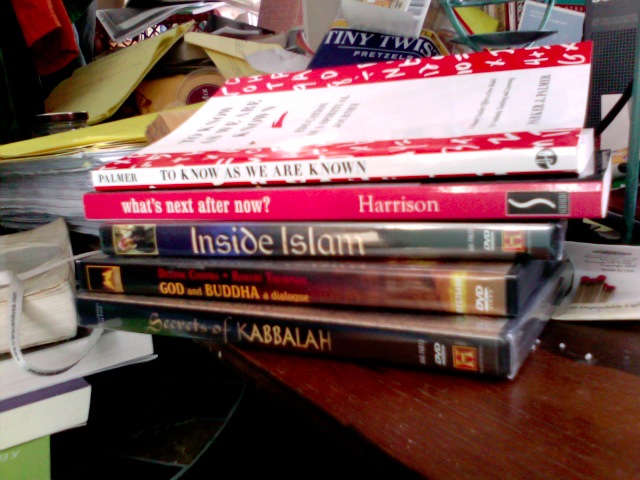
"...real learning does not happen until students are brought into relationship with the teacher, with each other, and with the subject.We cannot learn deeply and well until a community of learning is created in the classroom. (p.xvi Preface, of To Know As We Are Known, Education as a Spiritual Journey.)
When we lose soldiers, poets, workers, or anyone to the intentional or accidental vicissitudes of earthen life, we pause and contemplate for a brief while. We say a prayer. We wish them well on their journey. We've been community. It's a new classroom of shared life we all attend. We feel what takes place.

The breath of words about life and the touch of hands throughout our lives. How many hands have you touched? How many words have you shared? How many times have you stood still and gazed as words fell silent and hands dropped to sides?

I let Nikos Kazantzakis conclude:
Since we cannot change reality, let us change the eyes which see reality.
And:

The real meaning of enlightenment is to gaze with undimmed eyes on all darkness.
(--Nikos Kazantzakis)
I squint. And wince.

Sunday, January 03, 2010

It's not hard to love -- it's what you are.

What's hard is accepting who you are. For so long there have been words like those of Paul's. We've heard only the first part of his paragragh. We're so deluged by misemphasis and misdirection, we do not hear the final sentence -- which is primary:
You must kill everything in you that belongs only to earthly life: fornication, impurity, guilty passion, evil desires and especially greed, which is the same thing as worshipping a false god; all this is the sort of behaviour that makes God angry. And it is the way in which you used to live when you were surrounded by people doing the same thing, but now you, of all people, must give all these things up: getting angry, being bad-tempered, spitefulness, abusive language and dirty talk; and never tell each other lies. You have stripped off your old behaviour with your old self, and you have put on a new self which will progress towards true knowledge the more it is renewed in the image of its creator; and in that image there is no room for distinction between Greek and Jew, between the circumcised or the uncircumcised, or between barbarian and Scythian, slave and free man. There is only Christ: he is everything and he is in everything. (--from Colossians 3:5-16 )
Like a koan asking: "What is in everything?" Like a mirroring with: "What is everything in?" We find the moment sufficient with response -- every moment is sufficient as response. How can anyone claim their prayer not answered? Each moment, with whatever it brings, is answer.
Like the Sun

Cut down being and nonbeing
The All enfolds.
A dot of Buddha nature-
It shines like the sun.
You may grasp it right away
But can't escape a stick.
How can you then sit idly
And have a moment to think? -- Chin'gak (1178-1234)
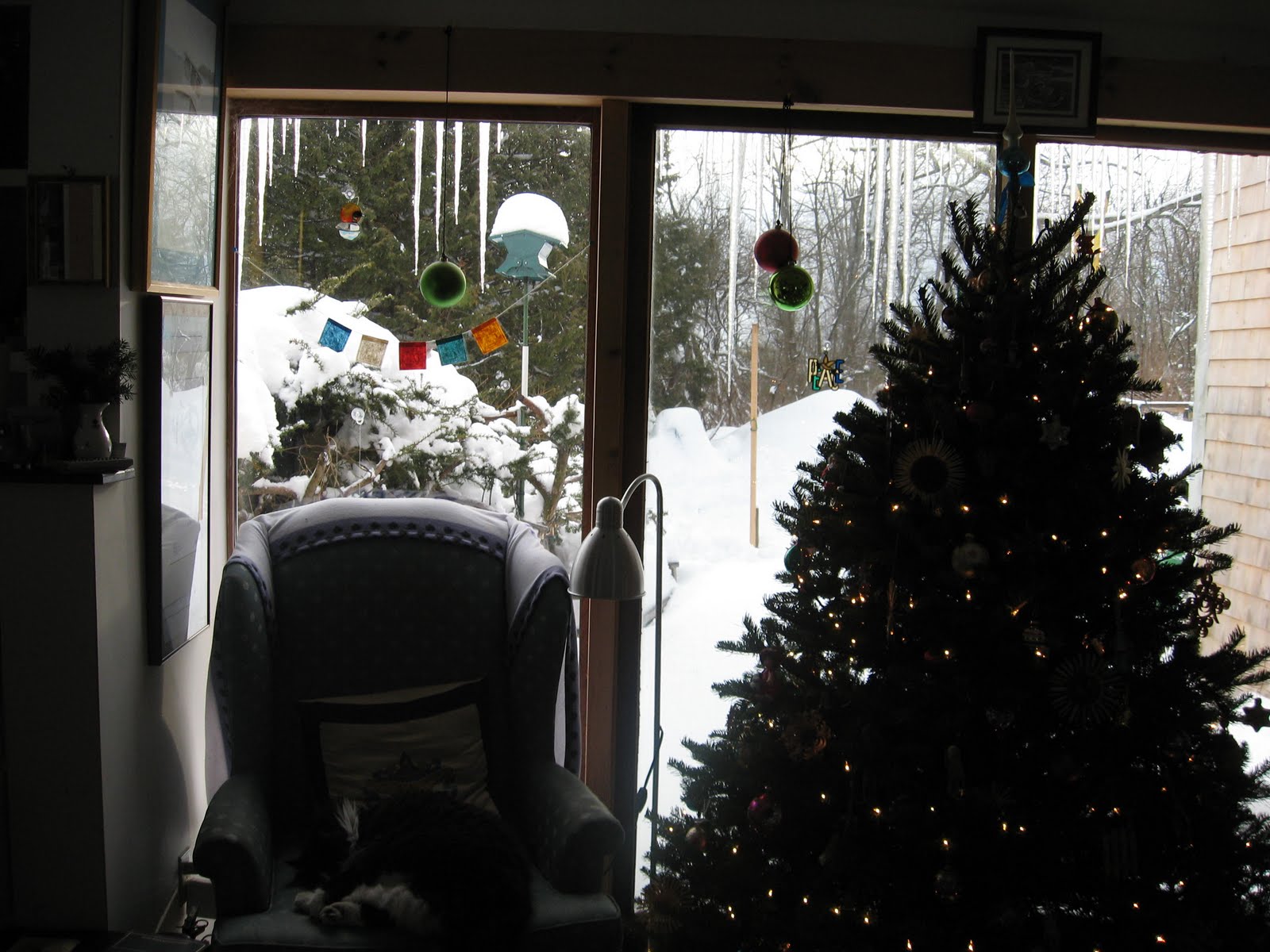
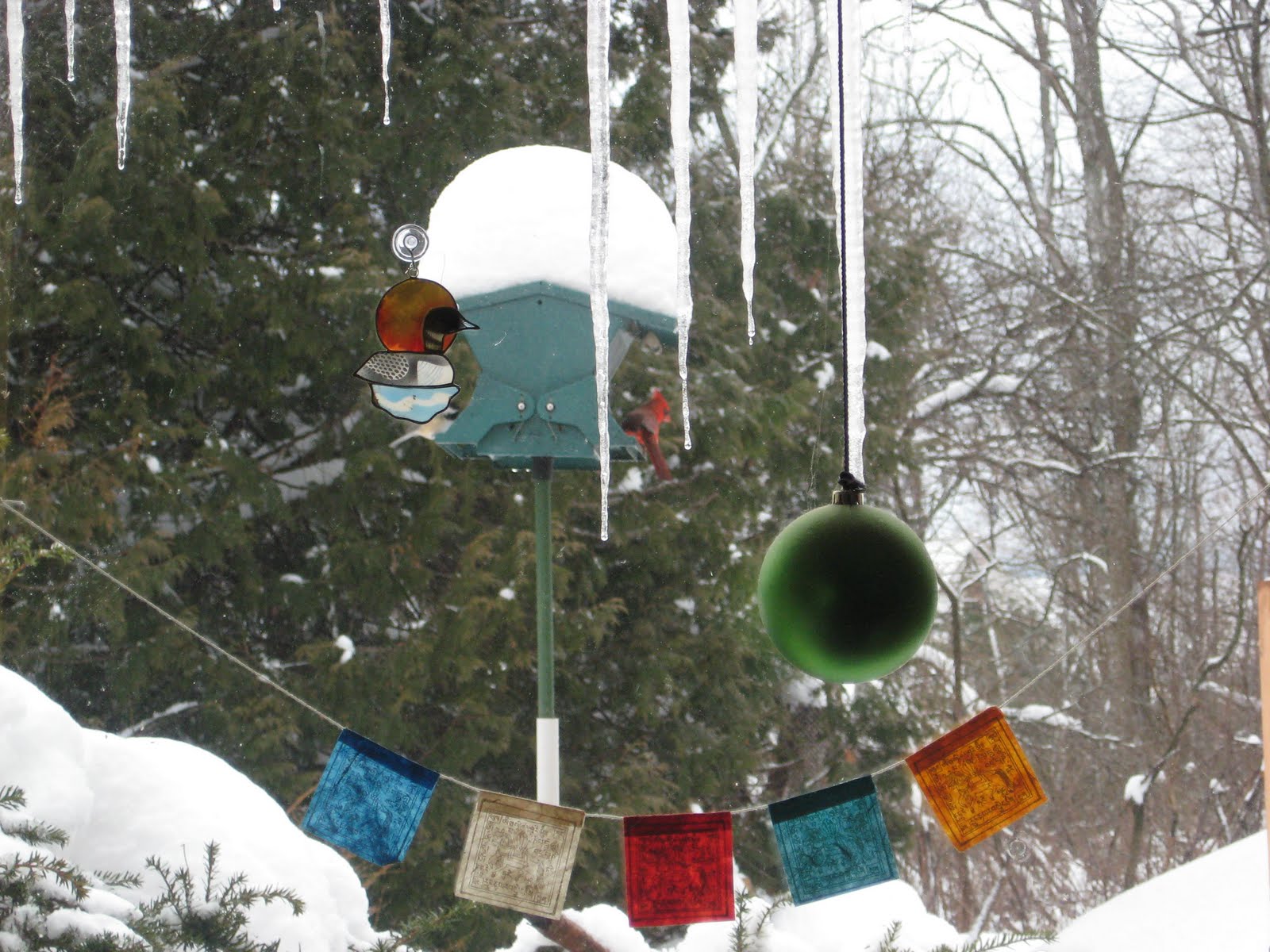
After snowfall, birds come to feed; icicles drip daylight to white covering.

After a time of darkness, light begins ascent each morning, each season, each person's intimate and immediate life.
You are told “Love God”. If you say to me “Show me whom I should love”, what can I say except what John says? 'No man has ever seen God.' But you must not think yourself wholly unsuited to seeing God: 'God is love,' says John, 'and whoever dwells in love dwells in God.' So love whoever is nearest to you and look inside you to see where that love is coming from: thus, as far as you are capable, you will see God.
So start to love your neighbour. 'Share your bread with the hungry, bring the homeless pauper into your house. Clothe the naked, and do not despise the servants of your kin.'
What will you get from doing all this? 'Your light will break forth like the dawn.' Your light is your God, your dawn, because he will come to you to end the night of this world — he who, himself, neither rises nor sets but is eternal.
By loving your neighbour, by having care for your neighbour, you are travelling on a journey. Where are you journeying, except to the Lord God, whom we must love with all our heart and all our soul and all our mind? We have not yet reached the Lord, but our neighbour is with us already. So support your neighbour, who is travelling with you, so that you may reach him with whom you long to dwell.

(-from St Augustine's tractates on St John, Office of Readings, 3Jan2010)
I love you!

However reluctant I am to say it.

I love you -- without and within "I" and "you." How is that possible?

Answer me this!

Saturday, January 02, 2010

Light caught in snowflakes.
Bless the Lord, my soul!
Lord, my God, how great you are!
You are robed in majesty and splendour;
you are wrapped in light as in a cloak.
(-- from Psalm 103)
No form of itself. Wrapped in light.

As in.

Hence, God is in-visible of itself.
Q: What is called dhyana?
R: Dhyana is concentration. As it is achievable in sitting, so it is called dhyana.
Q:When dhyana is called concentration, does it mean the concentration of mind or body?
R: Sitting cross legged concentrates the body, mental controlling concentrates the mind.
Q: The mind is formless, how can it be looked upon and be controlled?
R: It is like wind having no form of itself; one can determine it through the wavering of things. Likewise, the mind is formless, but it is immediately knowable when it contacts things. When the mind is controlled and ceases contact, it is called concentration.
Q: Five Stops on 18 realms are called concentration. When the eyes see material objects and the mind experiences mental objects, how can this be called concentration?
R: The mind arises when objects are seen, and things waver when wind blows. When wind stops, objects will be peaceful; and when objects vanish, the mind will rest. When the mind and objects are all vanished concentration and peace will be achieved spontaneously.

- The Tun-huang manuscript Seng-ch’ou ( 480-560)
Theres no need to talk about God.

Here is enough. In fact, here is all there is.


So it is we listen. With silence. And stillness. Sounding itself.

Friday, January 01, 2010

Everything always is in conversation with everything else.

We're just not paying attention.

When we do become aware, the conversation becomes vital.

Listen.

Carefully.

Deeply.
It's a new year. Let's begin again!

Thursday, December 31, 2009

End of a day. End of a year. End of a decade.

Anyone wish to pray for guidance?
After realizing the intent of Zen, people in ancient times used to spend decades polishing themselves thoroughly in order to free themselves from compulsions of conditioning and habit. This is called the work of maturation; the completion of maturation is called the attainment of unification. - Muso Kokushi (1275-1351)


We can choose to see things differently. We can transform, reverse, see truly differently whatever is occuring, has occured, or will be occurring in this perception we call the world. We can choose to live lovingly and compassionately throughout -- that is, in present presence upside down, backwards forward, inside out.

The house didn't burn down tonight. The energy was incendiary finishing with a roar the Epilogues of Course in Miracles. Eggnog sipped. Dog out and back in. We stay up and drain glasses.

Two nothing one nothing.

The message of the angel is:
"O neno thi ng. Twono thi ng."

Let's take the message. Let's follow the guidance.

Let's live in joy and light this 2010!

Happy New Year! New Day! New Decade!

Wednesday, December 30, 2009

As the year ends, there is a lot of work to do. First, exit Afghanistan. Second, encourage voluntary poverty. Third, welcome strangers.
8 Americans die in suicide blast in Afghanistan
DEB RIECHMANN, The Associated Press
Wednesday, December 30, 2009; 3:02 PM
-- At least eight Americans died Wednesday in a suicide bombing at a military base in eastern Afghanistan, U.S. officials said. Conflicting reports were reaching the Pentagon on whether the victims were civilian or military in the bombing at Forward Operating Base Chapman in Khost province near the border with Pakistan.

The deaths were confirmed late Wednesday by a U.S. official in the Afghan capital, Kabul.

A senior U.S. official in Washington said the Americans were killed by an attacker wearing a suicide vest.

Another senior U.S. official in Washington said there were conflicting reports on the number of casualties, and that other people were wounded in the attack reported hearing a blast on the base.

Soon afterward, two helicopters landed, a police officer in Khost said.

All the U.S. officials spoke on condition of anonymity because not all details about the incident had been confirmed.

(-- from The Washington Post.)
Maybe, for two, diminish greed.

And for three, accept the possibility that everyone is you without your particular ego.

A later report:

KABUL — A suicide bomber at a base in Afghanistan's volatile east killed eight CIA officers:

The attack is one of the most ambitious of the war, highlighting the insurgency's reach and coordination at a time when violence has reached its highest levels since the overthrow of the Taliban regime by U.S.-backed Afghan forces in 2001.


Reuters reports that the attack on CIA officers is one of the largest death tolls for the U.S. agency. The attack is also one of the worst loss of life for Americans in the country since October. Four Canadian soldiers and a journalist were killed by a roadside bomb in Afghanistan's south, NATO said.


U.S. officials in Washington said the suicide attacker detonated explosives Wednesday at Forward Operating Base Chapman in Khost province near the Afghan border with Pakistan, killing eight American civilians. A congressional official said CIA employees were believed to be among the dead.

"We mourn the loss of life in this attack, and are withholding further details pending notification of next of kin," U.S. State Department spokesman Ian Kelly said. (AP)

The killings must stop.

Tuesday, December 29, 2009

Wind chill to minus -18 degrees tonight.

It's cold.
"Do not be attached to the past or wait for the future.
Be grateful for each day, that is enough.
I do not believe in a future world, I deny the past.
I believe entirely in the present.
Employ your entire body and mind in the eternal now."

-Santoka Taneda
All day I read student's papers.

Crawling into sleeping bag.

Wind slicing through near-full moonlight on fresh white snow.

Wood stacked in barn.

Sticks by wood stove.

Furnace thinks it can do its job.

Monday, December 28, 2009

Quantumly, there are myriad ways of seeing an event. Ah, we say, this is a good thing! Or, as likely, we spot something that becomes for us something worrisome and revealing of a dangerous backyard.

The peanut butter and jam on toasted English with cup of yesterday's coffee reheated, is a good morning's treat. There are no guests, so I don't have to make fresh coffee. My tastes are primitive. Anything is good enough.

In the news, more info about the widening gyre of war. We now publicize, thanks to an incident on a plane landing in Detroit, that we are plying war in Yemen. Like buying donuts at Willow Bake Shop, we drop CIA operatives along with mercenary war-for-hire companies, and keep arms merchants in the dough.
U.S. Widens Terror War to Yemen, a Qaeda Bastion

By ERIC SCHMITT and ROBERT F. WORTH
Published: December 27, 2009


WASHINGTON — In the midst of two unfinished major wars, the United States has quietly opened a third, largely covert front against Al Qaeda in Yemen.
Yemeni protesters staged a demonstration in the southern part of the country on Thursday after a raid against Qaeda militants.

A year ago, the Central Intelligence Agency sent several of its top field operatives with counterterrorism experience to the country, according a former top agency official. At the same time, some of the most secretive Special Operations commandos have begun training Yemeni security forces in counterterrorism tactics, senior military officers said.

The Pentagon is spending more than $70 million over the next 18 months, and using teams of Special Forces, to train and equip Yemeni military, Interior Ministry and coast guard forces, more than doubling previous military aid levels.

As American investigators sought to corroborate the claims of a 23-year-old Nigerian man that Qaeda leaders in Yemen had trained and equipped him to blow up a Detroit-bound Northwest Airlines jet on Christmas Day, the plot casts a spotlight on the Obama administration’s complicated relationship with Yemen.

The country has long been a refuge for jihadists, in part because Yemen’s government welcomed returning Islamist fighters who had fought in Afghanistan during the 1980s. The Yemen port of Aden was the site of the audacious bombing of the American destroyer Cole in October 2000 by Qaeda militants, which killed 17 sailors.

(--from New York Times, http://www.nytimes.com/2009/12/28/world/middleeast/28yemen.html?hpw)
Donuts are considerably less expensive than the $3,888,888.89 a month or $125,448.03 a day to scope out who to kill, kidnap, or turn to the good guys. It is a complicated world, the rationale goes, and we have to fight against simplicity of thought.
Once the human mind goes astray,
Truth, the true pattern of the Tao,
Is lost.
Once the human mind is gathered in,
The true pattern of the Tao is there.

- Hu Juren (1434-1484)
The world, so it seems, is what we make it. We choose what small percentage of any given second or segment we see. We narrate the impressions we receive into a story that fits into our familiar pattern of thought. We place halos around what we call sacred and horns on that which we despise. We are the principle filmmakers of our own personal studios.

And we are frightened by a world of our own making. We blame anything, anyone, for what we see. We grow paranoid and unhappy with the lot we see.

We grow numb, cloistered and claustrophobic, very particular in our opinions and subscribed home front, and we settle in for a long winter's nap.

"And I felt it was a matter of personal integrity not to...interfere with it" -- that's what Dr. Helen Schucman said about the communication of A Course in Miracles through her. "It talked about a system I don’t know anything about, and confused me no end. I’m still cross-eyed."
(--audio, The Voice: A Historical Moment with Helen, http://www.acim.org/Scribing/the_voice.html)
As for me, I remain a kid from a Brooklyn street in Bensonhurst. I know stoop-ball and kick-the-can. I know hoops in P.S.205 Night-center and stickball in the schoolyard. We lived sewer to sewer. It was the measure of football toss, punchball hit, and how far Gary and Dominick's houses were from mine. When Anthony across the street was killed in a truck accident on the BQE something about childhood came to a close. Backyards, once the kingdom of a thousand idles, emptied out and all trace disappeared of someone else's footprints in the snow.

The old neighborhood is reconstructed within me. It is not, as the film-maker said on The Problem of God, memory. It is the energy that has comprised my very being coming alive again for a visit.
Sometimes
I catch my mind
circling for you with glazed eye--
my lost love hunting
your lost face.

Summer to summer,
the poplars sere
in the glare--
it's a town for the young,
they break themselves against the surf.

No dog knows my smell.

(--from poem by Robert Lowell - "Homecoming"
Now Yemen is my backyard.

Looking out my first-floor window a half-century gone toward the converted barn against the fence to 70th street -- no dog is chained to the link fence, no old man sits in folding chair smoking a White Owl, and no members of a large household come up stairs from basement or down stairs from back porch.

I look out at the Red Sea, the Gulf of Aden, and the Arabian Sea.

It seems a long way from the clinking glass bottles delivered to morning milk box under storm window.

I'd choose to be the milkman at dawn bringing a simple delight. The milk would be pasteurized, a process reducing the number of viable pathogens likely to cause disease and premature death.

How would you choose to see the world?

Sunday, December 27, 2009

If you wish to know the mind of God, do this: Nothing.
"Having seen that I was not capable of using all my resources in political action, I returned to my literary activity. There lay the battlefield suited to my temperament. I wanted to make my novels the extension of my own father's struggle for liberty. But gradually, as I kept deepening my responsibility as a writer, the human problem came to overshadow political and social questions. All the political, social, and economic improvements, all the technical progress cannot have any regenerating significance, so long as our inner life remains as it is at present. The more the intelligence unveils and violates the secrets of Nature, the more the danger increases and the heart shrinks."
(from Nikos Kazantzakis by Helen Kazantzakis, 1968)
Dust gathers on books. Rain falls on mountain. A quiet chant sways silence.

Saturday, December 26, 2009

The Franciscan priest at refectory table told me to read the book again in a year or ten and see what I thought about it then.

I did. Both times. And still liked it. That was over forty years ago.

Somewhere between Lin Yutang's loafer/scamp, Hermann Hesse's oscillating seeker, and Han Shan's Cold Mountain Hermit -- Maugham's Larry Darrell has been to war, come back -- but not all the way. Some part of him is lost in the meaninglessness of war and death.

He weaves through the surface postures of prosperity. He pilgrimages to deeper vistas -- with grace and goodness.
"You see my dear, goodness is after all the greatest force in the world, and he's got it."
(--final line, W. Somerset Maugham in film THE RAZOR'S EDGE, 1946).
I'm older now. Still looking. Grace and goodness continue to be profound longing. Even in fiction.

Or in fact.
Hermits are alone for one another.
My true home is Cold Mountain
perched among cliffs beyond the reach of trouble ...

The Tientiei Mountains are my home
mist-shrouded cloud paths keep guests away
thousand-meter cliffs make hiding easy
above a rocky ledge among ten thousand streams
with bark hat and wooden clogs I walk along the banks
with hemp robe and pigweed staff I walk around the peaks
once you see through transience and illusion
the joys of roaming free are wonderful indeed.

(-- anonymous 9th-century Chinese poet-hermit Han Shan, who called himself Cold Mountain.)

One day alone is a joy of roaming free.

A razor's edge paring and coring.
Tired of wandering far from home, I realize the closeness, the profound intimacy, of homecoming is right here where each one of us is.

The practice of dwelling at origin is watching.
Total Cost of Wars Since 2001
$946,948,475,346,
as of 26Dec2009, 5:10am. (http://costofwar.com/)
War is the disembodying destruction done in the name of ideal, spiritual, and unattainable utopia.

The Christmas story tells of the birth of Jesus. He is to be the Christ. So are we.

The Christ-Reality is being born in the heart/mind/center ("shin" or "kokoro"). These words are described in a posting from Buddhadharma: The Practitioner's Quarterly, Fall 2005.
Kokoro

Defined by Shohaku Okumura

When I moved to Minneapolis from Japan in 1993 to teach at the Minnesota Zen Meditation Center, my daughter Yoko was five years old. She went to kindergarten and then elementary school there. And while she learned English at school, at home we tried to talk in Japanese. One time, when she was seven or eight, we were talking about the Japanese word kokoro. I pointed to my heart as we usually do in Japan to show where kokoro is. She pointed to her head and said, “Kokoro is here.” I was amazed to discover that she was already translating the Japanese word kokoro into the English word “mind.”

Kokoro is a common Japanese word that carries meanings conveyed by the English words “mind” and “heart.” It is used as an equivalent of the Chinese word xin and covers almost the same range of meanings. The Japanese use Chinese characters to write Japanese, and have also studied Chinese literature as an essential part of both secular and Buddhist education for more than 1,500 years, which has led to a convergence of meaning between Chinese and Japanese for many classical words.

The Chinese ideogram for xin depicts the shape of the heart—the actual organ in the human body. Since ancient Chinese people thought the heart was where psychological function took place, the character conveyed a range of meanings including the heart organ, heart generally, mind, feeling, intention, center, and core.

The entry for kokoro in a dictionary of classic Japanese words communicates similar notions:

Originally, kokoro referred to the beat of the heart, which was considered to be the essential organ of life and the source of all activities. By extension, kokoro refers to all human activities affecting the outside world through intention, emotion, and intellect.
Kokoro, then, has three basic meanings: the heart and its functions; mind and its functions; and center, or essence.

The Chinese xin has an important spiritual and philosophical history, since it was used in Chinese translations of Buddhist scriptures for such Sanskrit terms as: citta, manas, and vijnana. In the Sarvastivadin view, these three were considered to be different names for basic mind. In Yogacara, though, citta refers to the alaya, or storehouse consciousness, while manas refers to the seventh consciousness, and vijnana refers to the function of the first six consciousnesses. These three can all be translated into the catchall English word “mind.” Another Sanskrit word, hrdaya, means the heart, center, or essence. It is also rendered as xin.

So both xin and kokoro carry the physical and spatial meaning of heart, center, or essence, and the psychological meaning of mind. It is very interesting to see that Sanskrit and English have completely different words to point to heart or mind and have no word that combines both meanings. The fact that they are both Indo-European languages may account for this shared dichotomy.

The Prajna Paramita Hrdaya Sutra is one of the most popular Mahayana sutras. In Japanese, it is called maka-Hannya-haramita-shin-gyo. The shin in the title is another rendering of the Chinese character xin, which of course carries the same dual meaning and roughly similar meaning to kokoro. But the best English translation is Heart Sutra, not Mind Sutra, because the original Sanskrit being rendered into Japanese and Chinese is hrdaya, not citta. Hrdaya, here, means that though this is a short sutra, the essence of the large six-hundred-volume Prajnaparamita Sutra is fully expressed.

There is another interesting and important usage of xin/shin/kokoro in Zen literature, as illustrated in Zen Mind, Beginner’s Mind, when Shunryu Suzuki Roshi says,

The mind which is always on your side is not just your mind, it is universal mind, always the same, not different from another’s mind. It is Zen mind. It is big, big mind. This mind is whatever you see—this mind is at the same time everything.
Although Suzuki Roshi used the English word mind, to me it is clear that he is elucidating the meaning of xin as it developed from the meaning of hrdaya, not citta. Mind, or citta, cannot be both subject and object, whereas xin includes both the subject and all the objects in the entire world. Suzuki Roshi’s understanding of this principle came from Dogen Zenji’s treatise entitled Shobogenzo Sokushinzebutsu (The Mind Is Itself Buddha), where he says, “The mind that has been correctly transmitted is the one mind... and all dharmas are one mind. The mind is mountains, rivers, and the great earth; the sun, the moon, and stars.”

I don’t think either the Sanskrit citta or the English word mind conveys such a meaning, which presents us with a typical problem in translation. Uchiyama Kosho Roshi often said that the xin used in Zen is not “psychological mind,” but it is rather “life,” which includes both subject and object. In the 1970’s when I tried to explain this to an American friend, he was puzzled by the expression “psychological mind” and asked, “Is there such a thing as mind that is not psychological?” In Zen, I think we would say yes.

Kokoro (xin, shin, heart/mind) ultimately refers to the entire network of interdependent origination in which we are born, live, and die, and to which we awaken through our practice.


(Shohaku Okumura was ordained as a Soto Zen priest in 1970 by the late Kosho Uchiyama Roshi. He now resides in Bloomington, Indiana, where he founded the Sanshin Zen Community.)
As of 5:45am, the cost has increased in 35 minutes to:
Total Cost of Wars Since 2001
$946,957,700,324

Cost of War in Iraq
$712,130,889,718

Cost of War in Afghanistan
$234,826,810,606
To become a Christ, to revere Christ, there is something very important to do. What is that?

To become a Buddha, to revere Buddha, there is something very important to be. What is this?

I will practice under the watchful gaze of these two questions.

I will sit, walk, eat, work, bow, converse, and keep silence.

For strength I will look to you -- as you practice.

Shin.

Kokoro.

Embody life here and now!

It is Christmas.

Friday, December 25, 2009

And so.

It's been Christmas.
I've lived in this hermitage
How long I don't know
Deep and secret and
Without obstructions
Heaven and earth meet
Like box and cover:
There's no turning toward
Or turning away.
I do not stay in the east, west,
South or north
The jewel tower and the jade palace
Do not stand opposite me.
I do not take guidelines from
Bodhidharma as a model
As the light shines freely through
Eighty four thousand gates.

- T'aego (1301-1382)
War, you know, is over.

If we want it.

I do.

You?