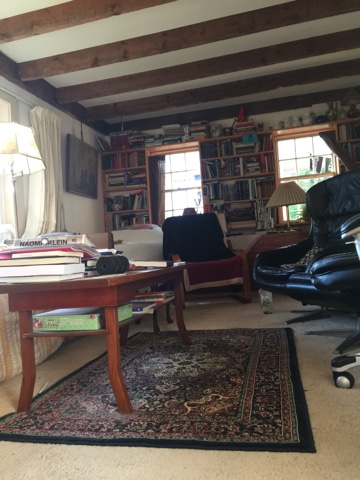
Saturday, June 11, 2016

no trace


There’s only one thing that matters in life: Arriving here, where we are, fully aware who we are where we are.

And there’s only one difficulty in life: We don’t want to be here. And yet here we are. 


Therefore there’s only one problem we have in life: We are a reluctant community, a reluctant community try to figure out what to do, how to be, here. 

Tea and Rice, by Zen Master Dogen 
When you ride in a boat and watch the shore, you might assume that the shore is moving. But when you keep your eyes closely on the boat, you can see that the boat moves. Similarly, if you examine myriad things with a confused body and mind, you might suppose that your mind and essence are permanent. When you practice intimately and return to where you are, it will be clear that nothing at all has unchanging self.  
--To study the way of enlightenment is to study the self. To study the self is to forget the self. To forget the self is to be actualized by myriad things. When actualized by myriad things, your body and mind as well as the bodies and minds of others drop away. No trace of enlightenment remains, and this no-trace continues endlessly.  
–If you attain unsurpassable, complete enlightenment, all sentient beings also attain it. The reason is that all sentient beings are aspects of enlightenment.  
–Great enlightenment right at this moment is not self, not other.  
–If you speak of “achieving enlightenment,” you may think that you don’t usually have enlightenment. If you say, “Enlightenment comes,” you may wonder where it comes from. If you say, “I have become enlightened,” you may suppose that enlightenment has a beginning.  
–Great enlightenment is the tea and rice of daily activity. 

♦From The Essential Dogen: Writings of the Great Zen Master, edited by Kazuaki Tanahashi and Peter Levitt © 2013. Reprinted with permission of Shambhala Publications.

http://tricycle.org/magazine/tea-and-rice-2/?utm_source=Tricycle&utm_campaign=8947c1f89e-Daily_Dharma_June_11_201606_11_2016&utm_medium=email&utm_term=0_1641abe55e-8947c1f89e-307306085 
Here we are.

We are here.


Why is it we pretend not to know who we are? 

They push each other around; these millionaires shoot baskets

No, this is not really about basketball.

Yes, we are beyond religion. 

Instead we are merely religious, with no structure able to coalesce the longing for truth that rises from each person.

Now what?

As an individual, become the thing itself you long for.

Become, religiously. without structure,  the empty wholeness of solitary communion.

Alone together.

Alone with others.

Alone within community.

Friday, June 10, 2016

Comma period exclamation point question mark

Yes

The article said that punctuation was coming to its end

How silly is that

How would we know when to upwardly inflect

Or whether to pause before

Going on

Thursday, June 09, 2016

I don't know why

What is giving self away?

Oh, that's what is called Christ.

What generous love is, giving oneself away.

And where is away?

It is where your self was.

You say hello, I say goodbye.

Wednesday, June 08, 2016

It's nothing, really

I go to daily mass in order to meditate on the mystery of someone attending daily mass in coastal Maine late May early June after teaching is done and afterward, for $3 even, a 24 ounce coffee and chocolate donut which feels as holy as thin white wafer and minitaste of altar wine.

Which is that and isn't that at same time.

Which just might be nothing other than anything else only completely itself -- a reconciliation, you might say, of everything with everything else, as god is no judge, only itself among us.

It is structures of consciousness elbowing each other for seat in final pew then going silent while something repeats itself from front of church. A 10 year old boy, Schwinn bicycle leaning on iron fence in Bensonhurst, answering first line with ad deum qui laetificat juventutum meum.

Then, the falling into nothing I knew nor know.

As it is now.

And, no doubt, ever will be.

World without end.

Amen

ex opere operato

Sun between top of window and top of trees.


Red vigil candle recognizes, if you will, its source.

PantaRhea moves from east to north window.


It is one thing to wake up of a morning, and another thing to not know anything else.

Not the idea of the room but the room itself.


Out of the work the work itself.

Tuesday, June 07, 2016

are and are not

I glanced at a job description for a position in the local parish. I looked up. When I looked back at it four and a half decades had passed. I realized there are things inside things, dolls inside dolls, and as morning unfolds, sun rising, Gregorian chant playing, my glance turns to natura. 
Eriugena's theology centers on the notion of an infinite, incomprehensible, transcendent God --"the immovable self-identical one" -- whose freely willed theophanies (divine manifestations) alone can be apprehended by created intellects such as angels and human beings.
...
Natura is defined as universitas rerum, the 'totality of all things' that are (ea quae sunt) and are not (ea quae non sunt).
(--Dermot Moran, Johannes Scottus Eriugena, in The History of Western Philosophy of Relinion, ed. by Oppy & Trakakis, c.2009)
I'm glad to have walked within and circumambulated the Catholic Church. I have done so as an idiorhythmic monastic mendicant.
Something I have come to understand slowly over my lifetime is that nature, earth, the world—whatever you call it—is not simply something I am on but something I am. It is not outside of me: it is me, and I am it. There is no outside.
(—Paul Kingsnorth, "The Witness")
The outside makes me lonely. The inside finds me alone.

The mystery and mysticism silently surround the place I pass through.

I belong nowhere.

I am content as, Camus suggests, was Sisyphus.

Monday, June 06, 2016

ama nesciri

The foolish want perfection.

The ordinary person wants to get through.

The empty minded says "thanks for this" -- and steps aside.

Sunday, June 05, 2016

unminding me

Looking back, I thought I missed the liturgical celebrations of the Sacred Heart, and the Immaculate Heart of Mary, doing prison, nursing home, helping with a woman needing medical/support help.

On reflection, these hearts beat without me.

negotiating for release

Prison is both concrete and metaphorical.

So is birth and death.
 The Incarnation announces the radical particularity of each individual and the radical particularity of the things in the world, and that the metaphysical cause of that condition of things is the birth and death and resurrection of Christ who, while being the universal God, took it upon himself to become a radical particular. This fact instigates, progressively, our transformation from being mere copies of eternal paradigms to being fully existent identities. Radical particularity applies universally: it delivers to all particulars their status as particulars; it imparts to each thing the condition of its identity, granting to it what in the past it only had as it were on loan from its eternal original. And yet the Incarnation is able to become a universal cause by becoming a particular fact. What for Platonic thought, for instance, belonged to a realm of atemporal forms or ideas, has entered history. The forms are in the world as the schemata for the things of the world, fully existing only as those things.  
(--from, History and “The Thinking Now Occurring” by Charles Stein)   http://www.charlessteinpoet.com/prose/unpublished-texts/history-and-the-thinking-now-occurring/
I’ve begun to think of my visits to prison these twenty seven years as a succession of three hour sentences I serve with a bevy of cellmates with whom I meet in enclosed rooms and open areas to discuss terms, negotiating for release.
Radical Particularity Outside of the West 
Humanity did not have to wait for the Christian epoch to attend and appreciate particular existence, however the course of Western thought appears, at least in one major stream of its history, to have been determined by the need to shake off the Platonic hypostatization of a realm of ideal forms supervenient upon concrete experience. Zen Buddhism, the Taoist tradition deriving from Chuang Tzu, the Dzogchen tradition in Tibetan Buddhism, and countless examples from animist peoples all give ample evidence of an anchoring of Being in the radically particular that, in terms of precise practice, far exceeds anything propounded in this regard in the West. From the perspective of these practices as spiritual perspectives, the radical particularism of the Thinking Now Occurring appears a bit like too little too late.These traditions offer many and varied forms of practice geared to explore what there is every reason to view as ontological possibilities unknown in the West. (Much of Buddhist thought, of course, abrogates ontological speculation as such. 
In general, it does not seek to deny or affirm the existence of objects or the truth of concepts but seeks rather to transform our relation to that ground in our sentience from which ontological concern arises. But that does not imply the irrelevance of Buddhist experience and practice to our ontological concerns.) The cartoon version of Buddhist, Taoist, and Hindu traditions as involving the subsumption of the individual by a supra- or sub-venient continuum, begs the question of the value and nature of the ontological territory these practices open. One does not know what the Buddhist means by his nirvana without undergoing the initiation that reveals it. Gautama Buddha, for instance, refused to answer questions which to us would be essentially ontological ones, including whether there exists an individual entity that survives from birth to birth and which undergoes enlightenment—presumably because he understood that the nature of existence as experienced once the enlightenment process has been undergone is no longer what it was experienced to be prior to this. We need to be as wise as a Buddha in this respect and not exclude from our polyontology the ontological perspectives that these practices quite plausibly might open. Many of the essential practices the Buddhist practitioner masters involve a radical attention to the minute particulars of sensory and mental experience, so that experiential regions which for the Western thinker are matters of speculation, for the Buddhist are open in depth to empirical exploration. In this regard, the attention to the concrete, and in that sense the historical, is far more advanced in the East than it is in the West in spite of the fact that Buddhism does not take a full-blown interest in what we call history. What we think of as history in the sense of a running narrative of the concrete appears to the Buddhist as the run-away elaboration of mental construction. 
(--from, History and “The Thinking Now Occurring” by Charles Stein) http://www.charlessteinpoet.com/prose/unpublished-texts/history-and-the-thinking-now-occurring/
 Friday’s bid was full of good-time.

Every time I walk in and out the twelve locked and clanging doors to open walkway to parked car I get to experience restorative freedom, the gift of particular gratefulness, nonrestrictive movement, the invitation to arrive, to depart, and to wonder about it all.

The minute particulars.

The radical particularity of being-with one another. 

in the opinion of the judges

The victory goes to the heavyweight champion, and still an example of thoughtful kindness and innocent presence, the one, the only, Muhammad Ali!

[The crowd roars~]

("Yay... Yeah...Yah")

Thanks Champ!

Saturday, June 04, 2016

a split decision

Of course we love him.
He was irrepressible, Muhammad Ali.
Still, the violence to brains and psyches by bashing bodies for sport.
It is a worrisome glory that courts debility.

Friday, June 03, 2016

this thinking now occurring

In prison this morning the drama players performed pieces of dialogue from Dead Poets, Hamlet, King Richard, Goodfellas, Glass Menagerie, and Purple Rain.

At same time, in back row, sitting between myself (the volunteer) and warden, the tall man (inmate) with goatee passed me articles on Leahy and Heidegger -- intellectual work he is doing now that he is out of segregation after "ten months, this time" (he says).

Like monks in scriptorium during dark ages we eke out fragments of illumination in pericopes of passing phrases during background discourse.

"I'm dying here," he says, as purple rain falls.

This thinking now occurring surrounding us.

Thursday, June 02, 2016

...and in the end

This is the way we are. The statistical probability of screwing up is fixed (but not final) and fluctuates between often and far too often.

Some call it the law of averages. Or Murphy's law. Some the human condition. Some weave the notion of sin with its need for redemption into the mix.

Whatever we call it, we know what it is.

The good is not the enemy of the perfect.

The good is a pragmatic and possible goal.

No matter what precedes it.

Wednesday, June 01, 2016

uncertain improvisation

Tuesday Evening Practice!


As Phoebe nest suddenly falls from under eaves.

Perfectly shaped empty space, sitting now on unplanted flower box -- a sudden uncertain improvisation -- the building Phoebes take their efforts to other side, an older transition site -- as once intended nesting home no longer holds.

Cabin zazen MU!

 Anicca visit!
Anicca, ( Pali: “impermanence”) Sanskrit anitya, in Buddhism, the doctrine of impermanence. Anicca, anatta (the absence of an abiding self), and dukkha (“suffering”) together make up the ti-lakkhana, the three “marks” or basic characteristics of all phenomenal existence. http://www.britannica.com/topic/anicca
 Charles Olson wrote:
There is no intelligence
the equal of
the situation
(--from poem, Love)

Tuesday, May 31, 2016

lacrima

Yes

Mozart's Requium in D minor at Camden Opera House yesterday, Memorial Day afternoon, was preceded by America the Beautiful.

 Down East Singers, musicians, conducted by Tony Antolini.

Bellissimo e profundo!

Monday, May 30, 2016

wit and winsome wisdom -- pray we learn to care for what is right in front of us.

re. Giant algae blob called ‘emergency’ for Camden pond, By Stephen Betts, BDN Staff, Posted May 29, 2016, at 3:17 p.m.
Gotta love the wit and winsome wisdom of comments section.
At issue here, as always, is how every commenter and reader is under thumb of the powerful and arrogant. In Camden it is managers of town and snow bowl. In United States it is war-entrepreneurs and thin-thougted enthusiasts demanding wars-for-profit and bodies-for-bullets to prop up in front of news coverage for nationalistic consumption.
There are always those who smugly think they know better and know how to cheer for private interests over common good.
This Memorial Day, what say we stop deployments, remember and pray for those dead and deadened by war, and figure out how to sideline the arrogance and idiocy of war as national pastime?
The dead from war are to be honored. The deadened from war, whether disillusioned veterans or illusional civilians, are to be helped through the terrible toll direct terror and fighting inflicts, or the numbing mindless indifference of the "it's not my problem" crowd. Wit and whimsy are poor substitutes for steady gaze and fierce compassion toward the work that remains to change minds and hearts from the glory of war to the (seemingly impossible to instantiate) love of life and earth and one another.
"What's wrong will always be wrong" said the poet Richard Hugo -- and I submit that what's right is each time created new.
It starts with cleaning up your own barn, back yard, junk room, algae'd pond, local town leader arrogance, state leader imperviousness, federal government patronization and pretentiousness. Finally, clearing up our own minds' cluttered beliefs that what matters most is power and winning, being number one and mocking anyone not inside our narrow and selective way of thinking.
We don't bury the dead and forget them. We remember them. We don’t walk away from polluted ponds, rivers, or oceans -- rather, we work together to revive a sense of belonging, belonging to the earth, your God, family, community, and, finally, belonging to yourself.
But we ought to bury the belief in my country right or wrong, water the ground with sorrow for offenses committed, and cultivate the soil for growth of awakened community.
And pray we learn to care for what is right in front of us.
May those killed in war rest in peace! May we preserve life in peace for the rest of our time on earth!

waking up, looking around

We remember
And pray for
All those dead
And deadened
By war --
This
Memorial Day

a time of defect and imperfection

Remember. So as not to forget.

The "Moving Wall" is in Thomaston. I've not gone to see it yet. It stands, this morning, in rain.

Vinny D's name is on it. I have his letters from Vietnam. My friend the left handed catcher on Brooklyn sandlots. 

I remember. His letters said he didn't want to hear complaints about how we lived in the States.  The people he saw in Vietnam had next to nothing. The contrast lit up his mind and broke his heart.

Then the news came home, and he didn't -- not alive -- a land mine.

We remember so as not to forget.

The way a people suffer.

The deaths of war.

The terrible cost.

The stupidity.

The flaw.

Sunday, May 29, 2016

seeing Christ is emerging

Corpus Christi, Yes --

The outer of the inner, the here of the beyond, the within of appearance.

The body of Christ is particular, singular, and historical. 

The Body of Christ is the whole of it, our commonality, the community sangha of each place in every time.

When, at communion, it is said "the body of Christ" -- these words are equally declarative, exclamatory, and interrogative. 

This is the body of Christ. This! This is the body of Christ!!! This? This, is the body of Christ?

Body is Christ -- this -- this is the thing, the mystery we do not understand.

To the question "What is Christ?" comes the answer "What is" is Christ. Everything seen. Everything appearing. As it is . Where it is. When we see it.

Yes, when we see it. There is an observatory aspect to Christ-reality.

It requires present seeing of its phenomenality. A seeing presencing that initiates reciprocal emergence of reality.

Christ is emergence. Not univocality, but reciprocality. There is no Christ without but for reciprocal recognition of Christ within one another and all manner of beings appearing in the world.

Hence, Christ is between us, or not at all.

The question "Do you believe in Christ?" is asking a much more simple, basic and profound question, namely, "Is there anything between us?"

(Not, "What separates us?" But "What is between us?")

Until and unless we come to see "what is" between us, we remain fragmented, separated, cut off from the really real reality longing to emerge from, into, as  this existence this place this time this being this revelation this liberation this no-other realization of complete creation accomplished in our presence.

The words "What is this" are equally declarative, exclamatory, interrogative, as well as evocative, and exhortatory.

These words are a spirituality unto itself, yes, unto Itself!

Combined with "body of Christ" the words "what is this" reveal themselves as a zen phenomenological aseity -- [aseity is defined as existence originating from and having no source other than itself] --
this seeing as itself between us between itself as seeing this.

Either way you look at it, we are not alone as long as Christ is, emerging.

My morning koan:

What                  Quid
is                         est
this ...                 haec ...

body        
of                       Corpus
Christ                  Christi