Friday, June 06, 2008

The men in prison spoke about neutrinos, God, belief, and science.
When body and soul are rid of the dust of this world of dreams our understanding is awakened and Truth perceived.
(- Wall poem at North Peak Temple)
Like God, neutrinos permeate and penetrate all of matter and form.
Neutrinos are elementary particles that travel close to the speed of light, lack an electric charge, are able to pass through ordinary matter almost undisturbed and are thus extremely difficult to detect. As of 1999, it is believed neutrinos have a minuscule, but nonzero mass. They are usually denoted by the Greek letter nu.
(--Wikipedia)
It's an old question: Is God out there or in here? The mind you have that looks at this is the mind that formulates the response circumscribed by the ability of that mind to see.
Most neutrinos passing through the Earth emanate from the sun, and more than 50 trillion solar electron neutrinos pass through the human body every second. (--Wikipedia)
And if someone embodied the creative natural vitality of God, would they also be Christ?

Our visit to prison passes through what passes through us.


We thank each other for the visit through and through..

Thursday, June 05, 2008

Thursday Evening Conversation for the past year plus has been an ongoing study of the Course in Miracles. Jack and Cathy lead. The group fluctuates from six to sixteen. Tonight, because Megan was lecturing in Rockland about her new book on Clare of Assisi, there was the lower end of the fluctuation.
You cannot walk the world apart from God, because you could not be without Him. He is what your life is. Where you are He is. There is one life. That life you share with Him. Nothing can be apart from Him and live.
Yet where He is, there must be holiness as well as life No attribute of His remains unshared by everything that lives. What lives is holy as Himself, because what shares His life is part of Holiness, and could no more be sinful than the sun could choose to be of ice; the sea elect to be apart from water, or the grass to grow with roots suspended in the air.
There is a light in you which cannot die; whose presence is so holy that the world is sanctified because of you All things that live bring gifts to you, and offer them in gratitude and gladness at your feet. The scent of flowers is their gift to you. The waves bow down before you, and the trees extend their arms to shield you from the heat, and lay their leaves before you on the ground that you may walk in softness, while the wind sinks to a whisper round your holy head.
The light in you is what the universe longs to behold All living things are still before you, for they recognize Who walks with you. The light you carry is their own. And thus they see in you their holiness, saluting you as savior and as God. Accept their reverence, for it is due to Holiness Itself, Which walks with you, transforming in Its gentle Light all things unto Its likeness and Its purity.

(--from Lesson 156, I walk with God in perfect holiness, The Course in Miracles)
I remember 1968. Martin Luther King Jr. Robert Kennedy. Over the years it has seemed their deaths were less and less explainable, their killers less and less likely. Staying just this side of complete disbelief, I wonder what it is the world holds as truth.

Lesson 157 begins: "This is a day of silence and of trust"

Silence and trust are necessary.

Hard to apply to 40 year old stories.

Still, in themselves, despite fluctuations, worthwhile.

Wednesday, June 04, 2008

I am this not that. I am this and that. I am beyond this and that.

Beyond this and that, yet including this and that, is I Am consciousness. It sees and knows in stillness. It is not afraid. It loves all and each as itself.

Human behavior needs to reflect on itself.
Taking refuge in the Buddha implies no personal guarantee that the Buddha himself will effect the arrival at the Goal of any of his followers. To the contrary, he says: "Surely by oneself is evil done, by oneself one becomes pure. Purity and impurity are of the individual. No one purifies another." ...According to the doctrine of karma, future happiness is a direct result or continuation of the maintaining of a satisfactory standard of conduct in the present.
(--from Buddhist Ethics, by Hammalawa Saddhatissa)
And:
The keynote in the life and teaching of Jesus with regard to man’s moral duty is found in "obedient love." This means that with faith in God as the energizing center of one’s being, one is required to seek to do the will of God by loving God supremely and one’s neighbor as one’s self. However, as the total impact of Jesus’ teaching makes evident, to love one’s neighbor as one’s self is not to be understood as any precise balancing and equating of love for others with self-love. Still less does it mean loving others for the sake of receiving love or other benefits in return. Agape love means, rather, an uncalculating, outgoing spirit of loving concern which finds expression in deeds of service without limit.
(--from Christian Ethics, by Georgia Harkness)
We need community. Community is our teacher. The teaching is not easy to discern.

Forty years ago Robert Kennedy was shot and killed. He'd be in his eighties today.

We have much to learn.
THE MAPLE TREE

The maple tree that night
Without a wind or rain
Let go its leaves
Because its time had come.
Brown veined, spotted,
Like old hands, fluttering in blessing,
They fell upon my head
And shoulders, and then
Down to the quiet at my feet.
I stood, and stood
Until the tree was bare
And have told no one
But you that I was there.

(--Poem by Eugene McCarthy)
We are all there.

Do not be fooled. There is much to learn. Look to it.

Perhaps there is a way to undo that wrong.
Drop, drop—in our sleep, upon the heart
sorrow falls, memory’s pain,
and to us, though against our very will,
even in our own despite,
comes wisdom
by the awful grace of God.
(--words by AESCHYLUS, Agamemnon. Edith Hamilton, trans., Three Greek Plays, p. 170, 1937).
Perhaps by being this right here.

Tuesday, June 03, 2008

Democratic primaries end tonight. In the next 90 minutes or so the pundits will exclaim, the candidates will proclaim, and rhetoric will declaim.
Holding his stick,
He points directly to humanity,
Yet as he was originally without form,
This portrait is not true.
His form cannot be seen
As form,
His benevolence is merely his
Natural benevolence.
If, all of a sudden,
You can understand this law,
Then your spirit can roam
Beyond the world.

- Ingen (1592-1673)
I pause to pray. For all of them. For all of us. For decency, authenticity, and wisdom.

Tonight, before the theater of the final six months towards a new president begins, I turn to a Maine poet.
A Quiet Life

by Baron Wormser


What a person desires in life
is a properly boiled egg.
This isn't as easy as it seems.
There must be gas and a stove,
the gas requires pipelines, mastodon drills,
banks that dispense the lozenge of capital.
There must be a pot, the product of mines
and furnaces and factories,
of dim early mornings and night-owl shifts,
of women in kerchiefs and men with
sweat-soaked hair.
Then water, the stuff of clouds and skies
and God knows what causes it to happen.
There seems always too much or too little
of it and more pipelines, meters, pumping
stations, towers, tanks.
And salt-a miracle of the first order,
the ace in any argument for God.
Only God could have imagined from
nothingness the pang of salt.
Political peace too. It should be quiet
when one eats an egg. No political hoodlums
knocking down doors, no lieutenants who are
ticked off at their scheming girlfriends and
take it out on you, no dictators
posing as tribunes.
It should be quiet, so quiet you can hear
the chicken, a creature usually mocked as a type
of fool, a cluck chained to the chore of her body.
Listen, she is there, pecking at a bit of grain
that came from nowhere.

(-- Poem, "A Quiet Life" by Baron Wormser, from Scattered Chapters. Sarabande Books, 2008.)
Imagine from nothingness a dwelling place of reverence.

Arrive from nowhere. Bring invisible love. The community is teacher.

Nancy said tonight about authenticity: "He is what he says. She is what she says."

Integrity.

Monday, June 02, 2008

Sitting zazen at 5:20AM in cabin, incense and candle, Rokpa and bird call. A mantra arrives:
"
Francis, Buddha, Dogen, Christ -- see us through this loving life!"

Carrying wooden stepladder to bird feeder, pouring wild seed into green metal holder, the words change into "lead us through this loving life." White dog has become good meditation companion in cabin, on trail, in yard. Three months with us, eight months old.
The great way of the buddhas is profound, wondrous, inconceivable; how could its practice be easy? Have you not seen how the ancients gave up their bodies and lives, abandoned their countries, cities, and families, looking upon them as shards of tile? After that they passed eons living alone in the mountains and forests, bodies and minds like dead trees; only then did they unite with the way. Then they could use the mountains and rivers for words, raise the wind and rain for a tongue, and explain the great void, turning the incomparable wheel.
- Dogen (1200-1253)
Practice is not easy, not hard. It is beyond easy and hard. Without practice we are the playthings of others.
How to Become a Buddhist

If one desires to become a Buddhist, there is no initiation ceremony (or baptism) which one has to undergo....If one understands the Buddha's teaching, and if one is convinced that this teaching is the right Path and if one tries to follow it, then one is a Buddhist.

But according to the unbroken age-old tradition in Buddhist countries, one is considered a Buddhist if one takes the Buddha, the Dhamma (the Teaching) and the Sangha (the community of Buddhists)--generally called "the Triple-Gem"--as one's refuges, and undertakes to observe the Five Precepts--the minimum moral obligations of a lay Buddhist:

(1) not to destroy life, (2) not to steal, (3) not to commit adultery, (4) not to tell lies, (5) not to take intoxicating drinks....

There are no external rites or ceremonies which a Buddhist has to perform. Buddhism is a way of life, and what is essential is following the Noble Eightfold Path.

(--Walpola Rahula in What the Buddha Taught, from Everyday Mind, edited by Jean Smith, a Tricycle book)
To be Buddhist is to practice awareness. Everyone will be Buddhist soon. Christians need not worry. Awareness is the essence of Jesus Christ. There's no choice to be made here.
All religions are cultural overlays whose undergrowth is awareness. Meet at awareness and inter-religious dialogue sits in loving silence together.

Lost

Stand still. The trees ahead and bushes beside you
Are not lost. Wherever you are is called Here,
And you must treat it as a powerful stranger,
Must ask permission to know it and be known.
The forest breathes. Listen. It answers,
I have made this place around you.
If you leave it, you may come back again, saying Here.
No two trees are the same to Raven.
No two branches are the same to Wren.
If what a tree or a bush does is lost on you,
You are surely lost. Stand still. The forest knows
Where you are. You must let it find you
(Poem: "Lost," by David Wagoner from Collected Poems 1956-1976, Indiana University Press.)

Standing or sitting in stillness we allow awareness to move freely within and around us. We drop our selfish desires to have the world the way we would construct it with our thought and ideology. God practices awareness. God looks for clearing to take place so that we begin dwelling in the open. No more secrets. No more unquestioning arrogance. No more dropping weapons on innocent victims.
Taking Refuge

To take refuge in the Buddha means acknowledging the seed of enlightenment that is within ourselves, the possibility of freedom. It also means taking refuge in those qualities which the Buddha embodies; qualities like fearlessness, wisdom, love and compassion.

Taking refuge in the Dharma means taking refuge in the law, in the way things are; it is acknowledging our surrender to the truth, allowing the Dharma to unfold within us.

Taking refuge in the Sangha means taking support in the community, in all of us helping one another towards enlightenment and freedom.
(--Joseph Goldstein, in The Experience of Insight, from Everyday Mind, edited by Jean Smith, a Tricycle book)
The community is finally rubbing sleep out of its eyes. It didn't want to believe, not entirely, that dad was a bit altered in his thinking by (some say, substances), insubstantial thought and inexplicable belief that he was the man, the one and only, without peer or opposition. Dad, or our disturbed brother, tired his arms swinging punches at our laws and the men and women holding fast to them practicing a modern Muhammad Ali rope-a-dope submission that rounded these seven years of administration pugs cynical pounding and punditry. There is, one can only hope, a turn towards enlightenment and freedom. It's been a long and very difficult detour from good will and legal decency.
Among the anecdotes in "Wiser in Battle: A Soldier's Story" is an arresting portrait of Bush after four contractors were killed in Fallujah in 2004, triggering a fierce U.S. response that was reportedly egged on by the president.

During a videoconference with his national security team and generals, Sanchez writes, Bush launched into what he described as a "confused" pep talk:

"Kick ass!" he quotes the president as saying. "If somebody tries to stop the march to democracy, we will seek them out and kill them! We must be tougher than hell! This Vietnam stuff, this is not even close. It is a mind-set. We can't send that message. It's an excuse to prepare us for withdrawal."

"There is a series of moments and this is one of them. Our will is being tested, but we are resolute. We have a better way. Stay strong! Stay the course! Kill them! Be confident! Prevail! We are going to wipe them out! We are not blinking!"

A White House spokesman had no comment.

( from: General Ricardo Sanchez's Book Slams Bush, Iraq Handling, Washington Post, June 2, 2008 10:51 AM)
Last Friday was the feast of The Most Sacred Heart of Jesus. Authentic compassion is hard to find. I'm looking for it in myself. If my compassion is authentic it must work backwards from the innocent deaths and pain in Iraq, to the men and women who carried out orders to bomb, shoot, and kill, to the families of warriors who mourn their dead and stitch up their traumatized returnees. It should also stretch to the perpetrators of this ill-begotten carnage. It must include Mr. Bush and his band of confidants, the inept congress, and puffed up supporters of something known to be a lie and a travesty.

This consideration and practice of authentic compassion has to be my daily practice. I'm glad to see the backs of these people, and I long for some justice to grab them from their lucrative future -- but they are clever and mostly immune from prosecution for their crimes. For perpetrators of war it is a blip on their resume. For the rest of the victims of war it is lifelong pain and suffering.

If we are going to practice religion we are going to have to admit God into the practice. Belief and personal testimony are insufficient. We must allow God, as God is, into moment to moment practice.

God help us.

No, really.

God help us.

See us through.

This.

Loving life.

Sunday, June 01, 2008

Sometimes Sunday is merely Sunday.
The wise people of old who
Took goodness as their way
Possessed marvelously
Subtle powers of penetration;
They were so deep that
None could plumb their mind,
And, on this account, if forced
To describe them we can only
Say that they moved cautiously
Like people fording a river;

The wise people of old who
Took goodness as their way
Were retiring as though shy

Their conduct to all was
Respectful as though to
Honored guests;
They could adapt themselves
Like ice melting before a fire;
They were artless
As blocks of uncarved wood.
- Lao tzu

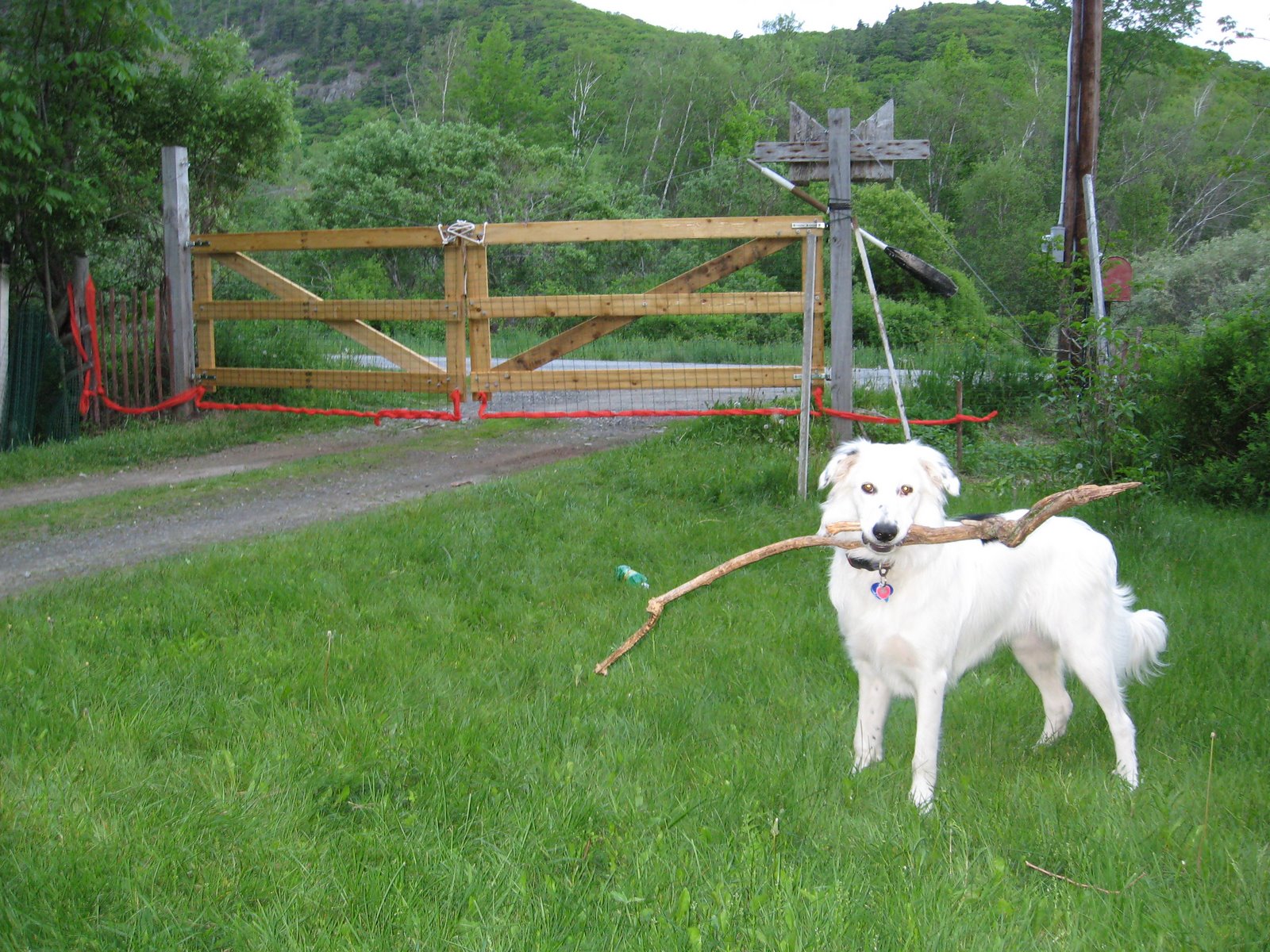
A dog by a gate is only a dog by a gate.

It is for this kind of revelation we live and breathe.

Saturday, May 31, 2008

May goes. Comes June. Rains today.
Wonderful! Wonderful!
The sermon of the inanimate is inconceivable.
If you try to hear it with your ears,
You’ll hardly understand
Only when you hear it in your eyes
Will you be able to know.

- Dongshan Liangjie (807-869)
It's one thing to know deception has been the leadership of this country. It's another thing to have that knowing verified by one of the inner circle. It makes the chilling truth that much colder.

Mr. McClellan’s book landed like a bombshell on Washington not because of any startling revelations or staggering new insights, but because he was an insider who wrote unflatteringly about his boss.

Forget that this is supposed to be a government of, by and for the people, and that the truth is supposed to matter. Mr. McClellan is being denounced as a traitor by those who readily accept the culture of deception, and who believe that a government official’s primary loyalty is not to the people, but to power itself — in this case, to the president.

It’s exactly that kind of thinking that begets unnecessary wars.
(-- Bob Herbert, New York Times, 31May08, Op Ed: Coming Late To The Table)

Four thousand troops die. Well over one hundred thousand Iraqis die. The president and his people lie, cheat, steal, and defy the ethos and laws of the country. They are above the law. No one can touch them. How frightening is that?

The Babes in the Wood
by Anonymous

My dear, do you know,
How a long time ago,
Two poor little children,
Whose names I don't know,
Were stolen away
On a fine summer's day,
And left in a wood,
As I've heard people say.

Among the trees high
Beneath the blue sky
They plucked the bright flowers
And watched the birds fly;
Then on blackberries fed,
And strawberries red,
And when they were weary
'We'll go home,' they said.

And when it was night
So sad was their plight,
The sun it went down,
And the moon gave no light.
They sobbed and they sighed
And they bitterly cried,
And long before morning
They lay down and died.

And when they were dead
The robins so red
Brought strawberry leaves
And over them spread;
And all the day long,
The green branches among,
They'd prettily whistle
And this was their song-
'Poor babes in the wood!
Sweet babes in the wood!
Oh the sad fate of
The babes in the wood!

(--Poem "The Babes in the Wood," Anonymous. Public domain.)

It has been, and is, a terrifying time for this country. The threat is as internal as it is external. We don't know if there is anyone to trust in the government.

It is the stuff of science fiction.

The people might awaken.

I do not wish to see their faces when they do.

Friday, May 30, 2008

Who are we without memory? The answer might be: We are right here, right now. How difficult, or even intolerable, would it be for most of us if we had no memory? Or worse, if what we recall is actually false memory? Our identity is a fragile thing. It is not non-negotiable.
There's no one place in the brain you can point to and say 'There's a memory.' You can't go into the brain and point a finger and say 'There's a memory.' It turns out that memories are more distributed than that, distributed in different parts of the brain. This is especially so for episodic memories. So a memory is a network of brain regions and all those brain regions have to come together in order for us to retrieve a memory. So I think this helps us understand that there's a sense in which all memories are constructed; they're not just literal replays of events that have happened to us.
(-- Professor Daniel L. Schacter, Professor of Psychology, Harvard University, as over-voiced in film Unknown White Male, by filmmaker Robert Murray, about Doug Bruce, a man who woke up on a New York subway with no clues as to who he was, other than a random phone number and a British accent. 2005)
There's a conversation between science and philosophy that meets in the between place, that place just off the edges of scientific verification and philosophic speculation. If I do not know the thing I am, am I lost to myself? The Course in Miracles states:

I do not know the thing I am, and therefore do not know what I am doing, where I am, or how to look upon the world or on myself. Yet in this learning is salvation born. And What you are will tell you of Itself.
(--from text, p. 614; T-31.V.17:7-9 )

Sometimes I seem to be a worded episode engaged in procedural liturgies of ritual repetition. We talk a lot about the same things over and over while sitting in the same spot.

I often refer to memory as a "fragile power." Memory is fragile because we are subject to forgetting and memory is not always as accurate as we would like to believe. Memory is powerful because most of the time it serves us well, forming the foundation of our knowledge of the world and of ourselves. In the case of emotionally experiences, memory is a source of tremendous power in our lives.

One of the key lessons we have learned is that memory is not unitary: there is no one area or structure in the brain that we would identify as memory. Moreover, there are multiple forms of memory. We make a major distinction between explicit memory and implicit memory. (Some researchers refer to these two forms of memory as declarative and non-declarative.)

Explicit memory involves the conscious, intentional recollection of previous experiences, what we tend to think of as memory in our everyday lives. It may involve reliving or reexperiencing past events. Implicit memory refers to nonconscious, unintentional influences of past experiences on current behavior and performance.

(-- from Project on the Decade of the Brain, Library of Congress, May 5 and 6, 1998. Discovering Our Selves: The Science of Emotion, Executive Summary, Panel: The Science of Memory and Emotion: "Memory: The Fragile Power"; Daniel L. Schacter, Ph.D., Professor of Psychology at Harvard University, is the author of Searching for Memory: The Brain, the Mind, and the Past.)

I remember my Aunt Marge and Uncle Mickey greeting me as I woke up in the back seat of the white DeSoto on Foster Avenue downstairs from Aunt Ronnie and Uncle Tom's apartment in Brooklyn. The memory is as real to me today as it was five or six decades ago. But did it happen? What was I doing alone in the family car on a busy street, and why did they not go upstairs and cement the apparition?

I feel that way at times about religious rituals. Before prison today (a ritual I've come to respect with religious devotion) we attended the express mass at Rockland church. Its the feast of the Sacred Heart. Afterwards, as often occurs, the coffee and donut seemed as equal an experience of Eucharist as the sacrament just received in quick distribution. (The priest at this 7am celebration is nothing if not rapid and methodical.)

I ask myself if the re-enactment and recollection involved in the highly ritualized gestures and words is more a consequence or a cause of memory.

Episodic memory refers to the memory of events, times, places, associated emotions, and other conception-based knowledge in relation to an experience. Semantic and episodic memory together make up the category of declarative memory, which is one of the two major divisions in memory. The counterpart to declarative, or explicit memory, is procedural memory, or implicit memory.
(-- from Wikipedia, Tulving, E. (1984). Precis of Elements of Episodic Memory. Behavioural and Brain Sciences, 7, 223 – 268.)

Is Jesus, (that oft-quoted and multi-referenced figure from Middle Eastern religious scripture), being re-enacted in the ritual, or are we creating a reference point from which to establish a procedural template for our lives? It's a question that is more than asking if the actions are historical or mythological -- more whether we are the reference point here and now of this creative theater.

Do we remember the one we call God? Or, do we create a memory of that which we long to remember? And if God is completely out-of-time itself, completely present in itself, and the complete gaze of what is itself -- then are we the action of God originally creating the event and the memory, the words and the retrieval of the activity of God-self-in-creation, ever-present, always at origin, and wholly aware of this as it is here and now?

I like the phrase:
And What you are will tell you of Itself.

This learning is beyond culture. It is beyond intellect. It is cellular. It is neural. Perhaps it is consciousness itself, (distinct from the conscious subject), urging an awareness that transcends location and occasion. It is the explication -- the unfolding and making clear of what-is-in-itself.

I'm fond of the phrasing: "What Is In Itself."

It is the nexus.

The connective.

The center.

Of something.

Which is.

Itself.

Thursday, May 29, 2008

O'a, at conversation last evening, spoke about the sanctuary surrounding each of us. She gestured with arms a semicircle, hands finishing in mudra of outstretched offering prayer before face. This sanctuary is a cloister of solitude that does not require physical separation. We are there in one another's midst, but retain a space, both psychologically and spiritually, not determined by the actions, words, or presence of any other being.

We'd been reading Anne Lamott, from Grace (Eventually): Thoughts on Faith, the final essay, "Kookaburra. " This morning I find an interview Lamott did with Tavis Smiley:

Tavis: Great title. Let me give you a chance to explain it. "Grace (Eventually)."

Lamott: Well, I think - I have written a lot about grace. I believe that there is a force of goodness or sweetness or sanity, and it does meet us where we are, and it doesn’t leave us where it finds us. And it sometimes feels like water wings if you're a kid who feels like she's going under the waves, or sometimes it feels like a thin ribbon of fresh air when you can't breathe or you feel claustrophobic.

Sometimes it looks like all of a sudden being kinder to yourself. But I do not believe that God has a magic wand, which doesn’t work for me because when I pray, my main prayers are help me, help me, help me and thank you, thank you, thank you. When I pray I would like God to tap me on the head with a magic wand so that I could understand that my prayer was answered. But it comes eventually. The answer and the grace come eventually.

Tavis: I’m fascinated - and there's so much I want to get to in the time we have about this wonderful book - I'm fascinated first though by your prayer. Everyone has his or her own prayer. Yours is, to your point, help me, help me, help me; thank you, thank you, thank you.

Lamott: That's my two prayers.

Tavis: Your two prayers. Tell me more about why those are your two prayers.

Lamott: Well, I think help most easily when we have given up on having any more good ideas (laughs). And I've always heard that our problems aren't the problem; it's our solutions that are the problem. And so usually - and I've also come to believe that the willingness comes from the pain, so as long as I'm kind of getting things to work, I don't give up and just let a higher power of some sort take over the controls.

And so you finally give up and you just say, "I'm so done. Just please help me." You know what it's like a little bit? I had a friend named Paul who used to say that he would feel like a kid in one of the backseat kid seats, where they have a plastic steering wheel attached to the car seat. And he'd be sure, that little kid, that if you turn the car to the right it's going right, 'cause you're making, and then you make it go to the left.

And when you finally realize you're not in charge of much, then help arrives, solutions arrive, serenity.

(--from Tavis Smiley interview with Anne Lamott, original airdate March 28, 2007)
"Who's in charge?" is a good question. As the days of the Bush presidency (mercifully) wind down, many more hithertofore devotees will feel unbound and finally tell what it felt like working in an environment of fear, arrogance, abuse, and distortions of every stripe. It will be a moot revelation. Many in the country knew we were living under perverse distortions. It has been the curious paralysis and numb impotency that held the country frozen in disbelief that remains notable.

Who's in charge, indeed? I am reluctant to say we are puppets to either political martinets or to spiritualist guides-and-dolls, but there are times (unfortunately) when no better explanation trumps.
And yet the world is different from what it seems to be
and we are other than how we see ourselves in our ravings.
People therefore preserve silent integrity
thus earning the respect of their relatives and neighbors.

The purpose of poetry is to remind us
how difficult it is to remain just one person,
for our house is open, there are no keys in the doors,
and invisible guests come in and out at will.

What I'm saying here is not, I agree, poetry,
as poems should be written rarely and reluctantly,
under unbearable duress and only with the hope
that good spirits, not evil ones, choose us for their instrument.

(from poem Ars Poetica?, by Czeslaw Milosz)
Milosz might not have had his poetic tongue-in-cheek. We might not be one person. The psychological scalpel that tries to unconjoin the loopy personality figure 8 ride of multiples crowding our inner amusement park rail platform might not have been sterilized properly and caused an infection in all of us crowded inside my name.

I am everyone I've ever seen, touched, heard, or thought. Mulder was right -- We're not alone! Scully was also right -- there's something very odd about both Mulder and the shadowy obsessions never quite provable nor deniable.

Milosz did use the word "hope" in penultimate line. We can hope. It might help.

In Lamott's essay she wrote something to the effect that just because the monkey is off your back it doesn't mean the circus has left town. As we continue to erect a fence to create a sanctuary of safety for our dear rescue Border Collie -- just because we know the whereabouts of wild rose thorns near our arms it doesn't mean that the bushes won't reach out and cut our hands as they work the wire.

Still in all, it is a lovely morning. Short mountain walk followed by Lauds in chapel/zendo, then to the perimeter with wire cutters and sledge hammer. It is all we can do in our small geography of intimacy with the sane holiness we wish to cultivate.
We are poor passing facts,
warned by that to give
each figure in the photograph
his living name.

(--from poem Epilogue, by Robert Lowell, in his book Day by Day
O'a and I grew up in multi-generational households. It's what contributes to the willingness and ability to attend diverse personalities and characters with a tempered equanimity that allows wide-ranging differences of type and sensibility while retaining a keen sense of humor useful for prying loose the stuck places that fix us fast with no seeming escape.

We cry, "Sanctuary!" and are delighted when something opens and we turn, unstuck for a bit, to see what is around us on all sides.
Neither by words nor by the patriarch;
Neither by colors nor by sound was I enlightened.
But, at midnight, when I blew out
The candle and went to bed,
Suddenly, I reached the dawn.
Profound quietude delivered me
To the transparent moonlight.
After enlightenment one understands
That the Six Classics contain not even a word
.
- Wang Yang-ming (1472-1529)
Enlightenment isn't what it used to be.

Enlightenment's not the cat or the dog at barn door wanting in for now, then wanting out.

Rather, enlightenment is the barn door itself, seeing each way through.

Wednesday, May 28, 2008

I've always liked what Ron H. said stepping out of the shop in 1996: "Solitude is not being left alone; Solitude is leaving alone."
Present-time Awareness
Mindfulness is present-time awareness. It takes place in the here and now. It is the observance of what is happening right now, in the present moment. It stays forever in the present, perpetually on the crest of the ongoing wave of passing time.

If you are remembering your second-grade teacher, that is memory. When you then become aware that you are remembering your second-grade teacher, that is mindfulness. If you then conceptualize that process and say to yourself, "Oh, I am remembering," that is thinking.

--Henepola Gunaratana, from Mindfulness in Plain English
We've come to think of the phrase "hermits in the open" as applicable. Not recluses in physical space; rather, mendicants seeking kindness and grace for all in open and intermediate solitude.
The term mendicant (Latin mendicans, begging) refers to begging or relying on charitable donations, and is most widely used for religious followers or ascetics who rely exclusively on charity to survive.
(--Wikipedia)
We beg. Not often and not loudly. Even not with much passion. Everything we earn at other jobs goes into maintaining the bookshop and bakery, paying bills, and shoring up our leaky life-skiff. And yet -- we are happy. And if the public marketplace face of Meetingbrook ends, we'll regroup at the hermitage.

Right now we're heading up Ragged Mountain with Rokpa. What a gift to be able to do this.
Solitude

Discipline of solitude (Christianity)

The truest solitude is not something outside and not the absence of people or sound; it is an abyss opening up at the centre of the soul. The abyss of interior solitude is created by a hunger that cannot be satisfied. It is found by hunger, sorrow, thirst, poverty and desire. The soul which has found this solitude is empty, as if emptied by death. This solitude is everywhere but there are mechanisms for finding it

All Christian religious communities have recourse to use means for finding solitude within their systems, possibly through retreat and/or periods of silence. This deliberate separation from the company of other people can help lead to deep inner silence and aid recollection and prayer without distractions. Solitude and silence are closely related states, the former giving the spiritual stillness to maintain the latter, and to speak only when words are really required. In many traditions a life of solitude as a hermit, whether totally alone or grouped around a common place of worship, has been used to achieve solitude of the soul. Frequently such retreat is to a place of harsh physical conditions (desert, mountain, forest); nevertheless, simply taking periods of solitude during the day whenever they may be experienced may be very efficacious

The retreat is not to escape for its own sake or from others or the world because it is unpleasant. Peace will not be found nor will solitude. To seek solitude because it is what one prefers will never result in escape from the world and its selfishness. The interior freedom required to be truly alone is not present. Solitude is to be alone in the healing silence of recollection and the untroubled presence of God. The state of solitude results in a deeper understanding and love for one's fellows

Thomas Merton says that solitude is not separation. If one goes into the desert it must not be to escape from others but to find them in God. There is a real need for solitude at a time when love and conformity are equated. True solitude is that of a person constituted by a uniquely subsisting capacity to love, it is not the refuge of an individualist. Physical solitude is contrasted with the escape into a crowd. Lost in a crowd, the person does not know he is alone but neither does he function as a person in a community. Not facing the risks or responsibilities of true solitude, his other responsibilities removed from his shoulders by the multitude, he is burdened by diffuse anxiety, nameless fears, the petty lusts and pervading hostilities which fill mass society. To remain human one must have true communion and dialogue with others - not simply living with others and sharing only the common noise and general distraction. True solitude is interior solitude, which is possible only for those accepting their right place in relation to others.

(--from Union of International Associations, http://www.diversitas.org/db/x.php?dbcode=hu&go=e&id=11803330)
Contemplation. Conversation. Correspondence.

Looking with attentive presence. Listening with root silence. Loving with transparent service.

It is morning.

Mountain green with sunlight prays.

Tuesday, May 27, 2008

If someone wants to show you their mind, look into it.
Song of Meditation

Sentient beings are primarily all Buddhas:
it is like ice and water,
apart from water no ice can exist;
outside sentient beings,
where do we find the Buddhas?
Not knowing how near the Truth is,
people seek it far away, what a pity!

- Hakuin (1685–1768)
Near, nearer, absolutely near.

You ain't going no-w-here.

Monday, May 26, 2008

At Vespers in the cabin we pray for all those dead and deadened by war. The dead are easy to trace. They reside away from sight. The deadened are less easy to find. They walk down streets, work beside us, drive the same roads, and do everything done by everyone else. Those of us deadened by war become fearful and angry. Trust is hard to come by. We feel that the world belongs to others. We are unwanted annoyances.

Among us, the winter soldiers.

"Winter Soldier’ is a term that turns from the opening of a pamphlet written by Thomas Paine in 1776:
“These are the times that try men’s souls. The summer soldier and the sunshine patriot will, in this crisis, shrink from the service of their country; but he that stands it now, deserves the love and thanks of man and woman. Tyranny, like hell, is not easily conquered; yet we have this consolation with us, that the harder the conflict, the more glorious the triumph.”
A contingent of winter soldiers testified today on Capital Hill. They actually know the disgrace of war in Iraq and Afghanistan. The families of the killed are left with the ambivalence of rhetoric in a time hardly any words are believed,
A man whose son died in the war walks in the street
like a woman with a dead embryo in her womb.
"Behind all this some great happiness is hiding."

(--From Amen by Yehuda Amichai, published by Harper & Row. 1977)
Surely, some great happiness beckons. Surely there is some redeeming spin that is not blatant untruth!

There's nothing romantic about war.

War is failure.

Still, even in failure, we honor the fallen.

A good soldier, it is said, will trust his commanders: they will salute, say 'Yes sir!', and die.

They do it for the rest of us.

We say, in prayer, 'Thank you; rest well!'

Sunday, May 25, 2008

What lovely people met this weekend.
Lu-men moonlight spills through misty trees
and I come again to the old hermitage.
The path leads through pines,
to the brushwork door
back again to solitude and silence.
Where a hermit lives,
there’s no need for companions.

- Meng Hao-jan (689-740)
There's an aspect of community that bypasses usual configuration. Jacques Ellul says it is orientation and signification.
At the level of personal life, I am convinced that every event, adventure, and encounter has its own meaning. Nothing in human relationships lacks meaning: neither a chance meeting nor an illness that attacks us. Everything makes sense because everything concerns these strange beings that we call human and that are significant in themselves. Each word and glance has meaning (in the twofold sense of the term). Some things orient me to life and some to death. Some have for me a signification that I must integrate into my life if I deserve to be called human.
(--p.16, in What I Believe, by Jacques Ellul, c.1989)
It is what is taking place between each and each that evokes meaning to become manifest.

We make history each time we act.

Today, meaning and history were manifestly made.

Saturday, May 24, 2008

His father has a goat ranch. His wife writes an impressive spontaneous poem. They naturally join the conversation.
The mountain lives in perpetual harmony with the Spirit of the Universe. It rose out of the Nameless, without resisting and suffering, and passes back into the Nameless. Man strives to overcome Nature and replace it with things of his devising. The wise know only one Universal Harmony exists and attune their mind and body to it. The monk does not go to the Mountain to rival it but to dwell in the eternal Oneness of Nature.
- Western Taoist
Solitude builds gate by road.

Solitude returns to itself.

With no fanfare.

Nor discourse

Dog gives paw.

Friday, May 23, 2008

A stupid remark by a desperate candidate raises the specter of 1968 assassination as coded anticipation of her chance in 2008.
Green waters and verdant mountains
are the places to walk in meditation;
by the streams or under the trees
are places to clear the mind.
Observe impermanence,
never forget it;
this urges on the will to seek enlightenment.

- Keizan Jokin (1264-1325)
It might have been a stupid mistake. But I fear the opposite.

Stupidity no longer has any right to remain on a stage that demands decency.

And yet stupidity does continue to infect the presidential milieu.

It is more that any one person can bear!

Thursday, May 22, 2008

A bird in high branch sang strong and clear at dusk.
Flowery Mountain is a treasure trove of marvels and esoteric lore as none other. Here fresh flowers bloom and the trees are ever green. Rocks are of all colors and spring waters of various hues. The wine decoctions of its genii clear the mind and the herbs culled by sages procure longevity. At night in the Hall of Shining Stars come whispering sounds from where the wisterias quiver. Unable to sleep I burn incense and read Taoist books.
- Hua-shan chih
I'm glad vespers was so easy.

Wednesday, May 21, 2008

Here is what I know. This is the truth. Between one thing and another is wisdom in the open.

We need saints.
Can you think of a word that describes a person who devoted much of her life to being with people many of us cross the street to avoid? Who for half a century did her best to make sure they didn’t go hungry or freeze on winter nights? Who went to Mass every day until her legs couldn’t take her that far, at which point Communion was brought to her? Who prayed every day for friend and enemy alike and whose prayers, some are convinced, had miraculous results? Who went to confession every week? Who was devoted to the rosary? Who wore hand-me-down clothes and lived in cold-water flats? Whose main goal in life was to follow Christ and to see him in the people around her?

A saint.

Can you think of a word that describes a person who refused to pay taxes, didn’t salute the flag, never voted, went to prison every now and then for protests against war and social injustice? Who spoke in a plain and often rude way about our way of life? Who complained that the Church wasn’t paying enough attention to its own teaching and compared some of its bishops to sharks?

A troublemaker.

Dorothy Day, saint and troublemaker.

(--from Dorothy Day — A Saint for Our Age? By Jim Forest; Presented at the Dorothy Day Centenary Conference, Marquette University, October 10, 1997.)
This world is not what it seems to be.

We need troublemakers.
When body and soul are rid of the dust of this world of dreams our understanding is awakened and Truth perceived.
(- Wall poem at North Peak Temple)
Let's pray for saints and troublemakers.

Dream truth.

Awaken dreams.

Tuesday, May 20, 2008

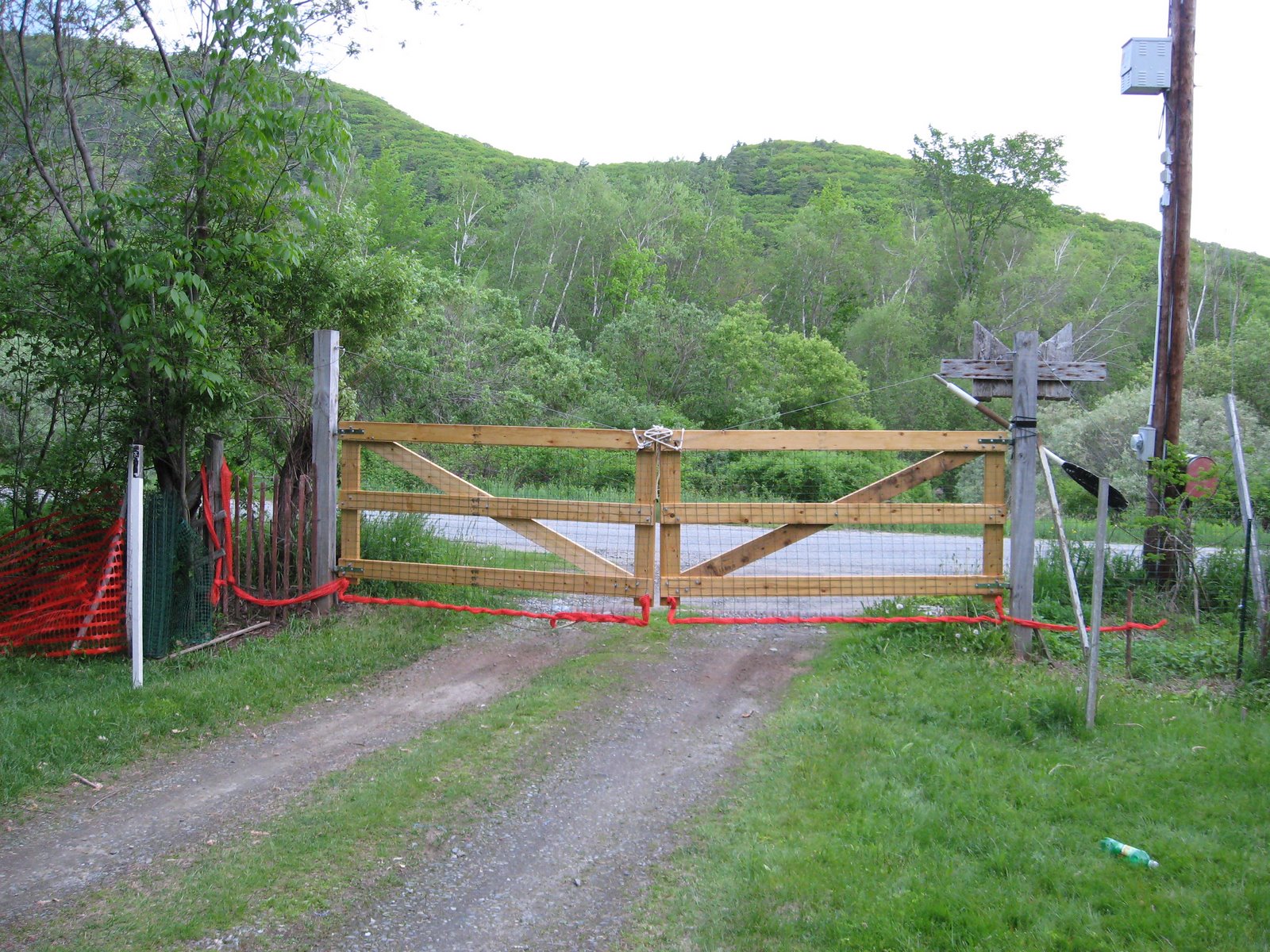
Boards are drilled, bolts set, then unset, stain brushed on boards stood upright against barn overnight. In the morning we'll fit the double gate, pick up a couple of bolt-throughs for sag prevention wire, finally, mount at bottom of drive.

Something about a gate. Even without livestock, everyone needs a farm gate.
Clouds bury the mountains behind the house,
Grass blocks the road to the gate.
Tattered books on the shelf,
A closed door to the outside world.

- Li Yu (10th century)
The world seems brighter tonight. A man who inspires steps closer to nomination for presidency. The old and disheveled despair will end -- if we are lucky. Luck is vital. It is precipice time.
Marching

At dawn I heard among bird calls
the billions of marching feet in the churn
and squeak of gravel, even tiny feet
still wet from the mother's amniotic fluid,
and very old halting feet, the feet
of the very light and very heavy, all marching
but not together, criss-crossing at every angle
with sincere attempts not to touch, not to bump
into each other, walking in the doors of houses
and out the back door forty years later, finally
knowing that time collapses on a single
plateau where they were all their lives,
knowing that time stops when the heart stops
as they walk off the earth into the night air.

--Poem, "Marching," from Jim Harrison's "Saving Daylight" (2006)
Harrison, in introductory notes to After Ikkyu (1996), a collection of Zen-inspired poetry, wrote: "I'm a poet and we tend to err on the side that life is more than it appears rather than less."

We're going to fall. That's where precipice leads. But it is unknown yet whether we will fall into our true nature or away from decency far from any recognizable facsimile of kindness or compassion. I vote for true nature.

There is so much more than many want us to see.

Our gate will remind us.

To pass through, you have to open.

Monday, May 19, 2008

Moon just shy of full. Jon Lester throws a no-hitter for Boston against Kansas City. No one is quite sure why the dollar has been allowed to de-value, nor why no one in government wants the troops in Iraq either to win or to come home.
The perfect person has many different aspects, but at heart he changes not. To understand the world he assumes its appearances, but his heart remains centered on the One. Within he is stable; outwardly he bends and straightens like a bow.
- Wen-tzu
Someone puts out a film taking on Christianity, the 9-11 official story, and the banking coup-d'etat in America and the world. Luckily they left Italian pizza alone.
Mother Night

When you wake at three AM you don't think
of your age or sex and rarely your name
or the plot of your life which has never
broken itself down into logical pieces.
At three AM you have the gift of incomprehension
wherein the galaxies make more sense
than your job or the government. Jesus at the well
with Mary Magdalene is much more vivid
than your car. You can clearly see the bear
climb to heaven on a golden rope in the children's
story no one ever wrote. Your childhood horse
named June still stomps the ground for an apple.
What is morning and what if it doesn't arrive?
One morning Mother dropped an egg and asked
me if God was the same species as we are?
Smear of light at five AM. Sound of Webber's
sheep flock and sandhill cranes across the road,
burble of irrigation ditch beneath my window.
She said, "Only lunatics save newspapers
and magazines," fried me two eggs, then said,
"If you want to understand mortality look at birds."
Blue moon, two full moons this month,
which I conclude are two full moons. In what
direction do the dead fly off the earth? Rising sun. A thousand blackbirds pronounce day.

(Poem: "Mother Night" by Jim Harrison from Saving Daylight. Copper Canyon Press, 2007.)
At 6AM bird flew into kitchen window. It lay stunned on grass. I watched it from second floor window, wishing it well, sending strength. Then I worried. Had the cat gone out earlier with the dog. I watched the stretch of grass. No cat. Good.

The bird, a rosy breasted grosbeak, rolled from it's side, still dazed. From under the bush came the cat. In a second both were gone. I had my screen out and ready to toss it -- but it happened so fast. When I got downstairs and out into yesterday's cut grass, only green clippings on my wet feet.

Religion is not, at the outset, a refuge of grace and mercy for the despondent and desperate, an enchanted stream for crushed spirits, but a raging, clamorous torrent of man's consciousness, with all its crises, pangs, and torments.
(- Rabbi Joseph B. Soloveitchik, 1903-1993)
At end of day we build one of two gates for end of driveway.

The impulse is to protect life.

Sometimes, more often than we'd like to think, life says: No, thank you!

Saturday, May 17, 2008

In loft of cabin warmed by birch in stove -- the silence of wood.
The bait is the means to get the fish where you want it; catch the fish, and you discard the bait. Words are the means to get the idea where you want it; catch on to the idea, and you forget about the words.
- Zhuangzi
Sky, earth, and water. This trinity sets alongside mythic metaphors acculturated through history by theology.

But then, isn't all of matter the making of theology?

I bow to the threeness. Holy, and holy, and holy is communion of each and each in all.


Who can say for certain what is true?

If you try, please, retain some humility.

Friday, May 16, 2008

One final patch of snow melts. They piled a 20 foot high mound about 60 feet round weeks ago. Now, a few inches high and three feet across it melts where the tube run once was at the Snow Bowl.
Every plant and tree knows spring will soon be gone
A hundred pinks and purples
Compete with their bouquets
Willow fuzz and elm pods lack such clever means
They only know how to fill the sky with snow.

- Han Yu (768-824)

The walking man with cancer sat in shop this evening talking about how he cannot tolerate the thought of a bladder bag and will nix the idea of surgery.

We're all walking death through life.

We just don't understand what either of them is exactly.

So, we walk on.

Happy for the practice.

Thursday, May 15, 2008

There is no teacher. Only learners; only the teaching.
Mind to Mind

Literature gives us the great gift of the present moment. As we read we enter the author's mind and follow it like a train on its tracks... she is taking us far out or far in and we're there! --no place else. Mind to mind...

But you ask, isn't the present moment just this: the sun coming in through the window, me leaning on a wooden desk, my eyes darting along the page, my legs crossed--not trucking along, my mind deep in the author's story?

Yes, that also is the present moment, but usually if I'm sitting there without reading, I am a divided person. Half of me is there, the other half is out the window, down the block shopping for wild rice, thinking about supper or how mad I am at a friend. But when I'm reading and I love what I'm reading, I'm totally connected, whole. Me and Shakespeare, me and Milton--no time or space between us. We are one--not two, not split. Then with that oneness, full of concentration and presence, I look up and can really see and experience through my whole body the light coming in through the glass pane and how it plays on the desktop where my book is, and I can feel my legs crossed underneath.

(--Natalie Goldberg, from 365 Nirvana, Here and Now by Josh Baran)
Just concentration.

Only presence.

Wednesday, May 14, 2008

Can we be entrusted to love?

"Do it!" -- we're told.

"Be it!" -- we intuit.
Just as the soft rains fill the streams,
Pour into the rivers,
And join together in the oceans,
So many the power of every moment
Of your goodness flow forth to awaken
And heal all beings;
Those here now, those gone before, those yet to come.

- Traditional Buddhist blessing
If we are love as it is loving, healing is the order of the day.
"What I command you is to love one another.
(--John 15:17)
Stout fellow! Fine lassie! As you are, so will you be.
Etymology:
Middle English, from Anglo-French comander, from Latin commendare, from com- + mandare to entrust.
Into your hands, Origin/Source, we commend our spirits.

An angel is a message taken in and made one's own.

Go ahead!

Be an angel!

Speak -- we'll listen!

Tuesday, May 13, 2008

Do you feel different?
How elegant is the morning sun
Shining on the rafters and eaves.
How cool are the terrace and pond after the rain.
I burn incense to break the deep silence,
Drink the spring water and relax in joy.
When the mind is at ease and spirit is at peace,
Understanding is gained.
There is nothing left to comprehend.
Who can say that the realm of Tao is far from us?
How tranquil it is
Like the beginning of Heaven and Earth.
- Ni Tsan (1301-1374)
The argument shifts. Are you ready?
In their arguments with Christopher Hitchens and Richard Dawkins, the faithful have been defending the existence of God. That was the easy debate. The real challenge is going to come from people who feel the existence of the sacred, but who think that particular religions are just cultural artifacts built on top of universal human traits. It’s going to come from scientists whose beliefs overlap a bit with Buddhism.

In unexpected ways, science and mysticism are joining hands and reinforcing each other. That’s bound to lead to new movements that emphasize self-transcendence but put little stock in divine law or revelation. Orthodox believers are going to have to defend particular doctrines and particular biblical teachings. They’re going to have to defend the idea of a personal God, and explain why specific theologies are true guides for behavior day to day. I’m not qualified to take sides, believe me. I’m just trying to anticipate which way the debate is headed. We’re in the middle of a scientific revolution. It’s going to have big cultural effects.

(--from The New York Times Op-Ed Column, The Neural Buddhists, By DAVID BROOKS, Published: May 13, 2008)
What's gotten into us?

We'll never be the same.

Ever.

Again.

Monday, May 12, 2008

Father is origin. Son is loving attention. Holy Spirit is enlightening consciousness.

Breathing mothers creation.
Let your love flow outward through the universe,
To its height, its depth, its broad extent,
A limitless love, without hatred or enmity.
- Sutta Nipata Buddha
When enlightening consciousness fills us, we begin to gather in communion.
In the evening of that same day, the first day of the week, the doors were closed in the room where the disciples were, for fear of the Jews. Jesus came and stood among them. He said to them, ‘Peace be with you’, and showed them his hands and his side. The disciples were filled with joy when they saw the Lord, and he said to them again, ‘Peace be with you.
‘As the Father sent me,
so am I sending you.’
After saying this he breathed on them and said:
‘Receive the Holy Spirit.
For those whose sins you forgive,
they are forgiven;
for those whose sins you retain,
they are retained.’

(--from John 20: 19-23)
You see, if you choose not to forgive, then it doesn't happen -- and you are burdened with carrying with you the weight of unforgiveness of an-other, namely none other than you.

But if you have understanding, and you forgive -- then everyone is unburdoned, and we go on, lightened and freed.

What do you think? Is it time for Pentecost?

Time for Holy Spirit?

Are you conscious?

Any awareness?

Of peace?

Breathe!

Thursday, May 08, 2008

Note: The bookshop/bakery will be closed Friday. (Open Sat & Sun)
There will be no Sunday Evening Practice 11May.
................................

“Love the whole world as a mother loves her only child.”
(--Hindu Prince Gautama Siddharta, the founder of Buddhism, 563-483 B.C.)

So much to learn about mothering!

When Jesus saw his mother and the disciple whom he loved standing nearby, he said to his mother, "Woman, behold, your son!" Then he said to the disciple, "Behold, your mother!" And from that hour the disciple took her to his own home.
(--John 19: 26-27)

One's own home!


Wednesday, May 07, 2008

Two weeks later, Mu-ge the cat walks back in the door. Just like that.

Meister Eckhart said: "Leben ohne warum." (Life without why.)

No questioning why. Just life.

At itself. With itself.

Looking as itself.

Tuesday, May 06, 2008

Riggers climb masts, painters brush hulls, captains shake out coastal charts. Schooners in Camden Harbor begin to ready the season.

I row small skiff around harbor.
Many paths lead from
The foot of the mountain,
But at the peak
We all gaze at the
Single bright moon.
- Ikkyu (1394-1481)
Someone asks about a spiritual teacher's connection to religion. "He's not not Christian," is the response.

In John 17:1-11 is the phrase: "And eternal life is this:".

Fill in what "this" is.

It's not not this.

Heaven help us.

Monday, May 05, 2008

On the count of three, jump!

When Iraq was invaded so many cheered. When Iran is attacked, so many will leave.
The truly still mind, with which you were born, is the mind that moves freely. Without ignoring anything, it reacts wholeheartedly to everything it encounters, to everything on which it reflects. And yet, for all that, it is the mind that is never seized by anything, but is always ready to react on the spot to whatever it encounters next. The mind that is still is the mind that never forfeits its freedom and is able to constantly keep rolling and rolling and rolling.
- Soko Marinaga Roshi (1925-1995) Dailyzen.com
Leaving this country because it has disappeared will not be easy. There's a need for a foothold; a place from which to step off. That's the difficulty with a disappeared country; there's no ground remaining to it.
Listen; the time will come – in fact it has come already –
when you will be scattered,
each going his own way and leaving me alone.

(--from John 16:29-33)
As if Jesus knew our situation. He lived so long ago. Good God -- this is the 21st century! What use could someone from the first century have? Does he see us disappearing?
Part Four: Time and Eternity

VIII

LOOK back on time with kindly eyes,
He doubtless did his best;
How softly sinks his trembling sun
In human nature’s west!

(--Emily Dickinson (1830–86). Complete Poems. 1924.)
We'll look back at this time in our country and wonder how it was everyone was so impotent and uncaring.

Many will weep.

Most won't.

Sunday, May 04, 2008

Rokpa the border collie licks peanut butter from my fingers. Rain tires us after 5:30am walk on Ragged Mtn. Sunday morning curls onto black chair.

Elsewhere, pastors, priests, rabbis, imams, zen masters, elders, and friends perform their rituals for people who hunger for justice, compassion, and a true experience of integrity. We've been fed illusion. Time to go beyond it.
When I started writing about Guantánamo several years ago, I thought the inmates might be lying and the Pentagon telling the truth. No doubt some inmates lie, and some surely are terrorists. But over time — and it’s painful to write this — I’ve found the inmates to be more credible than American officials.

Both Condoleezza Rice and Robert Gates have pushed to shut down Guantánamo because it undermines America’s standing and influence. They have been overruled by Dick Cheney and other hard-liners. In reality, it would take an exceptional enemy to damage America’s image and interests as much as President Bush and Mr. Cheney already have with Guantánamo.

(--from A Prison of Shame, and It’s Ours, By NICHOLAS D. KRISTOF, Published: May 4, 2008, New York Times)
It is a difficult time. Belief comes hard. Trust in our leaders is so low you'd think someone would notice. Only uncaring arrogance can ignore the somber bitter loss of faith and trust. What will replace what is lost? It is hard to imagine how the people of America will survive the defeat of principles long held dear by generations in this country. A difficult, bleak time.
I am not in the world any longer,
but they are in the world,
and I am coming to you.

(from John 17: 1-11)

I've come to a fondness for the universe. So vast. Maybe without end. Of uncertain beginning. A lot like human life. Space might have as many as ten or twelve dimensions. Strings of energy dance emphatically with tonal reverberation at core of the theoretical investigation of matter and (what is called) energy or spirit. Far far beyond our capacity to grasp with our thinking. Yet close, very very close.
What made Nishitani question emptiness on the basis of his own present existence was precisely nihilism. It is through the mediation of nihilism that emptiness was removed from a museum showcase--that is, from its status as a dead 'thing' to be viewed or an object of archaeological study, to make its appearance in the real marketplace as a currency with actual power, restored to its status of living and operative spirit. The real marketplace, of which we speak here, also has the meaning of the town called "The Motley Cow," where Nietzsche's Zarathustra proclaimed his idea of the eternal recurrence. According to Nishitani, this "town called The Motley Cow" means "the multicolored world with its infinite variety of forms"; in other words, the contemporary world. To let emptiness loose into it is to walk that town barefoot, or to stand in the very midst of nihilism. According to Nishitani, it is precisely when standing there that a human being gets in touch with the point of origin or zero point from where religion as religion is born.
(--from Nihilism, Science, and Emptiness in [Keiji] Nishitani, by Hase Shoto, Univ of Hawaii Press)
Time to begin again.

Passing through.

Illusion.

Saturday, May 03, 2008

What is looking and what is looked at co-construct what is being created as it is.

No kidding.
The entire day I searched for spring,
But spring I could not find,
In my straw sandals I tramped among the
Mountain peak clouds.
Home again, smiling, I finger a sprig of
Fragrant plum blossom;
Spring was right here on these branches
In all of its glory!

- Plum Blossom Nun (DailyZen.com)
One thing after another.

Nothing follows.

This.

Friday, May 02, 2008

Zen is seeing what-is.
Both the gaze that sees and the object that is seen construct themselves simultaneously in the one act of vision.
(--p.18, in Beauty, by John O'Donohue)
And, what-is takes place between us.

Thursday, May 01, 2008

He'd not ascended to the Father. He told Mary not to cling to him, not to hold on to who and what he was. He preferred to be who and what he is. And that, whenever he became that which he is where he is as he is.

So, let him.
I saw the Son of Man, and he said to me, ‘Have no fear! I am the First and the Last. I was dead and now I am to live for ever and ever, and I hold the keys of death and of the underworld.
(Apocalypse 1:17-18)
There being no time but now, Jesus is ascending as this is written, as this is read, as this is.

As are you and am I.

That's the kind of Thursday today is.

Nothing to cling to, so everything appears.

As it is.

With God.

Wednesday, April 30, 2008

A new template could help. A new religious life based on two rules: simplicity and kindness.

Tuesday, April 29, 2008

Some worry that America is heading for a big fall.
I let mind and body go
And gained a life of freedom
My old age is taking place
Among ten thousand peaks
I don’t let white clouds
Leave the valley lightly
I escort the moon as far
As my closed gate.

- Han-shan Te-ch’ing (1546-1623) Dailyzen.com
Rain has stopped.

Stars are out.

Cold wind blows.

After the fall, we'll try to get up.

Monday, April 28, 2008

When we bow we bow. Passing front room meditation space we bow. My eyes might look at crucifix. Or small seated Buddha. Or prayer flags hanging in window. Or icon of mother/child. Or the open emptiness of room itself. I have no object for the bow. Just bowing. With gratitude.
Do not sweep the fallen leaves,
For they are pleasant to hear on clear nights
In the wind, they rustle, as if sighing;
In the moonlight, their shadows flutter.
They knock on the window to wake a traveler;
Covering stairs, they hide moss.
Sad, the sight of them getting wet in the rain;
Let them wither away deep in the mountains.
- Kim Shi Sup (1435-1493)
Dog is bathed. White replaces gray. Mud drains into ground again.
You have been given more than human beauty,
and grace is poured out upon your lips,
(--from Psalm 44)
I'm glad the minister from Illinois spoke to the National Press Club. It's good to hear unapologetic wit, controversy, and spirit.

The mumbling incoherence of political swiping and sniping employed by contenders and commentators in this years horse race to the white house has become offensive and embarrassing. I'd like to hear something other than jejune backhand slaps.
I, Too, Sing America

I, too, sing America.

I am the darker brother.
They send me to eat in the kitchen
When company comes,
But I laugh,
And eat well,
And grow strong.

Tomorrow,

I'll be at the table
When company comes.
Nobody'll dare
Say to me,
"Eat in the kitchen,"
Then.

Besides,
They'll see how beautiful I am
And be ashamed--

I, too, am America.

(--From The Collected Poems of Langston Hughes, Knopf and Vintage Books. Copyright 1994)
In prison last Friday, the realization that words are alive, as are things alive, so too animals, humans, and all of nature, supernature, and that which we call divinity -- all life is alive, all being is, in itself -- holy.


Because we are mis-educated, Rev Jeremiah Wright says, we do not want to hear truth.

That's the truth.

Holy life!

Sunday, April 27, 2008

Consider the words: "because he is with you, he is in you".

Except for dripping faucet into scraped yogurt plastic, silence.
Gospel
Jesus said:
‘If you love me you will keep my commandments.
I shall ask the Father,
and he will give you another Advocate
to be with you for ever,
that Spirit of truth
whom the world can never receive
since it neither sees nor knows him;
but you know him,
because he is with you, he is in you.
I will not leave you orphans;
I will come back to you.
In a short time the world will no longer see me;
but you will see me,
because I live and you will live.
On that day you will understand that I am in my Father
and you in me and I in you.
Anybody who receives my commandments and keeps them
will be one who loves me;
and anybody who loves me will be loved by my Father,
and I shall love him and show myself to him.’

(--John 14:15 - 21)
Look no further than to Raisin Bran box, Cuisinart machine, and Nupro container on washing machine under cabinets beside window where gray morning sits with unmoving branches in dooryard. Daybreak walk with Border Collie beyond brook to winding trail, back to cabin -- zafu, candle, incense, sitting. In kitchen, dripping faucet, water from high mountain melt finds way through ground to well, pumped up to metronomic beat.
Prayer Chain

My mother called to tell me
about an old classmate of mine who

was dying on the parish prayer chain—
or was very sick—or destitute—

or it had not worked out—the marriage—
or the kids were all on drugs—and

all the old mothers were praying intensely
for all the pain of their children

and for life—they were praying for life—
in their quiet rooms—sipping decaf coffee—

I bet they've been praying for me at times—
so I'll find my way—so I won't rob a bank—

I'll take them—the mystical prayers of old mothers—
it matters—all this patient and purposeful love.

(Poem: "Prayer Chain" by Tim Nolan. The Writer's Almanac)
I mention my mother's name, her mother's name, their daughter and granddaughter, the men surrounding them, and the rippling remembrance of many names -- all gone beyond, (some say dead), as I crossed bridge over brook on morning prayerful steps and walking meditation.

Within us. We are within the within. No outside, no inside. Only God in God. Just us in us. We in God. God within all. The solitude of stillness, a silence of mind, an unknowing so profound there seems no need ever to speak or hear words again.

The mind says: "Show yourself!"

Earth responds with itself.

Itself knowing no other.

King falls; game over.

With or without words...

Love itself, nothing else.

Saturday, April 26, 2008

Mu-ge the cat has gone on walkabout. Traceless.
Lake water enters the bamboo fence,
Mountains surround the cottage.
A recluse’s life avoids this world.
The unused door hides behind
A green moss hue;
When a stranger passes,
The white birds fly in alarm.
Selling herbs, I taste and compare
But charge no price.
I do some gardening,
But love to do it unplanned.
Why is the wooded path leading
To T’ien-chu monastery
Still in autumn
Deeply dreaming in blue?
- Lin Pu
Six of us at Saturday Morning Practice consider hope as an obstacle.

There being no future, hope must have to do with what is in one's heart right now.

May each be where they need to be.

Happy, safe, truly at home.

Who knows where?

Friday, April 25, 2008

Vivian, in the drama W;T --(or Wit)-- says it is time for simplicity; time for kindness. She is dying.
All my life I have yearned for true reclusion,
Days on end sought wonders beyond this world:
Here old peasants enter their fields at dawn,
And mountain monks return to their temples at night.
Clear sounds come from pine-shaded springs,
Mossy walls filled with ancient truths.
I will lodge on this mountain forever,
I and the world are done with each other.

- Meng Hao-jan
At end her former professor reads to her about a bunny whose mother --like God -- will find it no matter where it hides; an allegory for soul being sought for by God.

There are choices to be made.

One is for kindness.

Take it.

Thursday, April 24, 2008

Maria is eighty today. She and Tom stay for dinner after conversation.

What if Spirit is not other than matter?

What if Word became flesh?

Never leaving?

Wednesday, April 23, 2008

Is death when self meets no-other?
According to Buddha’s words, once one has fully entered the world, there is no breach or need to leave the world. These words contain the principle of attaining Buddhahood by means of the world dharma. In the Kegon Sutra it is said: “the Buddha Dharma is not different from the world dharma, and the world dharma is not different from the Buddha Dharma.” Anyone who does not put to use this principle of attaining Buddhahood in the world dharma itself knows nothing of the real intentions of the Buddha.

Any and every occupation is Buddhist practice. It is on the basis of our atcual work that enlightenment is to be attained. Therefore, no work can be anything other than Buddhist practice.

- Shosan (1579-1655)
Or is it when no-self meets other?

Tuesday, April 22, 2008

Earth is God's body.
A crowd of stars lines up
Bright in the deep night.

Lone lamp on the cliff,

The moon is not yet sunk,
Full and bright without being
Ground or polished.
Hanging in the black sky is my mind.
-- Han Shan (early 9th century)
To believe is to hold affectionately.

I believe in earth!

Monday, April 21, 2008

Some of the irregulars on Sunday talked about the country. The disappointment was about the failure of the three branches of government, the failure of the press, and the failure of the populace to hold accountable any of the above. The question on the minds of the three men and a woman had to do with cognitive dissonance.
Cognitive dissonance is a psychological state that describes the uncomfortable feeling when a person begins to understand that something the person believes to be true is, in fact, not true. Similar to ambivalence, the term cognitive dissonance describes conflicting thoughts or beliefs (cognitions) that occur at the same time, or when engaged in behaviors that conflict with one's beliefs. In academic literature, the term refers to attempts to reduce the discomfort of conflicting thoughts by performing actions that are opposite to one's beliefs.
(--http://en.wikipedia.org/wiki/Cognitive_dissonance)
We're the good guys. Those without health care are people not particularly smart. Elected officials do indeed have the good of ordinary citizens as their primary responsibility. The war in Iraq was to protect the United States. Everything to know about September 11, 2001 has been told. This president is not an arrogant idiotes (it's a Greek word) serving the whims of corporations and promulgating shadow interests of ideologues. Osama Bin Laden started it. Saddam Hussein was the most dangerous leader in the world. The economy of the United States is in only a temporary slowdown. The Supreme Court is the most honorable judicial body and did not commit a hellish mistaken criminal act eight years ago. America clearly supports the down-trodden and helpless, but, really, the Chinese need our silence (as we need their imports) in their struggle against Tibet. There is equal justice for all, rich or poor, in this great nation.

If we meditate carefully on the above postulates, we might see into and through them. Carefully, we might begin to care for our peril.
There is a destination that must be reached within a day. One person endures great suffering and continues to walk with the aid of a stick. The other person decides to rest on a rock because it is too much for him. When he lies down and looks up, he sees clouds drifting in the wind and hallucinates that the rock he is on is also flying in the air. Cheerfully fantasizing that he has already reached his destination, he wakes up to find that he is just where he was before. The first person who continued to walk has already completed his trek. Although the second one finds himself far from his goal, he thinks it is useless to regret his error.
- Parable of Shakyamuni
The fire that destroys illusion longs to rage in our hearts and minds.

Do not be mistaken -- really -- we, at heart, long to be compassionate; we, in the deepest foundation of mind, long for wisdom and understanding.

The deception cultivated by the unwise and those devoid of compassion is not -- I repeat, is not -- how the true human being wishes to live in this existence.

Free Tibet.

Free the United States.

Free yourself.

Now -- let's get on with spring!

Sunday, April 20, 2008

Rokpa meets Alden in Belfast
I go to visit a prominent monk
In mountain mist and a thousand peaks.
The master himself points out the road
And the moon hangs its lantern out for me.
- Han Shan (early 9th century)
Each hermit returns to solitude.

Happily.