Saturday, March 15, 2008

In class we've been thinking about a mutation of consciousness. Then a woman who likes the shop's Topfen Kuchen sent the following link about possibly using salt water to power automobiles among other myriad uses. http://www.youtube.com/watch?v=M9lvw8rKAa4 It is naturally likely that an answer arises simply from mind attentive to earth.
"And what, monks, is the Noble Truth of the Origin of Suffering? It is that craving which gives rise to rebirth, bound up with pleasure and lust, finding fresh delight now here, now there: that is to say sensual craving, craving for existence, and craving for non-existence. And where does this craving arise and establish itself? Wherever in the world there is anything agreeable and pleasurable, there this craving arises and establishes itself. And what is there in the world that is agreeable and pleasurable? The eye in the world is agreeable and pleasurable, the ear... the nose... the tongue... the body... the mind in the world is agreeable and pleasurable, and there this craving arises and establishes itself. Sights, sounds, smells, tastes, tangibles, mind-objects in the world are agreeable and pleasurable, and there this craving arises and establishes itself." (--Mahasatipatthana Sutta: The Greater Discourse on the Foundations of Mindfulness, in Thus Have I Heard: The Long Discourses of the Buddha, trans. by Maurice Walshe. From Everyday Mind, edited by Jean Smith, a Tricycle book)
I love being. Then being alive. As well as mind's awareness of being alive. Also loss -- reminding me that two relinquishes one and, through relative nihility, retrieves one by something falling away. Here, finally, the choice to fall into absolute emptiness -- where each is itself -- with, in, as, and through one another. This meditation is a gift that Keiji Nishitani via Taietsu Unno gave at a conference entitled Encounters with Emptiness (Smith/Amherst Colleges, 1984).
San Antonio Tonight I lingered over your name, the delicate assembly of vowels a voice inside my head. You were sleeping when I arrived. I stood by your bed and watched the sheets rise gently. I knew what slant of light would make you turn over. It was then I felt the highways slide out of my hands. I remembered the old men in the west side café, dealing dominoes like magical charms. It was then I knew, like a woman looking backward, I could not leave you, or find anyone I loved more. (--Poem: "San Antonio" by Naomi Shihab Nye from Is this Forever, or What? Poems and Paintings from Texas. Harper Collins Publishers, 2004.)
I find that love is a long looking. Without choosing nor discarding there is the arising and dissolving of all things with form. We appear and we disappear. In the interval we get to look in ways beyond explanation or description. We get to fall into and to be the interstice. It is in this place where dwells that which we call God. It is this invitation to look, to look around, that encapsulates the mystery unveiling in ritual this coming week. Looking into, and seeing through -- in loving silence, in conjoining solitude -- the mysterious mutation of incarnate resurrection, is a gift presenting nothing but what is. "Many arrivals" (indeed do, as the poet Roethke wrote) "make us live." There is no. Leaving. This. There is only allowing this its own way. As you, love.

Friday, March 14, 2008

Like a sine curve, pain ascends and descends as I breathe, watching. Face feels like brittle shards broken crashing to marble floor splintering further with each non-zero waveform, positive value, negative value. Pill. Pause. Sleep.
The Dharma of the Buddha is not found in books. If you want to really see for yourself what the Buddha was talking about you don't need to bother with books. Watch your own mind. Examine to see how feelings come and go, how thoughts come and go. Don't be attached to anything, just be mindful of whatever there is to see. This is the way to the truths of the Buddha. Be natural. Everything you do in your life is a chance to practice. It is all Dharma. When you do your chores try to be mindful. If you are emptying a spittoon or cleaning a toilet don't feel you are doing it as a favor for anyone else. There is Dharma in emptying spittoons. Don't feel you are practicing only when sitting still cross-legged. Some of you have complained that there is not enough time to meditate. Is there enough time to breathe? This is your meditation: mindfulness, naturalness in whatever you do.
(--Ajahn Chah, in Jack Kornfields Living Dharma, From Everyday Mind, edited by Jean Smith, a Tricycle book)
Ruminating in prison this morning the possibility of 200 billion galaxies each with 200 billion stars stretching from here to nowhere. We imagine the expanse of mind willing to enter into the vast pleroma beyond our ability to conceive.

In protective custody, name of Jesus comes to table. Was this one incarnating what we call God so as to take away confusion about body and spirit -- not two, but just completely human completely divine? Liberation for wholeness; release from egoic identifications; mere integrity void of separation?

In Buddhist group, knuckling moktak as Heart Sutra drones with bell interlude. The wood fish with open mouth and empty belly makes good sound, cheering us at finish -- all are enlightened -- so shy yet to realize gift.

Crossing yard, a Muslim friend approaches with open arms. Joyful embrace. The sweetness of simple connection!
"One of the greatest charms of the Catholic Church for the Chinese soul is its monastic tradition. The Chinese people are on the whole more attached to the world; but they have a secret admiration for those who have heroically sacrificed all their worldly pleasures and relations in order to devote themselves to a life of union with God. At the bottom of their heart, the Chinese realize that all honors and riches will soon pass without leaving a trace; and therefore they admire those who abandon what is temporary in singlehearted pursuit of what is eternal.... When the love of God reigns supreme in a family, the family itself becomes a cloister and the duties of vocation constitute a cell for each member of the family. If one performs one's domestic, professional, and social duties for the love of God, one is a monk or nun in spirit."
(--by John C.H. Wu, author of Beyond East and West, a spiritual autobiography)
Some metaphors wear well. At home, in prison.

Cloister.

Monastic.

Cell.

Joy.

Thursday, March 13, 2008

Maybe there is a tree called the tree of life.
Enlightenment has no tree,
It would be an error to expect
It in a peach blossom.
Discard whatever is held in the hands
As an external aid to enlightenment,
For the monk is clothed
In the universe itself

- Takuan
On the mountain, deep snow gives circle of respect to tree trunk -- a hollow forms.
In 2001, Potter climbed the famous Nose route on El Capitan, a 3,000-foot vertical wall with a fierce overhang, in 3 hours 24 minutes. It was a feat stunning in its economy, considering that, in 1958, the renowned climber Warren J. Harding led the first team up the route in 45 days. Often, Potter has climbed thousands of feet carrying no ropes at all, nothing to aid his grip but shoes and a bag of chalk.

“Sport is all about being in the zone, when time and space stop and everything goes away,” said Beaver Theodosakis, the founder and president of prAna, the climbing apparel company that sponsors Potter. “Dean holds that zone for hours on end, when the mind can’t wander, when you can’t second-guess, when you have to be so confident and deliberate in your moves. Imagine in everyday life, if we could go to the office like that and not be distracted.”

(About climber Dean Potter, in article, 900 Feet Up With Nowhere to Go but Down
By JERÉ LONGMAN, Published: March 14, 2008, MOAB, Utah, in New York Times Online)
I don't want to second-guess someone seemingly fearless.

Maybe there is no place to fall. No death, as we know it, to catch us up.

Or just maybe hard frozen ice/snow this March will one day begin to soften and melt.

Late winter feels like a tiring hand grip and foot fastening over a deep cavern with no sign of end.

The universe itself reaches us.

Wednesday, March 12, 2008

When a message is not understood, and the response is not understandable, we are left with a rhetorical nightmare. As Robert Lowell wrote in his poem Epilogue,
All's misalliance.
Yet why not say what happened?
There are days when it all seems nuts, when nothing fits, and no explanation comes close to clarifying anything.
Yet why not say what happened?
Pray for the grace of accuracy
Vermeer gave to the sun's illumination
stealing like the tide across a map
to his girl solid with yearning.
We are poor passing facts,
warned by that to give
each figure in the photograph
his living name.

(Lowell, from Epilogue)
We've yet to give each one his or her living name. We seem stuck in making objects and categories of each other.

When the Man of Tao left the mountain,
The mountain turned as gray as ashes;
The white clouds hid away their smiles,
And the blue pines were filled with grief.
Suddenly came news of the Man of Tao’s return,
And bird’s song burst open the mountain valleys.
A divine light radiates from his precious temples,
And a dharma rain washes away the swirling dust.

- Su Shih (1073)
It takes one person to tell the truth. It takes many of us to accomplish and allow falsity.
Why asking “Why?” Makes No Sense and Also Makes Sense:
The Difficulty of the Mental–Rational in Comprehending the Act
We can apply this theory to a complex rhetorical piece of communication. The
destruction of the World Trade Center and the damage to the Pentagon can be
viewed as rhetorical, demonstrating a clear presence of a message. In addition to
the material destruction and the loss of life, the rhetorical message of the attack
was used technologically to inflict damage through influence. Of particular
interest here is the way in which this piece of communication obliterates the
sender–receiver model that has been popular in communication scholarship. This
model can say almost nothing about this communication. As noted below, the
absence of a self–proclaimed sender precludes the ground from which encoding can
be said to take place. In addition, because of complications arising from the
presence of multiple modes of awareness the decoding process is also impossible to
force into existence from a description of the communication. Likewise, the
“message” is ambiguous when cast in the form of the signitive or even the
argumentative. The result is that after the attack, most Westerners find
themselves asking, “Why do they hate us so much? Why did they do this? What
are they trying to tell us?” The answer has since been elaborated to some extent
and for various propagandistic and plainly rhetorical purposes. What is of concern
here is the immediate message, that of the act of crashing the planes into the
buildings.
...
If philosophy deals with concepts, rhetoric is the technology that enacts or expresses those concepts. Thus rhetoric is inherently tied to abstraction. The technological exercise of will and power, a consequence of the ego and of atomization and sectorization, is a mental rational phenomenon with its roots in magical consciousness. This form of expression is used to exert power over all aspects of the world (Mickunas, 1992). Rhetorical communication is a form of exercise of power and will.
...
History clearly demonstrates, and Gebser notes, that when civilizations fail to understand messages that work from very different forms of expressivity, from different communicative outlooks, the result is almost inevitably disaster. A response that treats this message as disputative in nature will fail in its purported intent of ending conflict. Instead, it will result in a failure to comprehend the self– examination necessary to be a receiver of such a message. Without this, there can be no appropriate response.

(--from Magic, Will, and Discourse: Rhetoric as Technology, by David Worth,
University of Oklahoma in Integrative Explorations (Vol. 1-8), The Jean Gebser Society)
We are slow to self-examination.

Slower yet to apply justice to those with power.

(Unless, of course, sex or fraud grabs headlines. Then we receive the message, still befuddled as to who sends it.)

We long for the return of the person of Tao, when bird song will burst open, divine light radiates throughout, and a dharma rain washes away the swirling dust.

As receiving responders we will practice heartfelt understanding -- becoming a clear presence of communion and integral action.

Alliance.

Silence.

Tuesday, March 11, 2008

Sun comes through bedroom window.

Re-rendering traditional prayer.
Prayer Of The One We Call God

Our origin, dwelling between us, sacred is this presence.
May just-this truth be our home.
Engaging wholeness be our longing, everywhere, with each and all.

Allow us today embracing union.
Calling one another with true names so too we are remembered as truly we are.
And when we miss the point of this existence, grace us with original ever-presence.

For this loving reality is true dwelling, creative energy, and what-is-itself, nowhere else.

With grateful awareness, we move and remain still, within and through...
One Another.
(-wfh, 11mar08)
For now.

Monday, March 10, 2008

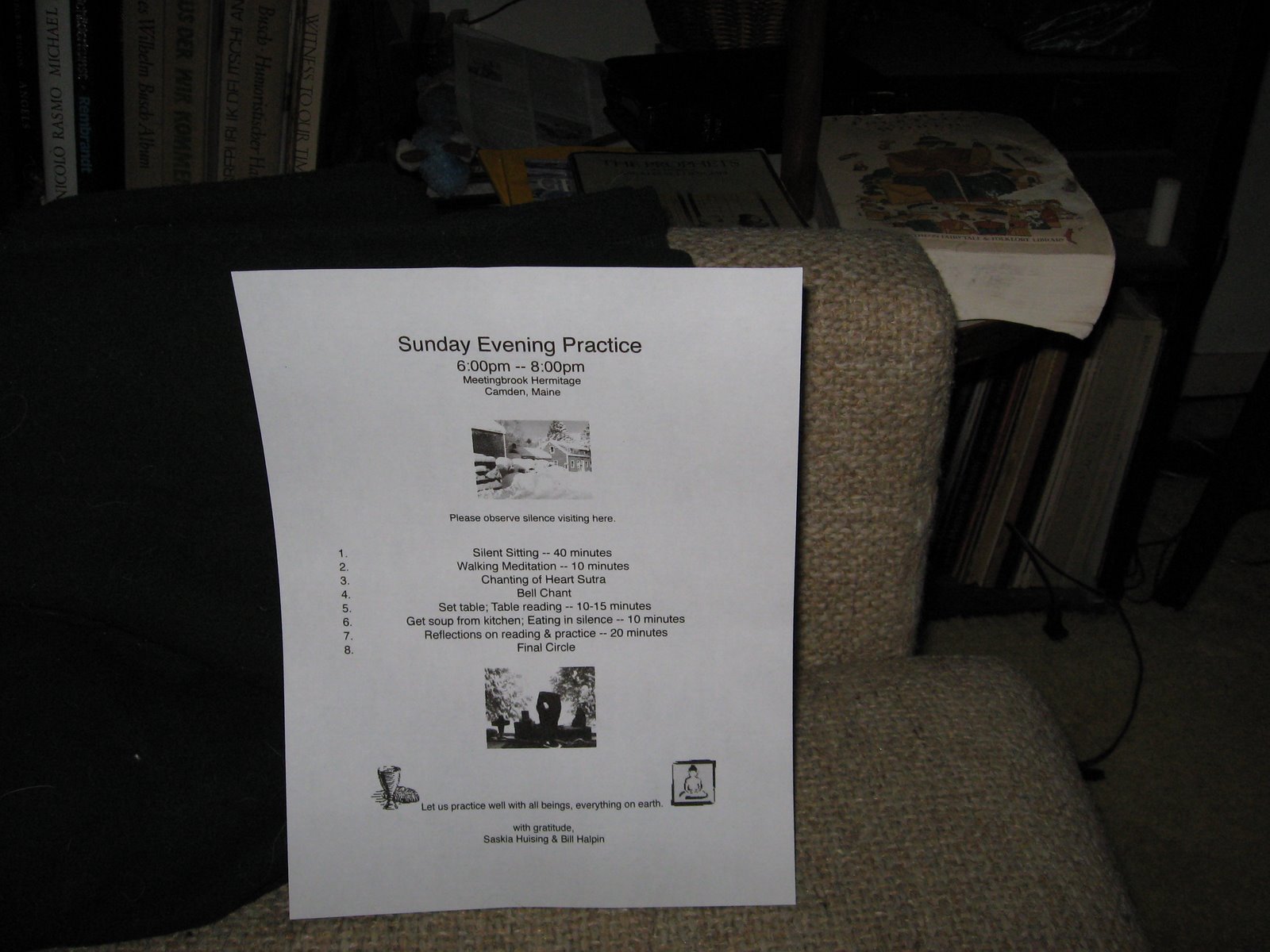
What is being done is being done by what is itself. (That's what was said at table Sunday Evening Practice.) We say we are sitting. But then again, sitting is what is being done. With reciprocity, wholeness.

Breathe away. Is death a breath away?
Time is passing every moment;
How can you be complacent and waste it,
Seeing death is but a breath away?

- Kuei-Shan (771-854)
And as for seeing death, that too is a breath. We must first stand still; then, away!
Moment of Inertia

It's what makes the pancake hold still
while you slip the spatula under it
so fast it doesn't move, my father said
standing by the stove.

All motion stopped when he died.
With his last breath the earth
lurched to a halt and hung still on its axis,
the atoms in the air
coming to rest within their molecules,
and in that moment
something slid beneath me
so fast I couldn't move.

(Poem: "Moment of Inertia" by Debra Spencer from Pomegranate. Hummingbird Press, 2004.)
A woman writes her mother died. I write this haiku:
haiku
(for s)

i heard in passing
only light and love remain --
through this nowhere else

(--wfh, 10mar08) 1.
Footnote:
1. It occurs to me these days that nothing is real until it is whole -- and that each of us holds the other in the throes of wholeness by our willingness to complete the wholeness.
Reciprocity.
I like this notion that darkness isn't dark. It is at the edge of light seeking itself wholly involved with light. When light pushes darkness away each remains half and opposed. In their embrace, light/dark is what-is-in-itself, well, rounded, and presentable for morning tea or coffee.

Perhaps, as some will say, "There is no death." There can't be death apart from life. One needs the other to have meaning, meaning being the whole, if it we long for. So too -- life with death. One embracing the other until there is no other.
one's not half two. It's two are halves of one:

one's not half two. It's two are halves of one:
which halves reintegrating,shall occur
no death and any quantity;but than
all numerable mosts the actual more

minds ignorant of stern miraculous
this every truth-beware of heartless them
(given the scalpel,they dissect a kiss;
or,sold the reason,they undream a dream)

one is the song which fiends and angels sing:
all murdering lies by mortals told make two.
Let liars wilt,repaying life they're loaned;
we(by a gift called dying born)must grow

deep in dark least ourselves remembering
love only rides his year.
All lose,whole find
(Poem by e.e. cummings)
There are times I think I'm ready to lose all.

Breath. Partiality. Ego.

Moving still.

Away. Far, far away.

And near. Nearer. Nearest.

To nowhere else.

Saturday, March 08, 2008

It's official -- I'm not good for much. Barely useful. Mostly absurd. And that's on a good day.
Three Friends and a Monk
There's a story of three people who are watching a monk standing on top of a hill. After they watch him for a while, one of the three says, "He must be a shepherd looking for a sheep he's lost." The second person says, "No, he's not looking around. I think he must be waiting for a friend." And the third person says, "He's probably a monk. I'll bet he's meditating." They begin arguing over what this monk is doing, and eventually, to settle the squabble, they climb up the hill and approach him. "Are you looking for a sheep?" "No, I don't have any sheep to look for." "Oh, then you must be waiting for a friend." "No, I'm not waiting for anyone." "Well, then you must be meditating." "Well, no. I'm just standing here. I'm not doing anything at all." ...[S]eeing Buddha-nature requires that we... completely be each moment, so that whatever activity we are engaged in--whether we're looking for a lost sheep, or waiting for a friend, or meditating--we are standing right here, right now, doing nothing at all.

(--Charlotte Joko Beck, Everyday Zen)
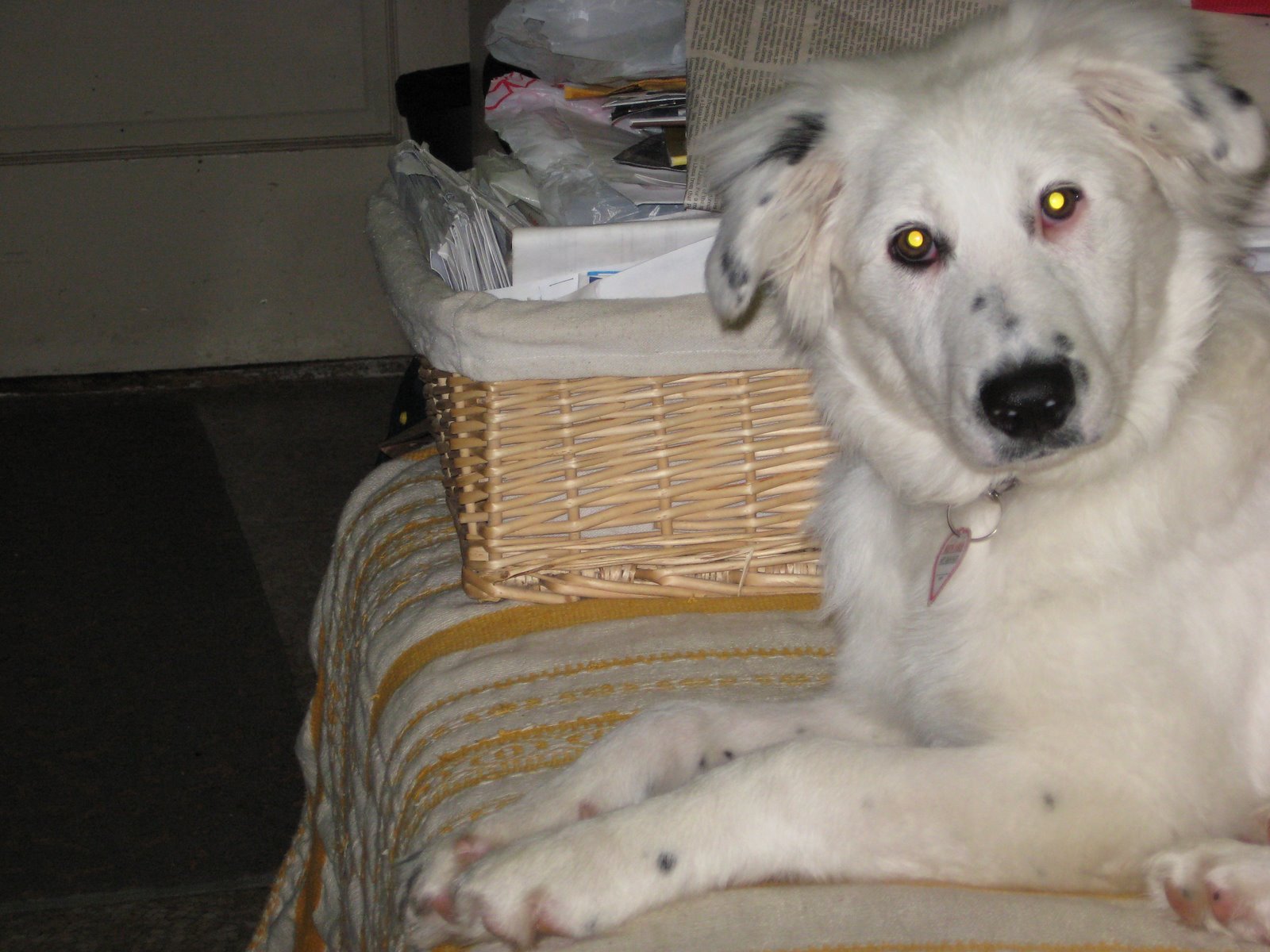
Every once in a while someone asks me about meditation. I'd rather point them to the sweet puppy. I tell them we just got a new round rug for the meditation room. That's all. Just sit down, shut up.

The disappearing hour happens tonight.

The odd ways of time!

Friday, March 07, 2008

In prison we wondered if by allowing and dying on the "t" (the cross) you return from there to here?

And if the ego is the obstacle to the river's flow, by dying to the ego you return to the flow of compassion through conflict?

These men are sangha of a Friday morning.
As I left my daytime resting place on Vulture Peak,
I saw an elephant
come up on the riverbank after its bath.

A man took a hook and said to the elephant,
Give me your foot.
The elephant stretched out its foot;
the man mounted.

Seeing what was wild before
gone tame under human hands,
I went into the forest
and concentrated my mind.

(- Dantika, in Susan Murcotts The First Buddhist Women
from Everyday Mind, edited by Jean Smith, a Tricycle book)

So large the mind. So easily diverted by obstacle. So wild the rampage of thoughts. So spacious the gap between observer and thoughts observed.

Ever impressive is the way sea and land meet.

Resolving long journeys and many differences.

With mere reciprocity.

Arrives here.

Thursday, March 06, 2008

A mug of milk, a slice of Bischof's Brot, and return to silence.
Impermanence, aging, and illness
Do not give people a set time.
One may be alive in the morning,
Then dead at night,
Changing worlds in an instant.
We are like the spring frost,
Like the morning dew
Suddenly gone.

--Kuei-Shan (771-854)
If you want to be a monk, be a monk. If a no-count, be that. What matters is that prayer be allowed through you into the world.

Be anything you wish.

Just allow through what prayer brings, namely, formless, unconditioned, refreshing grace.

Pass through well!.

Wednesday, March 05, 2008

Let egoic mind go on by. There's so much less crap to sweep up.
If we let a wild elephant loose in a populated area it will cause massive destruction, but the uncontrolled wild mind can cause much more harm than such a crazed beast. If the deluded, wild elephant of our mind is not subdued, it will create much suffering for us in this life and will cause us to experience the sufferings of the deepest hell in the future. In fact, if we investigate we can see that the creator of all the sufferings of this and future lives is nothing but our unsubdued mind. To subdue this wild beast is much more important than bringing a jungle elephant under our control.

Many benefits follow from taming our mind. If we take the rope of mindfulness and tie our elephant mind securely to the post of virtue, all of our fears will swiftly come to an end

If we do not develop mindfulness, our meditations will be hollow and empty. There will be nothing to keep our wild elephant mind from running back and forth in its customary, uncontrolled manner between objects of attachment, anger, jealousy and so forth.
(- Geshe Kelsang Gyatso, Meaningful to Behold, from Everyday Mind, edited by Jean Smith, a Tricycle book)
But if sweep we must, sweep we will.

Tuesday, March 04, 2008

Together we live. Together we die.

What is life? What is death?
For thirty years
I searched for the sword.
Often I watched leaves fall
And branches send forth shoots.
But from the moment
I saw peaches bloom,
No further doubts.
- Ling –yun (d. 729)
Letter from woman saying her husband nears death. She is sorry for waiting so long to say it in the open. He is a private man. I light candle for him, for her.

One candle flame with many reflections through and in panes of glass behind it on window sill. Same flame, only cool to touch.
Zen Master Bo Mun: Last night we met in small groups to discuss the most important issues of our practice. The major issue was balance: how to find it in the midst of formal practice as Zen students, families, jobs, relationships, etc.

There are two formal aspects to Zen practice: the killing sword and the sword that gives life. The killing sword means, how do we give ourselves to the situation? How, without repressing, do we let go of our condition, opinion, and situation and really offer ourselves to what's going on in the moment? For most of us that requires a fair amount of hard work. Sometimes it's painful and difficult. If we try to live that way all the time, only being "good" or only taking certain roles, most of us find that it doesn't work. We become brittle, irritable, out of balance. We do many things with such a charge behind them that we put ourselves in precarious situations.

The other aspect is the sword that gives life: the experience of empowering ourselves, doing things which come naturally, that we love to do and find fulfillment in. When we do too many of these things, most of us get a certain softness or flatness. There's no keen working edge to our practice. It's hard to believe in ourselves if we go too far to that side.

So there's a swing between "putting it all down" in formal practice, life at a Zen Center, the demands of family and job and relationships; and on the other side, empowering ourselves and being happy so that our lives are workable, so that we can be the kind of people in the world that other people would like to be.

These two aspects come up in many different dimensions. On the simplest level, they arise with the inhalation and exhalation of the breath, sitting completely and receiving experience on the cushion, and receiving what comes up in family life and all the other areas. How to balance all this was the major issue that came out of last night's meetings.

In talking with Zen Master Seung Sahn now, it would be nice if we could get into the spirit of heckling him a little. It's hard to do that, because whenever you ask him a question you are taking your life in your hands. I am reminded of the relationship between Ananda and the Buddha. The Buddha would give long dharma talks and then Ananda would say, "Yes, but what about men and women and what goes on between them?" The Buddha would make some reply, then Ananda would say, "Well, it's all well and good for you to say that, you're the Buddha (or the Zen Master). People fly you around everywhere and everyone bows to you, but we're here, slugging it out in the trenches. How about us?" So a little bit of that spirit would be helpful. Zen Master Seung Sahn, last night many people talked about balance and doing hard training. How do we find balance?

Zen Master Seung Sahn: Many people are confused about what their job is: how much they should practice, how much they should take care of their family. Sometimes this gets unbalanced. So we must talk about our direction. Why are we living in this world? Direction is very important.

If your direction is clear, then your relationships will be clear, your outside job will be clear, your inside practicing job will be clear. If your direction is not clear, it means you are holding some opinion, condition, or situation. Then already you have lost what is important. Many people want to drink alcohol and have a good time. If this mind appears, you cannot have a correct relationship to your family or your inside and outside jobs. Your practicing will not be clear. Nothing will be clear.

Everybody has this mind: I like movies, ice cream, good restaurants. Single people want a girlfriend or boyfriend to have a good time with. We have a lot of this "wanting a good feeling" mind. Good feeling is sometimes necessary; but first, what is most important? If we understand this, then family, relationships, job, practicing will be no problem. Everything will be correct and balanced.

(--from The Sword that Kills and the Sword that Gives Life -- Finding balance in Zen practice; Zen Master Seung Sahn with Zen Master Bo Mun, at the third annual Kwan Um School of Zen Congress, 1985
Sometimes my direction is laying low. Not good. Not bad. Only laying low. With aspirin and vitamin c.
Zen Master Seung Sahn
Together Action

One evening during an informal talk at the Providence Zen Centre a student said to Soen Sa Nim: “Soen Sa Nim, you always teach about “together action.” But suppose two people were hungry and had some food, but it wasn’t enough. What should they do?

Soen Sa Nim: “Divide the food.”

Student: “No. They don’t have enough to divide it and keep them alive. Then what should they do?”

Soen Sa Nim: “Divide the food and together die.”

(--Dharma Talk, http://www.subong.org.hk/dharma_talk_0307a_e.htm)
We do not live alone. We do not die alone.

Looking at candle flame --

Is prayer enough...

This night.

Monday, March 03, 2008

We're back. They've met. The circling begins. We'll see.
In the still night by the vacant window,
Wrapped in monk’s robe I sit in meditation.
Navel and nostrils line up straight;
Ears paired to the slope of the shoulders.
Window whitens – the moon comes up;
Rain’s stopped, but drops go on dripping.
Wonderful – the moon of this moment,
Distant, vast.
- Ryokan (1758–1831)
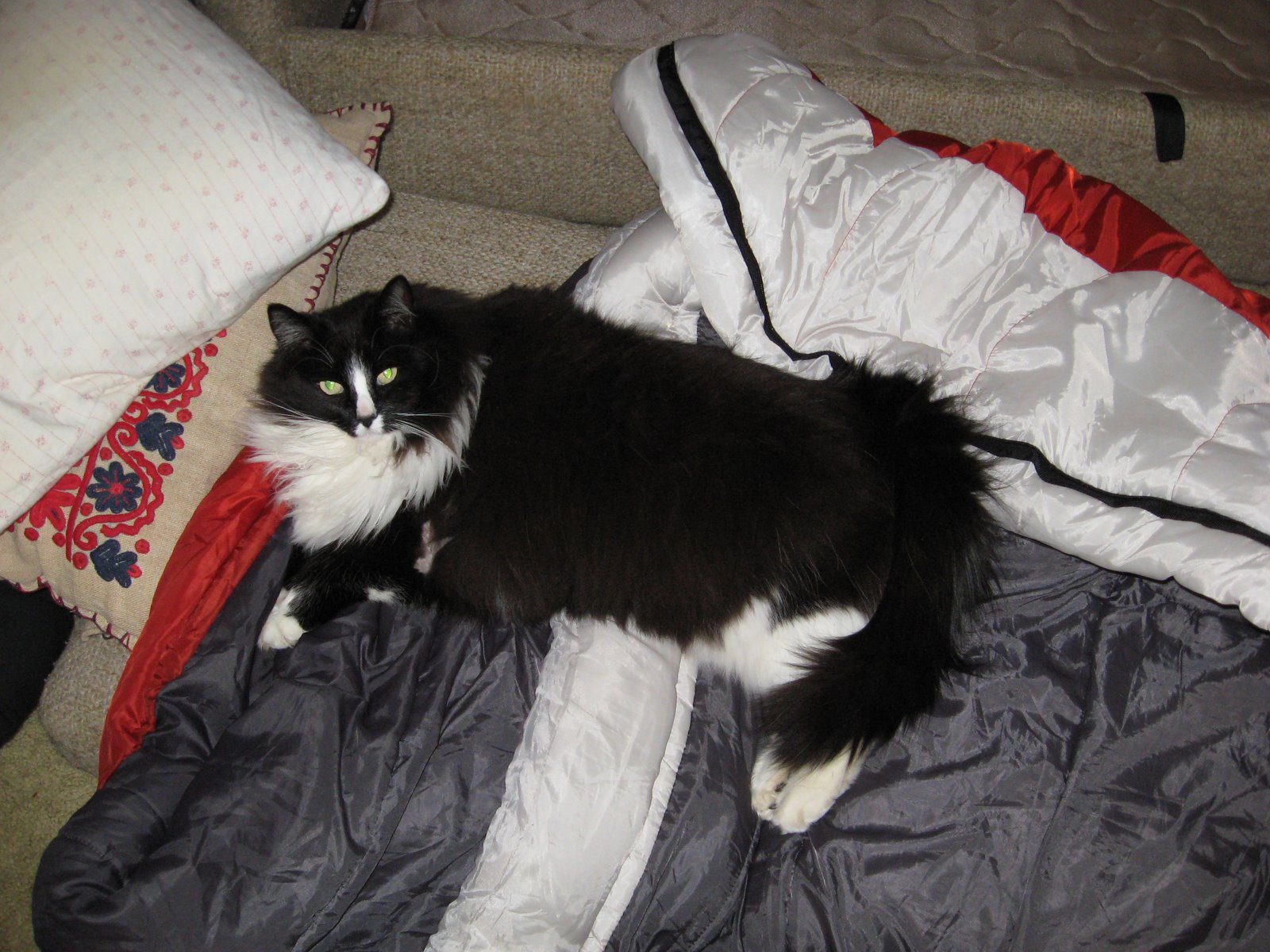
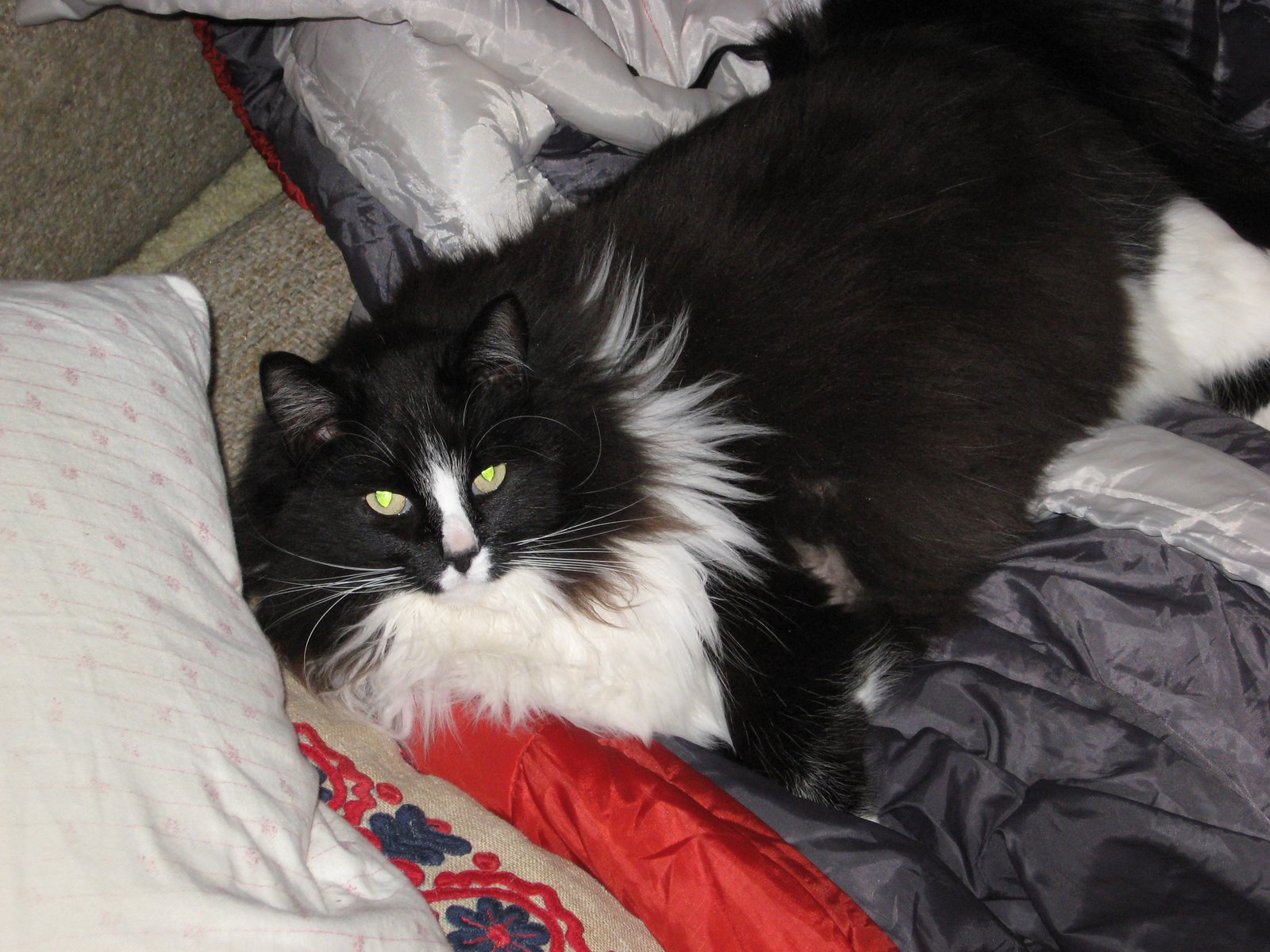
Mu-ge the Maine Coon mix...
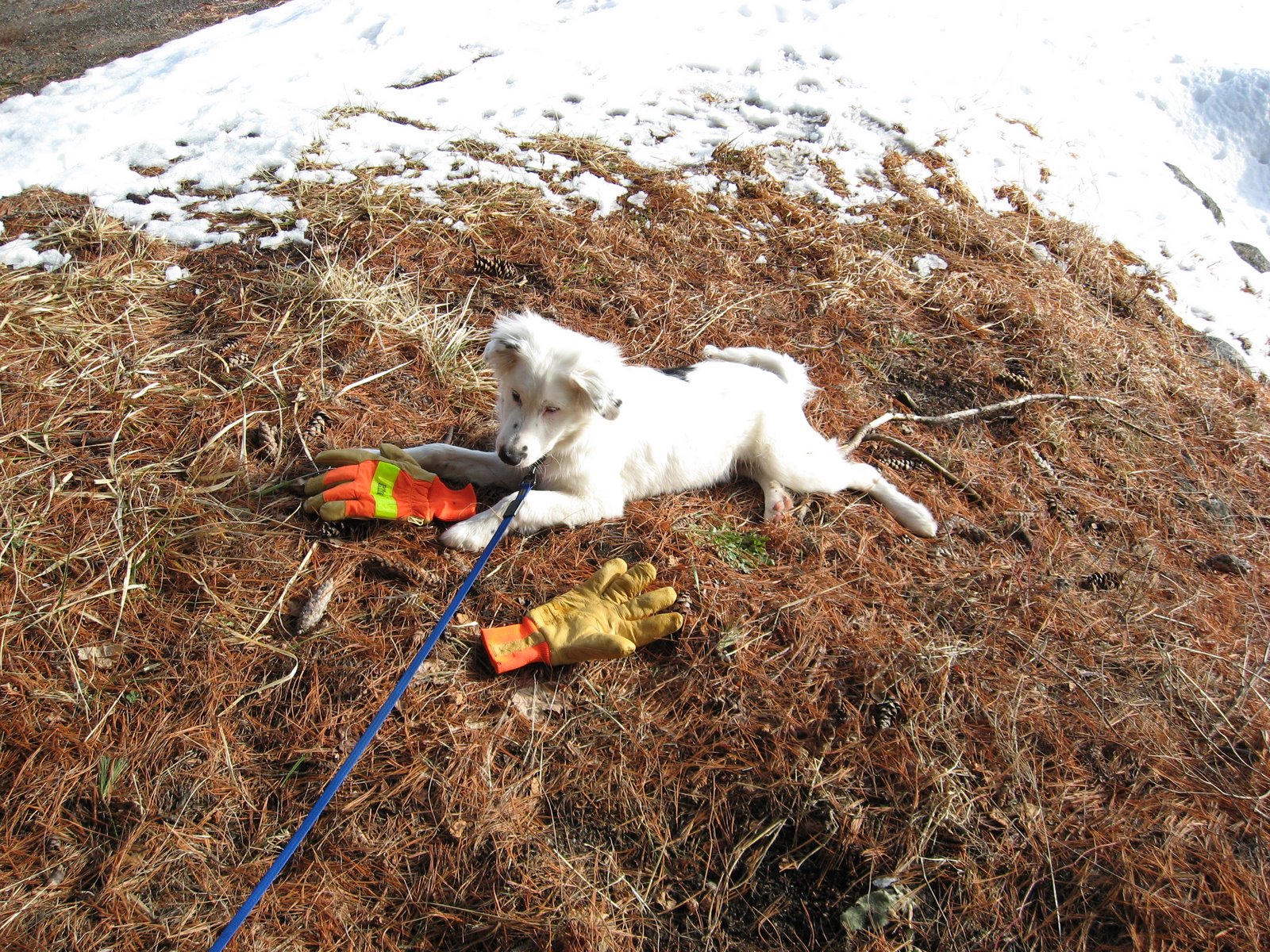
meet Rokpa the Border Collie mix. (In addition to his farm name, Blake, he will primarily be called Rokpa. "Rokpa" is a Tibetan word that means "to help" and "to serve.").

To see a world in a grain of sand,
And a heaven in a wild flower,
Hold infinity in the palm of your hand,
And eternity in an hour.

A robin redbreast in a cage
Puts all heaven in a rage.

A dove-house fill'd with doves and pigeons
Shudders hell thro' all its regions.
A dog starv'd at his master's gate
Predicts the ruin of the state.

...
Every night and every morn
Some to misery are born,
Every morn and every night
Some are born to sweet delight.

Some are born to sweet delight,
Some are born to endless night.

We are led to believe a lie
When we see not thro' the eye,
Which was born in a night to perish in a night,
When the soul slept in beams of light.

God appears, and God is light,
To those poor souls who dwell in night;
But does a human form display
To those who dwell in realms of day.
(Opening and closing verses of William Blake's (1757–1827) Auguries of Innocence)

One returns from hospital. The other arrives from rescue farm.

And the remaining two of us?

We're also approaching home. We suspect so, at least. Wandering mendicants together, step by (slowly...now) step.

A fine mix.

Friday, February 29, 2008

Note: The bookshop/bakery will be closed for the weekend -- Fri, Sat, Sun
Also: There will be no Sunday Evening Practice
....
We're off to meet and (hopefully) return with a new hermitage resident -- a sweet Border Collie from a rescue farm in New York State.
Meetingbrook Dogen and Francis Hermitage is delighted to note that this puppy was born on the feast of Francis of Assisi (4 Oct 07). (Just one more sign!)


ADOPTION PENDING

Other canine friends preferred


Special thanks to JoAnne Cook, Glen Miller, Susan Myers, Kendall Santarelli, Debbie Grassi, and Elana Hulsey for getting Blake to the Farm safely
BLAKE: A 4 month Border Collie/Collie mix, Blake is all about cuddling and love, love, love. He's certainly therapy dog material! Blake is super sweet with people and also loves other dogs. Like any puppy, he wants to play, play, play, wrestling and racing. He is quite a good natured, more submissive boy so would be best with an easy going canine friend. He is attentive and focused but not intense like a purebred. He has a more gentle nature like a collie. We know his lineage so know this is his mix. Blake is about 25 pounds. He was surrendered to a PA shelter from 'breeders' who could not sell him so routinely pass pups onto the shelter. Fortunately the shelter works with us and we're happy to have him at the Farm.
.....
Happy Leap Day, and (phew) end to February!

Love before you...leap.

Thursday, February 28, 2008

Not much better than caring for someone, something, somewhere. The straight ahead caring. Nothing sideways about it.
The universal spiritual quest
Suppose we use a traveling metaphor for the universal spiritual quest. The main map the Buddha offered for the trip to happiness and contentment is called the Eightfold Path, but I have often thought it should be called the Eightfold Circle. A path goes from here to there, and the nearer you are to there, the farther you are from here. A path is progressive on a genuine path you would need to start at the beginning and proceed in a linear way until the end. With a circle, you can join in anywhere, and its the same circle.

When the Buddha taught his path, he said it had a specific number of constituent parts; people could be sure they were going the right way if they saw any one of eight special markers. The order in which the traveler sees the signs doesn't matter. If we look at any sign closely, it becomes apparent that each one has all of the others hidden inside it. Even a tiny bit of Right Understanding, the suspicion that it is possible to be contented even when we aren't pleased, arouses Right Aspiration to make a lot of Right Effort to develop more Right Understanding its all connected.

(- Sylvia Boorstein, Its Easier Than You Think, from Everyday Mind, edited by Jean Smith, a Tricycle book)
To care is to be with another in everydayness.

Not hard to do. It's just the doing of it. That comes hard at times. Not hard to do. But the getting to it is what's hard.

Get to it.

Eh?

Wednesday, February 27, 2008

Sitting at dawn in front room. Comes mountain across road. Bit by bit of light revealing what came through night.
That night staying at a Buddhist temple,
I climbed to the highest room,
The brilliance of stars and moon
Obscured by the clouds,
Gibbons cried, the bell toned
I was oblivious to dawn
Until gradually brightening,
A cold winter sun rose in the East.
- Han Yu (805)
Something begins to slip away from me.

Incense and bows bring first light.

Returns infinite being to itself.

Tuesday, February 26, 2008

Snow. Cat still hurting. Also. Tired.
What is Right Mindfulness?
And what, monks, is Right Mindfulness? Here, monks, a monk abides contemplating body as body, ardent, clearly aware and mindful, having put aside hankering and fretting for the world; he abides contemplating feelings as feelings, he abides contemplating mind as mind, he abides contemplating mind-objects as mind-objects, ardent, clearly aware and mindful, having put aside hankering and fretting for the world. This is called Right Mindfulness.

- Mahasatipatthana Sutta: The Greater Discourse on the Foundations of Mindfulness, in Thus Have I Heard: The Long Discourses of the Buddha, trans. by Maurice Walshe, from Everyday Mind, edited by Jean Smith, a Tricycle book
And she abides as well.

We can't aways be certain about what happens.


We can, however look. Look carefully.

Beauty or Flight

The man who jumped from the highway bridge one afternoon
who drove his car along in rush hour traffic
then carefully pulled it over, fussed with something briefly on the dash,
so casually that another driver passing
thought he was looking for a map, or a cassette tape,
that had slid during the last turn before the bridge — that's all —
and then stepped out of the car, standing, stretching,
and closing the door routinely, a man in need of a break
on a long drive, a man untroubled by his next appointment,
a man who felt himself growing tired and thought
he needed some air, looked up the highway once
and then down at the almost frozen rows of traffic
under the haze that lingered above the bridge
and then broke simply and suddenly into a run, a dead run,
one motorist called it, crossing in front of his car
and not even stopping at the railing between the bridge
and the empty space beside the bridge, entering that space
and opening his mouth in what one driver called a scream,
though she heard no sound above the drone of traffic, and
other drivers saw as a gasp for breath, not unlike a child takes
when diving into a backyard pool, and he executed then
a nearly perfect, if a little rushed, swan dive out across the space
next to the bridge and into the water ninety-five feet below.

One fisherman in a boat a little upstream
saw the man who jumped from the highway bridge,
the moment he left the bridge and entered his dive, and the fisherman
swore he saw not a man but a large bird, a falcon or an eagle,
shot mid-flight by an angry driver, a large bird
who was trying to regain some sense of beauty, some sense of flight,
in its final dying seconds
(Poem: "Beauty or Flight" by Denver Butson from Triptych. The Commoner Press, 1999.)

So much depends on where we are what we see.

Monday, February 25, 2008

A good job is hard to find.
Right Livelihood
There are two criteria for right livelihood. First, it should not be necessary to break the five precepts in ones work, since doing so obviously causes harm to others. But further, one should not do anything that encourages other people to break the precepts, since this will also cause harm. Neither directly or indirectly should our means of livelihood involve injury to other beings. Thus any livelihood that requires killing, whether of human beings or of animals, is clearly not right livelihood. Selling liquor or other drugs may be very profitable, but even if one abstains from them oneself, the act of selling encourages others to use intoxicants and thereby harm themselves. Operating a gambling casino may be very lucrative, but all who come there to gamble cause themselves harm. Selling poisons or weapons arms, ammunition, bombs, missiles is good business, but it injures the peace and harmony of multitudes. None of these is right livelihood.

Even though a type of work may not actually harm others, if it is performed with the intention that others should be harmed, it is not right livelihood. The doctor who hopes for an epidemic and the trader who hopes for a famine are not practicing right livelihood.

(- S.N. Goenka, The Art of Living, from Everyday Mind, edited by Jean Smith, a Tricycle book)
There are so few jobs left that avoid wrong-livelihood.
Not many small huts in view,
Only three or four to be seen
Frosted trees dance in the sparse woods,
Showing sudden touches of color.
White clouds lie protectively
Over the closed brushwood gate;
The man out seeking the magic fungus
Has not yet returned.

- Toko Shin-etsu (1639-1696)

I hope we all get home alright.

Sunday, February 24, 2008

There's nothing to lose and nothing to gain with meditation.
Something has existed before
Heaven and earth;
Shapeless and silent
In its origin,
Yet the master of every
Image and form,
It can never wither
With the passing of time.

- Bankei (1622-1693)
Four students from Unity College at Sunday Evening Practice join six others in reading some words about nothing:
For me, meditation is a haven away from the ubiquitous world of self-improvement. It’s not just that there’s no such thing as “bad” meditation, but there’s no such thing as “good” meditation either. It is what it is. So when I hear words like “effort” and “discipline” and phrases like “deepening one’s practice” and “advancing along the spiritual path” spoken in the same breath as the word “meditation,” I wince. Just sitting (shikantaza)—doing and wanting nothing, breath coming and going unbidden, eyes seeing, ears hearing—in this effortless state, thoughts flurry like falling leaves.
(--January 31, 2008, ON THE CUSHION: The Myth of the Experienced Meditator, by Barry Evans, Tricycle Magazine)
Elsewhere, an 85yr old woman with viral infection has the family talking. Like chess players back from long vacation, their attention refocuses on the pieces scattered on table that must move or be lost.
I'm already lost.

But the cat is feeling better.

Saturday, February 23, 2008

Lou Reed sings that you can't depend on anything. Still, he says, you need a busload of faith to get by. In another song, he concludes:
"what's good? (life's good) but not fair at all"
(--from What's Good, song by Lou Reed)
Looking down at hands today, it occurred it's all a dream. By that I mean everything is passing, seemingly real, yet lacking distinct and separate existence once thought.
To study the Buddha way is to study the self.
To study the self is to forget the self.
To forget the self is to be enlightened by the ten thousand things [i.e., everything].
To be enlightened by the ten thousand things is to free one’s body and mind, and those of others.

-- Dogen Zenji, (1200 – 1253)
Forget about it! That's what Richie B. from Peconic Street would say with his tight lipped smile and nodding tilt of head. Mark called to say Richie, his uncle, died last week. (Requiescat in pace!)
Begin therefore with yourself and forget yourself. Truly, if you do not begin by getting away from yourself, then wherever you flee to, you will find obstacles and trouble no matter where it is. If people seek peace in outward things, whether in places or in methods or in people or in deeds or in banishment or in poverty or in humiliation, however great or of whatever kind all this may be, this is all in vain and brings them no peace. Those who seek thus seek wrongly; the further they go the less they find what they are seeking. They are like a man who has taken a wrong turning: the further he goes, the more he goes astray. But what should he do? He should resign himself to begin with, and then he has abandoned all things. In truth, if a man gave up a kingdom or the whole world and did not give up self, he would have given up nothing. But if a man gives up himself, then whatever he keeps, wealth, honour or whatever it may be, still he has given up everything.
--Meister Eckhart, (1260 – 1328)
Stepping into Bangor church the other day, there's a funeral mass for Marie going on. I sit in back pew. Priest talks about one carnation falling from bouquet. Holds it up. Finishes speaking. Walks it down to casket. Puts it on top. I get up. Guy in black coat watches me. I bow from back door. (Prego, Marie!) Leave.

Things are hardly ever fair.

But good?

Yeah.

Friday, February 22, 2008

In two different places and conversations in prison today, two different men were temporarily transfixed by the story told by Alice Walker about the circle custom of acceptance and release.

Alice Walker tells of a custom of the Babemba tribe of South Africa.
The Babemba tribe has a unique way of dealing with a member who acts irresponsibly or unjustly. They put the offending person in the center of the village, alone and unfettered.

All work ceases, and every man, woman and child in the village gathers in a large circle around the accused individual. Then each person in the tribe speaks to the accused, one at a time, about all the good things the person in the center of the circle has done in his lifetime. Every incident, every experience that can be recalled with any detail and accuracy is recounted. All his positive attributes, good deeds, strengths and kindnesses are recited carefully and at length.

The tribal ceremony often lasts several days. At the end, the tribal circle is broken, a joyous celebration takes place, and the person is symbolically and literally welcomed back into the tribe.

(--from Sent by Earth, by Alice Walker, Seven Stories Press, 2001).
There are times we go on with mind and heart numbed by kindness. At other times we are numbed by sorrow.
Lament

Listen, children:
Your father is dead.
From his old coats
I'll make you little jackets;
I'll make you little trousers
From his old pants.
There'll be in his pockets
Things he used to put there,
Keys and pennies
Covered with tobacco;
Dan shall have the pennies
To save in his bank;
Anne shall have the keys
To make a pretty noise with.
Life must go on,
And the dead be forgotten;
Life must go on,
Though good men die;
Anne, eat your breakfast;
Dan, take your medicine;
Life must go on;
I forget just why.

(--Poem: "Lament" by Edna St. Vincent Millay)
A curious night. Two women in Saskia's family find themselves in hospital a hundred miles apart. Snow tapers. Ground, nearly bare yesterday, goes white again.

Joe turned Pat's interpretation on its head this morning -- gently. Acceptance and forgiveness are for the accepting and forgiving. The one accepted and forgiven reflects the gift back.
And what, monks, is Right Speech? Refraining from lying, refraining from slander, refraining from harsh speech, refraining from frivolous speech. This is called Right Speech.
-( from Mahasatipatthana Sutta: The Greater Discourse on the Foundations of Mindfulness, in Thus Have I Heard: The Long Discourses of the Buddha, trans. by Maurice Walshe)
Most often we don't know why anything happens.

We can, nevertheless, speak well and kindly to one another.

It is up to the community to recognize the light in any one person.

We need not prove anything, nor deserve anything.

Light stands for itself.

Thursday, February 21, 2008

Beatrice Bruteau, talking to Tom Fox of National Catholic Reporter, said it is the unborn and the undying -- no origin, no destination -- which is the freedom of being beyond, in the holy spirit.

The perfectly free.
The moon and the paper
Are the same white
The pupil of the eye and the ink,
Both black.
This mysterious meaning
Remains a circle,
Beyond the possibility
Of understanding.

- Obaku Sokuhi (1611-1671)
What if Jesus is the way to save God?

Would we accept what and who we are if there was a change in translation?

Not Christian, but Jesusian?
Jesus saw nothing other.

Just things as they are.

With kindness.

Even love.

Wednesday, February 20, 2008

Full moon eclipse.
The way to true spirituality
Cannot depend upon others;
One instant of enlightenment
And I go beyond body and self.
The myriad and profound virtues
Are complete;
Anywhere in the universe
Is now my home.

- Mokuan (1611-1676)

No one is right. No one wrong.

That's not the world any more.

Adjust.

Come home.

Tuesday, February 19, 2008

Where are you?

Logging truck rolls past where I walk by frozen water near lumber yard.

Brief snow squall.

I listen to science podcast about nicotine, mimicry, and teleportation.
When everything inside and outside, bodily and mental, has been let go; when, as in the void, no attachments are left, that is the highest form of relinquishment.

Discard all you have acquired as being no better than a bed, spread for you when you were sick. Only when you have abandoned all perceptions, and rid yourself of dualistic concepts such as “ignorance” and “enlightenment,” will you be worthy to be called a Buddha. The original mind is without distinctions; when a sudden flash of thought occurs in your mind, even if a Buddha arises, cut him off.

Many people are afraid to empty their minds lest they plunge into the void. They do not know that their own mind is the void.

- Huang-po
Trying to avoid the void is like trying to unsay the word just spoken.

Like great rolling caskets the logging trucks deliver cadaver trees cut and stacked to yard for storage.

The first cigarette, the scientist says, captures the teenage brain and rewrites it according to addictive pathways.

Got a match? Yeah! Got suffering?

Suffering and a Crisis of Faith

If there is an all-powerful and loving God in this world, why is there so much excruciating pain and unspeakable suffering? The problem of suffering has haunted me for a very long time. It was what made me begin to think about religion when I was young, and it was what led me to question my faith when I was older. Ultimately, it was the reason I lost my faith.
(--Excerpt: 'God's Problem' by Bart Ehrman)
The explanation of suffering in the bible, he says, is unsatisfying.

There you are.

Monday, February 18, 2008

John O'Donohue in Anam Cara quotes Martin Heidegger as saying "True listening is worship."

Listening is a flower of silence. Even as flower gives it's impermanence to steady vase and loving gaze, silence finds itself with inches to spare between noise and chatter of crowded days.
If you want to learn about the Eternal Tao, do not be casual and in a hurry. Don’t glean too much from too many books, for each book is full of opinions, prejudices, and corruptions. Read only one book and only one, our Old Master’s Tao te Ching, and then try to understand it, not by juggling the words and meanings, but intuitively, through your heart and spirit.

Don’t ask too many questions, but patiently watch what we Taoists do, and perceive the hidden motives of our actions, and not that which is only for display. Do not be guided so much by your intellect as by faith, love, and your heart, which is another name for understanding and compassion.

What you need is wisdom, and not knowledge; for if one has wisdom, knowledge will come naturally. Always remember that the Eternal Tao is Infinite Wisdom, Infinite Love and Infinite Simplicity.

(- Ancient Taoist from Jade Mountain)

That to which my affection attends is thinner and smaller as each fire warms. Perhaps the wood pile will somehow last. No matter. Snow will go. Warmth return. Heart will accommodate next arrival when it shows itself. We'll gather what has fallen on mountain path.

You see, everything has its time. Joy is allowing what shows its quirky dance. Smile. Applaud when seemly. Walk on.
Shortly after finishing "Pragmatism and Romanticism," I was diagnosed with inoperable pancreatic cancer. Some months after I learned the bad news, I was sitting around having coffee with my elder son and a visiting cousin. My cousin (who is a Baptist minister) asked me whether I had found my thoughts turning toward religious topics, and I said no. "Well, what about philosophy?" my son asked. "No," I replied, neither the philosophy I had written nor that which I had read seemed to have any particular bearing on my situation. I had no quarrel with Epicurus's argument that it is irrational to fear death, nor with Heidegger's suggestion that ontotheology originates in an attempt to evade our mortality. But neither ataraxia (freedom from disturbance) nor Sein zum Tode (being toward death) seemed in point.

"Hasn't anything you've read been of any use?" my son persisted. "Yes," I found myself blurting out, "poetry." "Which poems?" he asked. I quoted two old chestnuts that I had recently dredged up from memory and been oddly cheered by, the most quoted lines of Swinburne's "Garden of Proserpine":
We thank with brief thanksgiving
Whatever gods may be
That no life lives for ever;
That dead men rise up never;
That even the weariest river
Winds somewhere safe to sea.
and Landor's "On His Seventy-Fifth Birthday":
Nature I loved, and next to Nature, Art;
I warmed both hands before the fire of life,
It sinks, and I am ready to depart.
I found comfort in those slow meanders and those stuttering embers. I suspect that no comparable effect could have been produced by prose. Not just imagery, but also rhyme and rhythm were needed to do the job. In lines such as these, all three conspire to produce a degree of compression, and thus of impact, that only verse can achieve. Compared to the shaped charges contrived by versifiers, even the best prose is scattershot.

(--from The Fire of Life, by Richard Rorty, an essay which originally appeared in the November 2007 issue of Poetry.)
Woodpile diminishes. No notion of how many days remain. Tonight there's warmth. That's good enough. What else is there?

Listen!

Fog rises from snow on Sally's field.
The Wood-pile

Out walking in the frozen swamp one grey day
I paused and said, "I will turn back from here.
No, I will go on farther--and we shall see."
The hard snow held me, save where now and then
One foot went down. The view was all in lines
Straight up and down of tall slim trees

Too much alike to mark or name a place by
So as to say for certain I was here
Or somewhere else: I was just far from home.
A small bird flew before me. He was careful
To put a tree between us when he lighted,
And say no word to tell me who he was
Who was so foolish as to think what he thought.
He thought that I was after him for a feather--
The white one in his tail; like one who takes
Everything said as personal to himself.
One flight out sideways would have undeceived him.
And then there was a pile of wood for which
I forgot him and let his little fear
Carry him off the way I might have gone,
Without so much as wishing him good-night.
He went behind it to make his last stand.
It was a cord of maple, cut and split
And piled--and measured, four by four by eight.
And not another like it could I see.
No runner tracks in this year's snow looped near it.
And it was older sure than this year's cutting,
Or even last year's or the year's before.
The wood was grey and the bark warping off it
And the pile somewhat sunken. Clematis
Had wound strings round and round it like a bundle.
What held it though on one side was a tree
Still growing, and on one a stake and prop,
These latter about to fall. I thought that only
Someone who lived in turning to fresh tasks
Could so forget his handiwork on which
He spent himself, the labour of his axe,
And leave it there far from a useful fireplace
To warm the frozen swamp as best it could
With the slow smokeless burning of decay.
(--Poem by Robert Frost)
This body is ready for night's rest.

Let every one arrive home safely!

Amen. Ok? Of course.

Listening carefully.

Let's let.

Go.

Sunday, February 17, 2008

Poor Clare hermit makes triennial visit to Meetingbrook. Her sweet shepherd eats biscuits, laps water, lays at her feet as we talk beyond piano along bookshelf.

The day begins sunny. Shop crowded with Manhattan, Kent England, New Hampshire, Belfast, and central Maine solitude.

Mind travels from all directions to receive itself in another.
The Kiss

She pressed her lips to mind.
—a typo


How many years I must have yearned
for someone's lips against mind.
Pheromones, newly born, were floating
between us. There was hardly any air.

She kissed me again, reaching that place
that sends messages to toes and fingertips,
then all the way to something like home.
Some music was playing on its own.

Nothing like a woman who knows
to kiss the right thing at the right time,
then kisses the things she's missed.
How had I ever settled for less?

I was thinking this is intelligence,
this is the wisest tongue
since the Oracle got into a Greek's ear,
speaking sense. It's the Good,

defining itself. I was out of my mind.
She was in. we married as soon as we could.

(Poem: "The Kiss" by Stephen Dunn from Everything Else in the World. W.W. Norton & Company, 2008.)
Too many peanut butter cookies with chocolate chips. That and smoke from downdraft this Sunday evening after practice. During walking meditation I fall off my slow steps, then begin again.


All we can ever do for one another is to be with.
Suffering is a universal experience
Seeing the suffering in the world around us and in our own bodies and minds, we begin to understand suffering not only as an individual problem, but as a universal experience. It is one of the aspects of being alive. The question that then comes to mind is: If compassion arises from the awareness of suffering, why isn't the world a more compassionate place? The problem is that often our hearts are not open to feel the pain. We move away from it, close off, and become defended. By closing ourselves off from suffering, however, we also close ourselves to our own wellspring of compassion. We don't need to be particularly saintly in order to be compassionate. Compassion is the natural response of an open heart, but that wellspring of compassion remains capped as long as we turn away from or deny or resist the truth of what is there. When we deny our experience of suffering, we move away from what is genuine to what is fabricated, deceptive, and confusing.

(- Joseph Goldstein, Seeking the Heart of Wisdom, from Everyday Mind, edited by Jean Smith, a Tricycle book)
Tears came at table when a woman spoke of her friend's suicide. I remembered our friend's, how she held my hands soon before, how we didn't know whether she would find her way through and out the despair. But there was that moment at the shop, in a crowded din, a moment of being with one another. That's all. Just that.

Every moment a call for creativity. That's what Delia said at table. The silent cry from the monastery of our heart.

O'Donohue is right -- there's a revelation of compassion for each wound attended.

The revelation is love.

In action.

No matter.

What.

Saturday, February 16, 2008

This world is a fragile construct.

Sometimes it seems unable to hold.

What is it we might have to let go of?
Illinois Gunman Showed Few Hints of Trouble, By MONICA DAVEY, Published: February 16, 2008
DeKALB, Ill. — Steve Kazmierczak, the man who walked silently into a classroom here on Thursday and opened fire, was not seen as struggling in college. He was not an outcast. And until recently, at least, he was not brooding.

In a stark, puzzling contrast to the usual image of a rampaging gunman, Mr. Kazmierczak, 27, was described Friday as a successful student — “revered,” the authorities said, by his professors — who had served as a teaching assistant and received a dean’s award as an undergraduate here at Northern Illinois University, where he returned Thursday, killing himself and five students and wounding 16 others.

Here, he had campaigned for a leadership post in a student group that studied the failings of the prison system, an issue he was passionately concerned about, and had apparently won. He was a co-author of an academic paper called “Self-Injury in Correctional Settings: ‘Pathology’ of Prisons or of Prisoners?” which examined why inmates might hurt themselves with behaviors like cutting their skin.

He was personable, easy to talk to, an excellent student, said his professors at the University of Illinois, Urbana-Champaign, some 130 miles south of here, where he was on his way to receiving a master’s degree in social work. The specialty he selected was in mental health.

(http://www.nytimes.com/2008/02/16/us/16gunman.html)
At times there is no perceptible center, no discernible core to the construct. The explanations fail to satisfy as to why all human beings are not equally treated with sustaining food, shelter, clothing, health care and esteem. The actions of governments and administrations in institutions of all sorts do not satisfy the desire for justice, fair, and equal treatment. The competitive, predatory, and exclusionary nature of business and economic practices inhibit the simple need to produce income for each individual based on basic initiative and self-subsistent enterprise. The pervasive mistrust and rampant fear-mongering in the social spectrum casts doubt on everyone -- we wonder: who can be trusted? who might be informing on us? who is spying on us? who is willing to delight in our weaknesses and charge 20-30% on debt? who is plotting a bombing? who carries guns into crowded places intent to harm and kill? who sees an opportunity to take advantage of terrible events of the kind at the University of Illinois for personal or political gain? who are authentic friends? and, at last, if this world is a battleground between good and evil, why do we not feel confident that good has any leverage and why are so many of our systems and corporate bodies so willing to use evil to inch toward the illusory good imagined coming from such an anguishing path?
No flower can compare with the pine.
Today the flower blooms in sweet beauty,
Overnight come snow and frost,
It fades away.
The pine is the evergreen.

(- Prose rendering of a wall poem seen in 1934 at Pai-szu Pagoda)

It is painful to experience so much of this world. Once we thought it was God's favor to be insulated and protected in life due, inevitably, to privilege, position, wealth, or status. Literature and headlines point out that no one is exempt from the ravages of impermanence, time, existence, and inevitability.
Pain is inevitable
The First Noble Truth declares unflinchingly, straight out, that pain is inherent in life itself just because everything is changing. The Second Noble Truth explains that suffering is what happens when we struggle with whatever our life experience is rather than accepting and opening to our experience with wise and compassionate response. From this point of view, theres a big difference between pain and suffering. Pain is inevitable; lives come with pain. Suffering is not inevitable. If suffering is what happens when we struggle with experience because of our inability to accept it, then suffering is an optional extra.


I misunderstood this when I started my practice and believed if I meditated hard enough I would be finished with all pain. That turned out to be a big mistake. I was disappointed when I discovered the error and embarrassed that I had been so nave. Its obvious we are not going to finish with pain in this lifetime.

The Buddha said, Everything dear to us causes pain.Those of us who have chosen relational life have made the choice that the pain is worth it.
(-Sylvia Boorstein, Its Easier Than You Think, from Everyday Mind, edited by Jean Smith, a Tricycle book)
We cannot fathom exactly how it is that the world is the way it is. Myths have arisen to try. So have theologies and philosophies. Ideology and manifesto combine to tell us how things are, how we are going to behave and live whether we agree or not, and invariably fail to contribute anything but a new variety of dread and fear.

Still, the world is the way it is.

How come?

How long?

Christians await Christ. Buddhists the Buddha of end times. Allah, Adonai, Alpha and Omega, Manjushri, Say Goodnight Gracie, and other assortments of valedictory wander our imagination and alternately comfort or worry us.
Beautiful Dreamer Serenade

Beautiful dreamer, wake unto me,
Starlight and dewdrops are waiting for thee;
Sounds of the rude world heard in the day,
Lull'd by the moonlight have all pass'd a way!

Beautiful dreamer, queen of my song,
List while I woo thee with soft melody;
Gone are the cares of life's busy throng,—
Beautiful dreamer, awake unto me!
Beautiful dreamer awake unto me!

Beautiful dreamer, out on the sea
Mermaids are chaunting with wild lorelie;
Over the streamlet vapors are borne,
Waiting to fade at the bright coming morn.

Beautiful dreamer, beam on my heart,
E'en as the morn on the streamlet and sea;
Then will all clouds of sorrow depart,—
Beautiful dreamer, awake unto me!
Beautiful dreamer awake unto me!

(--Poem: "Beautiful Dreamer Serenade" by Stephen C. Foster. Public domain.)
Is that it?

Are we dreaming?

Are we close to awakening?

Do we have the good heart and good sense to open with wise and compassionate response?

Friday, February 15, 2008

Memory slips. Not holding on to things in same way as before. Aging. Nor does it matter.
In front of us stood Flowery Mountain and its secret retreats. When we approached clouds veiled its summit. The vapors which covered the enclosing ring of mountains rose, and the morning sun illumined their crowning peaks. Then beautiful cliffs appeared one after another, and we heard the music of the wind howling against the rock walls. We were part of the living landscape.
- Wang Li

Cat under front room altar. Tussled last night with something in barn. A bit beaten.

In prison today conversing about Carl Sagan, Parinirvana Day, and Dan Millman.

Wind blows cold outdoors. Clinking fragility.

We hold on long past good sense.

Thursday, February 14, 2008

When things encase us, there's always the sun. It comes. But in it's own time.

The force of love
The practice of metta, uncovering the force of love that can uproot fear, anger, and guilt, begins with befriending ourselves. The foundation of metta practice is to know how to be our own friend. According to the Buddha, You can search throughout the entire universe for someone who is more deserving of your love and affection than you are yourself, and that person is not to be found anywhere. You yourself, as much as anybody in the entire universe, deserve your love and affection. How few of us embrace ourselves in this way! With metta practice we uncover the possibility of truly respecting ourselves. We discover, as Walt Whitman put it, I am larger and better than I thought. I did not think I held so much goodness.

(- Sharon Salzberg, Lovingkindness, from Everyday Mind, edited by Jean Smith, a Tricycle book)
This Valentine's Day we see Farmington, Belgrade Lakes, Rome, Augusta. Ice has visited. Stays the day. Crusts everywhere.
Arriving back to bookshop at end of conversation. Course in Miracles theme is:
Lesson 045
God is the Mind with which I think.
Today's idea holds the key to what your real thoughts are They are nothing that you think you think, just as nothing that you think you see is related to vision in any way. There is no relationship between what is real and what you think is real. Nothing that you think are your real thoughts resemble your real thoughts in any respect. Nothing that you think you see bears any resemblance to what vision will show you.
You think with the Mind of God. Therefore you share your thoughts with Him, as He shares His with you. They are the same thoughts, because they are thought by the same Mind. To share is to make alike, or to make one. Nor do the thoughts you think with the Mind of God leave your mind, because thoughts do not leave their source. Therefore, your thoughts are in the Mind of God, as you are. They are in your mind as well, where He is. As you are part of His Mind, so are your thoughts part of His Mind.

(--from ACIM)
When we do not lie about it, everything is just as it is. Even when we are lying, it is as it is. I want to stop lying.

Winter February will thaw.

Love will warm.

Mind well.

We'll see.

Wednesday, February 13, 2008

Canada is close and magnificant neighbor. It makes us think big.


We'd like a million dollars. We'd settle for 975,000. We'd buy a 16 acre farm in Canada with many outbuildings, a 7 bedroom, 4 bathroom house. We'd fashion a meditation cabin, a chapel, a bookshop/bakery, guest quarters, animal barn, organic acres for food, and choose the option of right of way down to beach at St Croix River opening through Passamaquoddy Bay into Bay of Fundy.

Alright -- the property only costs 549,000. But we thought it would be nice to have a buffer against additional costs for upkeep and improvements in order to bring about a marvelous center for retreat and lay monastic practice between traditions of Catholic/Anglican Christianity and Mahayanan/Theravadan Buddhism.

We'll start our capital campaign on Valentine's Day. We'd like to make an offer on the place by St. Patrick's Day and move in on the final day of winter so as to wake up the first day of spring.

Donors are encouraged. Those whose portfolios are large and whose hearts are generous will receive in return whipped cream on their ice cream. We'd prefer to have no mortgage. You can own it for us if you like.
Everyone who pauses at this prospect with a good thought is exceedingly welcome to visit and pray, sit and meditate, and eat good food sprinkled with hope, joy, compassion and loving kindness.
By listening to the sound of music and its fading, the wise understand the rise and fall of all things. By watching, the wise know the meaning of things even before they appear and take shape.
- Ko Hung 4th century
A million dollars. Maybe less. OK, a lot less. Maybe even a smile allowing that we still dream dreams of places where in parallel worlds a life such as ours is lived out wondering what resides on the other side of subtle cloaking dimension.
Land Love

We stood here in the coupledom of us.
I showed her this — a pool with leaping trout,
Split-second saints drawn in a rippled nimbus.

We heard the night-boys in the fir trees shout.
Dusk was an insect-hovered dark water,
The calling of lost children, stars coming out.

With all the feelings of a widower
Who does not live there now, I dream my place.
I go by the soft paths, alone with her.

Dusk is a listening, a whispered grace
Voiced on a bank, a time that is all ears
For the snapped twig, the strange wind on your face.

She waits at the door of the hemisphere
In her harvest dress, in the remote
Local August that is everywhere and here.

What rustles in the leaves, if it is not
What I asked for, an opening of doors
To a half-heard religious anecdote?

Monogamous swans on the darkened mirrors
Picture the private grace of man and wife
In its white poise, its sleepy portraitures.

Night is its Dog Star, its eyelet of grief
A high, lit echo of the starry sheaves.
A puff of hedge-dust loosens in the leaves.
Such love that lingers on the fields of life!

(--Poem by Douglas Dunn, Faber, 1985)
At turn in stairs there's a statue settled into a niche. A woman. Is it Mary? Or Kuan Yin? Whoever she is, she knows our hearts are filled with humor and openness to possibility. Do people want to come here to rest a while? Does silence wish minds to penetrate? Will the sweet beauty of nature draw into our tired minds reminders of true home?

It might not matter where one lives, or even whether there is room for others to visit and refresh. This dream of ours has been with us for a long time. Every once in a while we take it out, dust it off, and dance with it in the open air.

One of the small joys in life is the possibility of surprise.

The unexpected kindness.
Gift without explanation.

A grace quietly accepted.

Even before it appears.

Tuesday, February 12, 2008

Then, naturally, there's the question: Who are you not?

The question corresponds with its sister question: Where is God not?

The morning drive leaving Fort Kent, moving through northern Maine's rooftop laden with deep, deep snow. Mailboxes are covered, snow tiptoes up to first floor windows, heavy white burden buckles old barns, roadways are luge runs with soft embankments should the icy permafrost toss you askew. Then across to Caribou, down to Presque Isle -- the lovely beauty of winter! More snow tomorrow.
A saint is not ashamed of being despised, but saddened to see good counsel spurned. That life be brief does not depress him but avoidable suffering distresses him. He keeps his mind free of vain endeavors and embraces wisdom. By becoming one with the Great Unity the saint avoids the whirlpool of the mundane vanities.
- Wen-tzu
The activities might swirl about, even through, the saint -- but, I suppose, she is not drawn down by whirlpool and lost in dark depths. Perhaps preventive escape is not so much the issue as is sane survival. A friend used to speak about insulating himself against the world of temptations and dark forces. "Let these pass," Obi-Wan Kenobi said to the Imperial Guards, referring to his small coterie of fellow travelers passing through dangerous terrain, "they mean no harm." They were let pass. All rules of search and impede suspended.

Like walking across bridge between Fort Kent, Maine and Clair, New Brunswick -- at the international boundary over frozen river sided by floes passing under -- stand in two countries at once -- the freezing earth, air, and water giving not a thought to matters of government, nation, or possession of air space.

We're not, I concede, who we think we are. But there's more to it.
Someone I cared for

Someone I cared for
put it to me: Who
do you think you are?

I went down the list
of all the many
possibilities

carefully — did it
twice — but couldn't find
a plausible one.

That was when I knew
for the first time who
in fact I wasn't.
(Poem: "Someone I cared for" by Cid Corman, from And The Word. Coffee House Press, 1987.)

Once, I stood under the cliff at edge of beach in Downeast Maine. Everything leaned out in solid silence as tide rolled rocks behind us at shoreline. Everything we'd seen and everyone we'd spoken with that day accompanied us to that moment at that spot in a consciousness excluding nothing from itself. We see things for each other. We hear things for one another. We quietly contemplate nature -- elemental, animal, human, and divine -- and these varying forms and emptinesses allow themselves to open and flower before and within us.

So, we ask one another: Who do you think you are? And we pause for a bit and reflect. We consider the possible implications and parameters of any response. We then carry on to the next in our lives -- the next instant, next minute, and next hour arising with us.

We dwell in the swirl of everything happening at the same time.

In everything there is a calm center, a resting place in the chaos, a sanctuary where resides the sacred emptiness assenting our particular presence.

If we go there, we are not only not alone, we are more profoundly involved, and more paradoxically informed. There, in the center of the swirling motion that is the evidenced world, we are alone -- but alone with the Alone. This "Alone" is all there is, nothing missing, everything within everything.

Allow yourself the visit.

Touch any one thing, feel every thing.

Forget what we've thought God.

Enter God.

Where God is.

Pass well!

Monday, February 11, 2008

Note: The bookshop/bakery is closed Monday (11th), and Tuesday(12th).
We will re-open Wednesday 13 Feb.
................