
Wednesday, November 11, 2015
Tuesday, November 10, 2015
Before you say anything, consider everything
To be centered is to be at a still point.
To be off-centered is to wander in erratic movement.
By sitting still we settle into center.
By walking awarely we make each step its own.
There is only one peaceful spot in existence.
Do you know where it is?

Monday, November 09, 2015
limitless and lackless
Faint twilight follows white dog jumping on bed. Sliver moon and morning star dance ahead of day’s innuendo coming ‘round from our eastern rotation.
Richard Rohr writes.
So, I grind coffee beans from Oso Negro, step onto chilly sunless porch, and begin the monastic observances of awe at beginnings, surrender at endings, and groundless (limitless and lackless, {thank you Rupert Spira}) awareness at each revelation passing through us.
Richard Rohr writes.
Seems perfect to have Capuchin Friar wandering around before early departure.
The Great TurningMonday, November 9, 2015
[1] Joanna Macy and Molly Young Brown, Coming Back to Life: Practices to Reconnect Our Lives, Our World (New Society Publishers: 1998), 17.[2] Ibid., 21.[3] Adapted from Richard Rohr, unpublished "Rhine" talks (2015).[4] Ilia Delio explored this concept at CAC’s CONSPIRE 2014 conference... ... ... ...


So, I grind coffee beans from Oso Negro, step onto chilly sunless porch, and begin the monastic observances of awe at beginnings, surrender at endings, and groundless (limitless and lackless, {thank you Rupert Spira}) awareness at each revelation passing through us.
Sunday, November 08, 2015
no subsiding
I was reminded today of the Bush fiasco of Cheney and Rumsfeld and their fiasco of invading Iraq and the sorrowful results that followed.
It seems a sin that they were never indicted for what they did.
No matter what
We train our minds by looking into them. We just look in, not allowing ourselves to be carried away by our perceptions; we just look into what is going on, and ask, “Where does this come from?” We are training ourselves in the practice and study of Buddhism so that our thoughts and emotions do not disturb our true-nature mind, so that we can sit imperturbably no matter what.
—Maurine Stewart, “Our One and Only Commandment"
I can sit that way. I can also long for justice with a longing that does not subside.
Saturday, November 07, 2015
not presenting themselves aloud at roll call
Good men good women die in war.
War sucks.
Still, and beyond all, we are humbled by their sacrifice.
One cannot but be moved.
(After 2014 documentary film, “The Hornet’s Nest.”)
https://www.amazon.com/Hornets-Nest-Mike-Boettcher/dp/B00NGXPEFY/ref=aiv_vf_p2_al_1_doc_all_46_p
War sucks.
Still, and beyond all, we are humbled by their sacrifice.
One cannot but be moved.
(After 2014 documentary film, “The Hornet’s Nest.”)
https://www.amazon.com/Hornets-Nest-Mike-Boettcher/dp/B00NGXPEFY/ref=aiv_vf_p2_al_1_doc_all_46_p
let's look at this; let's see through silent gaze
Re. http://www.nytimes.com/2015/11/07/opinion/winds-blowing-through-the-catholic-church.html?ref=opinion&_r=0&referer=http://www.nytimes.com/pages/opinion/index.html?action=click&pgtype=Homepage®ion=TopBar&module=HPMiniNav&contentCollection=Opinion&WT.nav=page&nytmobile=0
Jesus, Catholics often forget, was Jewish. He was not a Catholic. He was not Christian. Hence he was not a conservative Catholic nor a fundamentalist Christian.
Capisce?
I'll find my own name for the interest I have toward this interesting man.
My interest in Yeshua bar Yosef comes from a hermeneutics of non-theological ordinariness.
I am a zen-poetics nomadic mendicant of mere gaze.
No institution owns Jesus. He stands alone.
Look at him. Not through creeds, doctrines, or self-justifying cant.
Just...look at the man.
He is free and clear.
I look there.
I look here.
In silence.
Friday, November 06, 2015
disappearing into one another
We call it silent sitting. Elsewhere it is known as zazen. Specifically, shikantaza. Themeless sitting meditation.
Why?
Rumi asks in one of his poems, 'What is my self? I can't stop asking.'
My self is what is. Asking has no end.
In prison this morning, only the unimprisoned.
Thursday, November 05, 2015
Cosmic purpose
What would drive you insane? Would seeing truth abused and pained? We are creatures made with creativity for creativity-Itself.
We'd best learn to think back so to think toward a new expression of the holy reality surrounding our environs. Without which, madness.
Though it overlaps with many aspects of non-Christian mysticism--such as nature mysticism, Islamic Sufi mysticism (ecstasy and joy), Hindu mysticism (unitive consciousness and asceticism), Buddhism (non-violence and simplicity), and Jewish prophetic oracles--Franciscan mysticism is both deeply personal and cosmic/historical at the same time. [1] We must know that Franciscanism is not primarily about Francis of Assisi. It is about God, and the utter incarnate availability of God. In fact, when some fixate on Francis and Clare too long their spirituality invariably becomes sentimental, cheap, and harmless. Franciscan mysticism is about an intuition of Jesus as both the Incarnate Human One and the Eternal Cosmic Christ at the same time. (For a deeper exploration of the Cosmic Christ, see my meditations from earlier this year.) [1] The first and cosmic incarnation of the Eternal Christ, the perfect co-inherence of matter and Spirit (Ephesians 1:3-11), happened at the Big Bang 13.8 billion years ago. Christians believe that Jesus of Nazareth was the human incarnation of that same Mystery a mere 2,000 years ago, when we were perhaps ready for this revelation. Christ is not Jesus' last .name, but the title of his historical and cosmic purpose. Jesus presents himself as the "Anointed" or Christened One who was human and divine united in one human body--as our model and exemplar. Peter seems to get this, at least once (Matthew 16:16), but like most of the church, he also seems to regress. Christ is our shortcut word for "The Body of God" or "God materialized." [2] This Christ is much bigger and older than either Jesus of Nazareth or the Christian religion, because the Christ is whenever the material and the divine co-exist--which is always and everywhere.
(--from, The Cosmic Christ, Thursday, November 5, 2015, a meditation by Richard Rohr)
Heidegger thought that we are still not thinking.
Camus didn't like driving in cars.
Nietzsche was troubled that God was dead, and that we killed God by not allowing the emergence of God from former concepts to occur.
We forget.
And in our forgetting, enter inconsolable anguish at creativity squandered and beaten in the street by thoughtless driver.
Wednesday, November 04, 2015
says it
“All that stays is dying all that lives is getting out”
(--from Urge for Going, sung by Tom Rush, lyrics by Joni Mitchell) https://www.youtube.com/watch?v=GKfYw2JIvgE
(--from Urge for Going, sung by Tom Rush, lyrics by Joni Mitchell) https://www.youtube.com/watch?v=GKfYw2JIvgE
Tuesday, November 03, 2015
andiamo, da nessuna parte
It’s a question that interests, namely, What happens ‘after’ what you thought was so is no longer so?
Where does light go when it goes out?
After something is lost, what is found?
Retiring to retiro, I am alone with no-one-near.
The sound of it!
Where does light go when it goes out?
After something is lost, what is found?
What do you identify as distinctive?
I identify four primary themes: the principle of conditionality; the practice of the fourfold tasks; the perspective of mindful awareness; and the power of self-reliance. I call them the four P’s. The book teases out of these four themes what hopefully is a comprehensive account both of the dharma and of the Buddha’s life.
The language you use for fundamental Buddhist terms and concepts is often a radical departure from convention. The four noble truths become “the four tasks”; nirvana becomes “a nonreactive ethical space”; dukkha, typically translated as “suffering,” simply becomes “life.” And tanha—craving—becomes “reactivity.” In many cases, your translations are more interpretive than literal.
As the cliché goes: translation is always interpretation. The meaning of words, as Wittgenstein pointed out, has to do with how they are used more than how the dictionary defines them. I may choose a term that might not be literally so close to the original but could actually shed more light on how that term operates within the framework of the discourses.
In the case of the four noble truths—what you call the four tasks—the departure is especially jarring. Can you explain?
If you open any book that purports to explain Buddhism, within two or three pages you’re onto the four noble truths. So to start questioning them is clearly controversial— even audacious. But on the basis of philological analysis, earlier translators—F. L. Woodward, for example, then people like Kenneth R. Norman—have spotted troubling incongruities in the way the expression “noble truth” is used. For instance, the Buddha’s first discourse literally says, “The second noble truth is to be abandoned.” Now that doesn’t make any sense. You don’t abandon the second noble truth; you abandon craving. It’s equally problematic to say, “The fourth noble truth is to be cultivated.” How do you cultivate a noble truth? Would that make it more true? Or more noble? Or both? It seems that at a later date the expression “noble truth” was rather clumsily introduced into the text. Now, that comes as a bit of a revelation, frankly, and a rather disturbing one. Norman concludes his analysis by saying: “The earliest form of [the Buddha’s first] discourse did not include the words ‘noble truth.’” That’s equivalent to saying: “In the original teaching the doctrine that people associate most fundamentally with Buddhism simply wasn’t there.”
Another example is the use of the word “truth” itself. I’m not suggesting the Buddha didn’t use the word. He did. But apart from in the expression “four noble truths,” the word “truth” in most cases refers to the virtue of speaking truthfully, being honest, having integrity in one’s life. We find this usage in the Ashokan edicts as well as in the Theravada doctrine of the perfections, one of which is sacca-parami: the perfection of truth. Here the word “truth” doesn’t refer to truth as a synonym for “reality,” it refers to truth as a virtue of speech. This supports my hypothesis that Buddhism did not start out as a truth-based metaphysics. In other words, to be awakened does not mean to understand the truth or nature of reality, which then frees you from ignorance, leaving you awakened. It may be more accurate to think of truth as truthfulness, or living a truthful life. It means to live in a certain way rather than to gain access to a privileged knowledge. So “four tasks,” as opposed to “four truths,” seem to me more appropriate. Truth is an act to be performed, not a fact to be known.
I finish another small notebook of brief jottings. Petits riens sans sens.
http://www.tricycle.com/magazine/magazine-departments/interview
- (--Interview, After Buddhism, An interview with Stephen Batchelor, Tricycle, Winter 2015)
Retiring to retiro, I am alone with no-one-near.
The sound of it!
Madama Butterfly (1986 Remastered Version), Act I: Gran ventura (Butterfly/Coro/Pinkerton/Sharpless/Goro) 3:49 Renata Scotto, Rolando Panerai, Coro del Teatro dell'Opera, Roma, Coro del Teatro dell'Opera di Roma, Orchestra del Teatro dell'Opera, Roma, Orchestra del Teatro dell'Opera di Roma, Gianni Lazzari, Sir John Barbirolli, Carlo Bergonzi & Piero de Palma Puccini: Madam Butterfly ClassicalI listen to and read about Renata Scotto,
Scotto’s achievement was, in large part, her own.
“I prefer my way,” she said, “because you have a chance to learn, a chance to look. John Dexter, though, for me he was the greatest because he was looking for movement. If I would move a hand with no reason he would say, ‘Why did you move that hand? There’s no reason. Give me a reason, then I’ll let you move your hand.’” http://www.capitalnewyork.com/article/culture/2011/02/1436893/afterlife-diva-renata-scotto-aging-talent-tradition-and-why-she-quit ,Why do we move?


Monday, November 02, 2015
maybe; is that so?
There might not be either birth or death.
But, still, we have cigars, we have hospice.
Joy.
And sorrow.
There is much to worry and wonder about.
Much to hold dear.
But, still, we have cigars, we have hospice.
Joy.
And sorrow.
There is much to worry and wonder about.
Much to hold dear.
Sunday, November 01, 2015
it is november; soul alone, coming home
 |
| camden outer harbor, 1nov15, emptiness |
Practicing what now is (playfully) called “coificit ease” -- namely: Contemplative origins -- inter-faith, inter-culture, inter-tradition; engagement, action, service, experience
First encountered Asian Philosophy in 1965 reading John Wu and Thomas Merton.
Sat first sesshin in 1975 and gone downhill since. Found hermitage that is far too lax in solitude, silence, and service.
So, we practice contemplation, conversation, and correspondence. Zen Buddhism and Contemplative Christianity host their parent religions and scattered cousins in ongoing circle holy chutzpah, dharma combat and spiritual warrior-ship over coffee, tea, toast, biscuits, and oatmeal raisin cookies.
We look, we listen, we don’t know.
As monastics of no other (mono), “we are poor passing facts, / warned by that to give / each figure in the photograph / his living name.” (Robert Lowell, from poem “Epilogue”)
 |
| tout seul âme, vient a la maison |
Saturday, October 31, 2015
Friday, October 30, 2015
There is much to reconcile
The pattern:
Looking and seeing
Listening and hearing
Process and product
Trainings and perfection
Practice and enlightenment
One might lead to another, or rather, one and the other are extensions of one another.
Dharma combat in prison today.
Symposium, retrieving notes, theology and philosophy during oil change visit
[Preface: Contemplating . . . the thought of God.]
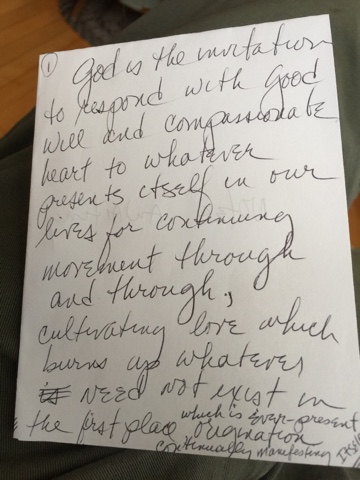
God is the invitation to respond with good will and compassionate heart to whatever presents itself in our lives for continuing movement through and through, cultivating love which burns up whatever need not exist in the first place which is ever-present origination continually manifesting Itself.

Jesus' [act was] to die to everything else, sacrificing everything in the name of love.
Like Buddhist monks immolating themselves in the 60's -- not suicides -- but acts of love calling attention to the need to move from sin and evil to wholeness and love.

Turn, and God is "right there." (This is not personifying God.)
God is "right here, right there." This means, presence without exception, no exceptions, no exclusions, no exemptions.
It is a recalculation of life, a re-contemplation of bare empty effortless action.

Understanding is not predicated on explanation. It is the result of listening.
No explanation suffices. No rationalizing , no excuses -- ever suffices.
What suffices is suffusion -- welling up to surface, pouring into appearance the depth profundity finds at origin.
[--sh, cb, bh, 29oct15, augusta maine]
Thursday, October 29, 2015
long story short
Page 1 of Symposium during Oil Change, Augusta, Maine:

[God needs be
listened
into existence]
Wednesday, October 28, 2015
Tuesday, October 27, 2015
no, don't overthrow
Heard Representative Tulsi Gabbard (d. Hawaii) speak about Syria and the US misguided policy.
Good words. Interesting voice speaking to the rarely spoken.
We cannot kill every annoyance.
Somewhere, sanity steps out of the darkness.
Monday, October 26, 2015
Sunday, October 25, 2015
No exercise
There's no teaching people about listening.
Either you have to listen, or you don't.
If you don't have to, no need bothering.
If you have to, you listen.
You listening?
Saturday, October 24, 2015
dogen would nod -- francis would smile
- “e m b r a c e”
= engaging moment, becoming realized active caring experience
- ”p r a c t i c e”
= placing reflection and compassion together in concentrated emptiness.
embrace practice -- practice embrace
Friday, October 23, 2015
coveting and consuming fear
In prison today, after sitting and walking practice, we read Richard Rohr.
There’s some concern at the militarization of special operations at the prison. What seems to be special forces, universal soldiers, patrolling the buildings and grounds dressed like troops in the Middle East. The men feel this new layer of force response readiness as intimidating and superfluous. As it is, they are just that; the war, unsuccessful in the Middle East, come home to Maine, a backyard application sure to provoke nominal semblance of success.
We consume fear.
We pay dearly for it.
It is our gross national product.
By "world," I am not referring to Creation, but to "the System." It's the way groups, cultures, institutions, and nations organize themselves to be in control. This may be the most hidden, the most disguised, and the most denied level of evil. We cannot see it because we are inside of it and because we cannot see beyond our own self-interest and self-protection. For example, I have been a Catholic all my life and I have yet to hear a sermon on the tenth commandment: "Do not covet your neighbor's goods." We live in an entire world of manufactured desire or covetousness. It is a virtue to seek to increase your goods. So it's almost impossible for an American to see capitalism or consumerism as a problem or a moral issue, because that is the way our world is shaped. It is in our hard wiring. It’s difficult to critique the ground you are standing on.
(--from, The World, the Flesh, and the Devil: The Spiral of Violence, Wednesday, October 21, 2015, by Richard Rohr) http://campaign.r20.constantcontact.com/render?ca=1a2dbe5a-3096-4558-a0ce-338c8af14adc&c=7013c380-e9ea-11e4-bdbe-d4ae52754b78&ch=70176d00-e9ea-11e4-bdbe-d4ae52754b78It was a good conversation.
There’s some concern at the militarization of special operations at the prison. What seems to be special forces, universal soldiers, patrolling the buildings and grounds dressed like troops in the Middle East. The men feel this new layer of force response readiness as intimidating and superfluous. As it is, they are just that; the war, unsuccessful in the Middle East, come home to Maine, a backyard application sure to provoke nominal semblance of success.
We consume fear.
We pay dearly for it.
It is our gross national product.
Thursday, October 22, 2015
Wednesday, October 21, 2015
Tuesday, October 20, 2015
ex post facto
Perhaps there are no words about God
Perhaps words are after God
What are we making of the silence of God?
prayer of petition; wording God from prison
“Write me,” said God, “I want to be read!”
“Write me,” says the prisoner, “I want to learn to read myself reading God reading God’s self.”
And so, we write one another.
This is how God learns about God and we learn about what it means to near ourselves nearing God.
Words matter.
Let’s create a new literature reading ourselves reading one another reading God learning to pronounce a new world one word at a time.
Liberated with love!
https://www.change.org/p/mary-lucia-maine-department-of-corrections-oppose-a-new-policy-that-punishes-incarcerated-maine-writers
“Write me,” says the prisoner, “I want to learn to read myself reading God reading God’s self.”
And so, we write one another.
This is how God learns about God and we learn about what it means to near ourselves nearing God.
Words matter.
Let’s create a new literature reading ourselves reading one another reading God learning to pronounce a new world one word at a time.
Liberated with love!
https://www.change.org/p/mary-lucia-maine-department-of-corrections-oppose-a-new-policy-that-punishes-incarcerated-maine-writers
Monday, October 19, 2015
It is Monday
At noon an Anthroposophical funeral joint between the spiritual and the earthly (as they noted) is held for one of their companions. I am 3rd to last in, occupy hallway, and am 3rd out after two mothers and their babes-in-arms. The Thomas More-looking celebrants complete their gentle story telling, prayer, and incense. Strings of lyre set the space wide and deep. Goodbye Susan.
...
Seldom do I read anything written on this blog, but this page came up while looking for something else. I put it here because it is Monday. http://www.meetingbrook.org/blogger/2004_06_20_archive.html
Saturday, June 26, 2004
Mother Purple Finch flies to feeder.
Young one follows noisily. On wet ground outside kitchen window three small chipmunks forage fell-seed in newly shortened grass.
A man of the Way comes
Rapping at my brushwood gate,
Wants to discuss the
Essentials of Zen experience.
Donít take it wrong if this
Mountain monkís too lazy
To open his mouth:
Late spring warblers
Singing their hearts out,
A village of drifting petals.
- Jakushitsu (1290 ñ1367)
Grey rainy summer's day. I turn around to see where I've come from. Nothing there.
As they were proceeding on their journey someone said to him, "I will follow you wherever you go." Jesus answered him, "Foxes have dens and birds of the sky have nests, but the Son of Man has nowhere to rest his head." And to another he said, "Follow me." But he replied, "Lord, let me go first and bury my father." But he answered him, "Let the dead bury their dead. But you, go and proclaim the kingdom of God." And another said, "I will follow you, Lord, but first let me say farewell to my family at home." To him Jesus said, "No one who sets a hand to the plow and looks to what was left behind is fit for the kingdom of God."
(from Luke 9:51-62)
I don't fit anywhere it is suggested one might, or might not, fit. The road-less road the homeless travel seems a fit-less footloose flight.
On the day before Thomas Merton retired to his hermitage at the Abbey of Gethsemani he used an apt metaphor to describe for his novices the new dimension of life as a monastic hermit. The date was August 20, 1965--the eve of the feast of the great early Cistercian, Bernard of Clairvaux (1090-1153). No doubt with Bernard (the reformer and creative thinker) in mind, Merton reclaimed the essence of every monk's vocation. Only three short years would intervene before his journey to Asia where he invested himself in dialogues with Buddhist and Hindu monks. Yet on that late summer day in 1965 Merton articulated for those novices a bold imperative when he said:
"At this particular point in the monastic life people need real evidence that it is possible to go further than just simply the convoy of routine work: everybody travelling at the speed of the slowest ship."(from “When the Heart is Right," Thomas Merton's Contemplative Contribution to Interreligious Dialogue," by George A. Kilcourse, Jr., Parliament of World Religions)
The hermit conveys nothing. The convoy inches through surface pitch and yaw mapped for some destination. The hermit has no destination. The hermit knows it is the thinnest of upholding engineering that floats the convoy ships above unfathomed depths. The hermit has already sensed the sinking helplessness of slipping below surface.
It is a solitary and uncharted descent. No provision is made for return. No return is conceived. Jesus would be surprised to learn there was a return ticket for him.
It is a Saturday afternoon filled with chirping birds, purring cat on lap, three dogs snoozing in tossed dischevel on floor.
Too lazy to open mouth, this ill-fitting hermit silence floats on precarious wave of empty listening. It is the open alone, with little understanding, conveys the silence of God passing through this, this now here, and this nowhere. This -- without end. This ñ without beginning.
This, our attentive presence.
Drifting petals.
Real evidence.
• • • • •
Friday, June 25, 2004
This morning, Billy said that in prison you are prey, predator, or you swim in your own pond.
In the awakened eye
Mountains and rivers
Completely disappear.
The eye of delusion
Looks out upon
Deep fog and clouds.
Alone on my zazen mat
I forget the days
As they pass.
The wisteria has grown
Thick over the eaves
Of my hut.
- Muso (1275-1351)
In Guantanimo, prey and predator are interchanged.
According to The Washington Post, the U.S. Vice-President tells a U.S. Senator to "Go fuck yourself."
Several guys in Maine State Prison used the "F" word today describing their point of view about the chaos and control, the discomforting of the environment, and pervasive tension of prison life. We'd been reading Robert Lax on learning to live on a Greek island.
At conversation on Islam at shop this evening a woman suggested that Islamic punishment that cuts off finger, hand, or foot might be more effective and kinder than America's ten to thirty years behind bars with the predation, fear, and warping of men's minds by fear and resentment -- especially when they might carry their lessons learned with them when they walk out and return to the streets.
"Pan metron ariston" is Greek for "all things in moderation."
We need to moderate the excesses of war and the regressive paralysis of hopelessness. We need to moderate extremes of division fomented by political factions racing to far right and left with nasty rhetoric and behavioral incivility.
It is good to visit prison for conversation.
It is like mystery. The more we understand about a mystery the deeper the mystery becomes. There's no end to the depths of mystery.
Passing through prison with heart and mind a little more open is like passing through mystery with new appreciation even the smallest understanding brings.
Billy, Rusty, Chris, Ryan, Saskia and I passed through today.
Our small understanding, shared each with each around table, deepens the mystery of who we are and what God is in our moderated midst.
And Harold visited with Erika in another part of the mystery this morning.
"That big something else," is what one of the guys said of God.
ñ at end of 1st post is a mistake mutated-by-ityself after eleven years. I don’t know.
Sunday, October 18, 2015
(Coificit Ease); (Geoeoc)
Someone said it takes wording to find new expressions of existence. That, and the suspicion we are moving out of old formulations and into new articulations of as yet unpronounced coming-into-being.
We could say God is the quintessential unpronounced coming-into-being.
Perhaps God is the originating experience of contemplation.
Maybe the phrasing, for us, for now, is, acronymic-ly: Coificit Geoeoc
C o i f i c i t e a s e
We could say God is the quintessential unpronounced coming-into-being.
Perhaps God is the originating experience of contemplation.
Maybe the phrasing, for us, for now, is, acronymic-ly: Coificit Geoeoc
C o i f i c i t e a s e
Contemplation originates--
inter-faith
inter-culture
inter-tradition
engagement
action
service
experience
And to the questions: "What is God? What is God doing?” -- This, for now:
G e o e o c -
i.e. God emerges originating experience of contemplation.
Saturday, October 17, 2015
all we are asking, yes, all of us are asking
Struggle, jihad, suffering, wound, discomfort.
These are the religious values.
These, the emotions of compassion.
Now, anyone feeling religious?
I thought so.
It’s not mystery why there’s a narrative disparaging religion.
Most people do not know what religion is.
Religion is the unspoken realization permeating felt awareness that what is completely real is just this, right now, true here, kind words, love acts.
[silent bow, palms together, deep gratitude]
interfaith
interculture
intertradition
These are the religious values.
These, the emotions of compassion.
Now, anyone feeling religious?
I thought so.
It’s not mystery why there’s a narrative disparaging religion.
Most people do not know what religion is.
Religion is the unspoken realization permeating felt awareness that what is completely real is just this, right now, true here, kind words, love acts.
[silent bow, palms together, deep gratitude]
c i f i c i t
contemplation --interfaith
interculture
intertradition
Friday, October 16, 2015
flectamus genua
In Utah, the Parliament of World Religions is meeting this weekend.
On Cobb Road, Susan J. collapses and dies.
In Georgia, two deputies are found not guilty of beating to death a Nigerian college student in a Savannah jail on New Year’s Day this year who was beaten to death by the two deputies.
There’s a connection here.
To find it means we have to learn to pray.
To pray -- then take action.
Doing something.
To begin a new understanding of faith.
To sit with the recently departed in blind vigil.
To finally say “No!” to the absurd belief that law enforcement can kill people with impunity.
Let us pray!
recitative
Meetingbrook is a place of contemplation,
conversation, and correspondence
practicing between traditions
for the benefit of all beings
toward cosmotheandric understanding,
kindness, and acts of service.
Thursday, October 15, 2015
Wednesday, October 14, 2015
Yes
say yes quickly
(~poem by Rumi)
Forget your life. Say God is Great. Get up.
You think you know what time it is. It’s time to pray.
You’ve carved so many little figurines, too many.
Don’t knock on any random door like a beggar.
Reach your long hand out to another door, beyond where
you go on the street, the street
where everyone says, “How are you?”
and no one says How aren’t you?
Tomorrow you’ll see what you’ve broken and torn tonight
thrashing in the dark. Inside you
there’s an artist you don’t know about.
He’s not interested in how different things look in moonlight.
If you are here unfaithfully with us,
you’re causing terrible damage.
If you’ve opened your loving to God’s love
you’re helping people you don’t know and have never seen.
Is what I say true? Say yes quickly,
if you know, you’ve known it
from the beginning of the universe.
Tuesday, October 13, 2015
Towing boat: hearing of someone's death
Possible name for sailing dinghy: See Kindly.
On way returning across border, a message that Dan Page died this morning. His long engagement with cancer now finished.
We wish him safe and enduring travels.
Monday, October 12, 2015
Scores
Cubs win.
On to 5th game.
Like thanksgiving dinner with friends and new acquaintances.
The nourishing collectivity of the assembled with a certain grace.
Bluejays win.
On to 4th game.
On to 5th game.
Like thanksgiving dinner with friends and new acquaintances.
The nourishing collectivity of the assembled with a certain grace.
Sunday, October 11, 2015
Saturday, October 10, 2015
Jesus is in you as you host one-an-other
Walking long road into dusk
Canada geese chorus lamenting
Something in another field
Thought of turning under corn
As socially constructed ground
Opens to reveal
Unseeable sea taking lives into her
Please note
As it is, there will be no formal Saturday Morning or Sunday.Evening Practice this weekend (10-11Oct).
The chapel/zendo and bookshed remain available for your use.
Keep us in mind.
Friday, October 09, 2015
Melvin
Montreal has too many exits, bridges, buses and cars. As does, inexorably, Boston, New York and San Francisco. I spill my coffee on jeans and leg at border. It was cold coffee, a cool and rainy day, and away from home for Thanksgiving in Ontario.
There are ladybugs at the lampshade beside the bed.

Passing through Colebrook NH, my first time, I gassho Dennis Joos who was shot and killed here in 1997. We were schoolmates in the early sixties in Callicoon NY. He was a writer, became editor of the local paper, and was a good fellow. Whimsical.
He died trying to save a woman from a man who'd just killed two state troopers.
He died trying to save a woman from a man who'd just killed two state troopers.
There are ladybugs at the lampshade beside the bed.
There is sorrow at the memory passing through.

Subscribe to:
Posts (Atom)