The danger is found in trying to take a thought so far down the road that it turns into a belief that there is a natural or artificial conclusion that has to be hammered out, promulgated, philosophized, mechanized, and implemented to erase the conceived problems falling outside the train rail of inference and logical pathway moving along the fastened iron going forward with irrepressible clickety-clack progress.
Reading about 19th century:
The Völkisch movement (German: Völkische Bewegung; alternative English: Folkist Movement) was a German ethno-nationalist movement active from the late 19th century through to the Nazi era, with remnants in the Federal Republic of Germany afterwards. Erected on the idea of "blood and soil", inspired by the one-body-metaphor (Volkskörper, "ethnic body"; literally "body of the people"), and by the idea of naturally grown communities in unity, it was characterized by organicism, racialism, populism, agrarianism, romantic nationalism and – as a consequence of a growing exclusive and ethnic connotation – by antisemitism from the 1900s onward.[1][2] Völkisch nationalists generally considered the Jews to be an "alien people" who belonged to a different Volk ("race" or "folk") from the Germans.[3]. (Wikipedia)
I recall a book I read during college studies by Alexis Carrel. It was intriguing. I do not think I understood sixty years ago the conclusions and ideology that could have been (and were) implied by the material pondered and impulses racing toward resolution that the studies and thought could careen recklessly (even mindlessly) toward.
Man, the Unknown (L'Homme, cet inconnu) is a best-selling[1]1935 book by Alexis Carrel in which he endeavours to outline a comprehensive account what is known and, more importantly, unknown of the human body and human life. The book elucidates problems of the modern world and possible routes to a better life for human beings. It is specifically known for its advocacy of eugenics and euthanasia.
For Carrel, the fundamental problem was that:
[M]en cannot follow modern civilization along its present course, because they are degenerating. They have been fascinated by the beauty of the sciences of inert matter. They have not understood that their body and consciousness are subjected to natural laws, more obscure than, but as inexorable as, the laws of the sidereal world. Neither have they understood that they cannot transgress these laws without being punished. They must, therefore, learn the necessary relations of the cosmic universe, of their fellow men, and of their inner selves, and also those of their tissues and their mind. Indeed, man stands above all things. Should he degenerate, the beauty of civilization, and even the grandeur of the physical universe, would vanish. ... Humanity's attention must turn from the machines of the world of inanimate matter to the body and the soul of man, to the organic and mental processes which have created the machines and the universe of Newton and Einstein.[2][3]. (Wikipedia)
I am led to consider the matter of concluding or conclusion.
I can’t remember who said it, and my trying to look it up meets no success, but here is what I recall: “Not to conclude is the sign of a creative mind.” Some French poet, I think, wrote it.
So much, it seems, depends upon an ability to draw conclusions, nail things down, wrap it up, submit report, file it away, move on to something else.
In doing so, I submit, there is a rush to put into action plans the conclusions reached, the outcomes concretized.
But, not to conclude . . . well . . .
That’s a tricky proposition. That’s a a risky non-strategy. That’s where spirituality and poetics meet meditation and contemplation within the auspices of practice and no-mind attentitiveness and presencing awareness.
Surely there’s a name for such a way of being-in-the-world?
But let’s not give it a fixed name.
For now, let’s call it the mourning of morning for what has been and what will be.
Let’s, for now, acronymize this "mourning of morning" as “mom”.
Give whatever name you wish to this arising and falling, coming and going, constructing and deconstructing, materializing and dematerializing, appearing and disappearing, loving and letting go . . .
For now, “mom” is gut genug — mom is good enough.
Good . . .
Enough!
(Happily)


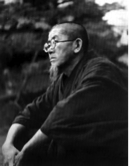 Taneda Santoka was a Japanese haiku poet who specialised in free verse haiku during the late 19th and early 20th centuries. He also translated works in French and Russian into Japanese.
