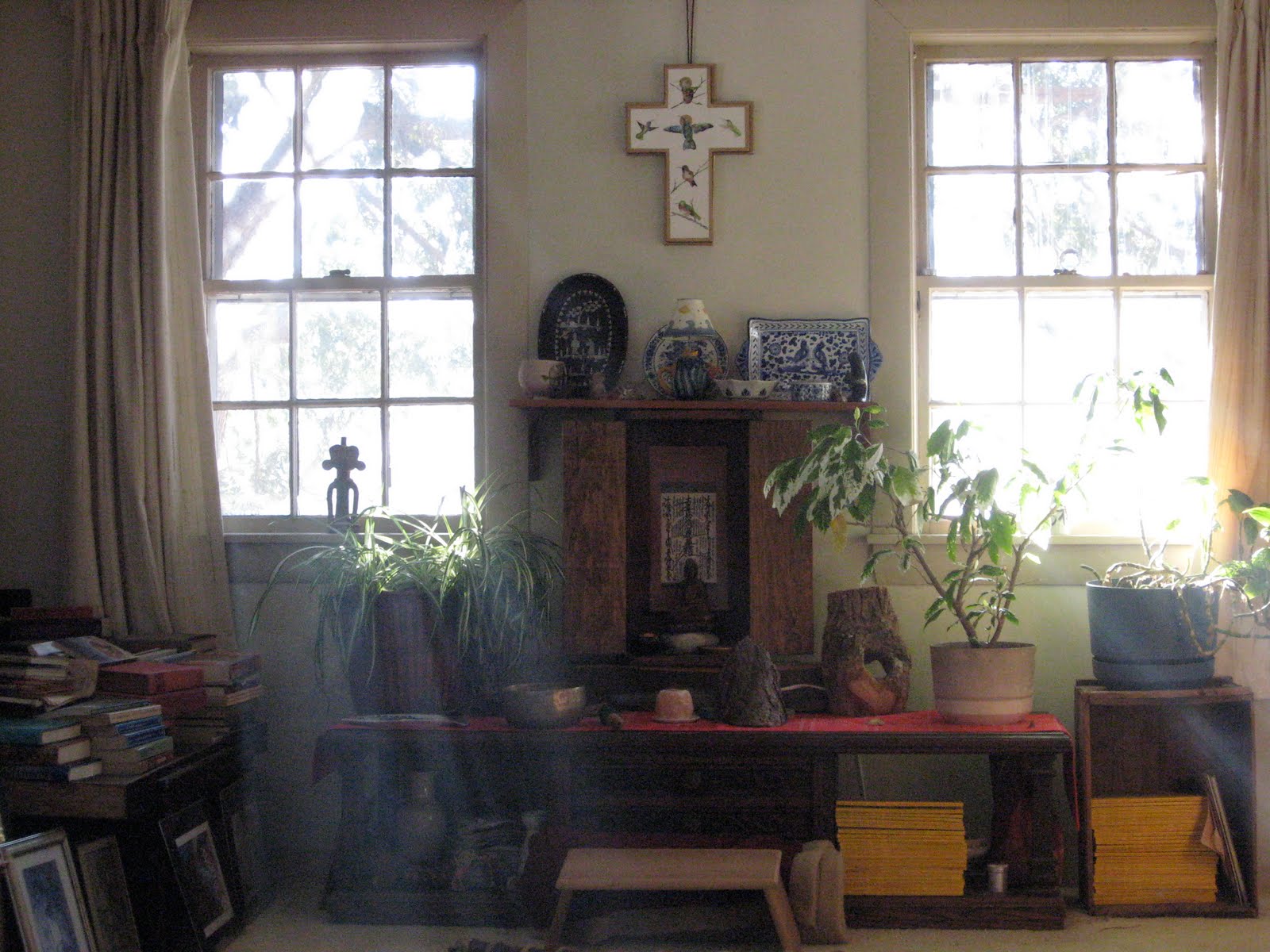
Clean meditation cabin.
Place rugs in bookshed.
Delusion, enlightenmentThank you winter.
just fox-words fooling
Zen practitioners everywhere.
- Daito (1282-1334)
Hello spring
Deep bow!

Pushed along by wind,I think that truth-telling is best.
Clouds layered along the peaks
Diffuse at daybreak:
Honking geese who've crossed
The mountains open the fall.
- Saigyo (1118-1190)
 Let's call it love-truth.

The Rose Tree
“O words are lightly spoken”
Said Pearse to Connolly,
“Maybe a breath of politic words
Has withered our Rose Tree;
Or maybe but a wind that blows
Across the bitter sea.”
“It needs to be but watered,”
James Connolly replied,
“To make the green come out again
And spread on every side,
And shake the blossom from the bud
To be the garden's pride.”
“But where can we draw water”
Said Pearse to Connolly,
“When all the wells are parched away?
O plain as plain can be
There's nothing but our own red blood
Can make a right Rose Tree.”
(Poem by William Butler Yeats)A melancholic theme.
It is, they say, a complicated world. Take the financial meltdown.We must resist the popular tendency to think of transcendence as an upward and outward escape from the realities of self and world. Instead, transcendence is a breaking-in, a breathing of the Spirit of love into the heart of our existence, a literal in-spiration that allows us to regard ourselves and our world with more trust and hope than ever before. To experience transcendence means to be removed -- not from self and world, but from that hall of mirrors in which the two endlessly reflect and determine one another. Prayer takes us out -- not out of self and world, but out of their closed circular logic.(p. 13, in To Know As We are Known, Education As A Spiritual Journey by Parker Palmer, c.1983)

I have just three things to teach:The back roads to Bangor were clear and sunny.
Simplicity, patience, compassion.
These three are your greatest treasures.
Simple in actions and in thoughts,
You return to the source of being.
Patient with both friends and enemies,
You accord with the way things are.
Compassionate toward yourself,
You reconcile all beings in the world.
- Lao Tzu
Root CellarThere is only bare breath remaining.
Nothing would sleep in that cellar, dank as a ditch,
Bulbs broke out of boxes hunting for chinks in the dark,
Shoots dangled and drooped,
Lolling obscenely from mildewed crates,
Hung down long yellow evil necks, like tropical snakes.
And what a congress of stinks!
Roots ripe as old bait,
Pulpy stems, rank, silo-rich,
Leaf-mold, manure, lime, piled against slippery planks.
Nothing would give up life:
Even the dirt kept breathing a small breath.
(Poem by by Theodore Roethke)
The moon shining in the middleWind sways trees. Rain pauses.
Of the sky swallows the lights
Of all creation.
The light in every age so clear
And mysterious that no words
Can describe it.
- Baekoon Kyunghan (1299-1375)
Students, when you want to say something, think about it three times before you say it. Speak only if your words will benefit yourselves and others. Do not speak if it brings no benefit.Silent today.
(--Dogen)
I ask how I am within myself today? Am I particularly tired, stressed, or off-form?Only today. There is no tomorrow.
If any of these characteristics apply, can I try to let go of the concerns that disturb me?
(--in Sacred Space, http://www.sacredspace.ie/dailyprayer/index.php?lang=en&d=15&m=03&y=2010#consciousness)
Of course, nothing that exists exists for its own sake; it exists for the sake of the whole. In origin, the whole is pregiven for man; it takes on for man its conscious character in the time-free present, for consciousness is not restricted to time and space. It cannot be concretized in conceptuality since conceptuality deals with abstractions and absolutes. It can be fathomed only dimly in vital, magic life, and is realizable through imagination and experience, as in myth and mysticism, only in a twilight of consciousness. It is approached in thought, but thought immediately closes itself off since in its process of deduction discursive thought always eludes any openness in its compulsion to system.
The new mutation of consciousness, on the other hand, as a consequence of arationality, receives its decisive stamp from the manifest perceptual emergence of the spiritual.
(--p.541, Ch 12, TheConcretion of the Spiritual, in The Ever-Present Origin, by Jean Gebser,c.1949)
 The arational, that which is not based on or governed by reason, in Gebser is acausal and integral.
The Second Patriarch Hui-k'o stood in the snow, cut off his arm, and awakened. The Sixth Patriarch heard someone recite the Diamond Sutra phrase "arouse the mind without placing it anywhere," and he awakened. Ling-yun saw a peach blossom and awakened. Hsiang-yen heard a tile fragment strike bamboo, and he awakened. Lin-chi was given sixty blows by Huang-po, and he awakened. Tung-shan noticed his own reflection when he was crossing a river, and he awakened. In each case, these men met the Master. - Daito (1282-1334)Finally get to stack strewn wood. Wind tosses the tarps. I set them again. And again.
It need not be pain. Just a walking through something that feels formless. A psychical uninhabitation.Solitudeby Ella Wheeler Wilcox (1855-1919)Laugh, and the world laughs with you;Weep, and you weep alone.For the sad old earth must borrow its mirth,But has trouble enough of its own.Sing, and the hills will answer;Sigh, it is lost on the air.The echoes bound to a joyful sound,But shrink from voicing care.Rejoice, and men will seek you;Grieve, and they turn and go.They want full measure of all your pleasure,But they do not need your woe.Be glad, and your friends are many;Be sad, and you lose them all.There are none to decline your nectared wine,But alone you must drink life's gall.Feast, and your halls are crowded;Fast, and the world goes by.Succeed and give, and it helps you live,But no man can help you die.There is room in the halls of pleasureFor a long and lordly train,But one by one we must all file onThrough the narrow aisles of pain.(From: Poems of Passion by Ella Wheeler Wilcox)
"The sense is obscured whenever we focus only on small, finished segments of being." --Chuang-tzuFeast and fast.
Mourner's Kaddish
Yit'gadal v'yit'kadash sh'mei raba (Cong: Amein).
May His great Name grow exalted and sanctified (`Cong: Amen.)
b'al'ma di v'ra khir'utei
in the world that He created as He willed.
v'yam'likh mal'khutei b'chayeikhon uv'yomeikhon
May He give reign to His kingship in your lifetimes and in your days,
uv'chayei d'khol beit yis'ra'eil
and in the lifetimes of the entire Family of Israel,
ba'agala uviz'man kariv v'im'ru:
swiftly and soon. Now say:
(Mourners and Congregation:)
Amein. Y'hei sh'mei raba m'varakh l'alam ul'al'mei al'maya
(Amen. May His great Name be blessed forever and ever.)
Yit'barakh v'yish'tabach v'yit'pa'ar v'yit'romam v'yit'nasei
Blessed, praised, glorified, exalted, extolled,
v'yit'hadar v'yit'aleh v'yit'halal sh'mei d'kud'sha
mighty, upraised, and lauded be the Name of the Holy One
(Mourners and Congregation:)
B'rikh hu.
Blessed is He.
l'eila min kol bir'khata v'shirata
beyond any blessing and song,
toosh'b'chatah v'nechematah, da'ameeran b'al'mah, v'eemru:
praise and consolation that are uttered in the world. Now say:
(Mourners and Congregation:)
Amein
Amen
Y'hei sh'lama raba min sh'maya
May there be abundant peace from Heaven
v'chayim aleinu v'al kol yis'ra'eil v'im'ru
and life upon us and upon all Israel. Now say:
(Mourners and Congregation:)
Amein
Amen
Oseh shalom bim'romav hu ya'aseh shalom
He Who makes peace in His heights, may He make peace,
aleinu v'al kol Yis'ra'eil v'im'ru
upon us and upon all Israel. Now say:
(Mourners and Congregation:)
Amein
Amen
http://www.jewfaq.org/prayer/kaddish.htm
 We don't know what happens after death.
Astronaut John Crichton assumes he'll be home in time for dinner. But a freak accident during an experimental space mission catapults him across a thousand galaxies to an alien battlefield. Suddenly, he's trapped among alien creatures wielding deadly technology - a battle that 20th century sci-fi pop culture never prepared him for. Hunted by a merciless military race, Crichton begins his quest for home from a galaxy far, far away...(--from The Jim Henson Company website, http://www.henson.com/fantasy_scifi.php?content=farscape)
SalatIf we know the direction for prayer, perhaps we know the direction of the one praying.
poetry is prayer
light dancing inside words
five times a day
I try to write
step by step
I move towards the mihrab
I prepare to recite
what is in my heart
I recite your name
(Poem by E. Ethelbert Miller)
I think that education is invitation and prelude to presence and compassion.Song of T'aego Hermitage
I've lived in this hermitage
How long I don't know
Deep and secret and
Without obstructions
Heaven and earth meet
Like box and cover:
There's no turning toward
Or turning away.
I do not stay in the east, west,
South or north
The jewel tower and the jade palace
Do not stand opposite me.
I do not take guidelines from
Bodhidharma as a model
As the light shines freely through
Eighty four thousand gates.
- T'aego (1301-1382)
Transformation: Let’s move to the presence of compassion. How do we recognize it?
O’Donohue: We recognize compassion in the willingness of someone to imagine himself into the life of another person. We recognize its presence in the withholding of huge negative moralistic judgment. We see compassion in the expression of mercy, in the refusal to label someone with a short-circuiting terminology that condemns her, even though her actions may be awkward. We see compassion in an openness to the greater mystery of the other person. The present situation, deed or misdeed is not the full story of the individual, there is a greater presence behind the deed or the person than society usually acknowledges. Above all, we see the presence of compassion as the vulnerability to be disturbed about awful things that are going on.
Transformation: What is the relationship between absence and compassion?
O’Donohue: Absence and presence are sisters. The opposite of presence is not absence, the opposite of presence is vacancy. Vacancy is a void, a space which is hungrily empty, whereas absence is a space of spatial emptiness, but there is a trail of connection toward the departed one, the lost one, the absent one. To feel absence is to feel connection with the one who has gone. There is still a huge affective involvement with the person. In exploring compassion and vacancy, vacancy is a sinister pain, because of its hunger, its emptiness. A form of vacancy that is prevalent in post-modern culture is indifference, the inability to imagine or show compassion to others who are in trouble. Absence is different. The feeling of absence can create an incredible feeling of compassion.
(--from, The Presence of Compassion, An Interview with John O’Donohue,We have to care. To be responsible for the world and the new ones entering it. For the creating materials of truth and dialoguing difficult reasoning discourse together.
By Mary NurrieStearns, http://www.personaltransformation.com/ODonohue.html)
THE ORANGE
At lunchtime I bought a huge orange
The size of it made us all laugh.
I peeled it and shared it with Robert and Dave—
They got quarters and I had a half.
And that orange it made me so happy,
As ordinary things often do
Just lately. The shopping. A walk in the park
This is peace and contentment. It’s new.
The rest of the day was quite easy.
I did all my jobs on my list
And enjoyed them and had some time over.
I love you. I’m glad I exist.
(Poem, The Orange, by Wendy Cope)
 So do I...
 See?
See?All religions are founded on a deep spiritual experience of unity consciousness where there was complete union between the personal and universal. Unfortunately, many times the followers of religion, instead of understanding the religious experience and seeking it for themselves ended up merely worshiping the founder of the religion. It is more important to fully grasp the teaching of the religion and its basic tenets, that have come from a deeper experience of transcendence. Self-righteous morality is not a means for experiencing higher consciousness. Higher consciousness, spontaneously leads to moral and ethical behavior. However, because spiritual knowledge is powerful, the custodians of organized religion have frequently ended up with destructive behaviors -- power mongering, cronyism, control, corruption, and influence peddling. As a result organized religion has frequently become quarrelsome, divisive, and led to conflict. No organized religion has been immune to this unfortunate tendency. So, we have had the crusades and witch-hunts of Christianity, the Jihads of Islam, the violent communal riots instigated by fundamentalist Hindus and the persecution of minorities and ethnic cleansing all in the name of God.Generator worked. Well pump installed. Rain again. Sump pump working. Bell at end of silent sitting always surprises when on timer.
Our present times are particularly dangerous because ancient habits combined with modern capacities and technologies of destruction are a devastating combination that can destroy life on our planet.
(--Deepak Chopra, Only Spirituality Can Solve The Problems Of The World: February 24, 2010 10:22 AM, http://www.huffingtonpost.com/deepak-chopra/only-spirituality-can-sol_b_474221.html)
George Harrison's My Sweet Lord LyricsIf we can speak, we can sing. If we can sing, we can find a way to smile and laugh.
My sweet lord
Hm, my lord
Hm, my lord
I really want to see you
Really want to be with you
Really want to see you lord
But it takes so long, my lord
My sweet lord
Hm, my lord
Hm, my lord
I really want to know you
Really want to go with you
Really want to show you lord
That it wont take long, my lord (hallelujah)
My sweet lord (hallelujah)
Hm, my lord (hallelujah)
My sweet lord (hallelujah)
I really want to see you
Really want to see you
Really want to see you, lord
Really want to see you, lord
But it takes so long, my lord (hallelujah)
My sweet lord (hallelujah)
Hm, my lord (hallelujah)
My, my, my lord (hallelujah)
I really want to know you (hallelujah)
Really want to go with you (hallelujah)
Really want to show you lord (aaah)
That it wont take long, my lord (hallelujah)
Hmm (hallelujah)
My sweet lord (hallelujah)
My, my, lord (hallelujah)
Hm, my lord (hare krishna)
My, my, my lord (hare krishna)
Oh hm, my sweet lord (krishna, krishna)
Oh-uuh-uh (hare hare)
Now, I really want to see you (hare rama)
Really want to be with you (hare rama)
Really want to see you lord (aaah)
But it takes so long, my lord (hallelujah)
Hm, my lord (hallelujah)
My, my, my lord (hare krishna)
My sweet lord (hare krishna)
My sweet lord (krishna krishna)
My lord (hare hare)
Hm, hm (gurur brahma)
Hm, hm (gurur vishnu)
Hm, hm (gurur devo)
Hm, hm (maheshwara)
My sweet lord (gurur sakshaat)
My sweet lord (parabrahma)
My, my, my lord (tasmayi shree)
My, my, my, my lord (guruve namah)
My sweet lord (hare rama)
[fade:]
(hare krishna)
My sweet lord (hare krishna)
My sweet lord (krishna krishna)
My lord (hare hare)
Oh happy dayMusic is the excuse we can use to step away from all forms lacking compassion, contemplation, and consideration.
Oh happy day
When Jesus washed
Oh when He washed
Mmm, when He washed
All my sins away
Oh happy day
Oh happy day (Oh happy day)
Oh happy day (Oh happy day)
When Jesus washed (When Jesus washed)
Oh when He washed (When Jesus washed)
Mmm, when He washed (Mmm, when He washed)
All my sins away (Oh happy day)
He taught me how to watch
Watch and pray
Watch and pray (Watch and pray)
And live rejoicing every day
Every day (Every day)
Oh happy day (Oh happy day)
Oh happy day (Oh happy day)
When Jesus washed (When Jesus washed)
Oh when He washed (When Jesus washed)
Mmm, when He washed (Mmm, when He washed)
All my sins away (Oh happy day)
It was a happy day (Oh happy day)
(--Music and lyrics by Edwin Hawkins, 1967, based on 18th century hymn)
Like entrusting yourself
To a brave person
When greatly afraid,
By entrusting yourself
To the awakening mind,
You will be swiftly liberated,
Even if you have made appalling errors.
- Majjhima Nikaya
Totality means continuity -- the carrying on of a former habit of action with the readaptation necessary to keep it alive and growing. Instead of signifying a ready-made complete scheme of action, it means keeping the balance in a multitude of diverse actions, so that each borrows and gives significance to every other. Any person who is open-minded and sensitive to new perceptions, and who has concentration and responsibility in connecting them has, in so far, a philosophic disposition.Go on.
(John Dewey, in Democracy and Education)
Once the human mind goes astray,My personal response to the themes of hospice conversation:
Truth, the true pattern of the Tao,
Is lost.
Once the human mind is gathered in,
The true pattern of the Tao is there.
- Hu Juren (1434-1484)
 'Safe': from Latin 'salvus' meaning 'uninjured.' Not likely to be harmed or lost.