(for 6jan2021)
1.
katauta:
slow death ravages
no cure for hypocrisy
next time, think, if there is one
2.
recitative:
what can we do? no-
thing rises to look over
troubled souls, hearts gone, minds dark

(for 6jan2021)
1.
katauta:
slow death ravages
no cure for hypocrisy
next time, think, if there is one
2.
recitative:
what can we do? no-
thing rises to look over
troubled souls, hearts gone, minds dark

Student:
Believing in the spirits and through communication is not easy at all. Currently being in prison has hindered a lot of my rituals that I would normally preform on the outside with family. I think the worst part of this is trying to follow my religion. This prison is highly Christian, Muslim, and Catholic and a lot of these people look at the Pagan, Odin, and Druid culture as if we worship the devil. During this class I have tried to be open minded and I take a lot away from others mistakes. I had recently a friend who is highly Christian and he found out that I wasn’t walking his same path.
This lead to some serious issues one because he thinks that my soul is damned to burn I the pit of hell. Right now it is all he can talk about and to an extent it drives me nuts now because our relationship has changed from friends to almost enemies. I have accepted that he is Christian and if my religion is bothering him to that extent I am fine in walking away from him. This is where the fact of why Indians like this class comes into play. I cannot or rather will not judge him based on his culture and I found that this class did a lot of judging of others cultures.
So I found that I don’t like being a judgmental person and I also think that we weren’t able to really get effective communication when we sat down with each other. We seemed to argue rather than what we needed to do. However, these discussions and journal entries have helped me review what I would consider honor, respect, and my morals. I also think this gave me a better understanding of what philosophy is how I would define philosophy as deep thinking.
(per.gm)
Tutor:
Opinionated judging is what people do when inclusive imagination has not yet been born in them. Which is always troubling to experience with those in the Christian metaphor, because inclusive imagination is, in my opinion, one of names of God resonating in the Christ-reality.
You're not wrong.
I'm not right.
“Right and wrong are temporal, but time is neither right nor wrong. Right and wrong are the Dharma, but the Dharma is neither right nor wrong. In the balance of the Dharma, wrong is balanced. In the balance of the Dharma, right is balanced. And so, in learning of complete and utter Awakening, in hearing the Teachings, doing the training, and realizing the effect, this is profound, vast, and wonderful. Some hear of unsurpassed Awakening from good friends, and some hear of it from the sutras. What one hears first is, “Not doing wrong action.” If one does not hear “not doing wrong action,” one is not hearing the Buddhas' true Dharma but demonic talk. Know that hearing “not doing wrong action” is hearing the Buddhas' true Dharma.”
(-- from, Shobogenzo: The Treasure House of the Eye of the True Teaching, from student's paper))
We've fallen out of balance.
Here's my hand.
Help me up.
We can find our balance, don't you think?
Prayer is intentional participation in a shared reality for the good of each.
The Alchemist “The boy was beginning to understand that intuition is really a sudden immersion of the soul into the universal current of life, where the histories of all people are connected, and we are able to know everything, because it is all written there.” (--quote from student's paper)
We pray tonight.
Let the sorrow of having experienced ignorance and cynicism find solace in wisdom.
Hold the violators accountable. President. Senators. Representatives.
Those who inflamed and those who rioted, threatened, and soiled democracy with infamy.
Let us be seen and known for what we are, henceforth and openly, in public sight.
Some of us turn within. We look at our resemblance to chicanery, deceit, and blind ambitious power.
Prayer begins.
God, come to my assistance!
Lord, make haste to help us!
We have offended.
May the Lord protect us, defend us from all evil, and lead us to life, authentic and compassionate life, now, and going forward!
Amen.
“In a dark time, the eye begins to see.” (Theodore Roethke)
It is a dark time.
Will those who intentionally turn away their eyes ever be able to see?
It takes courage to see what you are looking at.
There must be a door to exit those who cannot be trusted to represent democracy, civility, and decency.
Surely the outgoing president, clawing senators and congresspeople, and irresponsible fawning pundits, should all be shown that door, immediately, for sanity’s and integrity’s sake.
May it be so!
“In this country we have one great privilege which they don’t have in other countries,” [Mark] Twain once said on the issue of voting. “When a thing gets to be absolutely unbearable the people can rise up and throw it off. That’s the finest asset we’ve got – the ballet box.”
https://checkyourfact.com/2019/09/16/fact-check-mark-twain-voting-difference-illegal/
Driving back to Maine from Burlington Vermont.


St. Thomas Becket, also called Thomas à Becket or Thomas of London, (born c. 1118, Cheapside, London, England—died December 29, 1170, Canterbury, Kent; canonized 1173; feast day December 29), chancellor of England (1155–62) and archbishop of Canterbury (1162–70) during the reign of King Henry II. His career was marked by a long quarrel with Henry that ended with Becket’s murder in Canterbury Cathedral. He is venerated as a saint in the Roman Catholic Church and in the Anglican Communion. (--from, britannica.com)
And from Jean Anouilh's Becket:
KING. Does it amuse you—working for the good of my people?~ Do you mean to say you love all those folk? To begin with they're too numerous. One can't love them, one doesn't know them. Anyway, you're lying, you don't love anything or anybody.
BECKET. There's one thing I do love, my prince, and that I'm sure of. Doing what I have to do and doing it well.
KING. Always the es—es . . . What's your word again? I've forgotten it.
BECKET. Esthetics?
KING. Esthetics! Always the esthetic side, eh?
BECKET. Yes, my prince.
[p. 54].
(--from, Anouilh, Jean Becket; or, The Honor of God. Translated by Lucienne Hill. New York: Coward-McCann, 1960. 128 pp.)
In Zen, ensō (円相, "circular form")[1] is a circle that is hand-drawn in one or two uninhibited brushstrokes to express a moment when the mind is free to let the body create.
The ensō symbolizes absolute enlightenment, strength, elegance, the universe, and mu (the void). It is characterised by a minimalism born of Japanese aesthetics.
(—Wikipedia)
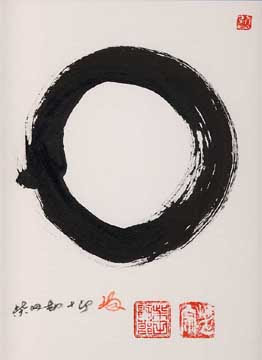
Ensō (c. 2000) by Kanjuro Shibata XX
In Burlington Vermont, meeting Saint Bernard Border Collie mix.
Tomorrow we’ll drive him home to Maine.
A good boy.
What is going on between us . . .(?) (!)
That sentence, seemingly a question, these six words, might be the clearest description of God so far this new year.
The year is young, however, and God, perhaps, will not be so easily satisfied with such designation.
Still, as exclamation, the movement, breath, and activity of God ... is
What is
Going on
Between us
First, the Abstract:
This paper argues that effective compassionate action must address two kinds of human cause of suffering.The first kind, pointed out by Buddhist epistemology, are universal human tendencies of misperception and mis-reaction, tendencies of delusion, greed, and ill-will.The second kind of cause of suffering, pointed out by Christian liberation theologies, are socio-economic systems which incorporate individuals into structures of inequity that organize resources and ways of knowing in oppressive ways.Effective contemplative practice is essential to address the first cause of suffering: deluded misperception and reaction, since social analysis alone does not remove the pervasive, unconscious misperception that some persons matter more than others, a misperception that distorts anyone’s attempt to build better social systems.Contemplative practices (from various spiritual traditions) that deconstruct that delusive tendency can also empower human capacities of discernment, love, compassion, peace, courage and creative responsiveness essential for effective work for social change.On the other hand, social analysis is essential to address the second kind of cause of suffering, oppressive social structures, which, if not addressed, promulgate systemic patterns of harm while socially conditioning individuals into the first cause of suffering: delusion, greed and ill-will.Contemplative practice that lacks social analysis may also prop up oppressive structures, by improving people’s ability to tolerate, but not to challenge, those structures.The conclusion is that neither contemplative practice nor social analysis alone effectively addresses enough man-made causes of suffering.Each must inform and empower the other to provide what is necessary for effective compassionate action.
Then, from body:
This deluded habit of misperception is not solved by social analysis or activism alone, because the mind that engages in social analysis is the same mind that unconsciously mistakes everyone included in its analysis for its reductive thoughts of them, perpetuating habits of misperception that exclude many from genuine care and compassion, even when we think we are working for social justice. When those of us seeking to dismantle oppressive social systems remain unconsciously identified with our own patterns of deluded perception, those patterns become woven into whatever new social system we may create (Knitter 2009, 200). In recent history, this has been evident, for example, in the actions of communist regimes of Russia, China, Cambodia, and Eastern Europe, which came into power under high ideals of social equity, then instituted death-dealing policies against masses of people whose lives held little value within the new regime.
Another sign that this basic habit of misperception is operative when we work for social change is how often dysfunctional rage and anger are experienced by social justice activists, anger that lacks awareness of its own tendencies of misperception. Many social justice activists report that, over time, they become caught in recurrent feelings of painful rage and anger, making it difficult to work effectively, to attract support, and often contributing to burnout (Gross in Gross & Reuther 2001, 181; Knitter 2009, 175; Makransky 2016, 89-90). Such dysfunctional anger is supported by the habit of reification and misperception described above, which triggers endless reactions to our own fragmented images of ourselves and others. Such reactive habits of anger, in themselves, lack any means to stay in touch with the fuller humanity and potential of everyone involved, especially those who oppose our positions. Such habits prevent us from accessing our fuller capacities for discernment, more inclusive care, inner replenishment, inspiration, and energy (Dass & Gorman 1985, 159-160).
By pointing out this tendency to mistake our reductive thoughts of persons for the persons, I am not arguing against the need to confront oppressive social systems and behaviors. Rather, to confront such things effectively we need a kind of knowing that can maintain awareness of the fuller personhood of everyone involved, including those we may confront, and for this a contemplative practice is essential. The Buddhist epistemology I draw on here assumes that there is much to be confronted in persons—all their ways of thinking and acting that are harmful to themselves and others. But in the moment that we confront others out of anger, even supposedly righteous anger, we tend not to sense their deep dignity and human potential beyond the single, reified image that our anger has made of them. And to declare our anger ‘righteous’ does nothing to correct that error.
For this reason, the power to confront harmful persons in many traditional Buddhist stories is understood as a fierce form of compassion rather than any ordinary form of anger. This is exemplified in stories of bodhisattva figures that fiercely confront an individual or group, out of compassion for all involved, and is also imaged in wrathful tantric Buddhist images of enlightenment. Fierce compassion is a power forcefully to confront someone who thinks and acts harmfully, both on behalf of those he harms and on behalf of his own underlying potential, his fuller personhood or Buddha nature.2
Finally, the conclusion:
In sum, individual forms of delusion, greed and ill-will have been the focus of Buddhism as the main cause of suffering, while systemic forms of delusion, greed and ill- will have been the focus of Christian liberation theology as the main cause of suffering. Yet both of these causes of suffering, individual and systemic, are mutually conditioning and mutually reinforcing. Neither can be adequately addressed unless the other is also addressed. This means that neither contemplative practice and action alone, nor social analysis and activism alone, are sufficient to address the world’s man-made
suffering. Each such practice must inform and empower the other. Another conclusion is that neither classical Buddhist epistemology nor Christian liberation epistemology alone are enough to inform effective compassionate action in the world. Both are needed to effectively address man-made suffering, and to illumine critical elements of the process toward individual and social awakening and liberation.
(--from, The Need to Integrate Buddhist and Christian Liberation Epistemologies, by John Makransky, 2019, Buddhist-Christian Studies Journal)
As year ends, Thursday turns to see where it's been. Just so, Friday tidies its room wondering what welcome might wish to be extended to whatever could appear.
In order to see things whole, you have to be seeing things whole.
The final Tuesday Evening Conversation of 2020 last night.
Naturally we talked about death. Georgiana died in 2019 we learned earlier, a friend from bookshop days up from Charlottesville, a good woman, strong and confident.
D, at ninety two, talks freely about death. C, after multiple surgeries and years of hospital stays, also speaks openly.
With each breath, great teacher demonstrates, arrival and departure, coming and going, beginning and end.
Where are the dead? As with everything and everyone, the dead are within me as I am within them.
Listen!
The great gift with hospice is listening. We listen things into existence. We listen things out of existence.
It strikes me that when someone does not listen it might indicate they are terrified of death, departure, disappearance.
The interminable talker attempts to stay death by fending away silence and perpetuating opinion and disagreement.
Silence is the field of awareness where death, like birth and surrounding life, arrives and departs with each accompanying breath.
Be silent, be still, even in movement — and know — I am, God.
Of course we want to know God.
God is what is here and now.
May God be with you!
And with your breath, in your breath, as your breath, coming, and going, inside and outside, with you and without you, near and far, on its way, here and not.
Poet and stonemason, John M. comes to mind and images in Martha’s Vineyard. His wife, Kristin, died in 2016 in Chilmark. I learned that today. I stare out window.
Light over past three hours has come up Barnestown road. Trees feel me feeling la tristesse. She was born on 4Oct in Paris. Those visits just after they met in Cambridge.
My traveling there for Robert Lowell and Richard Hugo. The apartment off Harvard square with Ezra Pound quote on refrigerator, something about never trust a poet who uses the word “cosmic” in a poem.
John, equally impressive, reciting his poem Last Call walking Mt. Auburn street, he doing all the voices.
I sent a telegram from Philadelphia in 1978 for their wedding: “May you be for one another a resting place for time to change hands.”
The western union operator asked:
"Who wrote those words?"
“I did.”
”You’re kidding.”
“Why would I lie to you, I don’t know you. We only lie to those we know.”
(This is now a serious koan for me.)
As is, and seems to be, everything, for me, now.
There we are!
... Love
everyone you can. The list gets longer and shorter.
We're seldom better than weather. We're nearly as good
as a woman we met in passing once at Invergarry.
Don't be sorry, for him or for self. Love the last star
broken by storm. And love you. You hold it together.
(—from poem, Villager, by Richard Hugo, in The Right Madness on Skye)
There's no bread and no wine in bookshop as I read the words in the 1964 red missale romanum found tucked in second floor acquisitions amid german and dutch language books:
Hoc est enim corpus meum.
And,
Hic est enim calix sanguines mei.
I feel to be some reincarnated catholic priest as I turn pages of dates and seasons, liturgical rubrics and words of consecration.
This is where some place god in ritual and daily devotion. The transubstantiation of bread and wine into body and blood of christ.
This unheated bookshed/retreat on 5th day of christmas, sun through glass door, wind roughing bird feathers landing on branches to crack open last season's sunflower seeds.
God, the trappist monk Matthew who died in 2018 is saying in concept film The Cloud of Unknowing, God is no thing.
Where is something when it is no thing?
Everywhere you look.
Seeing no—
thing.
Identity -- let's take a look at the word.
- is, ea, id -- (demonstrative pronouns): (Latin), (id: neuter) -- that
- entity: n that which is perceived or known or inferred to have its own distinct existence (living or nonliving)
So, we could say: That which is its own. Distinct existence. Perceived or known. To have that which is.
Identity doesn't have
to be
separate.
It has that which is as a whole. (It is perhaps a misperception to see separation as a means to establishing a misinterpreted 'distinct' existence.) Yes, we are distinguishable. No, we are not separate.
Perhaps we need to issue a new kind of 'identity' card to all our fellow existents across, along, and actualizing this planet, galaxy, cosmos.
So, here we are.
Who are we?
Bodhidharma and Emperor Wu had a dialogue:
Naturally, his first question to Bodhidharma was, “I have made so many monasteries, I am feeding thousands of scholars, I have opened a whole university for the studies of Gautam Buddha, I have put my whole empire and its treasures in the service of Gautam Buddha. What is going to be my reward?”
He was a little embarrassed seeing Bodhidharma, not thinking that the man would be like this. He looked very ferocious. He had very big eyes, but he had a very soft heart — just a lotus flower in his heart. But his face was almost as dangerous as you can conceive.
With great fear, Emperor Wu asked the question, and Bodhidharma said, “Nothing, no reward. On the contrary, be ready to fall into the seventh hell.”
The emperor said, “But I have not done anything wrong — why the seventh hell? I have been doing everything that the Buddhist monks have been telling me”.
Bodhidharma said, “Unless you start hearing your own voice, nobody can help you, Buddhist or non-Buddhist. And you have not yet heard your inner voice. If you had heard it, you would not have asked such a stupid question.
“On the path of Gautam Buddha there is no reward because the very desire for reward comes from a greedy mind. The whole teaching of Gautam Buddha is desirelessness and if you are doing all these so-called virtuous acts, making temples and monasteries and feeding thousands of monks, with a desire in your mind, you are preparing your way towards hell. If you are doing these things out of joy, to share your joy with the whole empire, and there is not even a slight desire anywhere for any reward, the very act is a reward unto itself. Otherwise you have missed the whole point.”
Emperor Wu said, “My mind is so full of thoughts. I have been trying to create some peace of mind, but I have failed and because of these thoughts and their noise, I cannot hear what you are calling the inner voice. I don’t know anything about it”.
(--in, This and That, There and Here, Observations, feelings and emotions of a Dame Quixote)
Elsewhere, Bodhidharma's responses to Wu were: "No merit"; "nothing holy, vast emptiness"; and, (responding to the question 'Who are you?'), "I don't know."
The apparent difficulty of hearing the inner voice derives from the mistaken belief that it comes from elsewhere to be heard by someone.
Perhaps the inner voice belongs no where else to no one other.
And, suddenly, the sound of --
That which is itself!
What if creation were incarnation?
Hypostasis of before and beyond.
The union of divinity, humanity, and cosmos.
One thing.
What if it came about by and of itself?
Virgin.
Parthenogenic.
And we are the mythology of christogenesis.
Unitive regenerative love.
Would you think it worth your while to be what you are for the moment experiencing everything as itself being itself?
I would think
So.

