Thursday, February 28, 2008

Not much better than caring for someone, something, somewhere. The straight ahead caring. Nothing sideways about it.
The universal spiritual quest
Suppose we use a traveling metaphor for the universal spiritual quest. The main map the Buddha offered for the trip to happiness and contentment is called the Eightfold Path, but I have often thought it should be called the Eightfold Circle. A path goes from here to there, and the nearer you are to there, the farther you are from here. A path is progressive on a genuine path you would need to start at the beginning and proceed in a linear way until the end. With a circle, you can join in anywhere, and its the same circle.

When the Buddha taught his path, he said it had a specific number of constituent parts; people could be sure they were going the right way if they saw any one of eight special markers. The order in which the traveler sees the signs doesn't matter. If we look at any sign closely, it becomes apparent that each one has all of the others hidden inside it. Even a tiny bit of Right Understanding, the suspicion that it is possible to be contented even when we aren't pleased, arouses Right Aspiration to make a lot of Right Effort to develop more Right Understanding its all connected.

(- Sylvia Boorstein, Its Easier Than You Think, from Everyday Mind, edited by Jean Smith, a Tricycle book)
To care is to be with another in everydayness.

Not hard to do. It's just the doing of it. That comes hard at times. Not hard to do. But the getting to it is what's hard.

Get to it.

Eh?

Wednesday, February 27, 2008

Sitting at dawn in front room. Comes mountain across road. Bit by bit of light revealing what came through night.
That night staying at a Buddhist temple,
I climbed to the highest room,
The brilliance of stars and moon
Obscured by the clouds,
Gibbons cried, the bell toned
I was oblivious to dawn
Until gradually brightening,
A cold winter sun rose in the East.
- Han Yu (805)
Something begins to slip away from me.

Incense and bows bring first light.

Returns infinite being to itself.

Tuesday, February 26, 2008

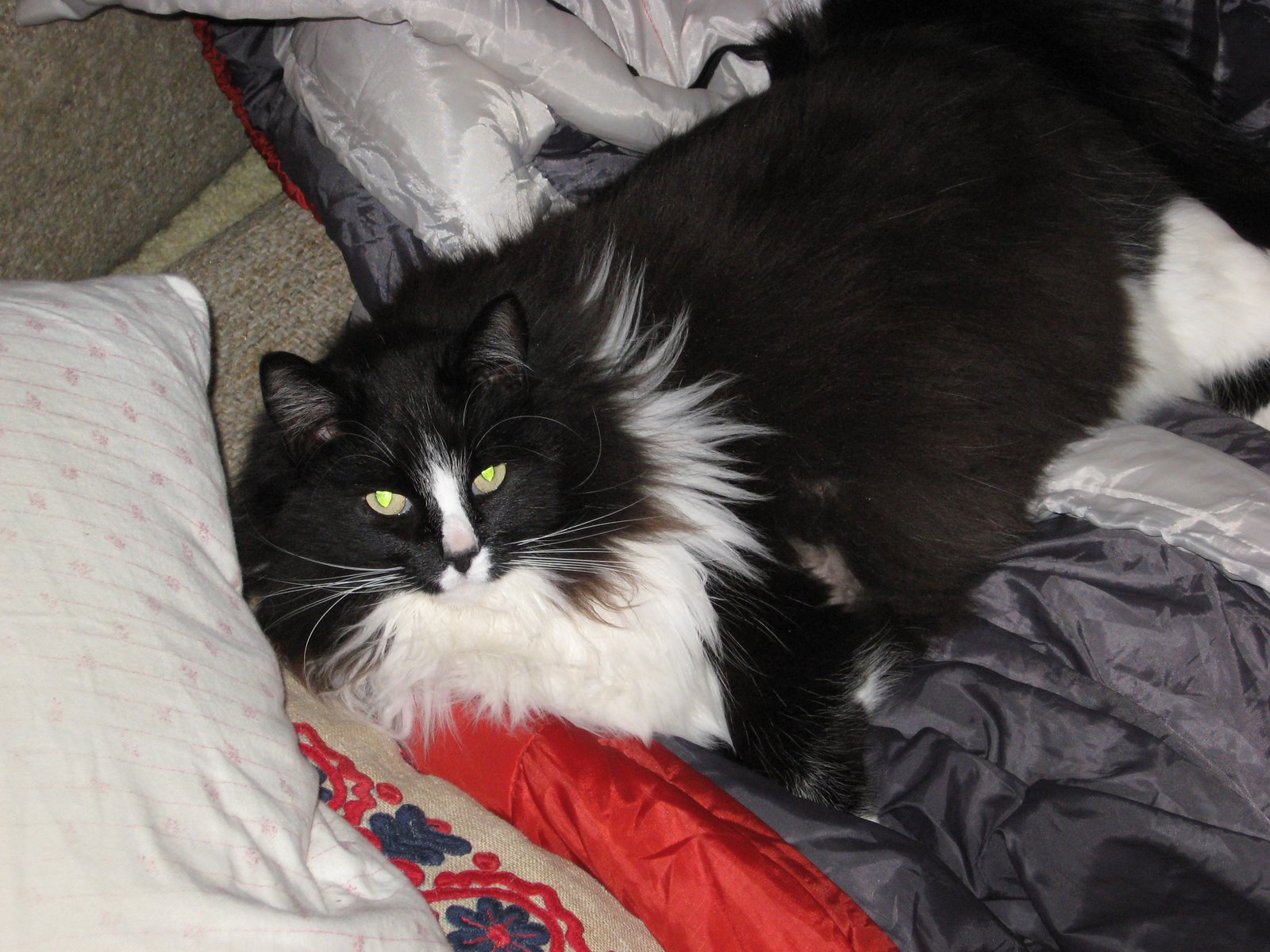
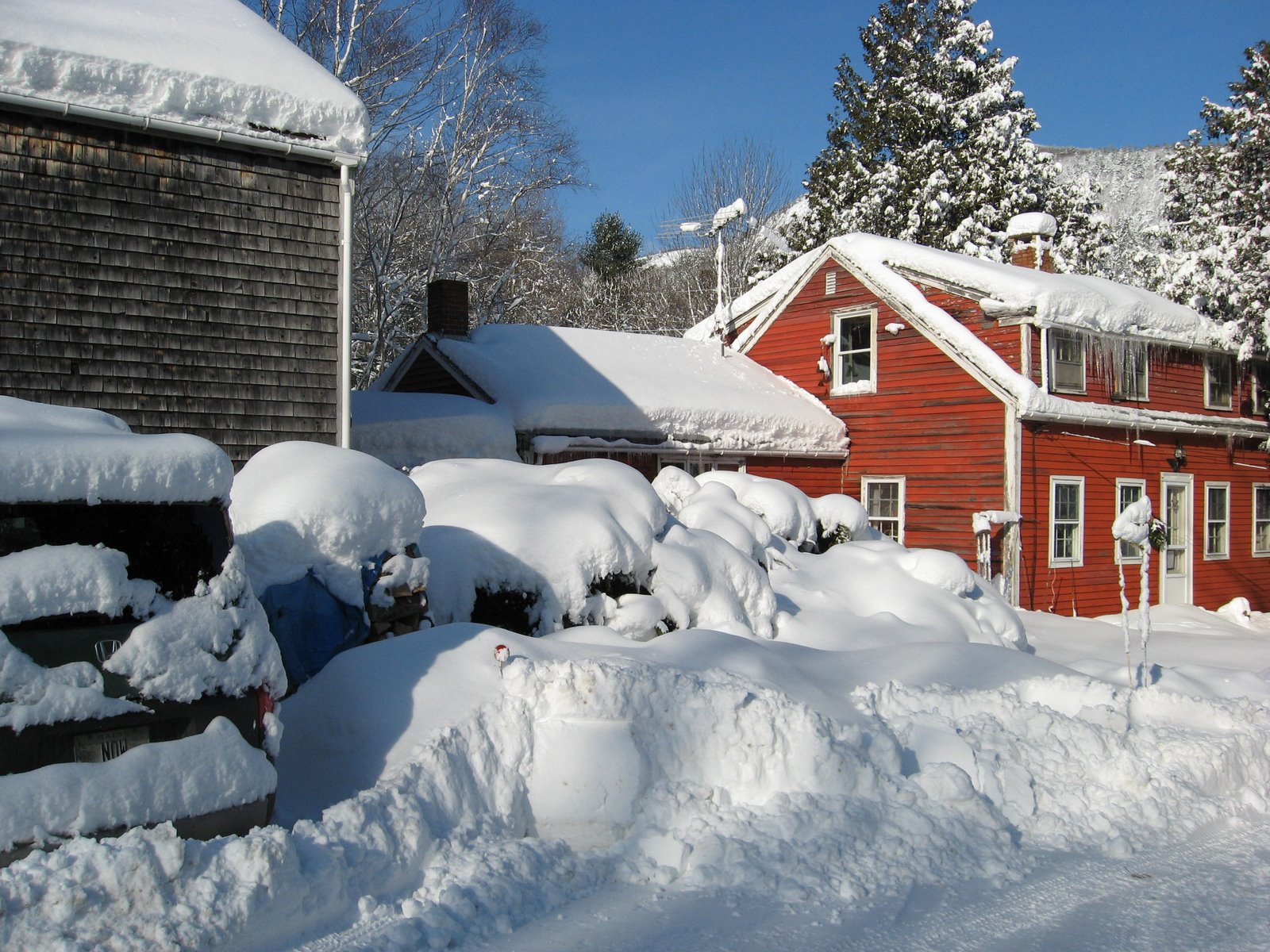
Snow. Cat still hurting. Also. Tired.
What is Right Mindfulness?
And what, monks, is Right Mindfulness? Here, monks, a monk abides contemplating body as body, ardent, clearly aware and mindful, having put aside hankering and fretting for the world; he abides contemplating feelings as feelings, he abides contemplating mind as mind, he abides contemplating mind-objects as mind-objects, ardent, clearly aware and mindful, having put aside hankering and fretting for the world. This is called Right Mindfulness.

- Mahasatipatthana Sutta: The Greater Discourse on the Foundations of Mindfulness, in Thus Have I Heard: The Long Discourses of the Buddha, trans. by Maurice Walshe, from Everyday Mind, edited by Jean Smith, a Tricycle book
And she abides as well.

We can't aways be certain about what happens.


We can, however look. Look carefully.

Beauty or Flight

The man who jumped from the highway bridge one afternoon
who drove his car along in rush hour traffic
then carefully pulled it over, fussed with something briefly on the dash,
so casually that another driver passing
thought he was looking for a map, or a cassette tape,
that had slid during the last turn before the bridge — that's all —
and then stepped out of the car, standing, stretching,
and closing the door routinely, a man in need of a break
on a long drive, a man untroubled by his next appointment,
a man who felt himself growing tired and thought
he needed some air, looked up the highway once
and then down at the almost frozen rows of traffic
under the haze that lingered above the bridge
and then broke simply and suddenly into a run, a dead run,
one motorist called it, crossing in front of his car
and not even stopping at the railing between the bridge
and the empty space beside the bridge, entering that space
and opening his mouth in what one driver called a scream,
though she heard no sound above the drone of traffic, and
other drivers saw as a gasp for breath, not unlike a child takes
when diving into a backyard pool, and he executed then
a nearly perfect, if a little rushed, swan dive out across the space
next to the bridge and into the water ninety-five feet below.

One fisherman in a boat a little upstream
saw the man who jumped from the highway bridge,
the moment he left the bridge and entered his dive, and the fisherman
swore he saw not a man but a large bird, a falcon or an eagle,
shot mid-flight by an angry driver, a large bird
who was trying to regain some sense of beauty, some sense of flight,
in its final dying seconds
(Poem: "Beauty or Flight" by Denver Butson from Triptych. The Commoner Press, 1999.)

So much depends on where we are what we see.

Monday, February 25, 2008

A good job is hard to find.
Right Livelihood
There are two criteria for right livelihood. First, it should not be necessary to break the five precepts in ones work, since doing so obviously causes harm to others. But further, one should not do anything that encourages other people to break the precepts, since this will also cause harm. Neither directly or indirectly should our means of livelihood involve injury to other beings. Thus any livelihood that requires killing, whether of human beings or of animals, is clearly not right livelihood. Selling liquor or other drugs may be very profitable, but even if one abstains from them oneself, the act of selling encourages others to use intoxicants and thereby harm themselves. Operating a gambling casino may be very lucrative, but all who come there to gamble cause themselves harm. Selling poisons or weapons arms, ammunition, bombs, missiles is good business, but it injures the peace and harmony of multitudes. None of these is right livelihood.

Even though a type of work may not actually harm others, if it is performed with the intention that others should be harmed, it is not right livelihood. The doctor who hopes for an epidemic and the trader who hopes for a famine are not practicing right livelihood.

(- S.N. Goenka, The Art of Living, from Everyday Mind, edited by Jean Smith, a Tricycle book)
There are so few jobs left that avoid wrong-livelihood.
Not many small huts in view,
Only three or four to be seen
Frosted trees dance in the sparse woods,
Showing sudden touches of color.
White clouds lie protectively
Over the closed brushwood gate;
The man out seeking the magic fungus
Has not yet returned.

- Toko Shin-etsu (1639-1696)

I hope we all get home alright.

Sunday, February 24, 2008

There's nothing to lose and nothing to gain with meditation.
Something has existed before
Heaven and earth;
Shapeless and silent
In its origin,
Yet the master of every
Image and form,
It can never wither
With the passing of time.

- Bankei (1622-1693)
Four students from Unity College at Sunday Evening Practice join six others in reading some words about nothing:
For me, meditation is a haven away from the ubiquitous world of self-improvement. It’s not just that there’s no such thing as “bad” meditation, but there’s no such thing as “good” meditation either. It is what it is. So when I hear words like “effort” and “discipline” and phrases like “deepening one’s practice” and “advancing along the spiritual path” spoken in the same breath as the word “meditation,” I wince. Just sitting (shikantaza)—doing and wanting nothing, breath coming and going unbidden, eyes seeing, ears hearing—in this effortless state, thoughts flurry like falling leaves.
(--January 31, 2008, ON THE CUSHION: The Myth of the Experienced Meditator, by Barry Evans, Tricycle Magazine)
Elsewhere, an 85yr old woman with viral infection has the family talking. Like chess players back from long vacation, their attention refocuses on the pieces scattered on table that must move or be lost.
I'm already lost.

But the cat is feeling better.

Saturday, February 23, 2008

Lou Reed sings that you can't depend on anything. Still, he says, you need a busload of faith to get by. In another song, he concludes:
"what's good? (life's good) but not fair at all"
(--from What's Good, song by Lou Reed)
Looking down at hands today, it occurred it's all a dream. By that I mean everything is passing, seemingly real, yet lacking distinct and separate existence once thought.
To study the Buddha way is to study the self.
To study the self is to forget the self.
To forget the self is to be enlightened by the ten thousand things [i.e., everything].
To be enlightened by the ten thousand things is to free one’s body and mind, and those of others.

-- Dogen Zenji, (1200 – 1253)
Forget about it! That's what Richie B. from Peconic Street would say with his tight lipped smile and nodding tilt of head. Mark called to say Richie, his uncle, died last week. (Requiescat in pace!)
Begin therefore with yourself and forget yourself. Truly, if you do not begin by getting away from yourself, then wherever you flee to, you will find obstacles and trouble no matter where it is. If people seek peace in outward things, whether in places or in methods or in people or in deeds or in banishment or in poverty or in humiliation, however great or of whatever kind all this may be, this is all in vain and brings them no peace. Those who seek thus seek wrongly; the further they go the less they find what they are seeking. They are like a man who has taken a wrong turning: the further he goes, the more he goes astray. But what should he do? He should resign himself to begin with, and then he has abandoned all things. In truth, if a man gave up a kingdom or the whole world and did not give up self, he would have given up nothing. But if a man gives up himself, then whatever he keeps, wealth, honour or whatever it may be, still he has given up everything.
--Meister Eckhart, (1260 – 1328)
Stepping into Bangor church the other day, there's a funeral mass for Marie going on. I sit in back pew. Priest talks about one carnation falling from bouquet. Holds it up. Finishes speaking. Walks it down to casket. Puts it on top. I get up. Guy in black coat watches me. I bow from back door. (Prego, Marie!) Leave.

Things are hardly ever fair.

But good?

Yeah.

Friday, February 22, 2008

In two different places and conversations in prison today, two different men were temporarily transfixed by the story told by Alice Walker about the circle custom of acceptance and release.

Alice Walker tells of a custom of the Babemba tribe of South Africa.
The Babemba tribe has a unique way of dealing with a member who acts irresponsibly or unjustly. They put the offending person in the center of the village, alone and unfettered.

All work ceases, and every man, woman and child in the village gathers in a large circle around the accused individual. Then each person in the tribe speaks to the accused, one at a time, about all the good things the person in the center of the circle has done in his lifetime. Every incident, every experience that can be recalled with any detail and accuracy is recounted. All his positive attributes, good deeds, strengths and kindnesses are recited carefully and at length.

The tribal ceremony often lasts several days. At the end, the tribal circle is broken, a joyous celebration takes place, and the person is symbolically and literally welcomed back into the tribe.

(--from Sent by Earth, by Alice Walker, Seven Stories Press, 2001).
There are times we go on with mind and heart numbed by kindness. At other times we are numbed by sorrow.
Lament

Listen, children:
Your father is dead.
From his old coats
I'll make you little jackets;
I'll make you little trousers
From his old pants.
There'll be in his pockets
Things he used to put there,
Keys and pennies
Covered with tobacco;
Dan shall have the pennies
To save in his bank;
Anne shall have the keys
To make a pretty noise with.
Life must go on,
And the dead be forgotten;
Life must go on,
Though good men die;
Anne, eat your breakfast;
Dan, take your medicine;
Life must go on;
I forget just why.

(--Poem: "Lament" by Edna St. Vincent Millay)
A curious night. Two women in Saskia's family find themselves in hospital a hundred miles apart. Snow tapers. Ground, nearly bare yesterday, goes white again.

Joe turned Pat's interpretation on its head this morning -- gently. Acceptance and forgiveness are for the accepting and forgiving. The one accepted and forgiven reflects the gift back.
And what, monks, is Right Speech? Refraining from lying, refraining from slander, refraining from harsh speech, refraining from frivolous speech. This is called Right Speech.
-( from Mahasatipatthana Sutta: The Greater Discourse on the Foundations of Mindfulness, in Thus Have I Heard: The Long Discourses of the Buddha, trans. by Maurice Walshe)
Most often we don't know why anything happens.

We can, nevertheless, speak well and kindly to one another.

It is up to the community to recognize the light in any one person.

We need not prove anything, nor deserve anything.

Light stands for itself.

Thursday, February 21, 2008

Beatrice Bruteau, talking to Tom Fox of National Catholic Reporter, said it is the unborn and the undying -- no origin, no destination -- which is the freedom of being beyond, in the holy spirit.

The perfectly free.
The moon and the paper
Are the same white
The pupil of the eye and the ink,
Both black.
This mysterious meaning
Remains a circle,
Beyond the possibility
Of understanding.

- Obaku Sokuhi (1611-1671)
What if Jesus is the way to save God?

Would we accept what and who we are if there was a change in translation?

Not Christian, but Jesusian?
Jesus saw nothing other.

Just things as they are.

With kindness.

Even love.

Wednesday, February 20, 2008

Full moon eclipse.
The way to true spirituality
Cannot depend upon others;
One instant of enlightenment
And I go beyond body and self.
The myriad and profound virtues
Are complete;
Anywhere in the universe
Is now my home.

- Mokuan (1611-1676)

No one is right. No one wrong.

That's not the world any more.

Adjust.

Come home.

Tuesday, February 19, 2008

Where are you?

Logging truck rolls past where I walk by frozen water near lumber yard.

Brief snow squall.

I listen to science podcast about nicotine, mimicry, and teleportation.
When everything inside and outside, bodily and mental, has been let go; when, as in the void, no attachments are left, that is the highest form of relinquishment.

Discard all you have acquired as being no better than a bed, spread for you when you were sick. Only when you have abandoned all perceptions, and rid yourself of dualistic concepts such as “ignorance” and “enlightenment,” will you be worthy to be called a Buddha. The original mind is without distinctions; when a sudden flash of thought occurs in your mind, even if a Buddha arises, cut him off.

Many people are afraid to empty their minds lest they plunge into the void. They do not know that their own mind is the void.

- Huang-po
Trying to avoid the void is like trying to unsay the word just spoken.

Like great rolling caskets the logging trucks deliver cadaver trees cut and stacked to yard for storage.

The first cigarette, the scientist says, captures the teenage brain and rewrites it according to addictive pathways.

Got a match? Yeah! Got suffering?

Suffering and a Crisis of Faith

If there is an all-powerful and loving God in this world, why is there so much excruciating pain and unspeakable suffering? The problem of suffering has haunted me for a very long time. It was what made me begin to think about religion when I was young, and it was what led me to question my faith when I was older. Ultimately, it was the reason I lost my faith.
(--Excerpt: 'God's Problem' by Bart Ehrman)
The explanation of suffering in the bible, he says, is unsatisfying.

There you are.

Monday, February 18, 2008

John O'Donohue in Anam Cara quotes Martin Heidegger as saying "True listening is worship."

Listening is a flower of silence. Even as flower gives it's impermanence to steady vase and loving gaze, silence finds itself with inches to spare between noise and chatter of crowded days.
If you want to learn about the Eternal Tao, do not be casual and in a hurry. Don’t glean too much from too many books, for each book is full of opinions, prejudices, and corruptions. Read only one book and only one, our Old Master’s Tao te Ching, and then try to understand it, not by juggling the words and meanings, but intuitively, through your heart and spirit.

Don’t ask too many questions, but patiently watch what we Taoists do, and perceive the hidden motives of our actions, and not that which is only for display. Do not be guided so much by your intellect as by faith, love, and your heart, which is another name for understanding and compassion.

What you need is wisdom, and not knowledge; for if one has wisdom, knowledge will come naturally. Always remember that the Eternal Tao is Infinite Wisdom, Infinite Love and Infinite Simplicity.

(- Ancient Taoist from Jade Mountain)

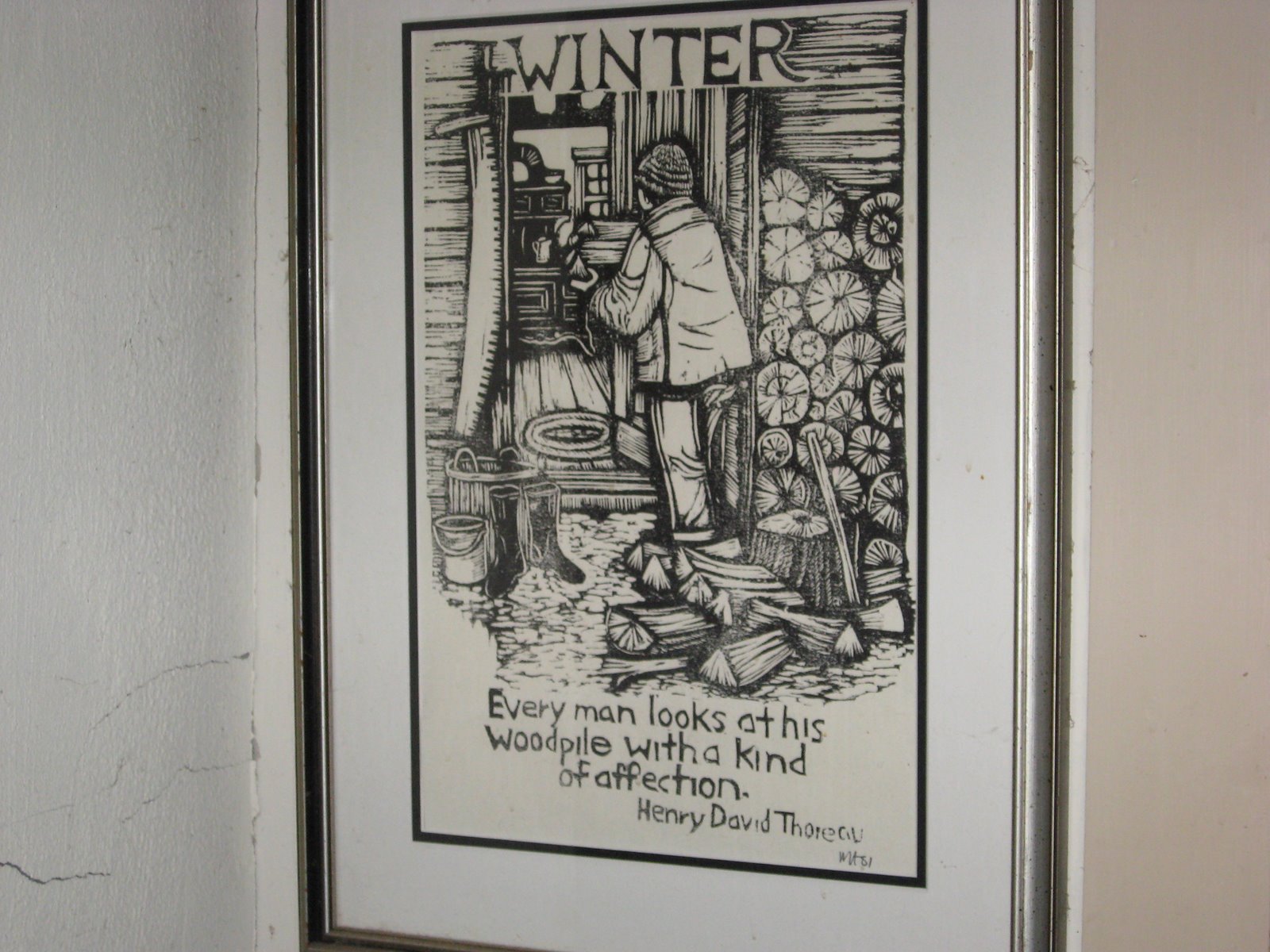
That to which my affection attends is thinner and smaller as each fire warms. Perhaps the wood pile will somehow last. No matter. Snow will go. Warmth return. Heart will accommodate next arrival when it shows itself. We'll gather what has fallen on mountain path.

You see, everything has its time. Joy is allowing what shows its quirky dance. Smile. Applaud when seemly. Walk on.
Shortly after finishing "Pragmatism and Romanticism," I was diagnosed with inoperable pancreatic cancer. Some months after I learned the bad news, I was sitting around having coffee with my elder son and a visiting cousin. My cousin (who is a Baptist minister) asked me whether I had found my thoughts turning toward religious topics, and I said no. "Well, what about philosophy?" my son asked. "No," I replied, neither the philosophy I had written nor that which I had read seemed to have any particular bearing on my situation. I had no quarrel with Epicurus's argument that it is irrational to fear death, nor with Heidegger's suggestion that ontotheology originates in an attempt to evade our mortality. But neither ataraxia (freedom from disturbance) nor Sein zum Tode (being toward death) seemed in point.

"Hasn't anything you've read been of any use?" my son persisted. "Yes," I found myself blurting out, "poetry." "Which poems?" he asked. I quoted two old chestnuts that I had recently dredged up from memory and been oddly cheered by, the most quoted lines of Swinburne's "Garden of Proserpine":
We thank with brief thanksgiving
Whatever gods may be
That no life lives for ever;
That dead men rise up never;
That even the weariest river
Winds somewhere safe to sea.
and Landor's "On His Seventy-Fifth Birthday":
Nature I loved, and next to Nature, Art;
I warmed both hands before the fire of life,
It sinks, and I am ready to depart.
I found comfort in those slow meanders and those stuttering embers. I suspect that no comparable effect could have been produced by prose. Not just imagery, but also rhyme and rhythm were needed to do the job. In lines such as these, all three conspire to produce a degree of compression, and thus of impact, that only verse can achieve. Compared to the shaped charges contrived by versifiers, even the best prose is scattershot.

(--from The Fire of Life, by Richard Rorty, an essay which originally appeared in the November 2007 issue of Poetry.)
Woodpile diminishes. No notion of how many days remain. Tonight there's warmth. That's good enough. What else is there?

Listen!

Fog rises from snow on Sally's field.
The Wood-pile

Out walking in the frozen swamp one grey day
I paused and said, "I will turn back from here.
No, I will go on farther--and we shall see."
The hard snow held me, save where now and then
One foot went down. The view was all in lines
Straight up and down of tall slim trees

Too much alike to mark or name a place by
So as to say for certain I was here
Or somewhere else: I was just far from home.
A small bird flew before me. He was careful
To put a tree between us when he lighted,
And say no word to tell me who he was
Who was so foolish as to think what he thought.
He thought that I was after him for a feather--
The white one in his tail; like one who takes
Everything said as personal to himself.
One flight out sideways would have undeceived him.
And then there was a pile of wood for which
I forgot him and let his little fear
Carry him off the way I might have gone,
Without so much as wishing him good-night.
He went behind it to make his last stand.
It was a cord of maple, cut and split
And piled--and measured, four by four by eight.
And not another like it could I see.
No runner tracks in this year's snow looped near it.
And it was older sure than this year's cutting,
Or even last year's or the year's before.
The wood was grey and the bark warping off it
And the pile somewhat sunken. Clematis
Had wound strings round and round it like a bundle.
What held it though on one side was a tree
Still growing, and on one a stake and prop,
These latter about to fall. I thought that only
Someone who lived in turning to fresh tasks
Could so forget his handiwork on which
He spent himself, the labour of his axe,
And leave it there far from a useful fireplace
To warm the frozen swamp as best it could
With the slow smokeless burning of decay.
(--Poem by Robert Frost)
This body is ready for night's rest.

Let every one arrive home safely!

Amen. Ok? Of course.

Listening carefully.

Let's let.

Go.

Sunday, February 17, 2008

Poor Clare hermit makes triennial visit to Meetingbrook. Her sweet shepherd eats biscuits, laps water, lays at her feet as we talk beyond piano along bookshelf.

The day begins sunny. Shop crowded with Manhattan, Kent England, New Hampshire, Belfast, and central Maine solitude.

Mind travels from all directions to receive itself in another.
The Kiss

She pressed her lips to mind.
—a typo


How many years I must have yearned
for someone's lips against mind.
Pheromones, newly born, were floating
between us. There was hardly any air.

She kissed me again, reaching that place
that sends messages to toes and fingertips,
then all the way to something like home.
Some music was playing on its own.

Nothing like a woman who knows
to kiss the right thing at the right time,
then kisses the things she's missed.
How had I ever settled for less?

I was thinking this is intelligence,
this is the wisest tongue
since the Oracle got into a Greek's ear,
speaking sense. It's the Good,

defining itself. I was out of my mind.
She was in. we married as soon as we could.

(Poem: "The Kiss" by Stephen Dunn from Everything Else in the World. W.W. Norton & Company, 2008.)
Too many peanut butter cookies with chocolate chips. That and smoke from downdraft this Sunday evening after practice. During walking meditation I fall off my slow steps, then begin again.


All we can ever do for one another is to be with.
Suffering is a universal experience
Seeing the suffering in the world around us and in our own bodies and minds, we begin to understand suffering not only as an individual problem, but as a universal experience. It is one of the aspects of being alive. The question that then comes to mind is: If compassion arises from the awareness of suffering, why isn't the world a more compassionate place? The problem is that often our hearts are not open to feel the pain. We move away from it, close off, and become defended. By closing ourselves off from suffering, however, we also close ourselves to our own wellspring of compassion. We don't need to be particularly saintly in order to be compassionate. Compassion is the natural response of an open heart, but that wellspring of compassion remains capped as long as we turn away from or deny or resist the truth of what is there. When we deny our experience of suffering, we move away from what is genuine to what is fabricated, deceptive, and confusing.

(- Joseph Goldstein, Seeking the Heart of Wisdom, from Everyday Mind, edited by Jean Smith, a Tricycle book)
Tears came at table when a woman spoke of her friend's suicide. I remembered our friend's, how she held my hands soon before, how we didn't know whether she would find her way through and out the despair. But there was that moment at the shop, in a crowded din, a moment of being with one another. That's all. Just that.

Every moment a call for creativity. That's what Delia said at table. The silent cry from the monastery of our heart.

O'Donohue is right -- there's a revelation of compassion for each wound attended.

The revelation is love.

In action.

No matter.

What.

Saturday, February 16, 2008

This world is a fragile construct.

Sometimes it seems unable to hold.

What is it we might have to let go of?
Illinois Gunman Showed Few Hints of Trouble, By MONICA DAVEY, Published: February 16, 2008
DeKALB, Ill. — Steve Kazmierczak, the man who walked silently into a classroom here on Thursday and opened fire, was not seen as struggling in college. He was not an outcast. And until recently, at least, he was not brooding.

In a stark, puzzling contrast to the usual image of a rampaging gunman, Mr. Kazmierczak, 27, was described Friday as a successful student — “revered,” the authorities said, by his professors — who had served as a teaching assistant and received a dean’s award as an undergraduate here at Northern Illinois University, where he returned Thursday, killing himself and five students and wounding 16 others.

Here, he had campaigned for a leadership post in a student group that studied the failings of the prison system, an issue he was passionately concerned about, and had apparently won. He was a co-author of an academic paper called “Self-Injury in Correctional Settings: ‘Pathology’ of Prisons or of Prisoners?” which examined why inmates might hurt themselves with behaviors like cutting their skin.

He was personable, easy to talk to, an excellent student, said his professors at the University of Illinois, Urbana-Champaign, some 130 miles south of here, where he was on his way to receiving a master’s degree in social work. The specialty he selected was in mental health.

(http://www.nytimes.com/2008/02/16/us/16gunman.html)
At times there is no perceptible center, no discernible core to the construct. The explanations fail to satisfy as to why all human beings are not equally treated with sustaining food, shelter, clothing, health care and esteem. The actions of governments and administrations in institutions of all sorts do not satisfy the desire for justice, fair, and equal treatment. The competitive, predatory, and exclusionary nature of business and economic practices inhibit the simple need to produce income for each individual based on basic initiative and self-subsistent enterprise. The pervasive mistrust and rampant fear-mongering in the social spectrum casts doubt on everyone -- we wonder: who can be trusted? who might be informing on us? who is spying on us? who is willing to delight in our weaknesses and charge 20-30% on debt? who is plotting a bombing? who carries guns into crowded places intent to harm and kill? who sees an opportunity to take advantage of terrible events of the kind at the University of Illinois for personal or political gain? who are authentic friends? and, at last, if this world is a battleground between good and evil, why do we not feel confident that good has any leverage and why are so many of our systems and corporate bodies so willing to use evil to inch toward the illusory good imagined coming from such an anguishing path?
No flower can compare with the pine.
Today the flower blooms in sweet beauty,
Overnight come snow and frost,
It fades away.
The pine is the evergreen.

(- Prose rendering of a wall poem seen in 1934 at Pai-szu Pagoda)

It is painful to experience so much of this world. Once we thought it was God's favor to be insulated and protected in life due, inevitably, to privilege, position, wealth, or status. Literature and headlines point out that no one is exempt from the ravages of impermanence, time, existence, and inevitability.
Pain is inevitable
The First Noble Truth declares unflinchingly, straight out, that pain is inherent in life itself just because everything is changing. The Second Noble Truth explains that suffering is what happens when we struggle with whatever our life experience is rather than accepting and opening to our experience with wise and compassionate response. From this point of view, theres a big difference between pain and suffering. Pain is inevitable; lives come with pain. Suffering is not inevitable. If suffering is what happens when we struggle with experience because of our inability to accept it, then suffering is an optional extra.


I misunderstood this when I started my practice and believed if I meditated hard enough I would be finished with all pain. That turned out to be a big mistake. I was disappointed when I discovered the error and embarrassed that I had been so nave. Its obvious we are not going to finish with pain in this lifetime.

The Buddha said, Everything dear to us causes pain.Those of us who have chosen relational life have made the choice that the pain is worth it.
(-Sylvia Boorstein, Its Easier Than You Think, from Everyday Mind, edited by Jean Smith, a Tricycle book)
We cannot fathom exactly how it is that the world is the way it is. Myths have arisen to try. So have theologies and philosophies. Ideology and manifesto combine to tell us how things are, how we are going to behave and live whether we agree or not, and invariably fail to contribute anything but a new variety of dread and fear.

Still, the world is the way it is.

How come?

How long?

Christians await Christ. Buddhists the Buddha of end times. Allah, Adonai, Alpha and Omega, Manjushri, Say Goodnight Gracie, and other assortments of valedictory wander our imagination and alternately comfort or worry us.
Beautiful Dreamer Serenade

Beautiful dreamer, wake unto me,
Starlight and dewdrops are waiting for thee;
Sounds of the rude world heard in the day,
Lull'd by the moonlight have all pass'd a way!

Beautiful dreamer, queen of my song,
List while I woo thee with soft melody;
Gone are the cares of life's busy throng,—
Beautiful dreamer, awake unto me!
Beautiful dreamer awake unto me!

Beautiful dreamer, out on the sea
Mermaids are chaunting with wild lorelie;
Over the streamlet vapors are borne,
Waiting to fade at the bright coming morn.

Beautiful dreamer, beam on my heart,
E'en as the morn on the streamlet and sea;
Then will all clouds of sorrow depart,—
Beautiful dreamer, awake unto me!
Beautiful dreamer awake unto me!

(--Poem: "Beautiful Dreamer Serenade" by Stephen C. Foster. Public domain.)
Is that it?

Are we dreaming?

Are we close to awakening?

Do we have the good heart and good sense to open with wise and compassionate response?

Friday, February 15, 2008

Memory slips. Not holding on to things in same way as before. Aging. Nor does it matter.
In front of us stood Flowery Mountain and its secret retreats. When we approached clouds veiled its summit. The vapors which covered the enclosing ring of mountains rose, and the morning sun illumined their crowning peaks. Then beautiful cliffs appeared one after another, and we heard the music of the wind howling against the rock walls. We were part of the living landscape.
- Wang Li

Cat under front room altar. Tussled last night with something in barn. A bit beaten.

In prison today conversing about Carl Sagan, Parinirvana Day, and Dan Millman.

Wind blows cold outdoors. Clinking fragility.

We hold on long past good sense.

Thursday, February 14, 2008

When things encase us, there's always the sun. It comes. But in it's own time.

The force of love
The practice of metta, uncovering the force of love that can uproot fear, anger, and guilt, begins with befriending ourselves. The foundation of metta practice is to know how to be our own friend. According to the Buddha, You can search throughout the entire universe for someone who is more deserving of your love and affection than you are yourself, and that person is not to be found anywhere. You yourself, as much as anybody in the entire universe, deserve your love and affection. How few of us embrace ourselves in this way! With metta practice we uncover the possibility of truly respecting ourselves. We discover, as Walt Whitman put it, I am larger and better than I thought. I did not think I held so much goodness.

(- Sharon Salzberg, Lovingkindness, from Everyday Mind, edited by Jean Smith, a Tricycle book)
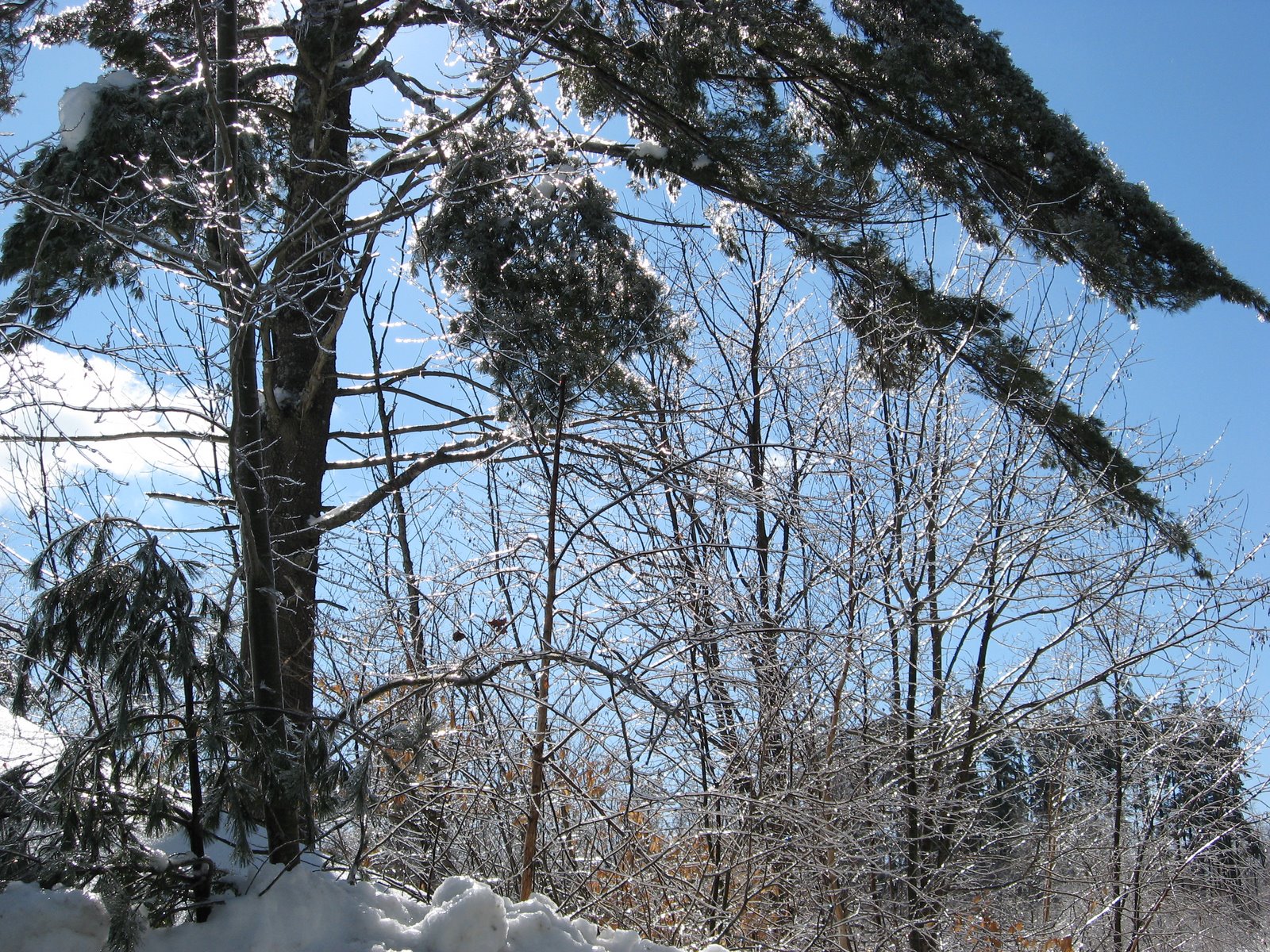
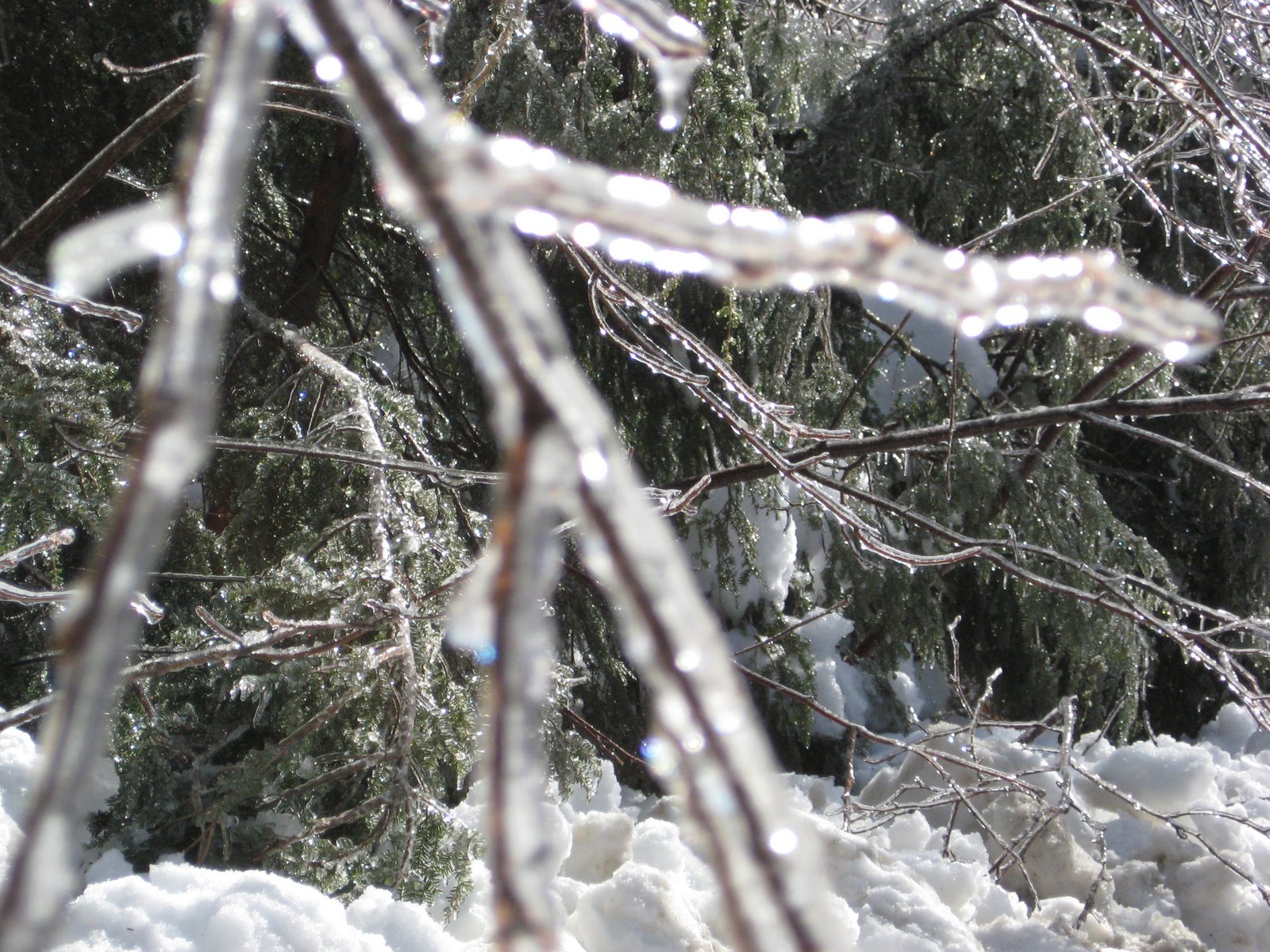
This Valentine's Day we see Farmington, Belgrade Lakes, Rome, Augusta. Ice has visited. Stays the day. Crusts everywhere.
Arriving back to bookshop at end of conversation. Course in Miracles theme is:
Lesson 045
God is the Mind with which I think.
Today's idea holds the key to what your real thoughts are They are nothing that you think you think, just as nothing that you think you see is related to vision in any way. There is no relationship between what is real and what you think is real. Nothing that you think are your real thoughts resemble your real thoughts in any respect. Nothing that you think you see bears any resemblance to what vision will show you.
You think with the Mind of God. Therefore you share your thoughts with Him, as He shares His with you. They are the same thoughts, because they are thought by the same Mind. To share is to make alike, or to make one. Nor do the thoughts you think with the Mind of God leave your mind, because thoughts do not leave their source. Therefore, your thoughts are in the Mind of God, as you are. They are in your mind as well, where He is. As you are part of His Mind, so are your thoughts part of His Mind.

(--from ACIM)
When we do not lie about it, everything is just as it is. Even when we are lying, it is as it is. I want to stop lying.

Winter February will thaw.

Love will warm.

Mind well.

We'll see.

Wednesday, February 13, 2008

Canada is close and magnificant neighbor. It makes us think big.


We'd like a million dollars. We'd settle for 975,000. We'd buy a 16 acre farm in Canada with many outbuildings, a 7 bedroom, 4 bathroom house. We'd fashion a meditation cabin, a chapel, a bookshop/bakery, guest quarters, animal barn, organic acres for food, and choose the option of right of way down to beach at St Croix River opening through Passamaquoddy Bay into Bay of Fundy.

Alright -- the property only costs 549,000. But we thought it would be nice to have a buffer against additional costs for upkeep and improvements in order to bring about a marvelous center for retreat and lay monastic practice between traditions of Catholic/Anglican Christianity and Mahayanan/Theravadan Buddhism.

We'll start our capital campaign on Valentine's Day. We'd like to make an offer on the place by St. Patrick's Day and move in on the final day of winter so as to wake up the first day of spring.

Donors are encouraged. Those whose portfolios are large and whose hearts are generous will receive in return whipped cream on their ice cream. We'd prefer to have no mortgage. You can own it for us if you like.
Everyone who pauses at this prospect with a good thought is exceedingly welcome to visit and pray, sit and meditate, and eat good food sprinkled with hope, joy, compassion and loving kindness.
By listening to the sound of music and its fading, the wise understand the rise and fall of all things. By watching, the wise know the meaning of things even before they appear and take shape.
- Ko Hung 4th century
A million dollars. Maybe less. OK, a lot less. Maybe even a smile allowing that we still dream dreams of places where in parallel worlds a life such as ours is lived out wondering what resides on the other side of subtle cloaking dimension.
Land Love

We stood here in the coupledom of us.
I showed her this — a pool with leaping trout,
Split-second saints drawn in a rippled nimbus.

We heard the night-boys in the fir trees shout.
Dusk was an insect-hovered dark water,
The calling of lost children, stars coming out.

With all the feelings of a widower
Who does not live there now, I dream my place.
I go by the soft paths, alone with her.

Dusk is a listening, a whispered grace
Voiced on a bank, a time that is all ears
For the snapped twig, the strange wind on your face.

She waits at the door of the hemisphere
In her harvest dress, in the remote
Local August that is everywhere and here.

What rustles in the leaves, if it is not
What I asked for, an opening of doors
To a half-heard religious anecdote?

Monogamous swans on the darkened mirrors
Picture the private grace of man and wife
In its white poise, its sleepy portraitures.

Night is its Dog Star, its eyelet of grief
A high, lit echo of the starry sheaves.
A puff of hedge-dust loosens in the leaves.
Such love that lingers on the fields of life!

(--Poem by Douglas Dunn, Faber, 1985)
At turn in stairs there's a statue settled into a niche. A woman. Is it Mary? Or Kuan Yin? Whoever she is, she knows our hearts are filled with humor and openness to possibility. Do people want to come here to rest a while? Does silence wish minds to penetrate? Will the sweet beauty of nature draw into our tired minds reminders of true home?

It might not matter where one lives, or even whether there is room for others to visit and refresh. This dream of ours has been with us for a long time. Every once in a while we take it out, dust it off, and dance with it in the open air.

One of the small joys in life is the possibility of surprise.

The unexpected kindness.
Gift without explanation.

A grace quietly accepted.

Even before it appears.

Tuesday, February 12, 2008

Then, naturally, there's the question: Who are you not?

The question corresponds with its sister question: Where is God not?

The morning drive leaving Fort Kent, moving through northern Maine's rooftop laden with deep, deep snow. Mailboxes are covered, snow tiptoes up to first floor windows, heavy white burden buckles old barns, roadways are luge runs with soft embankments should the icy permafrost toss you askew. Then across to Caribou, down to Presque Isle -- the lovely beauty of winter! More snow tomorrow.
A saint is not ashamed of being despised, but saddened to see good counsel spurned. That life be brief does not depress him but avoidable suffering distresses him. He keeps his mind free of vain endeavors and embraces wisdom. By becoming one with the Great Unity the saint avoids the whirlpool of the mundane vanities.
- Wen-tzu
The activities might swirl about, even through, the saint -- but, I suppose, she is not drawn down by whirlpool and lost in dark depths. Perhaps preventive escape is not so much the issue as is sane survival. A friend used to speak about insulating himself against the world of temptations and dark forces. "Let these pass," Obi-Wan Kenobi said to the Imperial Guards, referring to his small coterie of fellow travelers passing through dangerous terrain, "they mean no harm." They were let pass. All rules of search and impede suspended.

Like walking across bridge between Fort Kent, Maine and Clair, New Brunswick -- at the international boundary over frozen river sided by floes passing under -- stand in two countries at once -- the freezing earth, air, and water giving not a thought to matters of government, nation, or possession of air space.

We're not, I concede, who we think we are. But there's more to it.
Someone I cared for

Someone I cared for
put it to me: Who
do you think you are?

I went down the list
of all the many
possibilities

carefully — did it
twice — but couldn't find
a plausible one.

That was when I knew
for the first time who
in fact I wasn't.
(Poem: "Someone I cared for" by Cid Corman, from And The Word. Coffee House Press, 1987.)

Once, I stood under the cliff at edge of beach in Downeast Maine. Everything leaned out in solid silence as tide rolled rocks behind us at shoreline. Everything we'd seen and everyone we'd spoken with that day accompanied us to that moment at that spot in a consciousness excluding nothing from itself. We see things for each other. We hear things for one another. We quietly contemplate nature -- elemental, animal, human, and divine -- and these varying forms and emptinesses allow themselves to open and flower before and within us.

So, we ask one another: Who do you think you are? And we pause for a bit and reflect. We consider the possible implications and parameters of any response. We then carry on to the next in our lives -- the next instant, next minute, and next hour arising with us.

We dwell in the swirl of everything happening at the same time.

In everything there is a calm center, a resting place in the chaos, a sanctuary where resides the sacred emptiness assenting our particular presence.

If we go there, we are not only not alone, we are more profoundly involved, and more paradoxically informed. There, in the center of the swirling motion that is the evidenced world, we are alone -- but alone with the Alone. This "Alone" is all there is, nothing missing, everything within everything.

Allow yourself the visit.

Touch any one thing, feel every thing.

Forget what we've thought God.

Enter God.

Where God is.

Pass well!

Monday, February 11, 2008

Note: The bookshop/bakery is closed Monday (11th), and Tuesday(12th).
We will re-open Wednesday 13 Feb.
................

Sunday, February 10, 2008

Consciousness without thought, says Eckhart Tolle, is alert presence that is still and awake. It is, he says, Being before it becomes beings.
Without going outdoors
The Sage knows all things under heaven.
Without looking through the window
He sees the Way of Heaven.
The more one ventures forth
The less one knows.

- Tao te Ching
Barack Obama wins Maine caucus. At practice tonight a man who'd attended Obama's rally in Bangor yesterday said the candidate was real and electric, inspiring hope. It was good to hear his experience.
Beginningness
Most people think of enlightenment as a kind of magical attainment, a state of being close to perfection. At this level, one can perform amazing feats, see past and future lives of others, and tune in to the inner workings of the universe. This may be possible for a number of special beings, but for most of us enlightenment is much more in line with what Suzuki Roshi describes. It means having a quality of "beginningness," a fresh, simple, unsophisticated view of things. To have "beginner's mind" in how we approach things is a major teaching. In many ways, the process of enlightenment is clearing away the thoughts, beliefs, and ideas that cloud our ability to see things as they really are in their pristine form.

(- David A. Cooper, Silence, Simplicity and Solitude, from Everyday Mind, edited by Jean Smith, a Tricycle book)

We need new beginning. We've reached a cul-de-sac. Those at the barricades do not want heads to turn. We need to turn around. Head out. Out of head. Don't think. Investigate.
All That Is Glorious Around Us
(title of an exhibit on The Hudson River School)

is not, for me, these grand vistas, sublime peaks, mist-filled
overlooks, towering clouds, but doing errands on a day
of driving rain, staying dry inside the silver skin of the car,
160,000 miles, still running just fine. Or later,
sitting in a café warmed by the steam
from white chicken chili, two cups of dark coffee,
watching the red and gold leaves race down the street,
confetti from autumn's bright parade. And I think
of how my mother struggles to breathe, how few good days
she has now, how we never think about the glories
of breath, oxygen cascading down our throats to the lungs,
simple as the journey of water over a rock. It is the nature
of stone / to be satisfied / writes Mary Oliver, It is the nature
of water / to want to be somewhere else, rushing down
a rocky tor or high escarpment, the panoramic landscape
boundless behind it. But everything glorious is around
us already: black and blue graffiti shining in the rain's
bright glaze, the small rainbows of oil on the pavement,
where the last car to park has left its mark on the glistening
street, this radiant world.

(Poem: "All That Is Glorious Around Us" by Barbara Crooker from Radiance. Word Press, 2005.)
This observation comforts as it instructs: "everything glorious is around / us already". Around table this evening we read Henri Nouwen on Lent. He spoke of addictive behavior keeping us in a distant country.

It is time to start home.

Winter, tired, yawns.

Spring, waking, yawns.

They see-saw in our consciousness and on the ground.

We've less than half wood (or hay) on this past Candlemas day.

Saturday, February 09, 2008

Toboggan championships take place over at snowbowl. Saskia and Annie go snowshoeing learning about animal tracks along the St George river. I submit application to adopt rescue dog. It's time.
Evening wind, morning frost:
These things make solitude beautiful.

- Yun Shouping (1633-1690)
Snow over everything last night. Tomorrow again. Four to eight inches at a clip.
Moses was looking after the flock of Jethro, his father-in-law priest of Midian.
He led his flock to the far side of the wilderness and came to Horeb, the mountain of God. There the angel of the Lord appeared to him in the shape of a flame of fire, coming from the middle of a bush.

(--Exodus 3:1)
The thought occurs: What if the contemporary Bush is, as he and others claim, the doer/decider of God's will in the world. Such an instrumental possibility that what Mr. Bush has been doing/deciding in the world might be the will of God is a compelling argument to allow God go out of office with spokesman.
Roadside blasts kill 5 U.S. soldiers in Iraq
by Michael Holden, Sat. Feb 9, 9:37 AM ET

BAGHDAD (Reuters) - Five American soldiers were killed in roadside bombings in Iraq on Friday, the U.S. military said on Saturday, while Iraqi police detained 22 suspects in raids against Shi'ite militiamen.

The Population Clock for 9Feb08 suggests there are 303,492, 496 folks in the United States and 6,649,483,641 in the world. (http://www.census.gov/)

We're lucky to have a man at the helm with such an advisor as God.


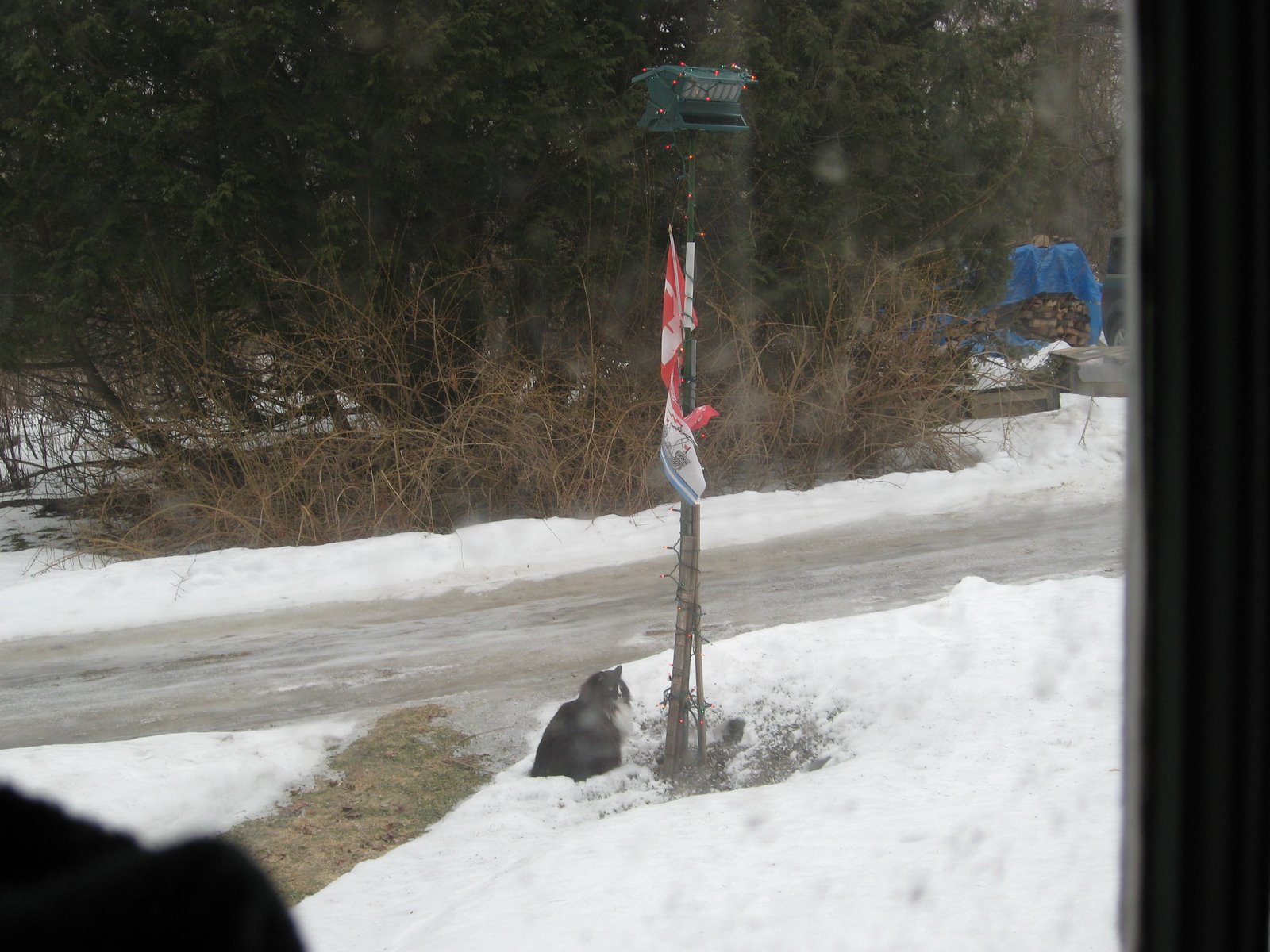
The cat at base of birdfeeder waits for misguidance and distraction to bring careless attraction across his path. If such occurs, he will swipe and slash, feathering snow with stunned fallen bird.

We call cat in when he approaches stakeout. Would we were able to recall those in power who perform their mindless destruction. Whether you argue that killing is part of animal or human nature -- or perhaps hold that the good of the one overarches the good of the many -- there is something unnerving and repulsive about the way humans kill and destroy with mere smirking explanation as rationale.

Cats are cats. But human beings are (some think) what God longs to be. With surrogate carriers such as the depleting president, it's no wonder why contraception and abortion continue as reasonable options. Who would want such a God as one that chooses such a surrogate? Who will be the one to bear resemblance to holiness incarnate?

It's a rarified argument for unborning. But then...perhaps our task is more forgiving. The game is afoot! (Cat bangs at barn screen door wanting in from wanderings.)

Moses, we hear, freed his people from enslaving ignorance.

Who will remember how that is done?

How do we cross today's flooding sea of enslaving ignorance?

Friday, February 08, 2008

In prison Buddhist Group we laugh with Tony as he points out his mind when he didn't get French fries on his tray yesterday.

We laugh because we know that mind. His flash of anger was (of course) righteous, and (of course) the fault of some other person, and (of course) something with the potential to keep him stewing for hours. But this morning he gifts us with his French fry mind near-dharma talk, and we laugh at our mind's incarceration.

Today (or on the 15th) is celebrated Nirvana Day.
Parinirvana

This is a Mahayana Buddhist festival that marks the death of the Buddha. It is also known as Nirvana Day.

Buddhists celebrate the death of the Buddha, because they believe that having attained Enlightenment he achieved freedom from physical existence and its sufferings.

Women outside Buddhist temple in Nepal

(Women outside Buddhist Temple in Nepal)

The Buddha's death came when he was eighty years old, and had spent forty years teaching after his Enlightenment. He died in a state of meditation, and attained nirvana, a release from the cycle of death and rebirth.

The Paranibbana Sutta describes the Buddha's last days, and passages from it are often read on Parinirvana Day.

Buddhists celebrate Parinirvana Day by meditating or by going to Buddhist temples or monasteries. As with other Buddhist festivals, celebrations vary throughout the world.

In monasteries Parinirvana Day is treated as a social occasion. Food is prepared and some people bring presents such as money, household goods or clothes.

The day is used as an opportunity to reflect on the fact of one's own future death, and on friends or relations who have recently passed away. The idea that all things are transient is central to Buddhist teaching. Loss and impermanence are things to be accepted rather than causes of grief.

Meditations are carried out for the newly deceased to give them help and support wherever they might be now. (http://www.bbc.co.uk/religion/religions/buddhism/holydays/parinirvana.shtml)

News of a suicide within larger prison community. Prayers follow. Here's one. And here's one.

There's always need of near-dharma and near-teisho stories.

We're glad the Buddha realized cessation of suffering.

We have a chance to transcend French-fry-mind.

We have a chance to laugh.

Thursday, February 07, 2008

How often have you heard: "You are something else!" It is a good day when I can say -- "I am nothing." It's because I am nothing else. In fact, there is nothing else.
Far, faraway, steep mountain paths,
Treacherous and narrow, ten thousand feet up;
Over boulders and bridges, lichens of green,
White clouds are often seen soaring,
A cascade suspends in mid-air like a bolt of silk;
The moon’s reflection falls on a deep pool, glittering.
I shall climb up the magnificent mountain peak,
To await the arrival of a solitary crane.
- Shide (8th century)
The awaiting man, the flying crane, the solid mountain -- these are not three things.

If we see things the way they are, we are not other than the way we are.
I Close My Eyes

I close my eyes like a good little boy at night in bed,
as I was told to do by my mother when she lived,
and before bed I brush my teeth and slip on my pajamas,
as I was told, and look forward to tomorrow.

I do all things required of me to make me a citizen of sterling worth.
I keep a job and come home each evening for dinner. I arrive at the
same time on the same train to give my family a sense of order.

I obey traffic signals. I am cordial to strangers, I answer my
mail promptly. I keep a balanced checking account. Why can't I
live forever?

Poem: "I Close My Eyes" by David Ignatow from Against the Evidence: Selected Poems 1934-1994. Wesleyan University Press, 1994.

Any one word is enough to introduce extraneous meaning into an already eloquent stillness of one's own presentation. Be careful about the impulse to speak. The whole world came about because of a few words.

There is much to listen to.

Whatever you do.

Say not.

A word.

If you do say anything, nothing will ever be the same.

We must allow nothingness the distinctive change of its own way.

Wednesday, February 06, 2008

This lent I will lose wait. No waiting. See the revelation here as it is now.

We are the earth. And, we are the space above as well as that surrounding this small planet. We are breath and we are body. It is Ash Wednesday. Ash on forehead -- wants us to remember what we are, wants us to remember we are earth, space, breath, body and all the rest of it.
I cannot find the Monastery of Heaped Fragrance,
Miles up now into the clouds of the summit.
There is no footpath through the ancient woods.
Where did the bell sound,
Deep in the sound, deep in the mountain?
The voice of the torrent gulps over jagged stones;
Sunlight hardly warms the bluish pines.
As dusk deepens in these unfathomable mazes,
I practice meditation

To subdue the dragon of desire.
- Wang Wei (701–761)
Today we remember what we dimly intuit: nothing is excluded from life -- not even death.


This lent I will lose wait and move with movement itself.

The immediacy and diversity of Christ's revealing mind is upon us.

It is Easter morning, Christmas evening, Tibetan and Chinese new year, followed by Buddha's Nirvana day -- all rolled into one.

Time says: "Wait a while; see what comes."

I'm not waiting.

The whole universe reveals itself.

Tuesday, February 05, 2008

A vote for him. A vote for her. A vote for someone else.
On Climbing the Highest Peak of Stone Gate
At dawn with staff in hand I climbed the crags,
At dusk I made my camp among the mountains.
Only a few peaks rise as high as this house,
Facing the crags, it overlooks winding streams.
In front of its gates a vast forest stretches.
While boulders are heaped round its very steps.
Hemmed in by mountains, there seems no way out,
The track gets lost among the thick bamboos.
Deep in meditation, how can I part from Truth?
I cherish the Way and never will swerve from it

- Xie Lingyun (385–433)

No more votes.

Election is not the importance we think it is.

Love is.

Our.

Only.

Way.

Monday, February 04, 2008

Play.

The drama of it.

Acting, not making. That's what Alan Watts says the difference is between two understandings of God. God is builder king in west. God is acting self in east. Boss versus theater troupe.
The unborn Dharma disappeared in both Japan and China, and it has long since been forgotten. But now it has appeared in the world again. Once you come to know without any doubt that the marvelous illuminative wisdom of the Unborn is the Buddha-mind, and that the Buddha-mind puts all things in perfect order by means of the Unborn, then you can no longer be deluded or led astray by others.
--Bankei (1622-1693)
Rather, stay luded.

Play.

Divinely recognize your true self beyond stage presence.

Put nothing between you and who you really are.

Sunday, February 03, 2008

Want anything? Want nothing?
In everyone it towers like
A mile high wall,
Flashing a great precious light
In everyone’s presence.
One thought ten thousand years,
Ten thousand years one thought,
Eating when hungry,
Sleeping when tired,
Who worries about the alternation
Of light and dark,
The change of the seasons?

- Daio (1235-1309)
The football game ends the way they all do: one team wins, one loses. Only the names change.
Seek the Lord,
all you, the humble of the earth,
who obey his commands.
Seek integrity,
seek humility:
you may perhaps find shelter
on the day of the anger of the Lord.

In your midst I will leave
a humble and lowly people,
and those who are left in Israel will seek refuge in the name of the Lord.
They will do no wrong,
will tell no lies;
and the perjured tongue will no longer
be found in their mouths.
But they will be able to graze and rest
with no one to disturb them.

(--Zephaniah 2:3 - 3:13)
February comes, and January falls of itself.

At practice tonight we read Chuang Tzu by way of Thomas Merton. We speak of wu-wei, non-doing.
The essential message of Taoism is that life constitutes an organic, interconnected whole which undergoes constant transformation.

This unceasing flow of change manifests itself as a natural order governed by unalterable, yet perceivable laws. Paradoxically, it is the constancy of these governing principles (like the rising and setting of the sun and moon and the changing of the seasons) that allows people to recognize and utilize them in their own process of transformation. Gaining an awareness of life's essential unity and learning to cooperate with its natural flow and order enables people to attain a state of being that is both fully free and independent and at the same time fully connected to the life flow of the Universe -
being at one with the Tao. From the Taoist viewpoint this represents the ultimate stage of human existence.

The writings of the legendary Taoist sages, Lao Tzu and Chuang Tzu, furnish us with specific principles as a guide to attaining this state of oneness. Through understanding these principles and applying them to daily living we may consciously become a part of life's flow.
A key principle in realizing our oneness with the Tao is that of wu-wei, or "non-doing." Wu-wei refers to behavior that arises from a sense of oneself as connected to others and to one's environment. It is not motivated by a sense of separateness. It is action that is spontaneous and effortless.
(--from Taoism - The Wu-Wei Principle, Part 4, by Ted Kardash
http://www.jadedragon.com/archives/june98/tao.html)
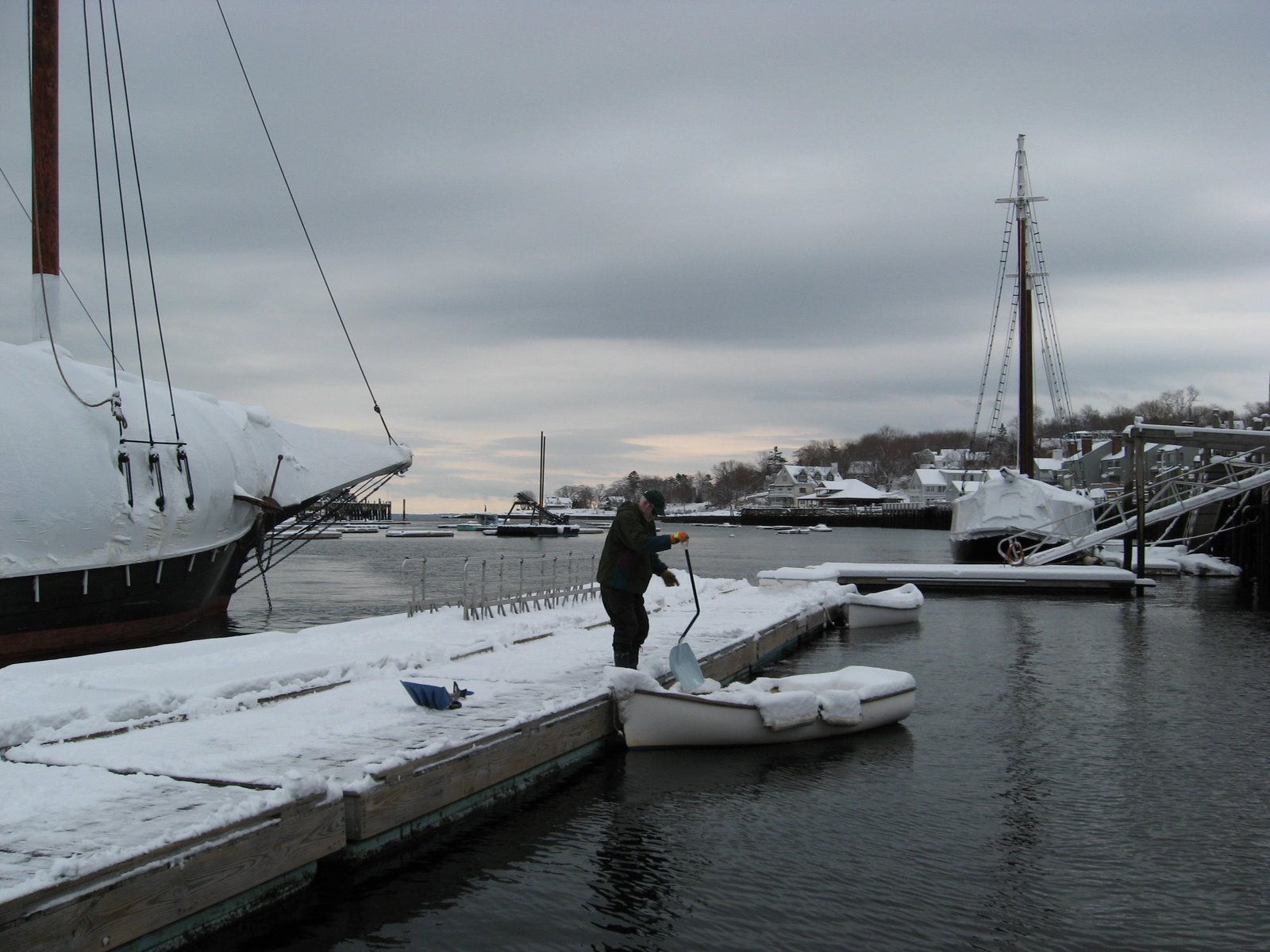
Rowed out and around R2 in the bay outside Camden harbor. Clangers sounding monastic hours in deep reclusive sacred solitude. The joyousness of small boat emptying mind in swell and tide!Being hermit in the open is grace enough!

Nothing else needed.

Naught wanted.

Saturday, February 02, 2008

Visiting hospital. Man says he missed by a few hours having his foot amputated. Lucky. At nurses station a half dozen folks charting.
In Buddhism there are numerous paths of spiritual training. Each has its unique goal, purpose, and benefits for oneself and others. But in order to be able to benefit truly, it is very important to understand the principal purpose underlying these practices. If we take the wrong turn at a crossroads, every step we make will take us further from our destination. In the same way, if we fail to realize the nature of our spiritual goal and what our aim should be, our practice will not be beneficial, or at least not nearly as helpful as it could otherwise be. The main focus of all of our training in Dharma is to benefit our minds.... If we do not improve our minds, then regardless of how many understandings we have about the ten stages, the five paths, ceremonies, philosophies, and so forth, they'll all become objects that we never apply to ourselves. It can be very simple, like when we are facing the right direction--every step will bring us closer to our destination.
(- Tulku Thondup, in Enlightened Journey)
from Everyday Mind, edited by Jean Smith, a Tricycle book
I'd rather look within and see nothing than look out into the world and see the nothing that comes with a side of nothing. In both cases, there is nothing to behold.

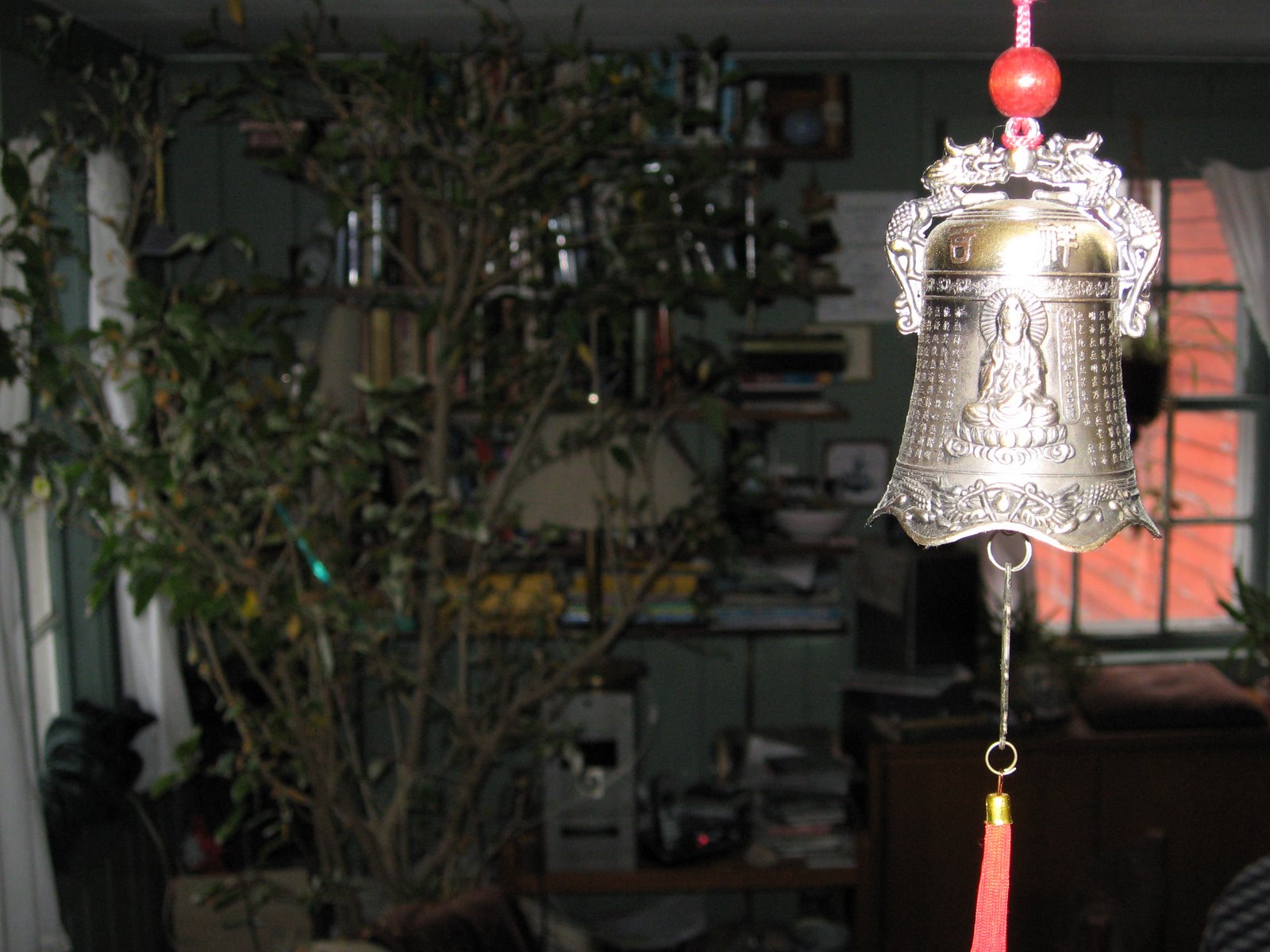
Listening to the sound of bell at beginning and end.

No need to remember, everything is right there at the sounding of the bell.

We enter and sit, stand and leave, without ever moving.

A still, clear, learning without anything added -- like, understanding.

Friday, February 01, 2008

I've been thinking about 9/11/2001 today 2/01/2008.

Just that. Nothing else.
What is this wonder-filled universe?
What constitutes seed?

Who centers the universal wheel?
What is this life beyond form pervading forms?
How may we enter it fully,
Above space and time,
Names and descriptions?

Let my doubts be cleared.
- Vigyan Bhairava (~4000 years ago)
A mistake was made that September morning.

I'm trying to remember what it was I forgot.

I think it had to do with loving the odd God making fire too hot to bear.

Or the men who felt they knew the name of God.

The mistake was trying to avenge and retaliate.

Yes, that's it. There was a chance to teach God something needed by God.

Just because we failed and forgot what to teach, it doesn't mean God cannot learn.

Fire doesn't burn fire. Water doesn't wash water.
In another moment
He had learned a different way of dying
Called Here and Now, called There and Where and Nowhere.
(--from poem Staying Found, by David Wagoner)
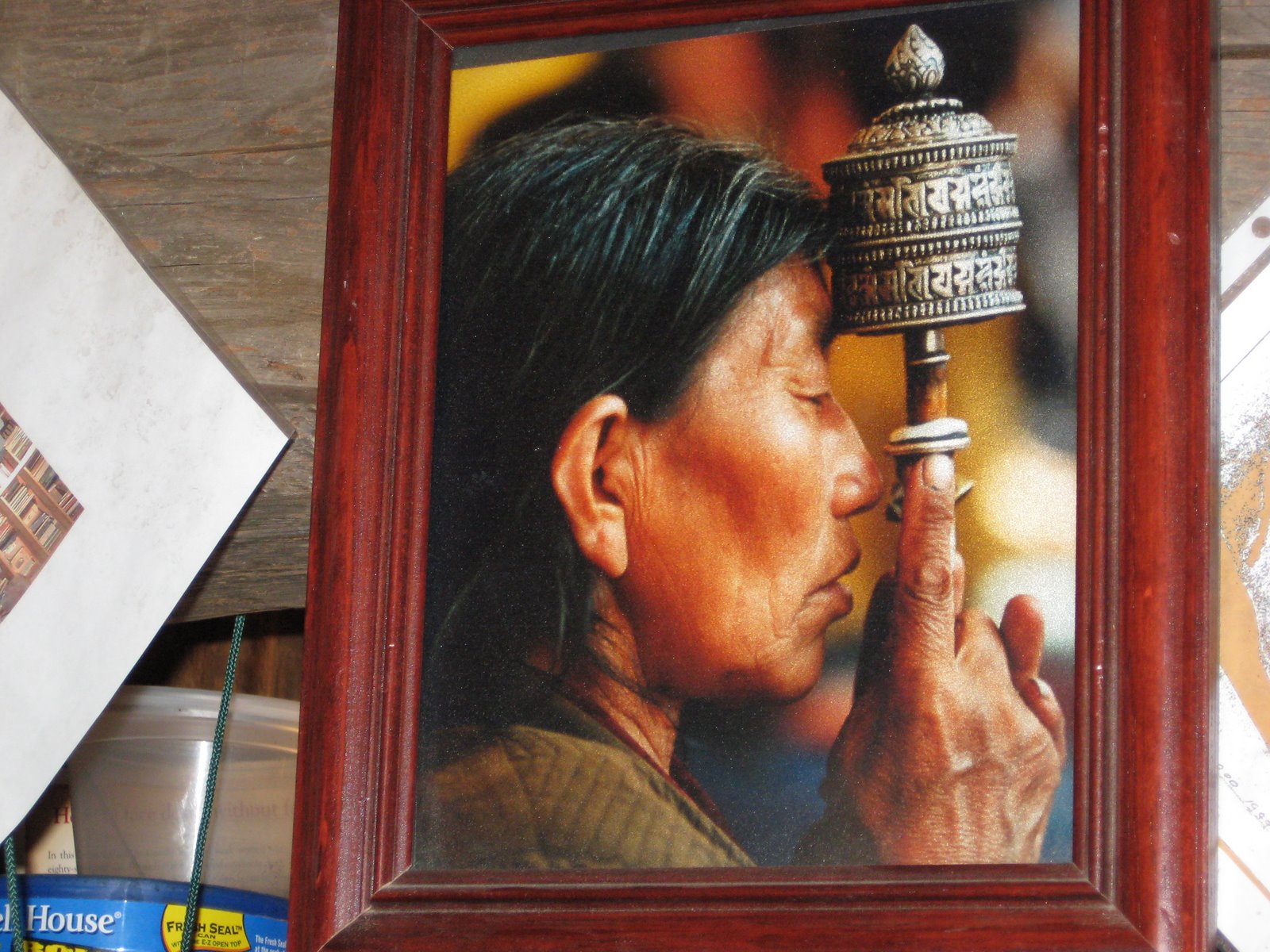
With prayer wheel in hand, someone prays. Someone else is touched by prayer.

Thursday, January 31, 2008

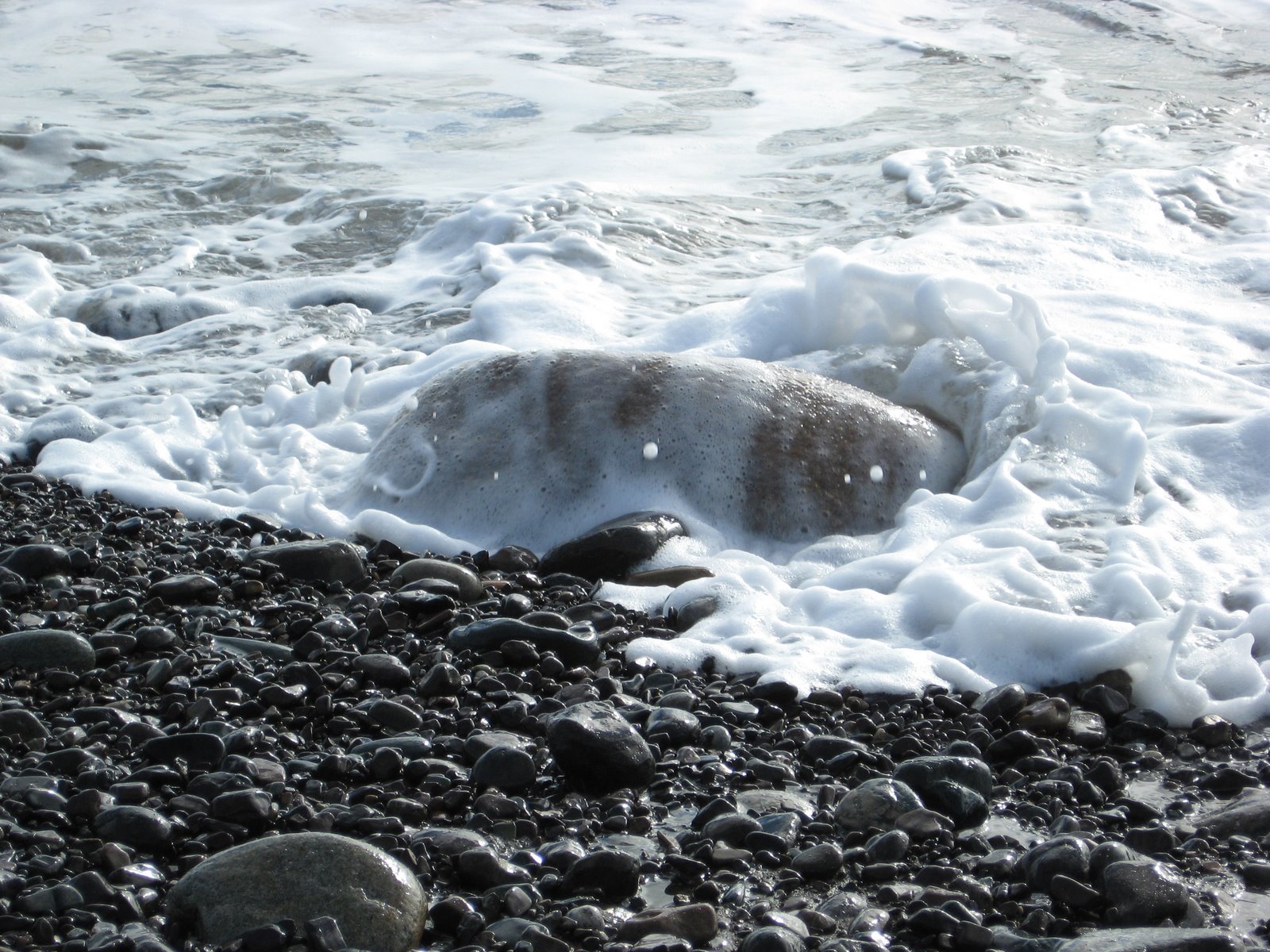
On beach of myriad small stones, a stolid stone seal swirls through rising water.
For all these years, my certain Zen:
Neither I nor the world exist.

The sutras neat within the box,
My staff hooked upon the wall,
I lie at peace in moonlight
Or, hearing water plashing on the rock,
Sit up. None can purchase pleasure such as this:
Spangled across the step-moss, a million coins!
- Ryushu Shutaku (1308–1388)

It is our grace to see swimming stones along end of January on Jasper Beach. A similar grace to that of hearing words of men in prison speak depth of life bursting through the surface.

Sit up.

Take notice.

The prison of popular ignorance is crowded. If there be freedom, release the mind.

Each stone calls out to passing edge of tide -- listen to receding call.
We are poor passing facts,
warned by that to give
each figure in the photograph
his living name.
(--from poem Epilogue, by Robert Lowell)
For now let's say -- brother, sister, friend, father, mother, you and you and you.

A million times each one.
God means movement, not explanation. (--Elie Wiesel)
Seeing pleasure such as this.

Move with care.

Wednesday, January 30, 2008

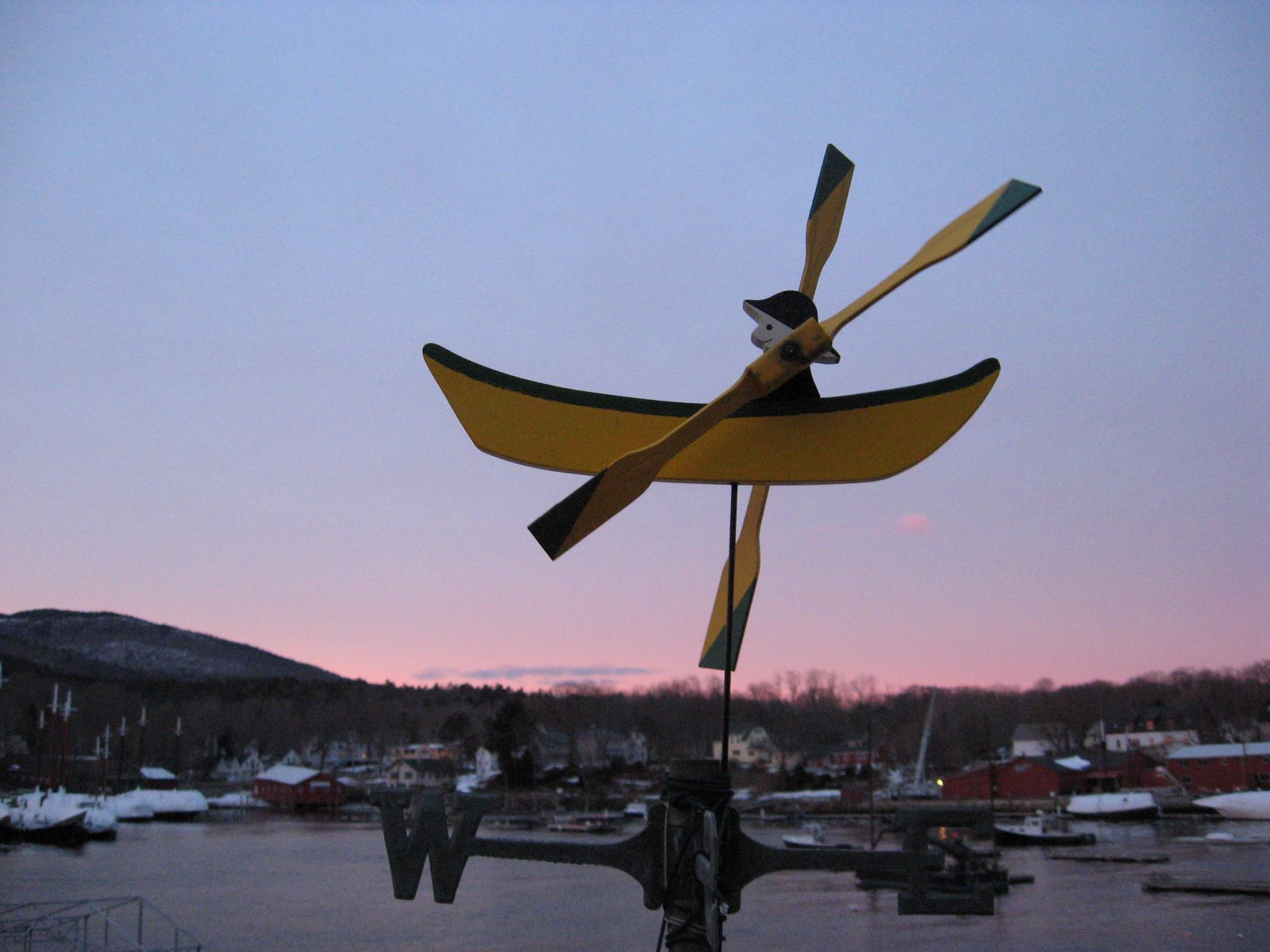
The dory rower has come down from wind vane. He's tired. He's taking a few weeks off.
Those who awaken never rest in one place.
Like swans, they rise and leave the lake.
On the air they rise and fly an invisible course.
Their food is knowledge.
They live on emptiness.
They have seen how to break free.
Who can follow them?
- Buddha in the Dhammapada

Watchng Kieslowski's Red. "Be," the retired judge tells the young woman. She wants to know what else he knows. "Who are you?" she asks.

Right. Who are we? And what are we doing in one another's life?

Rest well.

Tuesday, January 29, 2008

Below Machiasport, Bucks Harbor, the view from FAA parking atop hill begins with enormous radar ball above Downeast Correctional Facility where once an Air Force installation was housed. We have our first Meetingbrook Conversation at the prison there.
This old monk meditates and
Rests in the empty mountains
In loneliness and stillness
Through the days and nights.
When I leave the pure cliffs,
I am distracted by callers
The world of people is first
And always the world of people.
- Seigan Soi (1588-1661)

We take gift of the view. It's not theirs to see. They know there's one there. They encourage us to go see it. It's an odd clarity that sees through others.

People are always people. We have our ways about us.

Good to see faces of friends again. The mere art and practice of conversation.

About enthusiasm, ego, waving energy, ourselves. With the help of Eckhart Tolle.

These days of odd disorder retrieving some clarity.

Monday, January 28, 2008

Maybe there is no stopping.

I'm not saying everything is busy, busy, busy. Just that, maybe, there is no stopping.
The mind of attachment arises from the stopping mind. So does the cycle of transmigration. This stopping becomes the bonds of life and death. Stopping means the mind is being detained by some matter, which may be any matter at all. If there is some thought within the mind, though you listen to the words spoken by another, you will not really be able to hear. This is because your mind has stopped with your own thoughts. When facing a single tree, if you look at a single one of its red leaves, you will not see all the others. When the eye is not set on any one leaf, and you face the tree with nothing at all in mind, any number of leaves are visible to the eye without limit.
- Takuan
Even the Heart Sutra contains the words:
No suffering, no origination,
no stopping, no path, no cognition,
also no attainment with nothing to attain.
Some think meditation is meant to stop thoughts, stop the mind from ushering in thought after thought which we weave into story narrative, jumping on the boat of obsessive replay until we are far down river away from home.

Meditation is meant to help us recognize when we're being carried away by thoughts. It helps to keep us aware of the involuntary departures we make when beckoned by thoughts. This awareness and recognition are gifts of meditation. With them we can return home easier and more quickly.

5 U.S. Soldiers Killed in Iraq, By Richard A. Oppel, Jr., Published: January 29, 2008

BAGHDAD — Five American soldiers were killed in the northern city of Mosul on Monday when militants attacked them with a roadside bomb and then fired on their patrol from a nearby mosque with machine guns, military officials said. The troops returned fire and Iraqi forces raided the mosque, but the gunmen had fled, they said.

It was the second catastrophic attack on United States forces this month, after a house rigged with explosives killed six soldiers in Diyala three weeks ago. The attack underscored the grim situation in Mosul, Iraq's northern hub, which remains a stronghold for Sunni extremist fighters.

In addition, as many as 60 people were killed and 280 wounded in a huge blast in Mosul on Wednesday as Iraqi soldiers entered a building packed with thousands of pounds of explosives. The following day the provincial police chief was assassinated after he visited the site of the blast and an angry crowd of people gathered around him.

Some are taken away suddenly. Taken away and, then, comes grief. The war is still with us. All the distractions of primaries, caucuses, and football championships can only divert those not waiting for phone call or doorbell to sound.


Tonight the President of the United States will deliver his final State of the Union address. Many are pleased it's his last one. I no longer know what to think about the man and the perplexing policies and decisions he's made. I do know my hope we do not see his like anytime soon again.

The war does not stop. The games of sport and games of chance do not stop. The run for the White House does not stop. Our lives, with each breath, however temporary and impermanent, do not stop.

Nor does prayer stop. Nor meditation. Neither does conversation about what kind of person, what kind of world we long to manifest.

Today is the feast of Thomas Aquinas.
St Thomas Aquinas (1225 - 1274)
He was born of a noble family in southern Italy, and was educated by the Benedictines. In the normal course of events he would have joined that order and taken up a position suitable to his rank; but he decided to become a Dominican instead. His family were so scandalised by this disreputable plan that they kidnapped him and kept him prisoner for over a year; but he was more obstinate than they were, and he had his way at last.
He studied in Paris and in Cologne under the great philosopher St Albert the Great. It was a time of great philosophical ferment. The writings of Aristotle, the greatest philosopher of the ancient world, had been newly rediscovered, and were becoming available to people in the West for the first time in a thousand years. Many feared that Aristotelianism was flatly contradictory to Christianity, and the teaching of Aristotle was banned in many universities at this time – the fact that Aristotle’s works were coming to the West from mostly Muslim sources did nothing to help matters.
Into this chaos Thomas brought simple, straightforward sense. Truth cannot contradict truth: if Aristotle (the great, infallible pagan philosopher) appears to contradict Christianity (which we know by faith to be true), then either Aristotle is wrong or the contradiction is in fact illusory. And so Thomas studied, and taught, and argued, and eventually the simple, common-sense philosophy that he worked out brought an end to the controversy. Out of his work came many writings on philosophy and theology, including the Summa Theologiae, a standard textbook for many centuries and still an irreplaceable resource today. Out of his depth of learning came, also, the dazzling poetry of the liturgy for Corpus Christi. And out of his sanctity came the day when, celebrating Mass, he had a vision that, he said, made all his writings seem like so much straw; and he wrote no more.
Let us pray for the Holy Spirit to inspire us, like St Thomas, to love God with our minds as well as our hearts; and if we come across a fact or a teaching that seems to us to contradict our faith, let us not reject it but investigate it: for the truth that it contains can never contradict the truth that is God.

(--from Universalis, http://www.universalis.com/)
Straw. Straw ideas. Straw men. Straw ambition.

I'll listen to that final address. Maybe.

It'll be, with luck, the last straw.

Sunday, January 27, 2008

Whatever happens, the only thing we have any say about is our response to it.
"Absolute perfection is here and now, not in some future, near or far. The secret is in action - here and now. It is your behavior that blinds you to yourself. Disregard whatever you think yourself to be and act as if you were absolutely perfect - whatever your idea of perfection may be. All you need is courage."
(--Nisargadatta Maharaj)

Wandering through this monastery without walls, I greet and bow to so many members of the community.

Handful here, handful there -- monks of no order become monastics of no other.

All on their own.