Monday, January 18, 2010

I'm grateful for Martin Luther King Jr.'s gifts to this culture. I like the fact that he was persistent, courageous, skillful, and flawed. I'm ok with flaws. I've several. Martin Luther King was exactly the way he was, did extraordinary things, and helped diminish the unkindness and blinding prejudice permeating our society and rotting our psyche.
If you break open
The cherry tree,
There is not a single flower.
But the skies of spring
Bring forth the blossoms!

- Ikkyu (1394-1481)
Where is Martin now? If you say, "He's dead," or "He's still alive," you are right, but partially. If you say, "He is in heaven," you are again only partially right. If you suggest, "He's in the ground, nowhere else," you are still only half right.

In the photo on Huffington Post, Martin is linked-arms with Dr. Benjamin Spock on one of the marches, (Eunice Kennedy and Rosie Greer alongside). It occurs to me, in that Ben Spock used to attend silent sittings at our shop the year before his passing, that through his handshake and presence, Saskia and I have been "in touch" with Dr King.

Martin is hic et nunc, here and now: alive/dead, heaven/ground. He's where we least suspect.
In its physical reality there is only the total system; as far as its real operations and structure, all and each of the psychic notes are “of” the organic notes, and each one of the organic notes is a note “of” the psychic notes. Therefore, man does not “have” psyche and organism, but “is” psycho-organic, because neither organism nor psyche, each by itself, has any substantivity; only the system has it. Because of this I think we cannot talk about a psyche without an organism. Let us say in passing, that when Christianity for example, talks about surviving and immortality the one that survives and is immortal is not the soul, but man, that is, the whole human substantivity. Anything else is not of faith. Man is not psyche “and” organism, but rather his psyche is formally and constitutively “psyche-of” this organism, and this organism is formally and constitutively “organism-of” this psyche. The psyche is organic by itself and the organism is psychic by itself. This moment of the “of” is numerically “identical” in the psyche and the organism, furthermore it incorporates a “physical” characteristic. This numerical and physical identity of the “of” is what formally constitutes the systematic unity of human substantivity. It is a structural unity; structure is precisely and formally the unity of an “of” in its notes. Hence, human substantivity {108} is “one” by itself and from itself. The moments of this substantive system codetermine each other, but not as potency and act (as the Aristotelians might put it) of a hylomorphic substantial unity, but as realities in act and ex aequo whose codetermination consists in each being “of” all the rest. The “of” is a unity of the metaphysical type superior to the unity of potency and act. Moreover, in this “of” not only the radical unity of human substantivity consists, but also the very sameness during its entire life, a sameness that is entirely different from the numerical persistence of all the notes, something perfectly inexistent. Consequently, man is a psychorganic substantivity.
(MAN AND HIS BODY, by XAVIER ZUBIRI, From ESCRITOS MENORES (1953-1983), Alianza Editorial, Madrid, 2006, pp. 103-116, (Original article El hombre y su cuerpo, appeared in the journal Asclepio, No. 25, 1973, pp. 9-19), Translated by Joaquín A. Redondo, M.E., M.A. (Phil.) 2008)
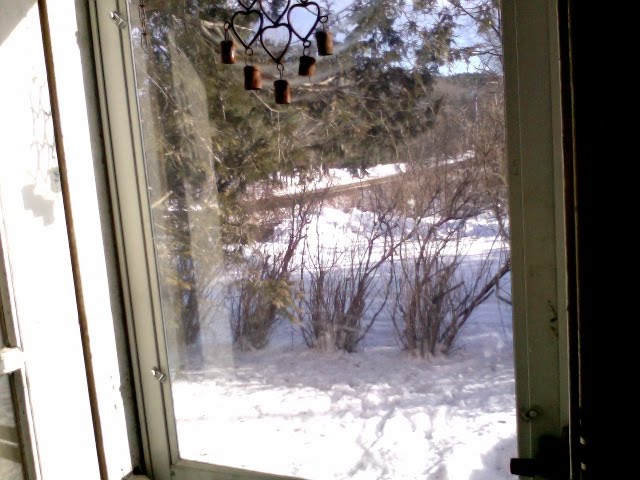
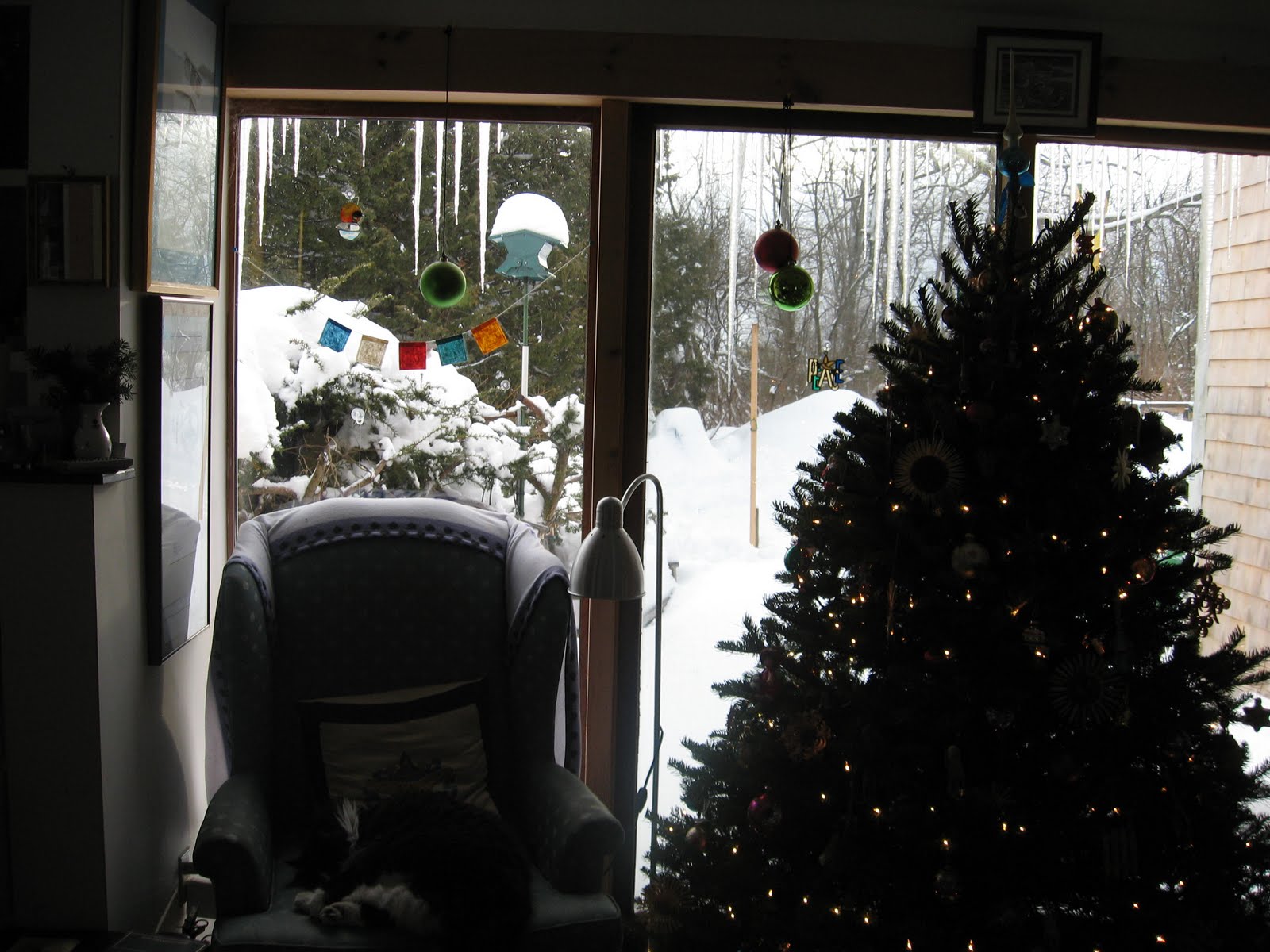
The snow in Maine this morning is light and nearing 4-6 inches. I finish nailing off the wood ceiling on 2nd floor of bookshed. Rokie is relentlessly dropping tennis ball under chair in Wohnkuche. I'm growing adept at tossing it across kitchen up through louvered doors on far upper wall and through to upstairs hallway. It's a necessary skill to occupy the Border Collie. (Oops...I missed. Three for seven now! ... Four for fifteen -- just like my sandlot batting average -- 'adept' was, as usual, inaccurate.)
The Edges Of Time

It is at the edges
that time thins.
Time which had been
dense and viscous
as amber suspending
intentions like bees
unseizes them. A
humming begins,
apparently coming
from stacks of
put–off things or
just in back. A
racket of claims now,
as time flattens. A
glittering fan of things
competing to happen,
brilliant and urgent
as fish when seas
retreat.

(Poem, The Edges of Time, by Kay Ryan)
I climb Tom's ladder to dust blades of overhead fan. It stops wobbling.

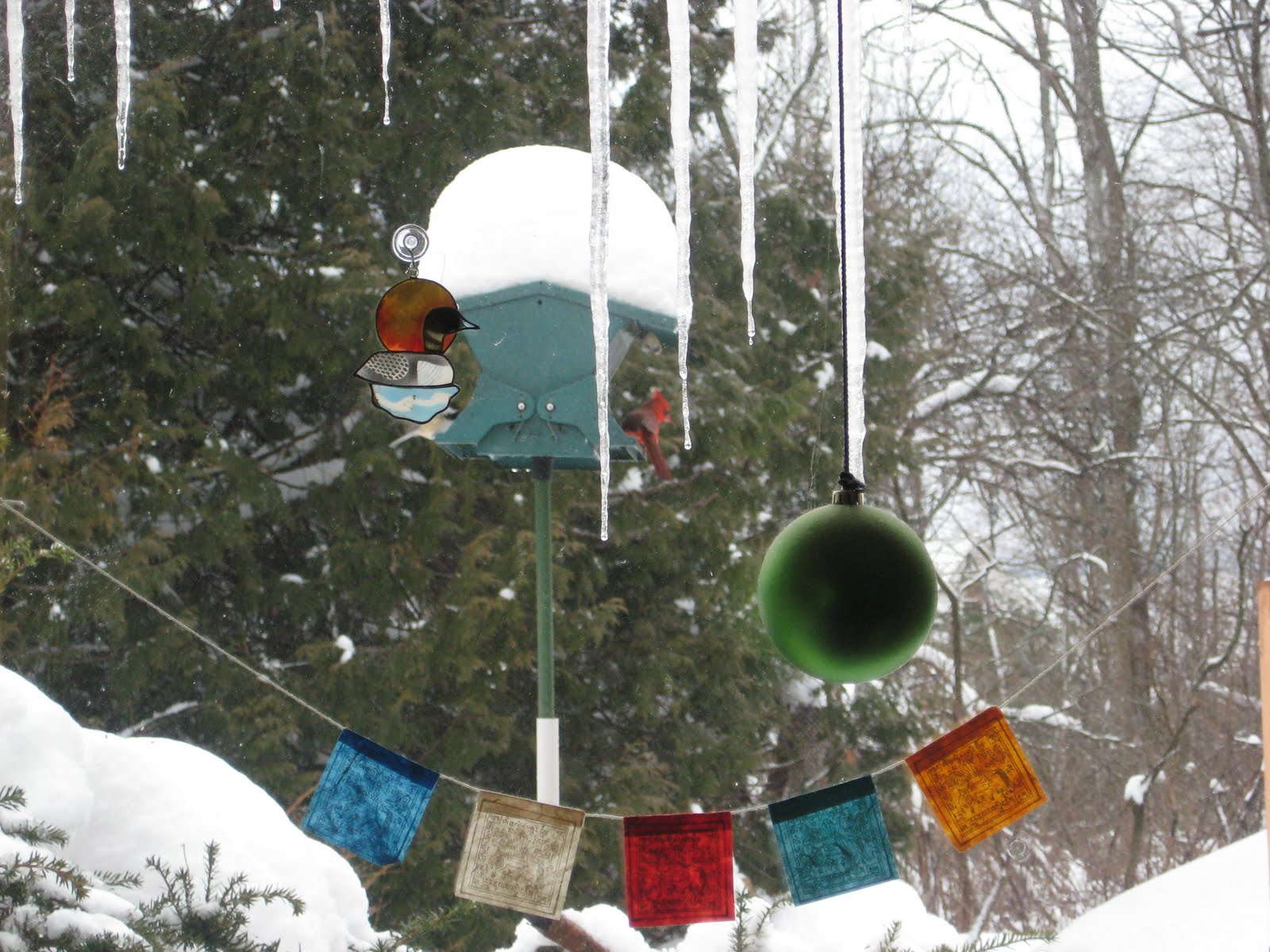
Bald Mountain is serene in white snow across the way. Chickadee take seed. Cape Breton dory rower keeps his back to the wind atop vane. The pain in my head abates. It is all a matter of time and earth.

It is a good pericope for Martin -- "brilliant and urgent."

No retreat!

Sunday, January 17, 2010

I wonder where we think we are? I wonder what we think we are doing here?
No worldly dust in Chongmyung Temple,
Among the clean mountains and streams.
A monk whose hair is turning grey
Lives there, forgetting the din of the world.

-
Daegak Euchon (1055-1101)
It's hard to forget the din of the world, even if some suggest doing so in the name of a disengaging spiritual purity pretending we are not living in this illusory madness called by many "the world." But here we live. I suspect our task is not to blink twice, tap our heels, and set off to a home free from the suffering and chaos of the world, landing in a heavon of transcendence and reward for our cleverness. While here, our task is to be here.
“There are thefts everywhere,” said Joel Querette, 23, a college student camped out at a park near the airport. “People have guns and knives, and they are stealing and looting the stores.”

As night fell, the police brought a man to Pétionville in the back of a pickup and informed a gathering crowd that he had been caught looting in another neighborhood, witnesses said. While the police officers stood by, an angry mob pulled the man from the truck.

The mob stripped the accused looter, then began beating him. They dragged him up the street while pummeling him, then threw him on a trash heap, where he lay vomiting and bleeding.

One man began piling trash on top of him and set it on fire. As the firelight flickered on an art gallery and a church on opposite sides of the street, dozens gathered to watch the man burn to death.

(--from, Looting Flares Where Authority Breaks Down, By SIMON ROMERO and MARC LACEY, Published: January 16, 2010, NY Times)
Does he get beaten and burned to death because he was looting? Or, because some misguided impulse of vigilantly justice says he has transgressed the ethos of earthquake survival wherein you are guiltless until the police say you are bait for the desperation of traumatized frenzy?
Trahison

Ce coeur obsédant, qui ne correspond
Pas à mon langage ou à mes costumes
Et sur lequel mordent, comme un crampon,
Des sentiments d’emprunt et des coutumes
D’Europe, sentez-vous cette souffrance
Et ce désespoir à nul autre égal
D’apprivoiser, avec des mots de France,
Ce coeur qui m’est venu du Sénégal?

—Léon Laleau


Betrayal

This unrelenting heart, whose rhythm suits
Neither my language nor my clothing
And into which bite, like jaws of a trap,
Borrowed sentiments and European
Customs—Do you feel this suffering
This despair unlike any other
Of domesticating, with words from France,
This heart that came to me from Senegal?

( Poem by Léon Laleau (1892-19??) who was a Haitian diplomat, intellectual and poet.)
And then:

Nouveau sermon nègre (extrait)

Ils ont craché sur Ta Face noire

Seigneur, notre ami, notre camarade

Toi qui écartas du visage de la prostituée

Comme un rideau de roseaux ses longs cheveux sur la source de ses larmes

Ils ont fait

les riches les pharisiens les propriétaires fonciers les banquiers

Ils ont fait de l’homme saignant le dieu sanglant

Oh Judas ricane

Oh Judas ricane:

Christ entre deux voleurs comme une flamme déchirée au sommet du monde

Allumait la révolte des esclaves

Mais Christ aujourd’hui est dans la maison des voleurs

Et ses bras déploient dans les cathédrales l’ombre étendue du vautour

Et dans les caves des monastères le prêtre compte les interêts des trente deniers

Et les clochers des églises crachent la mort sur les multitudes affamées

Nous ne leur pardonnerons pas, car ils savent ce qu’ils font

Ils ont lynché John qui organisait le syndicat

Ils l’ont chassé comme un loup hagard avec des chiens à travers bois

Ils l’ont pendu en riant au tronc du vieux sycomore

Non, frères, camarades

Nous ne prierons plus

Notre révolte s’élève comme le cri de l’oiseau de tempête au-dessus du clapotement pourri des marécages

Nous ne chanterons plus les tristes spirituals désespérés

Un autre chant jaillit de nos gorges

Nous déployons nos rouges drapeaux

Tachés du sang de nos justes

Sous ce signe nous marcherons

Sous ce signe nous marchons

Debout les damnés de la terre

Debout les forçats de la faim.

—Jacques Roumain


A New Black Sermon (excerpt)

They have spit on the blackness of Your Face,

Lord, our friend, our comrade,

You who parted the locks of the prostitute's face

Like a curtain of reeds covering the spring of her tears

They have made

the rich the pharisees the landowners the bankers

They have made of the bleeding man the bloodthirsty god

Oh, Judas, laugh,

Oh, Judas, laugh,

Christ between two thieves like a torn flame at the height of the world

Set fire to the slaves' revolt

But Christ is today in the house of the thieves

And his arms spread out like the vast wings of a vulture in the cathedrals

And the priest in the monastery's winecellar counts the interest on thirty pieces of silver

And the church steeples spit death onto the famished multitudes

We will not pardon them, for they know what they do

They have lynched John who organized the trade union

They hunted him with dogs like a weary wolf in the woods

Laughing they hung him from the old sycamore's trunk

No, brothers, comrades,

We will pray no more

Our revolt rises up like the cry of the storm bird over the lapping waters of the stinking swamps

We will no longer sing our despairing spirituals

A different song springs from our mouth

We will spread our red flags

Stained with the blood of our just

Under this banner we will march

Under this banner we are marching

Arise ye wretched of the earth

Arise ye prisoners of starvation

Jacques Roumain (1907-1944) was a Haitian intellectual and author. As a founder of the Haitian Communist Party, he was imprisoned early in his career for his political activities, then became active in the government after the end of the American occupation of Haiti
(--from, Oregon Literary Review, Vol. 2, No.1, Winter/Spring 2007)
The belly of the Mother known as Earth has shaken loose the world's attention on a small, very poor, island to the southeast of Guantanamo, Cuba, and attached to the Dominican Republic.
The two small nations are linked by geography and destiny. They share the island of Hispaniola and have similar histories of tyrannical governments and foreign invasions.

Yet a gulf of historical resentment and prejudice divides them. Even today, Haiti's occupation of Santo Domingo during the 19th century is still a source of mistrust.

But after the apocalyptic devastation and death inflicted on Haiti by the quake, the historical mistrust has given way among many Dominicans - both on the island and in New York - to an overwhelming sense of pained solidarity.

"We are family; we are brothers and sisters. We live side by side," a middle-aged Dominican woman in Washington Heights told Univision, the Spanish language TV network. "We have to lend a hand, to help in any way we can."
...
Although Dominican President Leonel Fernández has offered aid to Haiti, his military has been sent to the border to halt desperate refugees from crossing.

(--from, Earthquake closes gulf between Haiti and Dominican Republic, ALBOR RUIZ - NY LOCAL, Sunday, January 17th 2010, 4:00 AM, NY Daily News, 17Jan2010)
A televangelist fundamentalist preacher, Pat Robinson, has suggested the suffering and earthquake was a result of "a pact with the devil" made by Haiti to get free from France, the colonial power of the time. It could be the ramblings of demented belief.
The native leader Jean-Jacques Dessalines – long an ally and general of Toussaint l'Ouverture – defeated French troops led by Donatien-Marie-Joseph de Vimeur, vicomte de Rochambeau, at the Battle of Vertières. At the end of the double battle for emancipation and independence, former slaves proclaimed the independence of Saint-Domingue on 1 January 1804,[20] declaring the new nation be named Haïti, to honor one of the indigenous Taíno names for the island. Haiti is the only nation born of a slave revolt. [14] Historians have estimated the slave rebellion resulted in the death of 100,000 blacks and 24,000 of the 40,000 white colonists.
(--from Wikipedia, Haiti)
We sometimes don't know what we are saying or doing nor why we say or do it.

I grieve this ignorance.

I grieve the man burned to death in a street between a church and an art gallery. And all who suffer the shaking earth.

Enter the heart.

Dispel false notions.

Oremus pro invicem -- which translates, Let us pray for each other.
The Zen Master said, "Just like this," when asked for a definition of truth.

The poet places it here:
Seeker of Truth
seeker of truth

follow no path
all paths lead where

truth is here
(Poem by E.E. Cummings)

It's late. And dark.

There are, however, quiet illuminations. Scratches like guest animal/rodent in walls.

Like truth.

For the time/being

So it is.

Friday, January 15, 2010

Either way. Whether perception is projection, or projection is perception, it is our choice what we see.
Enlightenment Song

Every green mountain is the
Cave of Amitabha Buddha
And the boundless sea is the
Palace of nirvana.

- Master Wonhyo (617-686)
"I'm glad you choose to see me the way you do." (Walter to Peter in episode of "Fringe" on Fox TV).

No thinking.

Only looking.

New moon.

Thursday, January 14, 2010

Walking frozen pond. Hammering ceiling boards in place. Teaching nothing I know.
"The language used by Zen is therefore in some sense an antilanguage, and the “logic” of Zen is a radical reversal of philosophical logic. The human dilemma of communication is that we cannot communicate ordinarily without words and signs, but even ordinary experience tends to be falsified by our habits of verbalization and rationalization. The convenient tools of language enable us to decide beforehand what we think things mean, and tempt us all too easily to see things only in a way that fits our logical preconceptions and our verbal formulas. Instead of seeing things and facts as they are we see them as reflections and verifications of the sentences we have previously made up in our minds. We quickly forget how to simply see things and substitute our words and our formulas for the things themselves, manipulating facts so that we see only what conveniently fits our prejudices. Zen uses language against itself to blast out these preconceptions and to destroy the specious “reality” in our minds so that we can see directly. Zen is saying, as Wittgenstein said, “Don’t think: Look!”"
-Thomas Merton, Zen and the Birds of Appetite, pp. 48-49
No system of thought suffices. Only experience.

Thinking is not thought. Thinking is seeing.

Look here.

Wednesday, January 13, 2010

We sorrow with Haiti.

Monday, January 11, 2010

There's nothing to say.

So, I'll say it.

Saturday, January 09, 2010

Things remain invisible until they are asked into sight. So too does data remain invisible until the right question organizes it into visibility. When you need help, ask for it -- and take what comes as the help made available.

At dusk, snowshoeing Hosmer Pond in stiff cold wind. My left heel and right elbow are in pain.

I know a question looms.

Thursday, January 07, 2010

A Barquentine came into port last summer. I had a birthday. Two nice people each gave me a cup from the vessel.

The body of Buddha is everywhere,
Does the Goddess of Mercy live in the eastern sea?
Every green mountain is a place of awakening;
Why must you seek Mount Potalaka?

- Paegun (1299-1375)
There's no place to go where we are not. Each place, each sound, is replete with fullness.

Potalaka, Mount

[(Skt; Jpn Fudaraku-sen)

A mountain said to be located on the southern coast of India, regarded as the home of Bodhisattva Perceiver of the World's Sounds. According to the Flower Garland Sutra, the boy Good Treasures, who was traveling in search of the Law, encountered Bodhisattva Perceiver of the World's Sounds on this mountain.

(From Soka Gakkai International (SGI) website)
Someone suggested at last evening's conversation that, unlike me, they were interested in more than the physical sensory things that were there in the room. They might be right. I suggested, after mulling this, that the distinction between physical and spiritual no longer interested me. That the versions of reality some call past, present, and future no longer seemed compelling. And that words like "levels" "hierarchy" and "more evolved" were not something I thought applied -- at least to my way of looking at things. It was good conversation.
A Stone Is Nobody's
A man ambushed a stone. Caught it. Made it a prisoner.
Put it in a dark room and stood guard over it for the
rest of his life.

His mother asked why.

He said, because it's held captive, because it is
captured.

Look, the stone is asleep, she said, it does not know
whether it's in a garden or not. Eternity and the stone
are mother and daughter; it is you who are getting old.
The stone is only sleeping.

But I caught it, mother, it is mine by conquest, he said.

A stone is nobody's, not even its own. It is you who are
conquered; you are minding the prisoner, which is yourself,
because you are afraid to go out, she said.

Yes yes, I am afraid, because you have never loved me,
he said.

Which is true, because you have always been to me as
the stone is to you, she said.

(Poem by Russell Edson, b.1935)
I'm sure I must have been lying. If you cannot tell the whole truth, is part of the truth any benefit? And do we have only versions of truth and not truth itself? Is the opposite of what we say or think also equally true?

There's a final push to finish the bookshed. Saskia and I work into the night installing fiberglass insulation. Then up before dawn, do silent sitting, then out to insert more panels. I withdraw when two workmen and one volunteer arrive. I cannot, it seems, work well with others. It is something I have to either accept, forgive, or celebrate -- perhaps all three at once.
Antimatter
On the other side of a mirror there's an inverse world,
where the insane go sane; where bones climb out of the
earth and recede to the first slime of love.

And in the evening the sun is just rising.

Lovers cry because they are a day younger, and soon
childhood robs them of their pleasure.

In such a world there is much sadness which, of course,
is joy.

(Poem by Russell Edson)
Maybe it's true that what I hold as true is that everything is here, everything is in everything, and that the opposite is equally true.

The mystery is that what we call reality tumbles out of nothing and, like a round carpet suddenly on the floor before you, situates itself as it is as ground until, you, turning in another direction, see two books -- say "Original Blessing" by Fox and "The Solitary Self" by Georgianna on a shelf under "Readings in Anthropology" and "Philosophy for a New Generation" and a book of poems by Haas entitled "Praise" -- whereupon the cat decides it is time to groom himself on the bed by blue, white, and red throw pillow. Not only that -- but it all can be, and is, different from what I describe. The mystery is that anything is communicable with any kind of intelligibility -- held in common, with shared intention, for benefit of anyone or everyone.

Like monks at dawn at prayer.

Like the intention of peace. Or kindness. Compassion.

Or even allowing another their sight, their version, their attempt to find a way of being that mirrors itself with love.

Wednesday, January 06, 2010

Epiphany means manifestation.

What was manifested in the story of Jesus? What was recognized as great gift in the land of Palestine?

What, today, shows itself in our life-situation? Isn't that equally the feast we come to revere?

The Void is fundamentally without spatial dimensions, passions, activities, delusions or right understanding. You must clearly understand that in it there are no things, no people and no Buddhas; for this Void contains not the smallest hairsbreadth of anything that can be viewed spatially; it depends on nothing and is attached to nothing. It is all-pervading, spotless beauty; it is the self-existent and uncreated Absolute. A perception, sudden as blinking, that subject and object are one, will lead to a deeply mysterious wordless understanding; and by this understanding will you awake to the truth of Zen.

(--from Transmission of Mind, by Huang-po, d.850)


We go out to see what we can see. We stay in looking at what there is to see. Isn't it strange -- traveling far to try to see what it is you carry in your heart?

Life, as we experience it here and now, is impermanent. But life itself -- what of it?


The Manifestation


Many arrivals make us live: the tree becoming

Green, a bird tipping the topmost bough,

A seed pushing itself beyond itself,

The mole making its way through darkest ground,

The worm, intrepid scholar of the soil--

Do these analogies perplex? A sky with clouds,

The motion of the moon, and waves at play,

A sea-wind pausing in a summer tree.


What does what it should do needs nothing more.

The body moves, though slowly, toward desire.

We come to something without knowing why.

(--Poem, "The Manifestation" by Theodore Roethke)


To be a hermit today is to be quietly present and aware of the ways yourself and others attempt to crowd and control emotions, thoughts, and actions. Do not be deceived. The only ground is, for now, underfoot. And it, too, is slippery.
Snow: I

All night, snow, then, near dawn, freezing rain, so that by morn-

ing the whole city glistens

in a glaze of high-pitched, meticulously polished brilliance, every-

thing rounded off,

the cars submerged nearly to their windows in the unbroken drifts

lining the narrow alleys,

the buildings rising from the trunklike integuments the wind has

molded against them.

Underlit clouds, blurred, violet bars, the rearguard of the storm,

still hang in the east,

immobile over the flat river basin of the Delaware; beyond them,

nothing, the washed sky,

one vivid wisp of pale smoke rising waveringly but emphatically

into the brilliant ether.

No one is out yet but Catherine, who closes the door behind her

and starts up the street.

(--Poem, "SNOW: I" by C.K. Williams, from Love About Love. Ausable Press, 2001.)

It is good to see Catherine making her way -- wherever she is going.

At end of reading for feast of Epiphany is the phrase: "...and returned to their own country by a different way." They'd seen what they came to see.

Now, because those in authority and power want us to see what they want us to see, there's a need to sidestep their official roads so as to honor what each has seen and experienced within their own looking.

These days my return home seems to be by a different path. The walled church feels claustrophobic. Proscribed statements and historical fastness of narrative feels moribund. Contemporary concerns and current investigations seem out of sync and range of the traditional institutions no matter how they stretch forward.

Many arrivals do make us live. And we do come to something without knowing why.

For now, to be here, on one's own, seems sufficient.

It is Epiphany!

May it be a moment of sudden revelation or insight!

Tuesday, January 05, 2010

The wise, they say, find truth.
Night Rain

For no reason it rains,
Whispers of reality.
How lovely it sings,
Drop by drop.
Sitting and lying I listen
With emptied mind.
I don't need ears,
I don't need rain.

- Chin'gak (1178-1234)
Epiphany opens questions and reveals inner core.

At center, it is care.

And gentleness.

Shows itself.

Monday, January 04, 2010

Watched "Food Inc" the film directed by Robert Kenner, with Michael Pollan and Eric Schlosser adding sage words and commentary. It is about agriculture in USA this half century, the food we eat, the costs to environment, workers, and the consuming public. It is a sobering look.
I didn't know the way to the temple
So I walked miles
Among the cloudy peaks
Walked through primeval forests
No path
Not even a footprint
Deep in the mountains
I heard a bell
Where did it come from?
Then a little stream
Gurgling
Among gigantic rocks
Even the color of sunlight
Looks cool
Coming through bluegreen pines
At dusk I knelt
Next to a small
Deserted lake
Meditating
To chase away
The poison dragon of emotion.

- Wang Wei
It is hard to not feel the big boys with big sticks are coming around the corner of the street, nay, the kitchen door, where we live. It's hard to listen to and watch the way certain companies operate with their monopolized genetically engineered product and take-no-prisonor target-independent-farmer legal teams.

It's cold today in Maine. But the chill of cutthroat food production compounds and corporations goes deep to the bone.

In looking for poems to bring to the nursing home New Year's Day I found Rachel Wetzsteon.

Commands for the End of Summer

i.

Deepen,
leaves, not with what
has made us sorry but
with what was profound about that
sorrow.

ii.

Make me
spontaneous,
gathering winds, but don’t
blow so giddily I teeter
too much.

iii.

Songs I
listened to all
summer long, accept my
thanks: to regress is not to move
backward.

iv.

Splash of
patchouli on
my wrist, remind me that
in this cauldron there is a world
elsewhere.

v.

Smile! Those
days of humid
agony have earned you
the right to a hundred purple
sunsets.

vi.

Come, fall,
I can feel you
stirring, I can hardly
wait for the things that will happen
come fall.

(--Poem by Rachel Wetzsteon)

She'd just become poetry editor of The New Republic last fall. She died ten days ago. Her death was by suicide on the 24/25th of December. She was 42.
Short Ode to Morningside Heights

Convergence of worlds, old stomping ground,
comfort me in my dark apartment
when my latest complaint shrinks my focus
to a point so small its hugely present
but barely there, and I fill the air
with all the spiteful words I spared the streets.

The pastry shop’s abuzz
with crazy George and filthy graffiti,
but the peacocks are strutting across the way
and the sumptuous cathedral gives
the open-air banter a reason to deepen:
build structures inside the mind, it tells
the languorous talkers, to rival the ones outside!

Things are and are not solid.
As Opera Night starts at Caffe Taci,
shapes hurry home with little red bags,
but do they watch the movies they hold
or do they forego movies for rooftops
where they catch Low’s floating dome in the act
of always being about to fly away?

Ranters, racers, help me remember
that the moon-faced fountain’s the work of many hands,
that people linger at Toast long after we’ve left.
And as two parks frame the neighborhood—
green framing gray and space calming clamor—
be for me, well-worn streets, a context
I can’t help carrying home, a night fugue
streaming over my one-note how, when, why.
Be the rain for my barren indoor cry.
(--Poem by Rachel Wetzsteon, found on The New Republic's website)
Parker Palmer writes that
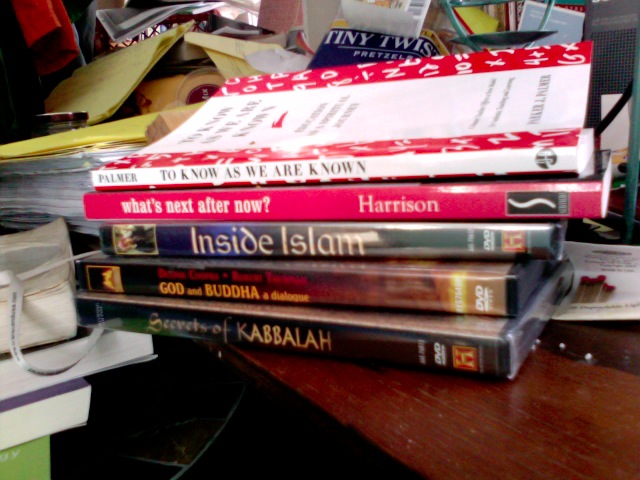
"...real learning does not happen until students are brought into relationship with the teacher, with each other, and with the subject.We cannot learn deeply and well until a community of learning is created in the classroom. (p.xvi Preface, of To Know As We Are Known, Education as a Spiritual Journey.)
When we lose soldiers, poets, workers, or anyone to the intentional or accidental vicissitudes of earthen life, we pause and contemplate for a brief while. We say a prayer. We wish them well on their journey. We've been community. It's a new classroom of shared life we all attend. We feel what takes place.

The breath of words about life and the touch of hands throughout our lives. How many hands have you touched? How many words have you shared? How many times have you stood still and gazed as words fell silent and hands dropped to sides?

I let Nikos Kazantzakis conclude:
Since we cannot change reality, let us change the eyes which see reality.
And:

The real meaning of enlightenment is to gaze with undimmed eyes on all darkness.
(--Nikos Kazantzakis)
I squint. And wince.

Sunday, January 03, 2010

It's not hard to love -- it's what you are.

What's hard is accepting who you are. For so long there have been words like those of Paul's. We've heard only the first part of his paragragh. We're so deluged by misemphasis and misdirection, we do not hear the final sentence -- which is primary:
You must kill everything in you that belongs only to earthly life: fornication, impurity, guilty passion, evil desires and especially greed, which is the same thing as worshipping a false god; all this is the sort of behaviour that makes God angry. And it is the way in which you used to live when you were surrounded by people doing the same thing, but now you, of all people, must give all these things up: getting angry, being bad-tempered, spitefulness, abusive language and dirty talk; and never tell each other lies. You have stripped off your old behaviour with your old self, and you have put on a new self which will progress towards true knowledge the more it is renewed in the image of its creator; and in that image there is no room for distinction between Greek and Jew, between the circumcised or the uncircumcised, or between barbarian and Scythian, slave and free man. There is only Christ: he is everything and he is in everything. (--from Colossians 3:5-16 )
Like a koan asking: "What is in everything?" Like a mirroring with: "What is everything in?" We find the moment sufficient with response -- every moment is sufficient as response. How can anyone claim their prayer not answered? Each moment, with whatever it brings, is answer.
Like the Sun

Cut down being and nonbeing
The All enfolds.
A dot of Buddha nature-
It shines like the sun.
You may grasp it right away
But can't escape a stick.
How can you then sit idly
And have a moment to think? -- Chin'gak (1178-1234)
After snowfall, birds come to feed; icicles drip daylight to white covering.

After a time of darkness, light begins ascent each morning, each season, each person's intimate and immediate life.
You are told “Love God”. If you say to me “Show me whom I should love”, what can I say except what John says? 'No man has ever seen God.' But you must not think yourself wholly unsuited to seeing God: 'God is love,' says John, 'and whoever dwells in love dwells in God.' So love whoever is nearest to you and look inside you to see where that love is coming from: thus, as far as you are capable, you will see God.
So start to love your neighbour. 'Share your bread with the hungry, bring the homeless pauper into your house. Clothe the naked, and do not despise the servants of your kin.'
What will you get from doing all this? 'Your light will break forth like the dawn.' Your light is your God, your dawn, because he will come to you to end the night of this world — he who, himself, neither rises nor sets but is eternal.
By loving your neighbour, by having care for your neighbour, you are travelling on a journey. Where are you journeying, except to the Lord God, whom we must love with all our heart and all our soul and all our mind? We have not yet reached the Lord, but our neighbour is with us already. So support your neighbour, who is travelling with you, so that you may reach him with whom you long to dwell.

(-from St Augustine's tractates on St John, Office of Readings, 3Jan2010)
I love you!

However reluctant I am to say it.

I love you -- without and within "I" and "you." How is that possible?

Answer me this!

Saturday, January 02, 2010

Light caught in snowflakes.
Bless the Lord, my soul!
Lord, my God, how great you are!
You are robed in majesty and splendour;
you are wrapped in light as in a cloak.
(-- from Psalm 103)
No form of itself. Wrapped in light.

As in.

Hence, God is in-visible of itself.
Q: What is called dhyana?
R: Dhyana is concentration. As it is achievable in sitting, so it is called dhyana.
Q:When dhyana is called concentration, does it mean the concentration of mind or body?
R: Sitting cross legged concentrates the body, mental controlling concentrates the mind.
Q: The mind is formless, how can it be looked upon and be controlled?
R: It is like wind having no form of itself; one can determine it through the wavering of things. Likewise, the mind is formless, but it is immediately knowable when it contacts things. When the mind is controlled and ceases contact, it is called concentration.
Q: Five Stops on 18 realms are called concentration. When the eyes see material objects and the mind experiences mental objects, how can this be called concentration?
R: The mind arises when objects are seen, and things waver when wind blows. When wind stops, objects will be peaceful; and when objects vanish, the mind will rest. When the mind and objects are all vanished concentration and peace will be achieved spontaneously.

- The Tun-huang manuscript Seng-ch’ou ( 480-560)
Theres no need to talk about God.

Here is enough. In fact, here is all there is.


So it is we listen. With silence. And stillness. Sounding itself.

Friday, January 01, 2010

Everything always is in conversation with everything else.

We're just not paying attention.

When we do become aware, the conversation becomes vital.

Listen.

Carefully.

Deeply.
It's a new year. Let's begin again!