red sky morning light
neighbor throws firewood in truck
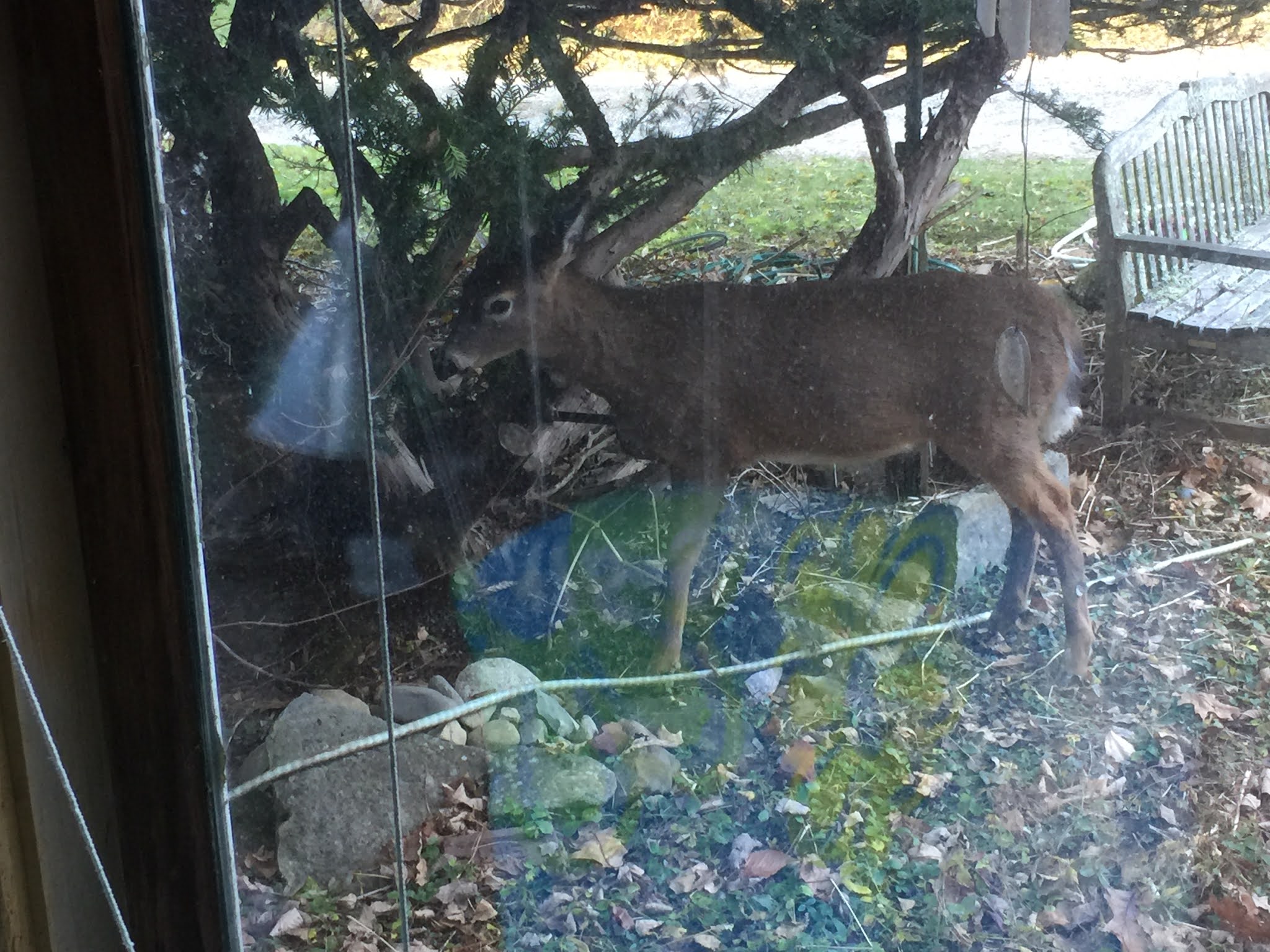
deer hide one more day —
everything now slow pace —
world becomes monastery

red sky morning light
neighbor throws firewood in truck
deer hide one more day —
everything now slow pace —
world becomes monastery

At my Thursday post


Thanksgiving volunteer
With gratitude

It has to do with corporeality, not spirituality.
Any gratitude is embodied realization.
It is characteristic that John twice employs the expression “he gave thanks”(6:11,23) instead of the verb “blessed” (Mark 6:41) in the account of the miracleof the feeding of the five thousand, thus probably alluding to early Christian interpretations of the communal meal as thanksgiving (εὐχαριστεῖν). This miraculous feeding story also has a striking ecclesiological background as well as literal and motivic affinities to the Pauline and Lucan traditions of the Lord's Supper. John uses the same verbs [λαμβάνειν, εὐχαριστεῖν, (δια)-διδόναι] and the noun bread (ἄρτος) that occur in the relevant Pauline and Lucan Texts. There are also etymologically (κλᾶν/κλάσμα) or semantically (σῶμα/σάρξ) related terms which link not only the miracle of feeding the five thousand but also the Bread of Life speech (v. 51) with very early traditions regarding Christological interpretation of the communal meal…
(—The Philosophical-Religious Hybridity in John 6 and Its Reception in the Commentaries of Origen and John, by Athanasios Despotis, Academia)
Do not be mistaken.
Bread, water, body, reality.
I read this twice.
Then a third time.
[I]n nature nothing exists alone.
-- Rachel Carson, Silent Spring (1962)
It feels true.
A phrasing that turns, dances, then sits down beside you, as though nothing else matters, nothing more true.
When you think about it —
Man becomes what he believes himself to be. Abandon all ideas about yourself and you will find yourself to be the pure witness, beyond all that can happen to the body or mind.
—Nisargadatta Maharaj
There’s not that much worth thinking about.
Except what is actually here.
Sardiner backs away from berth, turns in empty harbor, half speed ahead crossing sun-splotched water and disappears behind USCGC Abbie Burgess at Coast Guard station at end of Tillson Ave in Rockland.
“Who needs a master’s degree to boil water?” (-line in Colum McCann novel)
Captain of Kingfisher (1243750) sprays down deck of lobster boat as she drifts and turns in float-stripped marina.
No degree needed to haul catch or lift boat to the hard in late November.
Nor to sit and watch what wharf and tide let come before you.
In a nutshell.
We are finding it is nearly impossible to heal isolated individuals inside of a culture as unhealthy and unhealed as the USA, and inside any version of Christianity that supports exclusion and superiority. Individuals who remain inside of an incoherent and unsafe universe soon fall back into anger, fear, and narcissism. I sadly say this after 46 years of giving retreats, conferences, and initiation rites all over the world. Only people who went on to develop a contemplative mind could finally grow and benefit from the message that they heard.
(—from Richard Rohr email, A Great Story, 23nov21)
Our small story.
Looking to see from where it fell.
Standing one either side of fence surrounding tennis court at snow bowl, neighbor and I talk about Emmet Fox and Thomas Aquinas about this very topic found in quote after coming home.
Emptiness is effectively
the absence of you.
And where there is
the absence of ‘you’,
there shines
the presence of God.
(~ Mooji)
My neighbor was quoting someone (Emmet Fox) saying “the only real presence is God — all the rest is but shadow.”
Good fences make good neighborly conversation.
Don’t stop.
Nothing stops you from being a Gnani here and now, except fear. You are afraid of being impersonal, of impersonal being It is all quite simple. Turn away from your desires and fears and from the thoughts they create and you are at once in your natural state
(-- Nisargadatta)
It is naturally true.
"I hope more and more to become a person who can live in the world as it is, whatever that is. That’s what I hope for.” (—Elizabeth Gilbert)
To dwell where you are in the world as it is.
Where hope bows and gives everything over to surrender.
Feast of Cecilia
With gratitude to Gounod —
Death of Kennedy
Her crime, burying martyrs
Ours, years ago in Dallas
Married Love
(by Kathleen Flenniken)
All of them are dead now. My father
and mother, bedded together
under their matching stones.
Their married friends, close by.
The crystal and good plates all washed
and put away in other homes,
no party food left over. My job
was to whip the cream for dessert
and ride behind on their fishing weekends
like a seventh wheel,
along with our Airedale who wore
striped socks over his muddy paws
in the house. Spirits accelerated
toward cocktail hour in the red
ranch kitchen where they made
big to-do’s over their drinks—
then feigned concern they might
corrupt me. The men stirred
the air, clustered at the bar, moved
among the women conferring
over the bubbling stew.
My mother, flushed and pretty
as a cornucopia of summer fruit.
That September before college
I joined the happy group
on a fly-fishing river in Montana
and slept on the cottage’s foldout couch.
Late one evening, lights doused,
I was alone with Mother and one
of the men, not quite uncle
not quite friend though I newly
recognized that he was handsome.
I’ve erased whatever he said
that convinced me he’d forgotten
I was there. But there I was, afraid
to breathe, confused to learn
how delicately balanced
these practitioners of marriage must be.
Then they retired to their separate rooms,
though a presence hung in the air
like perfume.
Ler me show you the door.
Like breath, it is your constant passage.
How, then, do we live? Liz reflects on what it means to be entirely present to what’s happening. Speaking about hope, she’s cautious, aware that while many people who loved Rayya hoped — even until the last days — that she’d make a recovery, sometimes that hope got in the way of being present to the arrival of death.
“I hope more and more to become a person who can live in the world as it is,” Liz says, noting that the world as it is can be a tough place to be. It requires practice to maintain this presence. One of the practices that’s sustained her has been to write a letter to love. While it’s something she’s done on and off for many years, she’s come to it more particularly as a daily practice in the last few years. Writing to love helps her imagine how love would write back to her, and it keeps her attention on what’s happening in the day. In this way, writing, imagination, reality, reflection, and listening are all part of being present to her life. “Writing was my first prayer,” she says, reminding us of how writing — perhaps especially the form of a letter — is a powerful way to access what’s deep in us.
(—from Pádraig Ó Tuama’s Saturday email, The Pause, 20nov21, On Being, re conversation, Pico Iyer and Elizabeth Gilbert, The Future of Hope 3)
Breath doesn’t judge; it notices.
Sometimes, most times, we do not remember our passing through.
The words.
The novelist.
Oh, the day Joshua first shaved! Oh, the day! Covered himself with foam. So very careful with the razor. Made an avenue through the cheek, but nicked himself on the neck. Tore off a tiny piece of his Daddy's Wall Street Journal. Licked it and pasted it to the wound. The business page clotting his blood. Walked around with the paper on his neck for an hour. He had to wet it to get it off. She had stood at the bathroom door, smiling. My big tall boy, shaving. Long ago, long ago. The simple things come back to us. They rest for a moment by our ribcages then suddenly reach in and twist our hearts a notch backward.
No newspapers big enough to paste him back together in Saigon.
She takes another long haul, lets the smoke settle in her lungs -- she has heard somewhere that cigarettes are good for grief. One long drag and you forget how to cry. The body too busy dealing with the poison. No wonder they gave them out free to the soldiers. Lucky Strikes.
(p.81, in novel, Let The Great World Spin, by Colum McCann)
Scraps of paper.
The art of it.
I surrender.
Surrender is the strongest, most subversive thing you can do in this world. It takes strength to admit you are weak, bravery to show you are vulnerable, courage to ask for help. It’s also not a one-time gig; you don’t just do it once and move on. It’s a way of existing, a balancing act. For me, it looks like this: I pick up the baton and I run as far as I can, and I hand it over when I’m out of breath. Or actually maybe it’s like: I’m running with the baton, but the Universe is holding on to the other half of it, and we have an agreement that I’ll figure out the parts I can and hand over the parts I can’t.
Until you move to the sense of being able to trust there is a God who is guiding you, who loves you more than you love yourself—that's when you've made the transfer. That's when you know you're a part of a bigger flow, a bigger system—if you want to use that word—and you are not doing it, it is being done unto you. [2]
(—Holly Whitaker, The Power of Surrender, Richard Rohr’s Daily Meditation)
A condition of no conditions.
1.
Yes, people can be sh*ts.
2.
People in the House and Senate can be s*its.
3.
There’s no accounting for shi*heads or stupidity.
4.
Try not to be a disingenuous sh*t.
5.
Try to be humane, respectful, and helpful.
Please do not kill him
Julius Jones — Governor Stitt —
Find a way, save life
…. … …
(Note: later in day, at 1:29pm, with hours to go before execution, Stitt did commute, called off death penalty, changed to life without parole.)
My interests narrow. Anything too cute, formulaic, or clever drop from my ability to navigate, whether podcasts, cable news shows, or anything from anyone a millionaire. Everything seems to be self-promotion and dollar-a-word contributors in three minute interviews lined up like cereal boxes for plucking on grocery shelves.
I can barely stand myself and any opinion I mutter.
Head-butting cat thinks
“He has skill to pour kibbles
Into bowl for me”
While on roof some animal
Scurries on asphalt shingles
The time for dissolving disappearance has unpacked its bag. The boarding house room has no closets. The loo is down the hall. We’re all visitors passing by with post office boxes rented for six months.
And the empty turns its face to us
and whispers,
‘I am not empty, I am open.’
At Sunday Evening Practice we read:
Spirituality is in its essence an awakening to the inner reality of our being, to a spirit, self, soul which is other than our mind, life and body… to enter into contact with the greater Reality beyond and pervading the universe which inhabits also our own being, to be in communion with It and union with It, and a turning, a conversion, a transformation of our whole being as a result of the aspiration, the contact, the union, a growth or waking into a new becoming or new being, a new self, a new nature.
(-Sri Aurobindo, quoted in From the Age of Spiritual Emptiness To Spiritual Fullness)
The cat, Chitta, has returned to her perpetual nap. Kibbles will magically appear in kitchen sometime soon. Yesterdays purchase of English muffins will find way into toaster. C-Boost swig will take regimen of pills into gullet. There will be cereal with Fairlife chocolate low percentage milk.
What if we lived inside-out? What if we dropped down through layers of dark unknowing, through Freudian, Jungian, Adlerian levels of psychological accretion, falling deeper through darkened consciousness, until…
Until arriving at no place recognizable or known, somewhere nowhere that is ground of being, divine source, vital emptiness, sheer presence. This would only echo Leonard Cohan’s “You Want it Darker” paean of end of search submission. At bottom, at end, if we remain in great doubt and great faith, there just might be longed for reality, love, truth, and radical unpossesive freedom.
We're talking deep here. Deeper than dark. Where no concepts of evil versus good exist nor make any sense.
Nothing but nothing-itself. An unseen silence. An unmanifest irredescent absence so full of surround and centricity there is no place that does not see you, and as Rilke concludes, "You must change your life."
Once, absent-mindedly, called 'God' -- now, simply: 'Called-Itself.'
But for the time being, Maine Department of Transportation digs up driveway at edge of road replacing culvert pipe that has rusted out.
That is one place I see.
It's not that people don't care. It's more that people don't know what caring is nor what to care for. We know there are problems. But we prefer the antipathy of opposing points of view held by those with a different political or scientific vision of reality.
We're obtuse.
But no matter how well-informed you are, you are surely not alarmed enough. Over the past decades, our culture has gone apocalyptic with zombie movies and Mad Max dystopias, perhaps the collective result of displaced climate anxiety, and yet when it comes to contemplating real-world warming dangers, we suffer from an incredible failure of imagination. The reasons for that are many: the timid language of scientific probabilities, which the climatologist James Hansen once called “scientific reticence” in a paper chastising scientists for editing their own observations so conscientiously that they failed to communicate how dire the threat really was; the fact that the country is dominated by a group of technocrats who believe any problem can be solved and an opposing culture that doesn’t even see warming as a problem worth addressing; the way that climate denialism has made scientists even more cautious in offering speculative warnings; the simple speed of change and, also, its slowness, such that we are only seeing effects now of warming from decades past; our uncertainty about uncertainty, which the climate writer Naomi Oreskes in particular has suggested stops us from preparing as though anything worse than a median outcome were even possible; the way we assume climate change will hit hardest elsewhere, not everywhere; the smallness (two degrees) and largeness (1.8 trillion tons) and abstractness (400 parts per million) of the numbers; the discomfort of considering a problem that is very difficult, if not impossible, to solve; the altogether incomprehensible scale of that problem, which amounts to the prospect of our own annihilation; simple fear. But aversion arising from fear is a form of denial, too.
(--from The Uninhabitable Earth, Famine, economic collapse, a sun that cooks us: What climate change could wreak — sooner than you think. July 10, 2017, issue of New York Magazine.
Suicide becomes a viable destination. We didn't know, as the song goes, the gun was loaded, and we're not really so sorry, my friends.
We will have obsequies, until we can't. Raise a glass to the good times we had. Damn those nervous nellies who are against freedom and free expression of ignorance and loaded automatic rifles. We'll show them.
Show them what?
I don't know.
Several of the scientists I spoke with proposed global warming as the solution to Fermi’s famous paradox, which asks, If the universe is so big, then why haven’t we encountered any other intelligent life in it? The answer, they suggested, is that the natural life span of a civilization may be only several thousand years, and the life span of an industrial civilization perhaps only several hundred. In a universe that is many billions of years old, with star systems separated as much by time as by space, civilizations might emerge and develop and burn themselves up simply too fast to ever find one another. Peter Ward, a charismatic paleontologist among those responsible for discovering that the planet’s mass extinctions were caused by greenhouse gas, calls this the “Great Filter”: “Civilizations rise, but there’s an environmental filter that causes them to die off again and disappear fairly quickly,” he told me. “If you look at planet Earth, the filtering we’ve had in the past has been in these mass extinctions.” The mass extinction we are now living through has only just begun; so much more dying is coming.
And yet, improbably, Ward is an optimist. So are Broecker and Hansen and many of the other scientists I spoke to. We have not developed much of a religion of meaning around climate change that might comfort us, or give us purpose, in the face of possible annihilation. But climate scientists have a strange kind of faith: We will find a way to forestall radical warming, they say, because we must. (Ibid)
There's left-over coffee downstairs.
I'll be delighted to see what's in the white bakery bag.
We do what we must.
A single leaf falls through corner window view where morning cars diagonal up and down Barnestown road toward town or Hope.
There’s still time before long rain begins.
There’s not much, nearly nothing, I want. Not necessarily desireless; perhaps worn through. There’s no merit in a frayed sweater unfurled.
If you have any desire to surpass others, or any thought of your own ability, this is egoism and possessiveness.
These are sicknesses in the context of nirvana, so The Nirvana Sutra says,
“Space can contain everything, but space does not entertain the thought that it can contain everything.”
This is a metaphor for the disappearance of egoism and possessiveness, by which you proceed to indestructible concentration.
- Hongren (602-675) (dailyzen)
I can’t complain. French Benedictines chant Laudes in Latin from Abbaye du Barroux. Black cars drop off workmen at house across the way fixing for new occupants down the days somewhere.
If God is, God keeps to God-Self.
God-Self might be Reality-Itself. Reality doesn’t appear from some hidden place, Reality is appearance-itself revealing nothing unseen.
What do I want?
Nothing.
What is Reality?
Yes!
Coffee from two days
ago, cool in blue thermos
on counter between
sink and stove chilly kitchen
where cats will hear my footsteps
It is good to waka this morning!
Old and aged, he looks out over street, wonders if road crew will show up, or anyone appreciates the yellow orange leaves sticking to wet sidewalk, their survival into November, the tired letting go and twisting descent past pole wires and cable box to ground.
War was long ago.
He’s still there, never really came home, refusing to become one of the 17 veterans per day who take their lives by suicide. There are about 127 per day of general population who suicide in the United States. He watches car roll by to corner. He knows there’s more coffee in pot on stove.
For the Student Strikers
Go talk with those who are rumored to be unlike you,And whom, it is said, you are so unlike.Stand on the stoops of their houses and tell them whyYou are out on strike.It is not yet time for the rock, the bullet, the bluntSlogan that fuddles the mind toward force.Let the new sounds in our streets be the patient soundOf your discourse.Doors will be shut in your faces, I do not doubt.Yet here or there, it may be, there will start,Much as the lights blink on in a block at evening,Changes of heart.They are your houses; the people are not unlike you;Talk with them, then, and let it be doneEven for the grey wife of your nightmare sheriffAnd the guardsman's son.(—poem by Richard Wilbur written for the Wesleyan Strike News, Spring, 1970)
Richard Wilbur was the 2nd Poet Laureate (1987) after Robert Penn Warren. He won two Pulitzer Prizes. He lived to be 96.
“I feel that the universe is full of glorious energy,” he said in an interview with The Paris Review, “that the energy tends to take pattern and shape, and that the ultimate character of things is comely and good. I am perfectly aware that I say this in the teeth of all sorts of contrary evidence, and that I must be basing it partly on temperament and partly on faith, but that’s my attitude.”
(—from obituary for Richard Wilbur, died in 2017 at 96)
I knew a man who’d been a medic in the Air Force and served in Vietnam. He kept to his chair, watched baseball, filled-in boxscores, and drank coffee.
Leaves fall on his street-side lawn. He died eight months ago. Surrounded, the paper said, by his family.
Advanced in age, of a former time, a veteran
Morning rain.
“A true practitioner isn’t someone who doesn’t suffer, but someone who knows how to handle their suffering.” (Thich Nhat Hanh)
The sound of it.
“If we are not fully ourselves, truly in the present moment, we miss everything.” (~ Thich Nhat Hanh)
The whole of it.
Reading about Philippe Foot
I’m a dreadfully slow thinker, really,’ she once told an interviewer. ‘But I do have a good nose for what is important. And even though the best philosophers combine cleverness and depth, I’d prefer a good nose over cleverness any day!’ Her slowness might well have ended her career had she been born in a more professionalised age. But the absence of pressure toward relentless publication meant that she could follow her nose at her own pace, taking seriously one of her favourite dictums from Ludwig Wittgenstein: that it’s hard in philosophy to be slow enough. What mattered in the end, after all, was the work, and the light it cast on the place of the human in the natural world.
Then, later:
Moral judgments are an attempt, however flawed, to get at something true independently of human choices
Despite the enormous differences in style and tone between the Oxford philosophy of those years and the existentialism then modish in Paris, Hare’s view was uncannily like the one Jean-Paul Sartre had summarised in his cryptic slogan, ‘existence precedes essence’. As Sartre put it elsewhere, human beings do not have an essence – a basic nature – that determines how they must choose: ‘Man is nothing else but that which he makes of himself.’
The view had its attractions, but Foot, Murdoch, Anscombe and Midgley rejected them. As Murdoch put it to a New Yorker journalist, what they were united in denying was the claim that ‘the human being was the monarch of the Universe, that he constructed his values from scratch’. The four of them, by contrast, were interested in ‘the reality that surrounds man – transcendent or whatever’.
Murdoch’s ‘or whatever’ was a reference to the things that divided them: she herself was drawn to a vision of a Universe where ‘the Good’, if not God, was real; Anscombe was a devout Catholic; Foot – in her own words – was a ‘card-carrying atheist’. But all three of them took seriously the claim that moral judgments are an attempt, however flawed in particular cases, to get at something true independently of human choices. Much moral thought – and engaging in moral debate – feels like it is aspiring to get something right, something constrained by things beyond us, not some freewheeling creative act of invention. But is this feeling justified, or is this yet another attempt to pass the moral buck on to the Universe?
(—in, Aeon, “Is Goodness Natural?)
All the years teaching ethics and moral philosophy at university, you’d think I’d learned something. Or, at least, pretend to have done so
But, no.
Nothing.
Came and went like a dream in night with no dream-notebook on night table.
Slow thinking man.
Unwritten.
Like November leaves underfoot while circumambulating state park’s after-season campground loop. The vague memory of last season’s campers nowhere in the emptiness of vacant spaces where tents and recreational vehicles, now ghosted, leave no imprint.
So, too, moral goodness?
We traverse.
The land remains fixed.
It is in the circling we wonder — what holds us upright?
Then we return to town for bagels, sausage-n-eggs, vegetable cream cheese, lemon poppy muffin, a coffee and hello to Susan M on dock by dory at harbor.
I walk to post office on chestnut street, mail letter to Charlie at maine state prison.
It is high tide.
It was, and is, a good morning.
Song
You’re wondering if I’m lonely:
OK then, yes, I’m lonely
as a plane rides lonely and level
on its radio beam, aiming
across the Rockies
for the blue-strung aisles
of an airfield on the ocean.
You want to ask, am I lonely?
Well, of course, lonely
as a woman driving across country
day after day, leaving behind
mile after mile
little towns she might have stopped
and lived and died in, lonely
If I’m lonely
it must be the loneliness
of waking first, of breathing
dawn’s first cold breath on the city
of being the one awake
in a house wrapped in sleep
If I’m lonely
it’s with the rowboat ice-fast on the shore
in the last red light of the year
that knows what it is, that knows it’s neither
ice nor mud nor winter light
but wood, with a gift for burning.
(—Poem by Adrienne Rich)
… … …
Also:
(Cf — If You Are Permanently Lost, by Molly McCully Brown, The Paris Review, Issue 231, Winter 2019)
Beannacht / Blessing
John O'Donohue
For Josie, my mother
On the day when
the weight deadens
on your shoulders
and you stumble,
may the clay dance
to balance you.
And when your eyes
freeze behind
the grey window
and the ghost of loss
gets into you,
may a flock of colours,
indigo, red, green
and azure blue,
come to awaken in you
a meadow of delight.
When the canvas frays
in the currach of thought
and a stain of ocean
blackens beneath you,
may there come across the waters
a path of yellow moonlight
to bring you safely home.
May the nourishment of the earth be yours,
may the clarity of light be yours,
may the fluency of the ocean be yours,
may the protection of the ancestors be yours.
And so may a slow
wind work these words
of love around you,
an invisible cloak
to mind your life.
Poem by John O'Donohue, from Echoes of Memory (Transworld Publishing, 2010)
article’s title
(Darkness into light)
Little wonder belief is
So rare, so few, sacrifice
preaching no no no
every reformer tries to
eliminate you —
you are not important, they
want their idea of you
The dead
Cannot speak
Unheard
The living
Do not understand
The dead
I have
Nothing
To say
Nor do I
Understand
Anything
Today, All
Souls Day, is
Our feast day
*Mute understanding,
The human condition,
A canticle for rising sun
**Silent consent
Enlightenment
Seeing all things
Through
when my friend died five
years ago today, absence
found another face
turned away from many years
she was happy, disappeared
Doris sends Milosz.
Just in time.
On Prayer
You ask me how to pray to someone who is not.
All I know is that prayer constructs a velvet bridge
And walking it we are aloft, as on a springboard,
Above landscapes the color of ripe gold
Transformed by a magic stopping of the sun.
That bridge leads to the shore of Reversal
Where everything is just the opposite and the word 'is'
Unveils a meaning we hardly envisioned.
Notice: I say we; there, every one, separately,
Feels compassion for others entangled in the flesh
And knows that if there is no other shore
We will walk that aerial bridge all the same.
(Poem by Czeslaw Milosz, 1911-2004)
And it occurs to me the reversal of 'is' in Spanish is 'si', 'yes.'
Read together, they say 'I am' or 'to be' ... 'yes.'
Affirmation, therefore, is the essence of Being.
And prayer, the springboard/bridge we walk.
Earth turns. Light arises. Night fades. It is morning. Outlines of tree branches. November. All saints.
What is holiness?
According to Dr. Ambrosio, the secular saint is a person who lives the question of meaning fully while at the same time they are committed to searching for meaning along both the paths of hero and saint. It is common for the secular saint to work toward mastering their vision. In the case of Simone Weil, she not only lived but also died her life in search of meaning. She died of tuberculosis that was aggravated by lack of food. This lack of food was self imposed as she was avoiding food in an effort to show solidarity with her countrymen in Nazi occupied France. This act alone provides us with insight into what makes Simone Weil and how she defines the secular saint. As someone who is trying to live a life that is meaningful at least to themselves, to die by this meaning would be to fulfill the meaning in its entirety. Simone Weil, in her spiritual zeal, felt it was necessary to show solidarity with her countrymen as a way of finding meaning for herself. She had lived her short life in such a way that this death comes as little surprise. She had tried to identify with others through the course of her life, in other ways as well. She had taken a year off from teaching to live as a factory worker, a way to better understand the challenges of such a life. Through these examples from the life of Simone Weil, we can see how she did toe the line between the path of the saint and the path of the hero. Through her spirituality and love of humanity as a whole, she exemplified the life of the saint while her commitment to living her life out in such a way as to find herself at death’s door while in the midst of living out the meaning of her life, she exemplified the life of the hero.
(—from blog, something more, by GEM2011)
Victor Frankl captures descriptions of the secular saint in his Man’s Search For Meaning.
Viktor E. Frankl
Saints aren’t owned by churches, religions, or nominating committees. They are everywhere asking the questions:
What is this?
Who am I?
What can I do for you?
The exercise of such inquiry, the fumbling steps toward anodyne* action to relieve suffering, the willingness to practice healing and presence when meaningless absurdity permeates existence — these are signs of a holiness that is in itself unseen trust and unnamed compassion, the mystical signets stamping whatever is touched with what is holy, hopeful, and good.
Simone Weil believed that while people may not be able to alleviate all suffering, no harm should be done either. People should attempt, in Weil’s opinion, to alleviate any suffering they can, at any cost but if this cannot be done, one must at least live their life in a way that sees to it that all avoidable harm is, in fact, avoided. In these stances in their lives, there is an overwhelming sense of the justice they were each seeking while an obvious love of humanity is also evident. For Weil, it is in her sense of justice where we can see the life of the Greek citizen hero has been of particular influence on her; the way that she focuses her vision on all, not just some. (—from blog, something more, by GEM2011, Nov.14, 2013)
The question ‘Who am I?’ is not different nor separate from the corollary question ‘Who are you?’ This second expression of inquiry doesn’t get answered without the first expression being investigated.
What we do is forever done.
It is the season of considering what holiness is. Inquiry, meaning, and presence are known associates of holiness.
Hang with them if you wish to enter the season of justice and obvious love of humanity.
Live out the meaning of (your) life.
… … …
* anodyne (adj.).
"having power to relieve pain," 1540s, from Medieval Latin anodynus "pain-removing, allaying pain," from Latin anodynus "painless," from Greek anodynos "free from pain," from an- "without" (see an- (1)) + odyne "pain, torment" (of the body or mind), a word of uncertain origin, evidently Indo-European, but none of the proposed etymologies satisfies Beekes. Some suggest it is a suffixed form of PIE root *ed- "to eat" (compare Lithuanian ėdžioti "to devour, bite," ėdžiotis "to suffer pain").
As a noun, "substance which alleviates pain," 1540s; in old slang, frequently a euphemism for "death" (as the final relief from the mental pain or distress of life) as in anodyne necklace "hangman's noose." Related: Anodynous
Cheerful but not too
much — early glimpse faint blue dawn
turns tide from dark night
Give yourself some space
Stupid crams tight leaving no
Room for What-is-this?


