Tuesday, February 05, 2008

A vote for him. A vote for her. A vote for someone else.
On Climbing the Highest Peak of Stone Gate
At dawn with staff in hand I climbed the crags,
At dusk I made my camp among the mountains.
Only a few peaks rise as high as this house,
Facing the crags, it overlooks winding streams.
In front of its gates a vast forest stretches.
While boulders are heaped round its very steps.
Hemmed in by mountains, there seems no way out,
The track gets lost among the thick bamboos.
Deep in meditation, how can I part from Truth?
I cherish the Way and never will swerve from it

- Xie Lingyun (385–433)

No more votes.

Election is not the importance we think it is.

Love is.

Our.

Only.

Way.

Monday, February 04, 2008

Play.

The drama of it.

Acting, not making. That's what Alan Watts says the difference is between two understandings of God. God is builder king in west. God is acting self in east. Boss versus theater troupe.
The unborn Dharma disappeared in both Japan and China, and it has long since been forgotten. But now it has appeared in the world again. Once you come to know without any doubt that the marvelous illuminative wisdom of the Unborn is the Buddha-mind, and that the Buddha-mind puts all things in perfect order by means of the Unborn, then you can no longer be deluded or led astray by others.
--Bankei (1622-1693)
Rather, stay luded.

Play.

Divinely recognize your true self beyond stage presence.

Put nothing between you and who you really are.

Sunday, February 03, 2008

Want anything? Want nothing?
In everyone it towers like
A mile high wall,
Flashing a great precious light
In everyone’s presence.
One thought ten thousand years,
Ten thousand years one thought,
Eating when hungry,
Sleeping when tired,
Who worries about the alternation
Of light and dark,
The change of the seasons?

- Daio (1235-1309)
The football game ends the way they all do: one team wins, one loses. Only the names change.
Seek the Lord,
all you, the humble of the earth,
who obey his commands.
Seek integrity,
seek humility:
you may perhaps find shelter
on the day of the anger of the Lord.

In your midst I will leave
a humble and lowly people,
and those who are left in Israel will seek refuge in the name of the Lord.
They will do no wrong,
will tell no lies;
and the perjured tongue will no longer
be found in their mouths.
But they will be able to graze and rest
with no one to disturb them.

(--Zephaniah 2:3 - 3:13)
February comes, and January falls of itself.

At practice tonight we read Chuang Tzu by way of Thomas Merton. We speak of wu-wei, non-doing.
The essential message of Taoism is that life constitutes an organic, interconnected whole which undergoes constant transformation.

This unceasing flow of change manifests itself as a natural order governed by unalterable, yet perceivable laws. Paradoxically, it is the constancy of these governing principles (like the rising and setting of the sun and moon and the changing of the seasons) that allows people to recognize and utilize them in their own process of transformation. Gaining an awareness of life's essential unity and learning to cooperate with its natural flow and order enables people to attain a state of being that is both fully free and independent and at the same time fully connected to the life flow of the Universe -
being at one with the Tao. From the Taoist viewpoint this represents the ultimate stage of human existence.

The writings of the legendary Taoist sages, Lao Tzu and Chuang Tzu, furnish us with specific principles as a guide to attaining this state of oneness. Through understanding these principles and applying them to daily living we may consciously become a part of life's flow.

A key principle in realizing our oneness with the Tao is that of wu-wei, or "non-doing." Wu-wei refers to behavior that arises from a sense of oneself as connected to others and to one's environment. It is not motivated by a sense of separateness. It is action that is spontaneous and effortless.
(--from Taoism - The Wu-Wei Principle, Part 4, by Ted Kardash
http://www.jadedragon.com/archives/june98/tao.html)
Rowed out and around R2 in the bay outside Camden harbor. Clangers sounding monastic hours in deep reclusive sacred solitude. The joyousness of small boat emptying mind in swell and tide!Being hermit in the open is grace enough!

Nothing else needed.

Naught wanted.

Saturday, February 02, 2008

Visiting hospital. Man says he missed by a few hours having his foot amputated. Lucky. At nurses station a half dozen folks charting.
In Buddhism there are numerous paths of spiritual training. Each has its unique goal, purpose, and benefits for oneself and others. But in order to be able to benefit truly, it is very important to understand the principal purpose underlying these practices. If we take the wrong turn at a crossroads, every step we make will take us further from our destination. In the same way, if we fail to realize the nature of our spiritual goal and what our aim should be, our practice will not be beneficial, or at least not nearly as helpful as it could otherwise be. The main focus of all of our training in Dharma is to benefit our minds.... If we do not improve our minds, then regardless of how many understandings we have about the ten stages, the five paths, ceremonies, philosophies, and so forth, they'll all become objects that we never apply to ourselves. It can be very simple, like when we are facing the right direction--every step will bring us closer to our destination.
(- Tulku Thondup, in Enlightened Journey)
from Everyday Mind, edited by Jean Smith, a Tricycle book
I'd rather look within and see nothing than look out into the world and see the nothing that comes with a side of nothing. In both cases, there is nothing to behold.

Listening to the sound of bell at beginning and end.

No need to remember, everything is right there at the sounding of the bell.

We enter and sit, stand and leave, without ever moving.

A still, clear, learning without anything added -- like, understanding.

Friday, February 01, 2008

I've been thinking about 9/11/2001 today 2/01/2008.

Just that. Nothing else.
What is this wonder-filled universe?
What constitutes seed?

Who centers the universal wheel?
What is this life beyond form pervading forms?
How may we enter it fully,
Above space and time,
Names and descriptions?

Let my doubts be cleared.
- Vigyan Bhairava (~4000 years ago)
A mistake was made that September morning.

I'm trying to remember what it was I forgot.

I think it had to do with loving the odd God making fire too hot to bear.

Or the men who felt they knew the name of God.

The mistake was trying to avenge and retaliate.

Yes, that's it. There was a chance to teach God something needed by God.

Just because we failed and forgot what to teach, it doesn't mean God cannot learn.

Fire doesn't burn fire. Water doesn't wash water.
In another moment
He had learned a different way of dying
Called Here and Now, called There and Where and Nowhere.
(--from poem Staying Found, by David Wagoner)
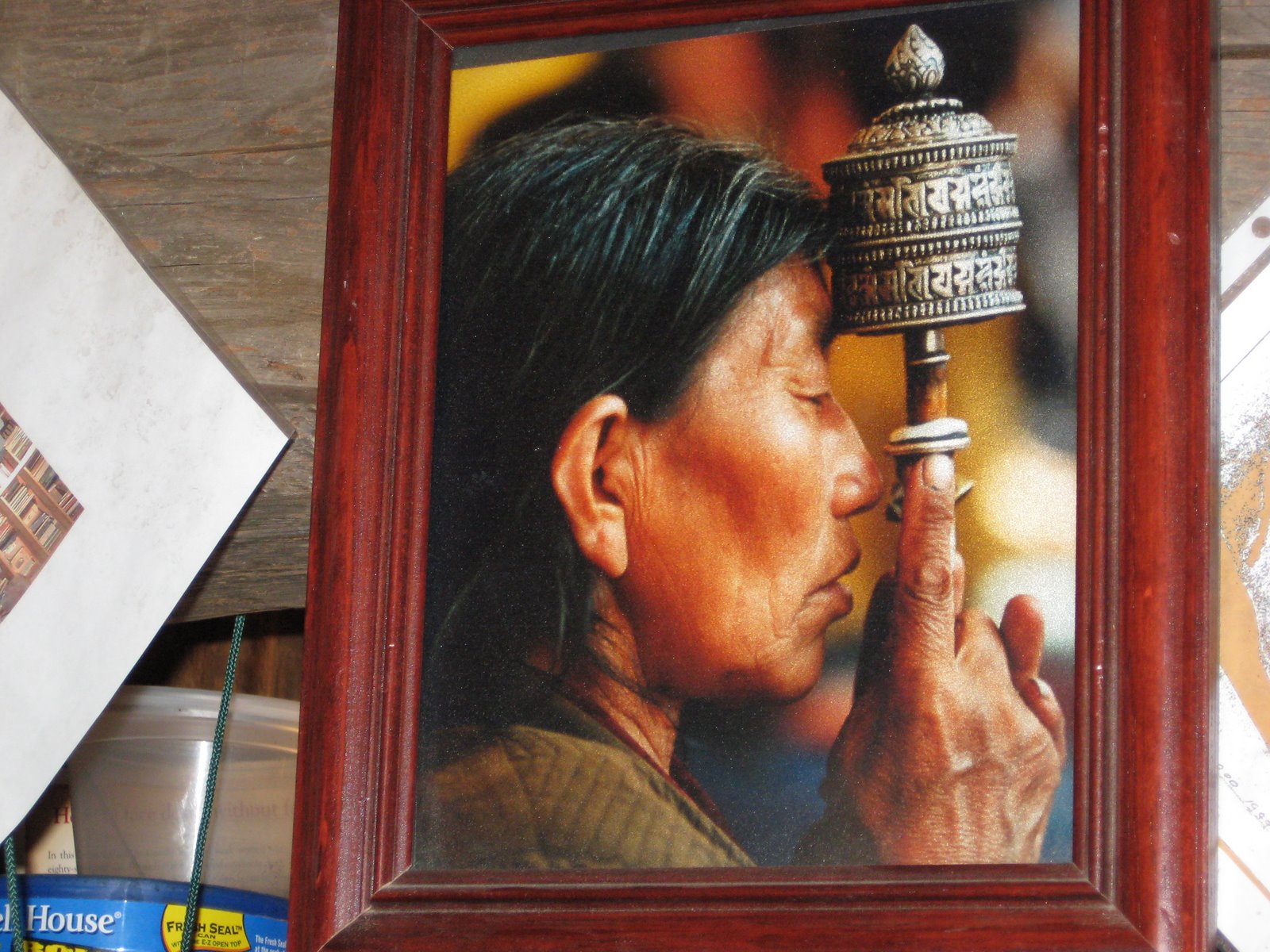
With prayer wheel in hand, someone prays. Someone else is touched by prayer.

Thursday, January 31, 2008

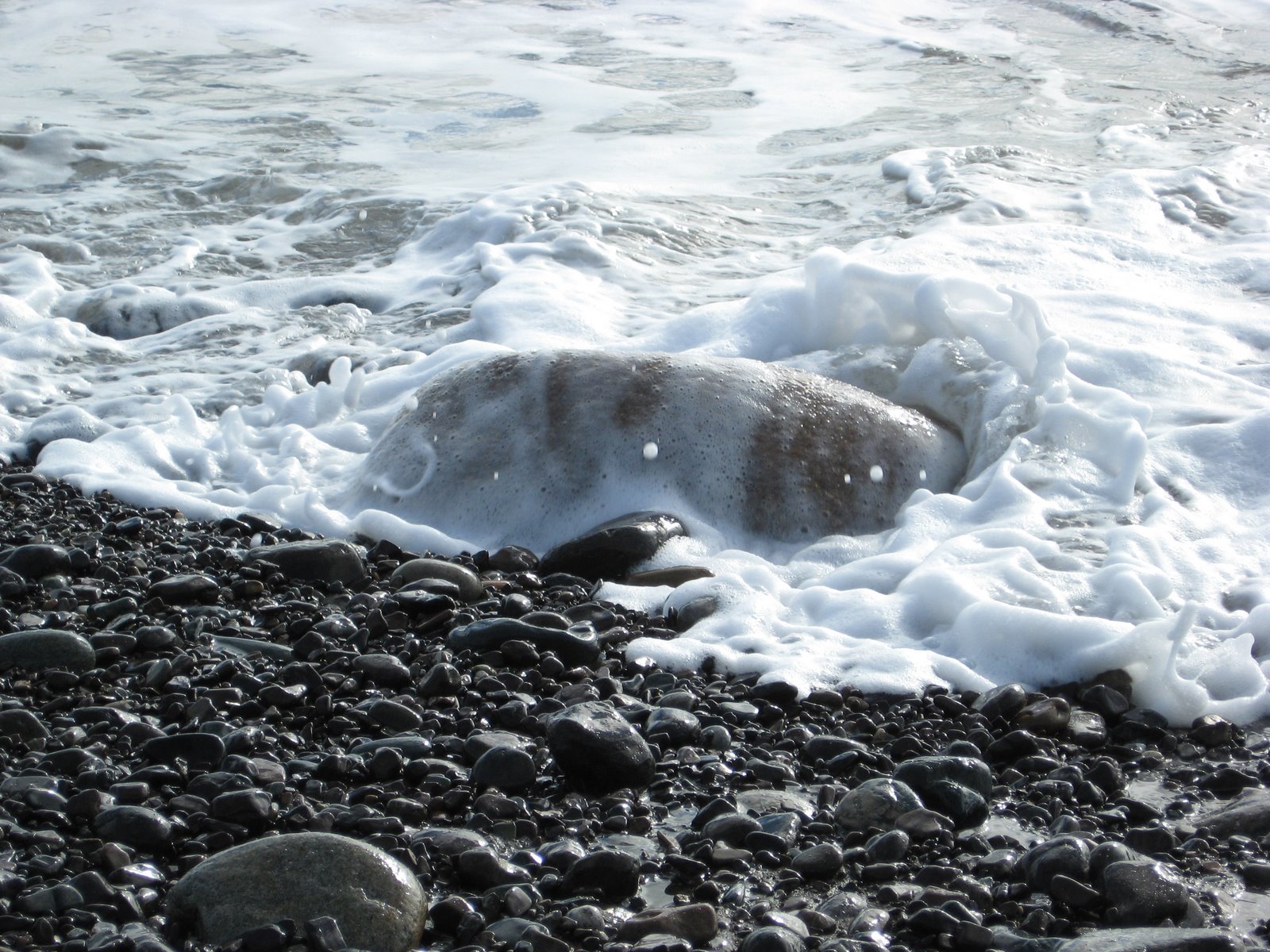
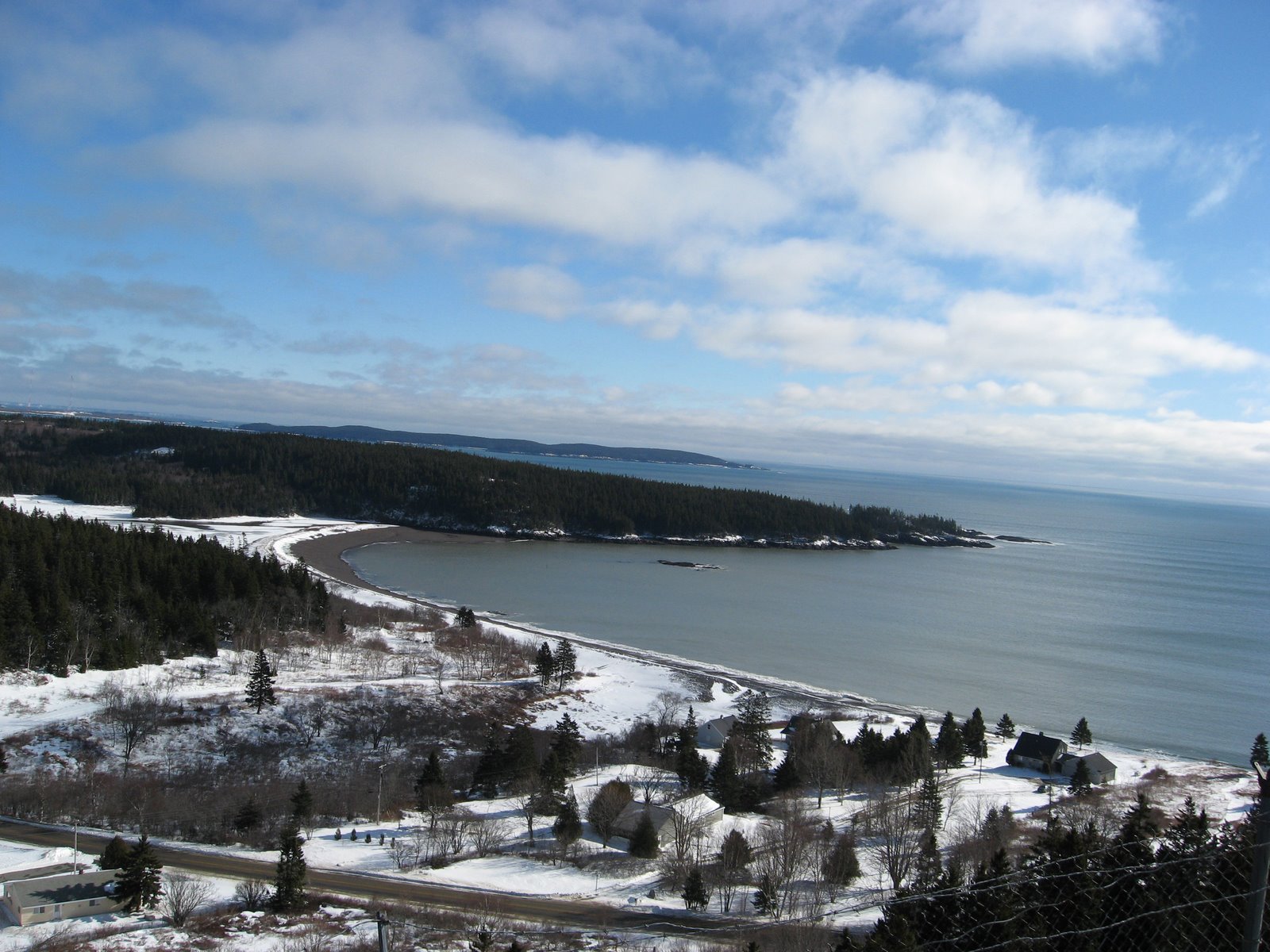
On beach of myriad small stones, a stolid stone seal swirls through rising water.
For all these years, my certain Zen:
Neither I nor the world exist.

The sutras neat within the box,
My staff hooked upon the wall,
I lie at peace in moonlight
Or, hearing water plashing on the rock,
Sit up. None can purchase pleasure such as this:
Spangled across the step-moss, a million coins!
- Ryushu Shutaku (1308–1388)

It is our grace to see swimming stones along end of January on Jasper Beach. A similar grace to that of hearing words of men in prison speak depth of life bursting through the surface.

Sit up.

Take notice.

The prison of popular ignorance is crowded. If there be freedom, release the mind.

Each stone calls out to passing edge of tide -- listen to receding call.
We are poor passing facts,
warned by that to give
each figure in the photograph
his living name.
(--from poem Epilogue, by Robert Lowell)
For now let's say -- brother, sister, friend, father, mother, you and you and you.

A million times each one.
God means movement, not explanation. (--Elie Wiesel)
Seeing pleasure such as this.

Move with care.

Wednesday, January 30, 2008

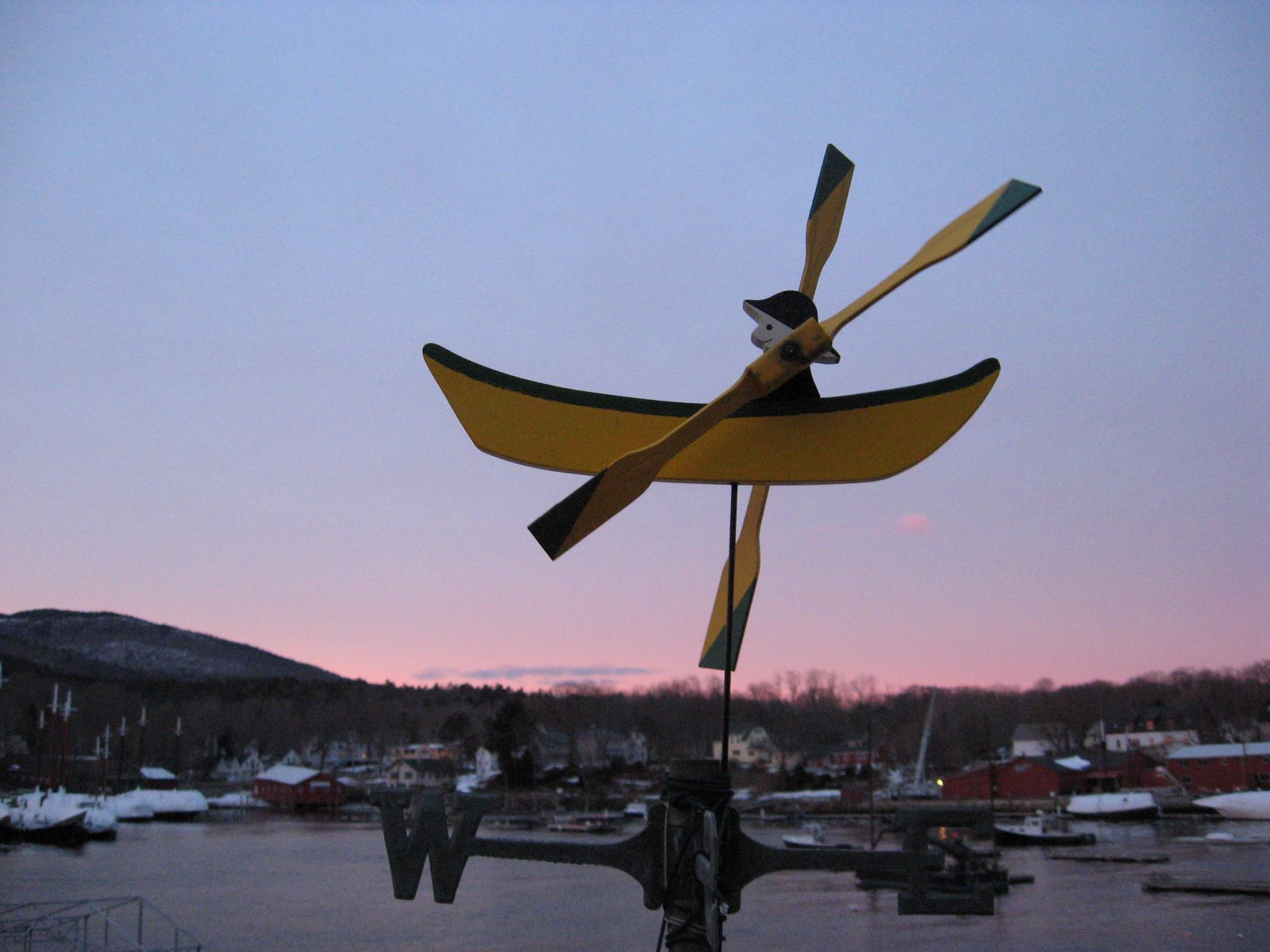
The dory rower has come down from wind vane. He's tired. He's taking a few weeks off.
Those who awaken never rest in one place.
Like swans, they rise and leave the lake.
On the air they rise and fly an invisible course.
Their food is knowledge.
They live on emptiness.
They have seen how to break free.
Who can follow them?
- Buddha in the Dhammapada

Watchng Kieslowski's Red. "Be," the retired judge tells the young woman. She wants to know what else he knows. "Who are you?" she asks.

Right. Who are we? And what are we doing in one another's life?

Rest well.

Tuesday, January 29, 2008

Below Machiasport, Bucks Harbor, the view from FAA parking atop hill begins with enormous radar ball above Downeast Correctional Facility where once an Air Force installation was housed. We have our first Meetingbrook Conversation at the prison there.
This old monk meditates and
Rests in the empty mountains
In loneliness and stillness
Through the days and nights.
When I leave the pure cliffs,
I am distracted by callers
The world of people is first
And always the world of people.
- Seigan Soi (1588-1661)

We take gift of the view. It's not theirs to see. They know there's one there. They encourage us to go see it. It's an odd clarity that sees through others.

People are always people. We have our ways about us.

Good to see faces of friends again. The mere art and practice of conversation.

About enthusiasm, ego, waving energy, ourselves. With the help of Eckhart Tolle.

These days of odd disorder retrieving some clarity.

Monday, January 28, 2008

Maybe there is no stopping.

I'm not saying everything is busy, busy, busy. Just that, maybe, there is no stopping.
The mind of attachment arises from the stopping mind. So does the cycle of transmigration. This stopping becomes the bonds of life and death. Stopping means the mind is being detained by some matter, which may be any matter at all. If there is some thought within the mind, though you listen to the words spoken by another, you will not really be able to hear. This is because your mind has stopped with your own thoughts. When facing a single tree, if you look at a single one of its red leaves, you will not see all the others. When the eye is not set on any one leaf, and you face the tree with nothing at all in mind, any number of leaves are visible to the eye without limit.
- Takuan
Even the Heart Sutra contains the words:
No suffering, no origination,
no stopping, no path, no cognition,
also no attainment with nothing to attain.
Some think meditation is meant to stop thoughts, stop the mind from ushering in thought after thought which we weave into story narrative, jumping on the boat of obsessive replay until we are far down river away from home.

Meditation is meant to help us recognize when we're being carried away by thoughts. It helps to keep us aware of the involuntary departures we make when beckoned by thoughts. This awareness and recognition are gifts of meditation. With them we can return home easier and more quickly.

5 U.S. Soldiers Killed in Iraq, By Richard A. Oppel, Jr., Published: January 29, 2008

BAGHDAD — Five American soldiers were killed in the northern city of Mosul on Monday when militants attacked them with a roadside bomb and then fired on their patrol from a nearby mosque with machine guns, military officials said. The troops returned fire and Iraqi forces raided the mosque, but the gunmen had fled, they said.

It was the second catastrophic attack on United States forces this month, after a house rigged with explosives killed six soldiers in Diyala three weeks ago. The attack underscored the grim situation in Mosul, Iraq's northern hub, which remains a stronghold for Sunni extremist fighters.

In addition, as many as 60 people were killed and 280 wounded in a huge blast in Mosul on Wednesday as Iraqi soldiers entered a building packed with thousands of pounds of explosives. The following day the provincial police chief was assassinated after he visited the site of the blast and an angry crowd of people gathered around him.

Some are taken away suddenly. Taken away and, then, comes grief. The war is still with us. All the distractions of primaries, caucuses, and football championships can only divert those not waiting for phone call or doorbell to sound.


Tonight the President of the United States will deliver his final State of the Union address. Many are pleased it's his last one. I no longer know what to think about the man and the perplexing policies and decisions he's made. I do know my hope we do not see his like anytime soon again.

The war does not stop. The games of sport and games of chance do not stop. The run for the White House does not stop. Our lives, with each breath, however temporary and impermanent, do not stop.

Nor does prayer stop. Nor meditation. Neither does conversation about what kind of person, what kind of world we long to manifest.

Today is the feast of Thomas Aquinas.
St Thomas Aquinas (1225 - 1274)
He was born of a noble family in southern Italy, and was educated by the Benedictines. In the normal course of events he would have joined that order and taken up a position suitable to his rank; but he decided to become a Dominican instead. His family were so scandalised by this disreputable plan that they kidnapped him and kept him prisoner for over a year; but he was more obstinate than they were, and he had his way at last.
He studied in Paris and in Cologne under the great philosopher St Albert the Great. It was a time of great philosophical ferment. The writings of Aristotle, the greatest philosopher of the ancient world, had been newly rediscovered, and were becoming available to people in the West for the first time in a thousand years. Many feared that Aristotelianism was flatly contradictory to Christianity, and the teaching of Aristotle was banned in many universities at this time – the fact that Aristotle’s works were coming to the West from mostly Muslim sources did nothing to help matters.
Into this chaos Thomas brought simple, straightforward sense. Truth cannot contradict truth: if Aristotle (the great, infallible pagan philosopher) appears to contradict Christianity (which we know by faith to be true), then either Aristotle is wrong or the contradiction is in fact illusory. And so Thomas studied, and taught, and argued, and eventually the simple, common-sense philosophy that he worked out brought an end to the controversy. Out of his work came many writings on philosophy and theology, including the Summa Theologiae, a standard textbook for many centuries and still an irreplaceable resource today. Out of his depth of learning came, also, the dazzling poetry of the liturgy for Corpus Christi. And out of his sanctity came the day when, celebrating Mass, he had a vision that, he said, made all his writings seem like so much straw; and he wrote no more.
Let us pray for the Holy Spirit to inspire us, like St Thomas, to love God with our minds as well as our hearts; and if we come across a fact or a teaching that seems to us to contradict our faith, let us not reject it but investigate it: for the truth that it contains can never contradict the truth that is God.

(--from Universalis, http://www.universalis.com/)
Straw. Straw ideas. Straw men. Straw ambition.

I'll listen to that final address. Maybe.

It'll be, with luck, the last straw.

Sunday, January 27, 2008

Whatever happens, the only thing we have any say about is our response to it.
"Absolute perfection is here and now, not in some future, near or far. The secret is in action - here and now. It is your behavior that blinds you to yourself. Disregard whatever you think yourself to be and act as if you were absolutely perfect - whatever your idea of perfection may be. All you need is courage."
(--Nisargadatta Maharaj)

Wandering through this monastery without walls, I greet and bow to so many members of the community.

Handful here, handful there -- monks of no order become monastics of no other.

All on their own.

Saturday, January 26, 2008

Only this is certain.

What is this?
Can you imagine a world without certainty?
The wind rises the wind falls.

The gravels of the world,
the stones of the world
are in their proper places.

The vast, writhing
worms of the sea
are in their places.

The white gulls
on the wet rocks
are in their places.

is certainty.

(--from section 1 of poem Gravel, by Mary Oliver)


This is the thing about enlightenment: It is what it is! You're there. Try to see this. No, just see this!

We don't seem to realize we exist on planes and dimensions vast and parallel. Like this morning's sunlight issuing through crystal orb hanging in meditation room window; this through-which-itself scattered in color on ceiling, wall, and rug.

Issuing forth as one another from source shared.
10

This the poem of goodbye.
And this is the poem of don't know.

My hands touch the lilies
then withdraw;

my hands touch the blue iris
then withdraw;

and I say, not easily but carefully—
the words round in the mouth, crisp on the tongue—


dirt, mud, stars, water— I know you as if you were myself.

How could I be afraid?

(--section 10, from Gravel, by Mary Oliver)
Let's reflect what we are.

Let's fearlessly reflect one another.

For the love of God.

Friday, January 25, 2008

Never mind, for now, the near-death experience.

Most of us are looking for a near-life experience.
As you discuss the skill in means here, you will think: “My physical body, composed of the four elements, was obviously born from my father and mother. At some unspecified time it is sure to decompose. What then was my original face before my father and mother were born?” (- T’aego)

I'm not alive, not really and not fully, as long as I hide from who I really am, lie about myself, or fail to accept and forgive who you are.

Yet, there are glimpses. Brief insights into what might be true nature. Fleeting and temporary.

A near-life experience reminds how far from being alive I am.

Even now, this cold night, I wander between. Near-life; near-death.

Unaccountably unafraid; neither of one nor of the other.

Facing both.

Thursday, January 24, 2008

Sometimes we rest.

Sheltering.

Waiting.

Winter.

Out.

Wednesday, January 23, 2008

When transparency comes, all space will be seen through as holiness.

Until then, we turn into darkened walkways with as much resolve as possible.
Dark, dark my light, and darker my desire.
My soul, like some heat-maddened summer fly,
Keeps buzzing at the sill. Which I is I?
A fallen man, I climb out of my fear.
The mind enters itself, and God the mind,
And one is One, free in the tearing wind.

(--from poem In a Dark Time, by Theodore Roethke)
It's only an illusion, they say, Yet, the separation feels real.

Maybe it's not.

Tuesday, January 22, 2008

The Buddhist teacher said of happiness or equilibrium, best to choose the latter. The still point.

It's like the center of a seesaw. There's movement at each end and close up, but at the center -- only the center.
The Second Patriarch Hui-k’o stood in the snow, cut off his arm, and awakened. The Sixth Patriarch heard someone recite the Diamond Sutra phrase, “arouse the mind without its abiding anywhere,” and he awakened. Ling-yun saw a peach blossom and awakened. Hsiang-yen heard a tile fragment strike bamboo, and he awakened. Lin-chi was given sixty blows by Huang-po, and he awakened. Tung-shan noticed his own reflection when he was crossing a river, and he awakened. In each case, these men met their Master.
- Daito
It doesn't matter who wants to be president. The powerful play power. What matters is something more important. What matters is meeting the one who will lead you to the drop.


The drop through the center. Where nothing holds and nothing falls. It's where no opposite exists.

Where nothing else is.

Not even you.

And that's that.

Monday, January 21, 2008

Watching Charles Ferguson's No End in Sight. About the invasion and occupation of Iraq. The unexplainable stupidity of the American administration.

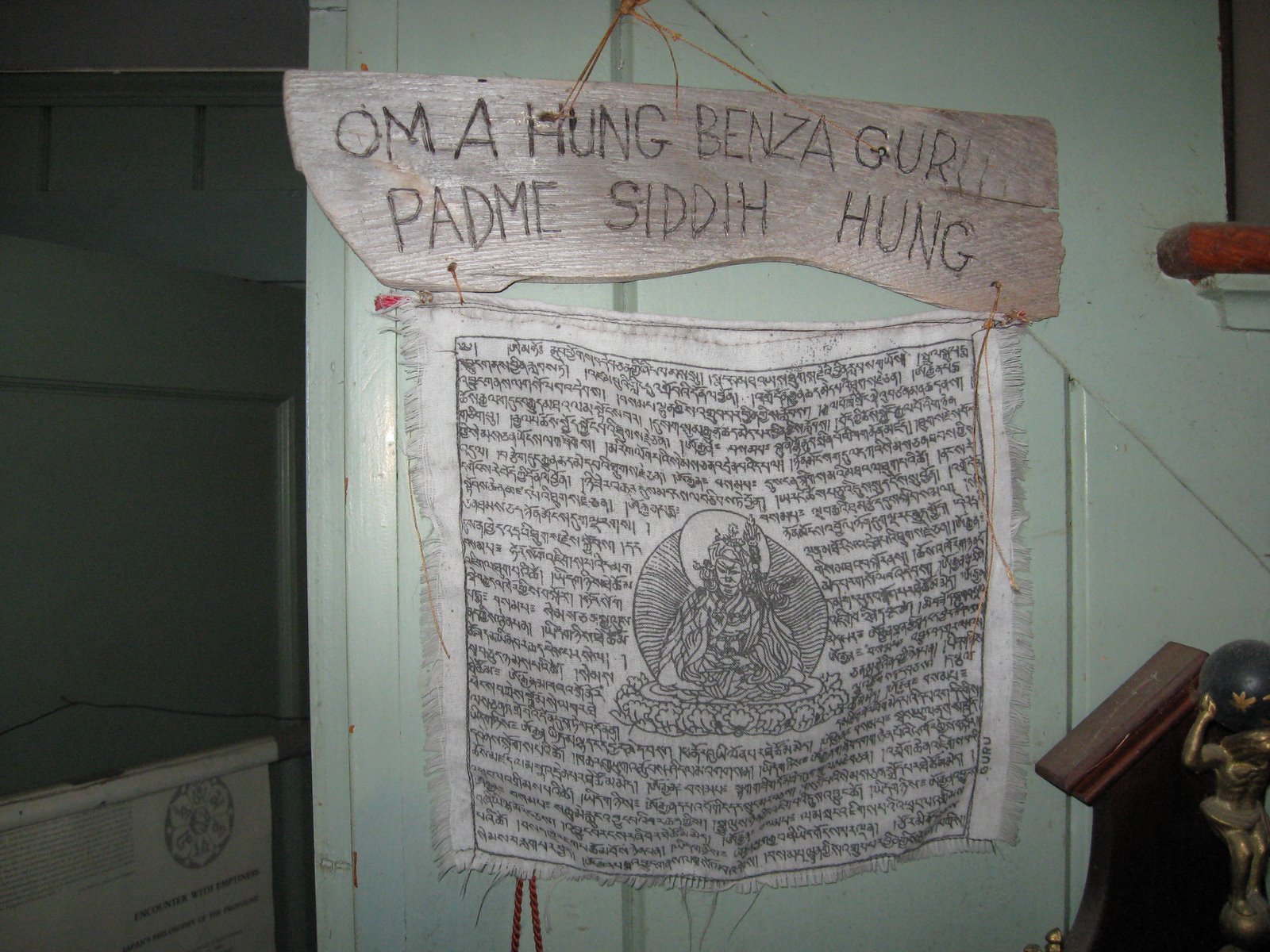
Some time after Charlotte's death, O'a brought us her prayer banner. We have much mud to ponder.

The Vajra Guru mantra is, “Om Ah Hung Benzar Guru Padmé Siddhi Hung.” It is the mantra of Padma Sambhava, the Lotus-born Guru, the Indian master who brought Buddhism to Tibet in the eighth century. Tibetans call Padma Sambhava the Second Buddha, the Buddha of Tibet. So the mantra starts with, “Om Ah Hung; then it says Benzar, or Vajra, Guru Padmé. That’s like saying, “Homage to the diamond master, born in the lotus.” Padmé is lotus. Siddhis mean spiritual powers, like love, wisdom, compassion, forgiveness, enlightenment. So the meaning is, “Homage to the enlightened powers of the Lotus-born Guru.” It’s a way of affirming that the lotus grows and flourishes out of the mud of one’s own nature. Those enlightened powers grow in the mud of our own base nature. Human nature is like the tip of the vast iceberg of Buddha-nature.
(--from New Dharma Talks, Mantras, June 2003, http://www.dzogchen.org/teachings/talks/ndt03.htm/)

I suppose I cannot think of Bush, Cheney, Rumsfeld, Wolfowitz, and Rice without thinking of my own stupidity and callousness. They bring to me the memory of all that is arrogant and insensitive.

These people make me ashamed of myself.

I must change my life.

These teachers.

Demand it.

Sunday, January 20, 2008

The man in Sound of the Soul said, "Spirituality is enlightening one another."
If you misunderstand your mind, you are an ordinary person; if you realize your mind, you are a sage. There is no difference at all whether man, woman, old, young, wise, foolish, human, animal, whatever. Thus, in the Lotus of Truth assembly, was it not the eight year old Naga girl who went directly south to the undefiled world Amala, sat on a jewel lotus flower, and realized universal complete enlightenment?
- Jakushitsu Genko
There has never been a sole enlightened person.

No one lives alone. No one dies alone.

Get over it!

We're in this together.

Saturday, January 19, 2008

When the music festival at Fez, Morocco, appears on film tomorrow, the following question might be raised: Perhaps music, song, art, dance and spirit are greater unifiers of world traditions and peoples than scriptures, thought, dogma and doctrine. Are we on the brink of recognizing one another through metaphor, sound, movement, and color -- a universal understanding without translation?
The state we call Realization is simply
Being one’s self,
Not knowing anything or
Becoming anything.
If one has realized,
One is that which alone is and
Which alone has always been.
One cannot describe that state,
But only be That.
Of course, we loosely talk
Of Self-realization for want of a better term.

- Ramana Maharshi
By being that, we become this -- without reason or explanation -- intimate relation.
Concluding Prayer
In your love, Lord, answer the prayers of your people:
make us see what we have to do
and give us the strength to do it.

Through our Lord Jesus Christ, your Son,
who lives and reigns with you in the unity of the Holy Spirit,
God for ever and ever.
Amen.
(--from Office of Readings)
To see. That's worth praying.

Never mind the knowing and reciting, the behooving and amen amen I say to you. No suras or sutras, no litanies no oaths no salaaming or shaloming no reverends or imams masters or priests, no rabbis no elders no missionaries no acolyte's.

You Must Be Present to Win
There is a sign outside a casino in Las Vegas that says, "You must be present to win." The same is true in meditation. If we want to see the nature of our lives, we must actually be present, aware, awake. Developing samadhi [concentration] is much like polishing a lens. If we are looking to see the cells and workings of the body with a lens that has not been ground sufficiently, we will not see clearly. In order to penetrate the nature of the mind and body, we must collect and concentrate our resources and observe with a steady, silent mind. This is exactly what the Buddha did: he sat, concentrated his mind, and looked within. To become a yogi, an explorer of the heart and mind, we must develop this capacity as well.

(--Jack Kornfield, Seeking the Heart of Wisdom, from Everyday Mind, edited by Jean Smith, a Tricycle book)
"So then," asked the man in prison Friday," what keeps us from feeling and acting with empathy for everyone in the world?"

He asks the question worth asking.

No simple answers need apply.

In fact, no answers at all will be received.

This question demands twirling in an empty square; listening along a winter river; splashing color on a blank canvas; looking long and hard at nothing in particular; nodding attentively to the one before you.

This one asks for a far deeper presence than any answer can give.

No one translation.

Understanding.

Itself.

Alone.

Friday, January 18, 2008

Eat spinach every day. And a banana.
Soundless Sound

I like bamboo as the symbol
Of constancy and simplicity.
I built my house deep within the grove.
Do not strike my bamboo with a piece of brick.
Perhaps the sound might be
Heard by other Zen monks
And cause trouble.

- Jakushitsu (1290–1368)
Chew quietly.


No need to confuse anybody with the suspicion you're interested in health.

Thursday, January 17, 2008

Sometimes what appears to be conversation is monologue.

Someone we know is diagnosed with depressive cancer. He lives alone. His monologue is a conversation. His busy mind conducts every square millimeter of space into a place of inquiry and complaint. We send a message he is in our prayer. And he is.
Good friends, if you would cultivate imperturbability, just whenever you see people, do not see their right or wrong, good or bad, faults or troubles; then your own nature is immovable. Good friends, even though the bodies of deluded people be immobile, yet when they open their mouths to speak of the right and wrong, strengths and weaknesses, good and bad of other people, they turn away from the path. If you cling to mind or cling to purity, this veils the truth.
What is called sitting meditation? In this way there is no obstruction, no impediment. When outwardly, in the midst of all pleasant or unpleasant realms, thoughts do not arise in the mind, this is called “sitting.” Inwardly to see that one’s own nature does not move is called “meditation.”

- Hui-neng (638-713)
In "No Exit" Sartre wrote "Hell is other people." Does that suggest that heaven is no-other? Not in the sense of vacuity, but that if you see "no-other" you are seeing heaven as singular expression of lovely what-is.

St Antony, Abbot (251 - 356) is considered the founder of monasticism.
He lived to be over a hundred years old, and died in 356.
The Gospels are full of wise sayings of Jesus that seem to be ignored, and one of the most poignant of these was in his meeting with that young man who asked over and over again, insistently, “What must I do to have eternal life?”. When, in the end, Jesus told him that if he wanted to be perfect he would have to sell all that he had and give the money to the poor, the young man went away, sorrowing; because he was very rich. What could be more of a waste than that? You tell someone what he has to do, and he is afraid to do it. And yet... 250 years later, St Antony hears the story, and does give away all that he has, and becomes the founder of monasticism. And then again, over 1,000 years later, St Francis of Assisi hears the story, and gives away his possessions (and some of his father’s) and revolutionises Christianity again.
Not all the words that we speak are forgotten, even though we cannot see their effects ourselves. Let us pray that those unknown effects may always be good ones.
(--from Universalis.com)

In the desert there were many monks. There were, no doubt, many mad monks. We're all a bit mad. If someone cries out to God, are they mad? When purpose and meaning seem less and less, are we mad? When no-other appears in the emptiness of just this and this, is that madness?

So many madmen and madwomen! We cry for God; God hears the cry; God is the one crying. The balm and calming resurrecting realization that comes over us time to time is the fact God is no-other. I'd ask what that means, no-other, but it's not meaning nor is it purpose surrounds the realization of true mature no-other.

It's just that everything is itself and, as well, that which is beyond itself. Particular facts, jottings of instances that pretend they're not the whole ball of rubber bands -- when they are.
What's In My Journal

Odd things, like a button drawer. Mean
Thing, fishhooks, barbs in your hand.
But marbles too. A genius for being agreeable.
Junkyard crucifixes, voluptuous
discards. Space for knickknacks, and for
Alaska. Evidence to hang me, or to beatify.
Clues that lead nowhere, that never connected
anyway. Deliberate obfuscation, the kind
that takes genius. Chasms in character.
Loud omissions. Mornings that yawn above
a new grave. Pages you know exist
but you can't find them. Someone's terribly
inevitable life story, maybe mine.
(-- Poem: "What's In My Journal" by William Stafford, from Crossing Unmarked Snow, Harper Collins, 1981.)
No one's fooled.

God is in the details.

Every one of them.