With sunrise.
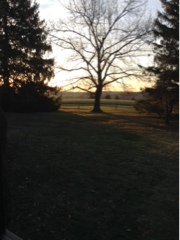
Drying socks.

The rising ordinary.
Putting the plates on second shelf.

Every thing appears as it is.


"What is happening? Today there is a great silence over the earth, a great silence, and stillness, a great silence because the King sleeps; the earth was in terror and was still, because God slept in the flesh and raised up those who were sleeping from the ages. God has died in the flesh, and the underworld has trembled."
(--from An Ancient Homily for Holy Saturday)
|


Darshan is the intimate process of seeing and being seen by a deity. Hindus describe darshan not as the detached, passive sight of aesthetic observance but with the active transitive verbs of taking (in Hindi, darshan lena) and giving darshan (darshan dena). In modern usage, the term darshan signifies the moment when humans view the supernatural, whether through an icon of a deity (murti), a sacred site (tīrtha), or a living embodiment of the divine (avatār). Through darshan, the deity and the devotee engage in a mutual seeing in “a moment of dramatic spiritual interaction.”7 This interactive process symbolizes the “desire for fusion— for the subject/object dissolution of the ‘double sensation.’ ”8 As Isabelle Nabokov/Clark-Decès explains, “The act of darshan . . . also becomes a form of absorbing, so that any objectification of a supernatural is always a form of assimilation as well.”9 It is in such moments of Hindu devotional ritual that the individual both recognizes divinity and is recognized as divinity.10 In Hindu practice, it is through darshan that humanity gains the opportunity to experience the divine on earth. Ideally the darshan experience dissolves the individual ego into cosmic unity with divinity. When interpreted through the advaita vedantic theological ideal of nonduality, the moment of darshan between guru and devotee provides the opportunity for the dissolution of the individuated ego, the symbolic union with divinity, and the intense physical expression of metaphysical cosmic oneness that eradicates duality. Ideally, darshan transforms the individual through these temporary suspensions of the sense of self and individuated difference that incite the recognition of the ultimate similitude between the self and divinity.
Through darshan, devotees not only see the image of the deity but infuse themselves within it in an active process of becoming. Devotees aim to absorb the gaze of the deity and in the process be transformed. As Lawrence Babb suggests, there is a parallel between the impulse be- hind eating blessed food (prasad), wherein “you become what you eat,” and the process of darshan, in which “you somehow become what you see.”11 Thus darshan should not be explained in terms of being merely an aesthetic experience—something that one passively witnesses—but, rather, as an agentive interaction—something in which one actively engages, a transformative and participatory process. A devotee of Mother Meera understands her unique method of silent visual darshan in highly active terms of transformation. She says, “Along with the gaze from Mother Meera’s eyes comes an infusion of light, light designed to heal wounds within the psyche and give a person sufficient power to move from the perspective of the personality to a divine perspective. . . . This is not one woman staring as the other stares back. Instead, one offers the gift of her soft, penetrative gaze, and the other offers the gift of acceptance.”12 In the Radhasoami tradition the compassionate gaze of the guru during darshan is believed to assist devotees in their spiritual de- velopment: “the drishṭi, the ‘seeing’ or ‘glance,’ of the guru aids the devotee in achieving deliverance.”13 Devotees of Sathya Sai Baba experience darshan as “a moment of ultimate self-transformation by which they are ‘captured’ spiritually and experience a ‘complete immersion in Sai Baba’s love.’ ”14
Amma’s devotees relate similar experiences of the dissolution of indi- vidual boundaries, immersion in divine love, and cosmic awakenings. Shanti relayed a particularly powerful experience of her darshan during one Devī Bhāva night: “As we knelt in front of Amma, she put our heads together, cheek to cheek, and looked straight into our eyes, the right eye on me and the left eye on Caleb. I remember thinking, Oh no! here we go!!! I lost all track of where I was . . . there was no sense of time, the universe was swirling to life in her eye, and then I was in the universe and I sort of felt, for lack of a better word, everything that has ever been and every thing that will ever be in one second. She pulled back and it was over. I totally lost track of where I was for a second. But as soon as she disengaged I was back with no confusion.” Devotees long for the darshan experience because of the potential for this type of transformative experience, the possibility of experiencing a glimpse into the cosmic reality of the divine, and the efficacy of darshan for catalyzing spiritual awakening.
(--from Chapter 1, A Darshan Embrace, Experiencing Authenticity and Feeling Witnessed, in Reflections of Amma, Devotees in a Global Embrace, Amanda J. Lucia (Author) http://www.ucpress.edu/content/chapters/12560.ch01.pdf)
Doing nothing is essential for thinking to occur. Many of the most important thoughts are unintentional—they can be neither solicited nor cajoled but have a rhythm of their own, creeping up, arriving, and leaving when we least expect them. It is important to cultivate the lassitude of mind that clears a place for the arrival of what cannot be anticipated. Idleness allows time for the mind to wander to places never before imagined and to return transformed.
(—Mark C. Taylor, "Idleness Waiting Grace")

Once you eliminate the impossible, whatever remains, no matter how improbable, must be the truth. —Sherlock Holmes
We can easily forgive a child who is afraid of the dark. The real tragedy of life is when men are afraid of the light. —Plato
Even the smallest glimpse of freedom heightens our awareness of the pain we have created by our ego-fixation. Seeing the contrast is what inspires us to go forward on the path. In particular, each time we sit on the cushion and meditate, we relax and let go a little bit more. The notion we’ve held onto—that if we don’t keep up our ego-momentum something bad is going to happen—dissolves bit by bit. (—from Judy Lief, “Letting Go,” in Tricycle Magazine)We are cor-respondence. We are com-munion. We are con-versation. Hence, equality is what belongs to us.
She asked us to engage in several exercises -”keep going in a straight line until you have to turn” – each an invitation to spontaneous interaction, each with a natural lifespan, 5 minutes, 15 minutes, then the energy turned formulaic or repetitive and died away. She said that’s how it is with all energy, all relationships, that the energy comes and goes and comes and goes like the tide. She implied that we’re happier when we recognize this pattern, stop fighting it, and just let it happen. (--from Peter Cunningham blog; dancer Martha Myers words) http://petercunninghamphotography.comWe’ve had it wrong. We thought it was objects. Others as objects. It’s not.
SZ: Would you say that your father was the most important person in your life? ED: No. (Laughs) Right now I’m talking to you, so you are. Congratulations! (--Michel Engu Dobbs interview, Sweeping Zen, Feb. 21, 2012) http://sweepingzen.com/michel-engu-dobbs-interview/Unearthing.
Moon this April 7
is the same age today
as she was
the same age yesterday --
each a Good day
What we call “self” is not clenched double-fist solid entity. Rather, self is open-fingered falling through exchange of sensations, memories, thoughts, and awareness engaging a flowing grace and sweet dignity in communion with circumstance and surroundings.birth! Hello (--wfh)
Free passion is radiation without a radiator, a fluid, pervasive warmth that flows effortlessly. It is not destructive because it is a balanced state of being and highly intelligent. Self-consciousness inhibits this intelligent, balanced state of being. By opening, by dropping our self-conscious grasping, we see not only the surface of an object, but we see the whole way through. We appreciate not in terms of sensational qualities alone, but we see in terms of whole qualities, which are pure gold.
(—Chogyam Trungpa Rinpoche, “Love Story” http://www.tricycle.com/insights/love-story)

Mountains on all sides
Rivers looped around it
There's no trail to my hut.
When the dragon elephant approaches
A path opens all by itself
In the hour of soaring talk
Neither has to think of meeting
The other half way
Though all of you keep
Wandering into yes and no.
(-- Muso Soseki (1275-1351))
A MADMAN DREAMS OF TURING MACHINES
A Madman Dreams of Turing Machines bridges fiction and nonfiction to tell a strange if true story of coded secrets, psychotic delusions, mathematical truth, and lies. This story of greatness and weakness, of genius and hallucination, is based on the parallel lives of Kurt Gödel, the greatest logician of many centuries, and Alan Turing, the extraordinary code breaker during World War II. Taken together their work proved that truth is elusive, that knowledge has limits, that machines could think. Yet Gödel believed in transmigration of the soul and Turing concluded that we were soulless biological machines. And their suicides were complementary: Gödel, delusional and paranoid, starved himself to death fearing his food was poisoned. Turing ate a poison apple, driven to suicide after being arrested and convicted of homosexual activities. These two men were devoted to truth of the highest abstract nature, yet were unable to grasp the mundane truths of their own lives. Through it all, the narrator wonders, along with these two odd heroes, if any of us can ever really grasp the truth.
(-- from description of her novel by Janna Levin on her website) http://www.jannalevin.com/science.html
A Way of Working
Once, Chuang Tzu tells us, there was a master craftsman who made such beautiful things out of wood the the King himself demanded to know the secret of his art.
“Your Highness,” said the carpenter, “there is no secret; but there is something. This is how I begin. When I am about to make a table, I first collect my energies and bring my mind to absolute quietness. I become oblivious of any reward to be gained or any fame to be acquired. When I am free from the influences of all such outer considerations, I can listen to the inner voice which tells me clearly what I have to do. When my skill is thus concentrated, I take up my ax; I make sure that it is perfectly sharp, that it fits my hand and swings with my arm. Then I enter the forest. I look for the right tree: the tree that is waiting to become my table. And when I find it, I ask: ‘what have I for you, what have you for me?’ Then I cut down the tree and set to work. I remember how my masters taught me to bring my skill and my thought into relation with the natural qualities of the wood.”
The King said, “When the table is finished, it has a magical effect upon me. I cannot treat it as I would any other table. What is the nature of this magic?”
“Your Majesty,” said the carpenter, “what you call magic comes only from what I have already told you.”
(--from Chang Tsu: Inner Chapters – Translated by Gia-Gu Feng, Illustrated by Jane English.)


