Saturday, September 19, 2009

"I'm here," the character says at end of film. Je suis la! She has finally spoken her grief and action after 15 years spent in absence from everyone and her own life.

We say: Here is one -- another itself.
The eye sees it,
But no hands can take hold of it.
The moon in the stream:
This is the secret of this school.
--Shrinkage-ryu school
This is how the earth is shaped. How we are. How God is blossoming the seed bursting forth from hiding.

Soil came to be so that the shovel would have something to move.

Something changes with our thinking.

We're not two.

We're here.

Friday, September 18, 2009

The practice is stillness. Even when moving.
Wind stirs;
Waterfall sends cold sounds
Moonrise over the foothills
Shines its light on my bamboo window
Dearer with age,
These mountains ways.
If I die at the foot of this cliff,
Even my bones will be pure.
- Jakushitsu (1290–1367)
Today at prison and at nursing home, good conversations, poems, and Confucian thought.

Tonight at hermitage, continuing to read Tolle. Learning to let be.

Nearing midnight, we dedicate the brass bell donated to us by the kind woman in Cushing. We make the intention to pray for her family. The bell sits on woven creation before Buddha and under cross.

We also pray that stupidity in religion, ours and others', might pass away and be forgiven as we learn to let be with attentive awareness.


Mu-ge and Rokpa have the right no-idea.

Thursday, September 17, 2009

It's an old debate. What use the body? Why not attend to spirit alone. Mind and body are separate, aren't they?

I come down on the side of the body. As Tom said tonight, with trillions of cells comprising the human form, so miraculous and mysterious, how is it someone thinks that getting rid of ego and the body is even possible? Matter and energy will transform and transcend, but not go away.

Maria said, "The body has many needs...why is that?" Harold said years ago God enters the world through our senses and learns of it the same way. If so, stipulating the metaphor, why do we nix the body and wish it gone for some spiritual eternity?
17 Whether Pirsig thinks he is speaking to eternity is a point he is ambiguous on. Pirsig's pragmatism comes through when, after Gennie tells him that he should write down all of his thoughts about philosophy, he says, “The trouble is that essays always have to sound like God talking for eternity, and that isn't the way it ever is. People should see that it's never anything other than just one person talking from one place in time and space and circumstance.” (ZMM, p. 172) Here Pirsig directly repudiates the style of writing that traditional philosophers have generally used, but while describing the opening and closing of routes through the “mountains of the spirit” Pirsig says, “But the fact that the old routes have tended, because of language rigidity, to lose their everyday meaning and become almost closed doesn't mean that the mountain is no longer there. It's there and will be there as long as consciousness exists.” (ibid., p. 188-9)
(--footnote from Philosophologology: An Inquiry into the Study of the Love of Wisdom, by Matthew P. Kundert, August 2004, in MOQ.org, a forum for the discussion of Robert M Pirsig's Metaphysics of Quality.)
http://www.moq.org/forum/Kundert/Philosophologology/Philosophologology.html

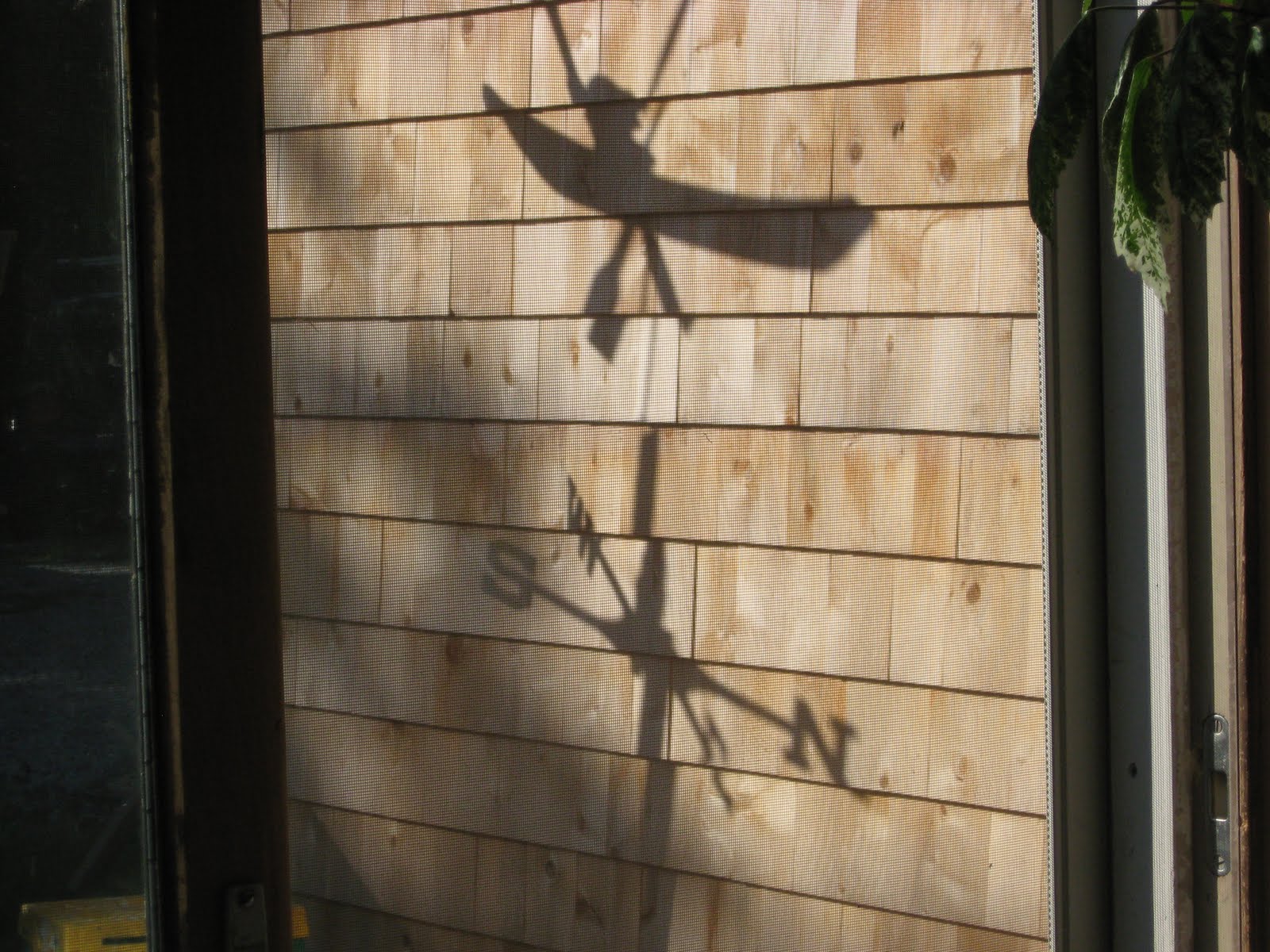
The rower in the dory floats above iron weather vane on cedar shingles of sun-shadow outside glass slider. He's there only early mornings. Ephemeral, yes. Impermanent, of course. Insubstantial, if you must. But -- there.

As long as consciousness exists we will see and experience. No amount of 'believing' will add or subtract what is actually part of sentient apprehension. Things are 'there' for us -- as we return the favor by acknowledgment and appreciation.

I look up to the sky while at end of driveway at edge of road. There are a lot of celestial bodies above. None of which I have imagined. With or without me, they are there.

I am willing to allow that 'God' is not what I nor anyone thinks God is.

I have no idea that contains the matter.
Chuang Tzu And The Butterfly

Chuang Tzu in dream became a butterfly,
And the butterfly became Chuang Tzu at waking.
Which was the real—the butterfly or the man ?
Who can tell the end of the endless changes of things?
The water that flows into the depth of the distant sea
Returns anon to the shallows of a transparent stream.
The man, raising melons outside the green gate of the city,
Was once the Prince of the East Hill.
So must rank and riches vanish.
You know it, still you toil and toil,—what for?
(Poem by Li Po, 701-762 / Chu / Kazakhstan)
Matter re-forms my life.

Life re-forms matter.

Form, they say, is emptiness.

So, it is, we go on.

What for?

Ha!

Wednesday, September 16, 2009

On cushion this morning, circular rug with rings of circles, the silence of it.

Five phrases: no burden, no barrier, no beginning, no boundary, no bullshit.

Spacious and content,
Without confusion from
Inner thoughts of grasping,
Effectively overcome habitual behavior
And realize the self
That is not possessed by emotions.
Be broad-minded,
Whole, without relying on others.

- Hongzhi Zhengjue (1091–1157)
Five no's.

Afterwards, coffee, egg, muffin, sausage, and cantaloupe.

Tuesday, September 15, 2009

What do you say?

Poet Wallace Stevens in his poem, 'Evening Without Angels,' writes:
Where the voice that is in us makes a true response,
Where the voice that is great within us rises up
,
We wonder: What voice? We ask: Is it the voice of God? Or is it my own voice? Some ask: Are these two questions with two answers, or one with one?
The practice of true reality
Is simply to sit serenely
In silent introspection.
When you have fathomed this,
You cannot be turned around
By external causes and conditions.
This empty, wide-open mind
Is subtly and correctly
Illuminating.

- Hongzhi Zhengjue (1091–1157)
Sometimes sorrow is our sole comfort. A diffuse sorrow. Nothing that can't fade with the end of downpour when sun comes suddenly through and day is different than it was. Still, sorrow seeps into earth even as quiet resides with fallen chipmunk prey to awkward facticity of cat's teeth.
The Changes In Santa Ynez
Through the last long weeks of summer
I waited for fall,
though you’d hardly know it,
so subtle here,
a tinge in the vineyards,
stately old tarantula crossing the road
on his way to die for love.

Now it’s come, and I’m hardly aware,
a paler blue in the sky,
the blanket I pull up
from the foot of the bed at three a.m.,
the familiar books of longing I turn to,
the rustle of leaves I’ve walked through before

(Poem by Dan Gerber, b. 1940)
On mountain trees myriad leaves quorum talking about autumn as summer takes a final lap. Like sensitive souls gathering to give heart a place to express its loving concern, the conversation is about ordinary things -- red squirrels, last night's wind, the way rain keeps wet all June. They talk of things as flutter of chickadee arrives at branch. They will become a different form of emerging earth soon enough. They do not talk much of that. What is beyond is what is within.
The holy old man [Simeon] said of the infant Jesus: "He has been established as a sign which will be contradicted." He went on to say to Mary: "And your own heart will be pierced by a sword." (--from A sermon of St Bernard, Office of Readings, on Feast of Our Lady of Sorrows)
Yesterday Cross, today Sorrows -- two days of ancient metaphor -- and we stand up again and cross over the terrain of daily life with all that accompanies. A man recently talked about traveling with anger. We were reading The Art of Just Sitting at table practice. The night became itself.

We go on with what we are, what we carry, thinking about all the misalliances and misapprehensions stuffed into rucksacks, strings loose, slung on shoulders. Jesus and Mary are touchstones. It's easier to talk of them, it seems, than our own personal and intimate experience. Over airwaves and over our shoulders is heard Jesus this Jesus that Jesus everywhere. In other circles it's Allah this Allah that Allah everywhere. Our religious references give us room to sequester ourselves off to the side while fronting argument and dispute in matters that deflect our true and troubled heart and mind.

We ofttimes use religiosity and spirituality to prop us up as if glue were a protection in autumn's transforming transition.
Evening Without Angels

the great interests of man: air and light, the joy of
having a body, the voluptuousness of looking.
—Mario Rossi


Why seraphim like lutanists arranged
Above the trees? And why the poet as
Eternal chef d'orchestre?

Air is air.
Its vacancy glitters round us everywhere.
Its sounds are not angelic syllables
But our unfashioned spirits realized
More sharply in more furious selves.

And light
That fosters seraphim and is to them
Coiffeur of haloes, fecund jeweller—
Was the sun concoct for angels or for men?
Sad men made angels of the sun, and of
The moon they made their own attendant ghosts,
Which led them back to angels, after death.

Let this be clear that we are men of sun
And men of day and never of pointed night,
Men that repeat antiquest sounds of air
In an accord of repetitions. Yet,
If we repeat, it is because the wind
Encircling us, speaks always with our speech.

Light, too, encrusts us making visible
The motions of the mind and giving form
To moodiest nothings, as, desire for day
Accomplished in the immensely flashing East,
Desire for rest, in that descending sea
Of dark, which in its very darkening
Is rest and silence spreading into sleep.

. . . Evening, when the measure skips a beat
And then another, one by one, and all
To a seething minor swiftly modulate.
Bare night is best. Bare earth is best. Bare, bare,
Except for our own houses, huddled low
Beneath the arches and their spangled air,
Beneath the rhapsodies of fire and fire,
Where the voice that is in us makes a true response,
Where the voice that is great within us rises up,
As we stand gazing at the rounded moon.

(Poem by Wallace Stevens, 1879-1955)
The voice within us -- the voice that is great within us -- is asking a new question. It asks: What am I? What are you?

From a small silence comes a quiet sound: "I am the within."

All these years the small quiet voice has been in the gently moving stillness.

It is. And we are. Le meme chose. The Itself.

What am I? I am the not-other-than voice that is gentle and great, moving and still, within and always within. This is the ne (non) plus ultra: (i.e. "Nothing further; the uttermost point; perfection.")

This is what I am. This is who we are.

All sorrow, all joy. All suffering, all healing. All uncertainty, all peace. It is here we find one another. As we are. Included. Welcomed.

Nothing other than.

As leaves on branches all along the path test the air.

Readying.

Monday, September 14, 2009

And you?
What are they asking when they say, How do you feel?

When you ask accomplished teachers how they are, they always say, “Good, good, very good” — always good. Many people say that they feel dishonest saying they are good when in fact they have problems. But what we are talking about here is developing a fundamental sense of strength and well-being. Wouldn’t it be better to associate our mind with that rather than with all the fleeting emotions and physical sensations we experience throughout the say? What is the point of being honest about something so fleeting and impossible to pin down? If your well-being is so dependent upon emotions and physical sensations, you will have little opportunity to say, “I am well.” So when people ask how you are, say, “Good!”

— Dzigar Kongtrul Rinpoche, from "Old Relationships, New Possibilities" (Tricycle, Winter 2008)
The premier tennis players finish two weeks of tournament in New York. The Argentine beat the Swiss and took home a new car and 1.8 million dollars. He's twenty years old.

On the news an actor has died. A cable network star is calling the president someone who hates white people. The elected people in congress see an advantage in disgracing their office with mute assent of the folly.

It is not easy to cheer oneself through the day. Still, things are good.

I read about someone attempting to prove there is a God because he saw lights while teetering on the verge of death. Maybe the 'out of body' experience talked about might better be characterized as an 'outer body experience.'

There is no separation.

We share the particles of our bodies and breath.

It's hard not to feel the desperation that vibrates in another's bones in ones own bones.

Even the tenderness is felt.

Who are we?

And what are we doing here?
How can we ever lose interest in life?
Spring has come again
And cherry trees bloom in the mountains.
- Ryokan (1758-1831)
Soon, Autumn.

The falling time.

Sunday, September 13, 2009

The wind filled cabin tonight. It sat on each cushion not occupied. It rang bells and bamboo chimes. It walked slowly in circle with the rest of us.

Shikantaza, or, just sitting. Or just walking. Just eating. Just watching. Just lying down.

Nothing but what you are doing.
I sought Zen from temples and teachers,
Then found it along the way of Tsao His
Inside this moment forever.
When walking now, I walk Zen.
When sitting, I sit Zen.
Talking, quiet; moving, stillness,
The calm within.
- Hsuan Chyuen (655–713)
From sidewalk in front of St Francis Church in Belfast I joined my hands together and bow to Father Joe as the priest stepped out door after his last mass at the parish. He has handkerchief to his face. The people are singing final hymn. He holds up his hand gesturing to my direction saying, "Thank you Bill." (I'm surprised to hear my name.)

Things change. Nothing remains the same. Everything returns in a different version of itself.

And so, we practice being life.

Say goodbye. Say hello.

And go. Or stay.

As is asked of us.

Just this.

Saturday, September 12, 2009

Maybe the fall of the Roman Empire is instructive. When a house no longer cares for those living there, it collapses from without. When those living there no longer care for the house, it collapses from within.

America no longer tries to hide its hate for itself.
Picking chrysanthemums at the eastern gate
I leisurely view South Mountain.
The vapors rise along the valleys,
Groups of birds fly back
Inside each sunset.
Trying to talk about it,
I have forgotten the words.

- Tao Yuan Ming (365–427)
G.K. Chesterton said, "The problem with Christianity is not that it has been tried & found wanting but that it has not been tried." I think there's a parallel with democracy in America. Capitalism and hegemony have masked themselves as democracy and shed theatrical tears at their performances. No failure is complete without blaming the vulnerable and poor for one's own failure of moral courage.
Equinox
I must keep from breaking into the story by force
for if I do I will find myself with a war club in my hand
and the smoke of grief staggering toward the sun,
your nation dead beside you.

I keep walking away though it has been an eternity
and from each drop of blood
springs up sons and daughters, trees,
a mountain of sorrows, of songs.

I tell you this from the dusk of a small city in the north
not far from the birthplace of cars and industry.
Geese are returning to mate and crocuses have
broken through the frozen earth.

Soon they will come for me and I will make my stand
before the jury of destiny. Yes, I will answer in the clatter
of the new world, I have broken my addiction to war
and desire. Yes, I will reply, I have buried the dead

and made songs of the blood, the marrow.

(Poem by Joy Harjo)
Let us bury the dead and remember their longing.

It is a sad occurrence to watch a thing being destroyed.

By its own hand.

On its antipathetic throat.

Choking on self loathing.

When love would be so much more pleasing.

Friday, September 11, 2009

Two plus two is where we do not want to dwell. Stick to one. Be one place. Ground yourself.
Mr. Cogito and the Imagination

Mr. Cogito never trusted
tricks of the imagination

the piano at the top of the Alps
played false concerts for him

he didn't appreciate labyrinths
the Sphinx filled him with loathing

he lived in a house with no basement
without mirrors of dialectics

jungles of tangled images
were not his home

he would rarely soar
on the wings of metaphor
and then he fell like Icarus
into the embrace of the Great Mother

he adored tautologies
explanations
idem per idem

that a bird is a bird
slavery means slavery
a knife is a knife
death remains death

he loved
the flat horizon
a straight line
the gravity of the earth

(Poem by Zbigniew Herbert, 1924-1998)
Stay with earth.

Stay with what is in words.
In modern poetry, Herbert advocated semantic transparency. In a talk given at a conference organized by the journal Odra he said: "So not having pretensions to infallibility, but stating only my predilections, I would like to say that in contemporary poetry the poems that appeal to me the most are those in which I discern something I would call a quality of semantic transparency (a term borrowed from Husserl's logic). This semantic transparency is the characteristic of a sign consisting in this: that during the time when the sign is used, attention is directed towards the object denoted, and the sign itself does not hold the attention. The word is a window onto reality."[4]
[4] Herbert's talk at the meeting "Poet in face of the present day", organized by the "Odra" journal; print version: preface to: Zbigniew Herbert "Poezje", Państwowy Instytut Wydawniczy, Warszawa 1998,[4] (--Wikipedia)
Sure it's chilly. It's September.

Still, open the window.

Thursday, September 10, 2009

This day is this day. Who do you think you are?
Spring has its hundred flowers,
Autumn its many moons.
Summer has cool winds,
Winter its snow.
If useless thoughts do not
Cloud your mind,
Each day is the best of your life.

- Wu-Men-Hui-Kai (1183-1260)
Now it is night. Who am I?

9/11 arrives. We have no idea.

Who did it?

Or have we?

Tuesday, September 08, 2009

You remain the same true person. Before the thought arrives and after it leaves you remain watching throughout.

You're free.
The water of the mind,
how clear it is!
Gazing at it,
the boundaries are invisible.
But as soon as even
a slight thought arises,
ten thousand images crowd it.
Attach to them,
and they become real.
Be carried by them,
and it will be difficult to return.
How painful to see a person
trapped in the ten-fold delusions.

- Ryokan
Reading Confucius. Harmony in individual. in town, in government, in country, in heaven. Circles rippling outward.

I watch the fear in America. Do the people fear liberalism, intelligence, or a black man?

Evening sitting. Reading about Vigilance in Dhammapada.

Happy Birthday, Mary!

Confucius said to observe the rites.

In addition we must watch the Right.

We must care for our rights.

Eh? It's a dangerous time.

Monday, September 07, 2009

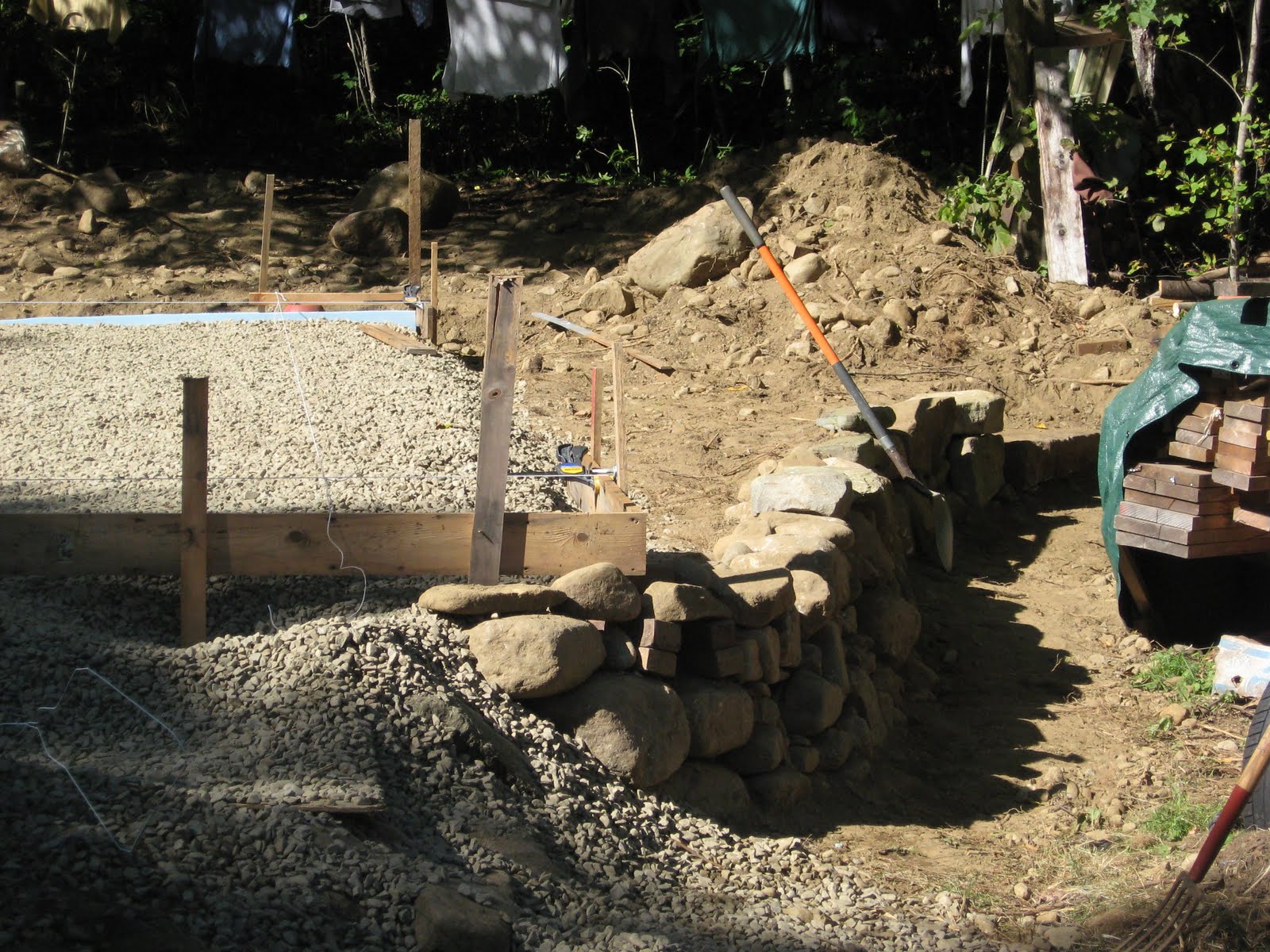
Labor day in laboring. Cutting trees and limbs. Shoveling dirt. Excavator digging stone, roots, and ground, swale, as well as pushing debris back against hill in farm pit.
The Buddha said, "Elements come together and form this body. At the time of appearing, elements appear. At the time of disappearing, elements disappear. When elements appear, I do not say "I" appear. When elements disappear, I do not say "I" disappear. Past moments and future moments do not arise in sequence. Past elements and future elements are not in alignment. This is the meaning of ocean mudra samadhi."
(--Ocean Mudra Samadhi (1242), Written at the Kannon-dori Kosho Horin Monastery on the twentieth day, the fourth month, the third year of the Ninji Era (1242), as translated in Beyond Thinking : A Guide to Zen Meditation (2004) edited by Kazuaki Tanahashi)
One of the women at Sunday Evening Practice spoke about the forming of American Zen.

What would it look like?

Lugging tree stumps to farm pit I find the words, "I am doing this," to be helpful.

If "this" is all there is, and you are doing "this" then you are what is taking place.

As God is. Even if there is no God.

There is always this possibility: that there is God; or, this is what God is doing.

Let's review: What is this?

Good!

Welcome to America!

Sunday, September 06, 2009

Ten of us at Sunday Evening Practice. At table we read two Zen Masters.
What is a perfect clown? A low class clown can only make people who are already happy laugh. A middle class clown can make people who are sad laugh. A high class clown can teach all people how to make each other laugh.

A high class Dharma Teacher can be a high class clown. A high class clown is already a high class Dharma Teacher. (--from Clowns & Dharma Teachers, by Zen Master Soeng Hyang, aka Bobbie Rhodes)
A man remembers gratitude for what his father provided him. We laugh at Zen Master Seung Soen's humor in a Tricycle interview about the response to mokta souund in various countries.

Zen is clear like space this moment.
Love

Love means to learn to look at yourself
The way one looks at distant things
For you are only one thing among many.
And whoever sees that way heals his heart,
Without knowing it, from various ills—
A bird and a tree say to him: Friend.

Then he wants to use himself and things
So that they stand in the glow of ripeness.
It doesn’t matter whether he knows what he serves:
Who serves best doesn’t always understand.

(Poem, Love, by Czeslaw Milosz)
American Zen is forming. Camden Zen is finding its way. No Zen is probably where we will excel.

This is the way of the moment.

Saturday, September 05, 2009

Will there be a time of truce and peace?

Is Islam, is Judaism, is Christianity capable of abiding in peace?
Impermanence, aging, and illness
Do not give people a set time.
One may be alive in the morning,
Then dead at night,
Changing worlds in an instant.
We are like the spring frost,
Like the morning dew
Suddenly gone.

- Kuei-Shan (771-854)
If religions and cultures want conflict and strife, there will be conflict and strife.

Count me out. I've no faith in egoistic destructive exclusivity divinity triumphalistic servitude to deathknell diatribe and dark certitude's wilful obsession with murderous false righteousness.

Call me Infidel.

The simplemindedness of dualistic contending exhausts the heart and mind that seeks understanding and compassion.

I hope to deepen that longing and plead nolo contendere.

Friday, September 04, 2009

September is lovely.

So far.

We hold our first conversation at Quarry Hill, an extended care facility in Camden. It is called "Poetry, Tea, and Thee." We read three Billy Collins poems. Gertrude will be 92 tomorrow. Marjorie, Catherine, Veronica, and Suzanne were also in the circle with Saskia and I.
The First Night
by Billy Collins
The worst thing about death must be
the first night.
—Juan Ramón Jiménez
Before I opened you, Jiménez,
it never occurred to me that day and night
would continue to circle each other in the ring of death,

but now you have me wondering
if there will also be a sun and a moon
and will the dead gather to watch them rise and set

then repair, each soul alone,
to some ghastly equivalent of a bed.
Or will the first night be the only night,

a darkness for which we have no other name?
How feeble our vocabulary in the face of death,
How impossible to write it down.

This is where language will stop,
the horse we have ridden all our lives
rearing up at the edge of a dizzying cliff.

The word that was in the beginning
and the word that was made flesh—
those and all the other words will cease.

Even now, reading you on this trellised porch,
how can I describe a sun that will shine after death?
But it is enough to frighten me

into paying more attention to the world’s day-moon,
to sunlight bright on water
or fragmented in a grove of trees,

and to look more closely here at these small leaves,
these sentinel thorns,
whose employment it is to guard the rose.

(Poem by Billy Collins)
Poetry invites things out of hiding. Only for a while. A brief hello. Then go.

Like our lives.

Gertrude recited Robert Burns.

In the midst of such lovely faces and the Scottish lines we remember Sylvia who died three years ago this date. A candle burned in the cabin for her after morning sitting.

It is good to miss someone loved.

Thursday, September 03, 2009

A single holy ground. A single principle. All in each. Each in all.
Sisters and Brothers of America,
It fills my heart with joy unspeakable to rise in response to the warm and cordial welcome which you have given us. I thank you in the name of the most ancient order of monks in the world; I thank you in the name of the mother of religions, and I thank you in the name of millions and millions of Hindu people of all classes and sects
My thanks, also, to some of the speakers on this platform who, referring to the delegates from the Orient, have told you that these men from far-off nations may well claim the honor of bearing to different lands the idea of toleration. I am proud to belong to a religion which has taught the world both tolerance and universal acceptance. We believe not only in universal toleration, but we accept all religions as true. I am proud to belong to a nation which has sheltered the persecuted and the refugees of all religions and all nations of the earth. I am proud to tell you that we have gathered in our bosom the purest remnant of the Israelites, who came to Southern India and took refuge with us in the very year in which their holy temple was shattered to pieces by Roman tyranny. I am proud to belong to the religion which has sheltered and is still fostering the remnant of the grand Zoroastrian nation. I will quote to you, brethren, a few lines from a hymn which I remember to have repeated from my earliest boyhood, which is every day repeated by millions of human beings: "As the different streams having their sources in different paths which men take through different tendencies, various though they appear, crooked or straight, all lead to Thee."
The present convention, which is one of the most august assemblies ever held, is in itself a vindication, a declaration to the world of the wonderful doctrine preached in the Gita: "Whosoever comes to Me, through whatsoever form, I reach him; all men are struggling through paths which in the end lead to me." Sectarianism, bigotry, and its horrible descendant, fanaticism, have long possessed this beautiful earth. They have filled the earth with violence, drenched it often and often with human blood, destroyed civilization and sent whole nations to despair. Had it not been for these horrible demons, human society would be far more advanced than it is now. But their time is come; and I fervently hope that the bell that tolled this morning in honor of this convention may be the death-knell of all fanaticism, of all persecutions with the sword or with the pen, and of all uncharitable feelings between persons wending their way to the same goal.
(--from Swami Vivekananda's Speech, The World Parliament of Religions, Chicago, WELCOME ADDRESS - Chicago, Sept 11, 1893)
There's a talk and a date to ponder.

Still -- we seem to struggle: What to do with what is true?

I'll sit with the question.
There's not much to live for.

Beside love.
You ask why I stay in the mountains
I smile without speaking, my heart content
Peach blossoms in the stream float into the distance
There's another realm beyond the world of man.

- Li Pai
The wind blows clear the night.

Not for a minute am I fooled.

I am the night clearing.

Tuesday, September 01, 2009

We've shown up. Some say we've been born. Some say we'll die. We'll disappear.

Temporarily.

In the meantime we'll try to realize the imaginative infinity of what it means to become human, to actually be human, in this world.
East Mountain Temple

I looked all around me and up to the bluest heaven
The moon shone alone through a veil of white clouds
In this boundless world and infinity of people
How many people are worthy of their stature?

- Pai chu-yi (772-846)
We're all worthy of our stature.

We're all Buddhas, or Buddhas to be.

We just don't know it yet.

Soon we will. Someone among us will help. A Bodhisattva who has taken a vow to help all beings become enlightened and to be happy.

I look around every day. Who is it? When will they appear?

When you come into view, I look at you.

Is it you?

Monday, August 31, 2009

It's a nightmare. Your house catches fire. Your three daughters die. You are accused of setting the fire. Convicted. Imprisoned. Executed.

And you are innocent. Proven so years later by science, an intelligent researcher, a friend. And so what
Dozens of studies have shown that witnesses’ memories of events often change when they are supplied with new contextual information. Itiel Dror, a cognitive psychologist who has done extensive research on eyewitness and expert testimony in criminal investigations, told me, “The mind is not a passive machine. Once you believe in something—once you expect something—it changes the way you perceive information and the way your memory recalls it.”
(--fromTRIAL BY FIRE, Did Texas execute an innocent man?, by David Grann, The New Yorker, 31Aug2009, re Cameron Todd Willingham, accused of arson that killed his 3 daughters in 1991. He was executed on Feb 17,2004.)
We watch film on the destruction of the Great Buddhas in Bamiyan, Afghanistan. Both the man killed by state sanctioned lethal injection and the thousand plus year old carved into stone statues were destroyed. By what?

By certainty. By a belief that has failed to question. By an unwillingness to open to uncertainty.
Just before Willingham received the lethal injection, he was asked if he had any last words. He said, “The only statement I want to make is that I am an innocent man convicted of a crime I did not commit. I have been persecuted for twelve years for something I did not do. From God’s dust I came and to dust I will return, so the Earth shall become my throne.”
(--final lines, Grann, TRIAL BY FIRE article)
Certainty must not be our goal.

Curiosity and compassion come first.

I mourn the death of the Texas man. And the destruction of the Buddhas.

I celebrate the birthday of the lad who walks the mile each day to his job at the state offices in Vermont. If he wasn't born I would not be a father.

We must continue to grow more comfortable with uncertainty.
To think of nothing is to think of the Buddha. So what does to think of nothing mean? What thinks of nothing is the mind that thinks of the Buddha. Apart from the mind, there is no Buddha somewhere else. And apart from the Buddha, there is no mind somewhere else. To think of the Buddha is to think of the mind. To search for the mind is to search for the Buddha.
- Tao-hsin
We are safe.

A quiet night.

A perfect end.

Sunday, August 30, 2009

I'm skeptical.

I don't know.

Hardly anything.
Are you really ready to let go?

Working intimately with a teacher is the same as learning to stop shielding ourselves from the completely uncertain nature of reality. All the ways that we hold back and shut down, all the ways that we cling and grasp, all our habitual ways of limiting and solidifying our world become very clear to us, and it's unnerving. At that painful point, we usually want to make the teacher wrong or make ourselves wrong or do anything that is habitual and comforting to get ground back under our feet. But when we make an unconditional commitment to hang in there, we do not run away from the pain of seeing ourselves—and this is a revolutionary thing to do and it transforms us. But how many of us are ready for this? One has to gradually develop the trust that it is ultimately liberating to let go of strongly held assumptions about reality.
–Pema Chodron, from "Unconditionally Steadfast: An Interview with Pema Chodron," Tricycle, Fall 1999
I might never believe anything that happened during the Bush/Cheney years -- from 9/11 to WMD's to torture to wiretapping to two elections decided by awkward incongruities to a war started under false pretenses to the use of fear fear fear in order to keep the American people afraid afraid afraid to deregulation and incompetence at every level of governmental undertaking.

This distress is bilateral. Many today doubt and revile the current Obama/Biden administration for their policies and plans for health care, resolving the economic crises, and international negotiations for stability and peace.

We're generally ambivalent about those in authority, the precariousness of finances, and the underlying fuming of those inclined toward aggressive or violent response.

A man tonight worried about his anger. It is so much with him.

Yes, there is anger. At a right-wing threatening more violence and harm to an elected president and to legislation geared to equalize health care; to a policy of negation negation negation. At a left-wing threatening more governmental control, more benefits to more people, and perhaps more than can be expressed, the changing ethnography of race and religion accelerating across borders and traditional comfort zones.

I told the angry man it was good he came to meditation practice.

I'm glad I was there.

Skepticism.

And all.

(Since Dick died, I no longer receive notes from him chiding such foolish references to ersatz political matters.)